On March 6, 2026, OpenAI officially released its latest flagship model, GPT-5.4. Positioned as a professional-grade work system, the core logic of this model lies in the integration of reasoning, programming, and agentic workflows into a single productivity framework. This update marks a transition for AI from a conversational tool to an autonomous system with execution capabilities.
Core Technical Upgrades of GPT-5.4
Native Computer Use and the OpenClaw Trend
GPT-5.4 introduces native Computer Use functionality. The model can now parse screen coordinates from screenshots and issue mouse and keyboard commands directly. This upgrade formalizes the “OpenClaw” (Open Agent Control) methodology, allowing the AI to execute continuous tasks across multiple applications.
Technical Implementation Details: This feature does not operate directly on physical hardware. It requires controlled execution environments such as Playwright ou Docker to act as an interaction medium. In enterprise production, this necessitates specific infrastructure configurations rather than simple API calls.
Reasoning Plan Preview
On the interaction level, GPT-5.4 adds a “Reasoning Plan Preview” feature. Before generating a final response, the model displays its thinking steps and execution logic. Users can input instructions during the generation process to adjust the plan’s direction, thereby increasing the success rate for complex tasks.
Performance Prerequisites: Some of the top performance data released by OpenAI was tested using the “xhigh” reasoning mode. In standard production environments, the default reasoning intensity may show a gap compared to the demonstration data when solving extremely complex problems.
Million-Level Context Window and Token Billing Logic
GPT-5.4 supports a long context window of up to 1.05 million tokens in Codex and specific API environments. It is designed to handle massive codebases or complete sets of industry documents.
Billing Reminders:
- Configuration Requirements: The 1.05M token capacity is an experimental feature in Codex and requires manual configuration.
- Tiered Billing: Usage exceeding 272K tokens is billed at double the base rate, meaning marginal costs for processing ultra-long texts increase significantly.
Unified Reasoning and Programming System
This version integrates the programming expertise of Codex GPT-5.3, eliminating the boundary between general-purpose and specialized programming models. The model can simultaneously invoke logical reasoning and code generation, achieving a closed loop of automated development and debugging through the new Playwright skill.
ChatGPT-5.4 Benchmark Performance Analysis
Test data released by OpenAI indicates that GPT-5.4 has approached or surpassed human benchmarks in several dimensions:
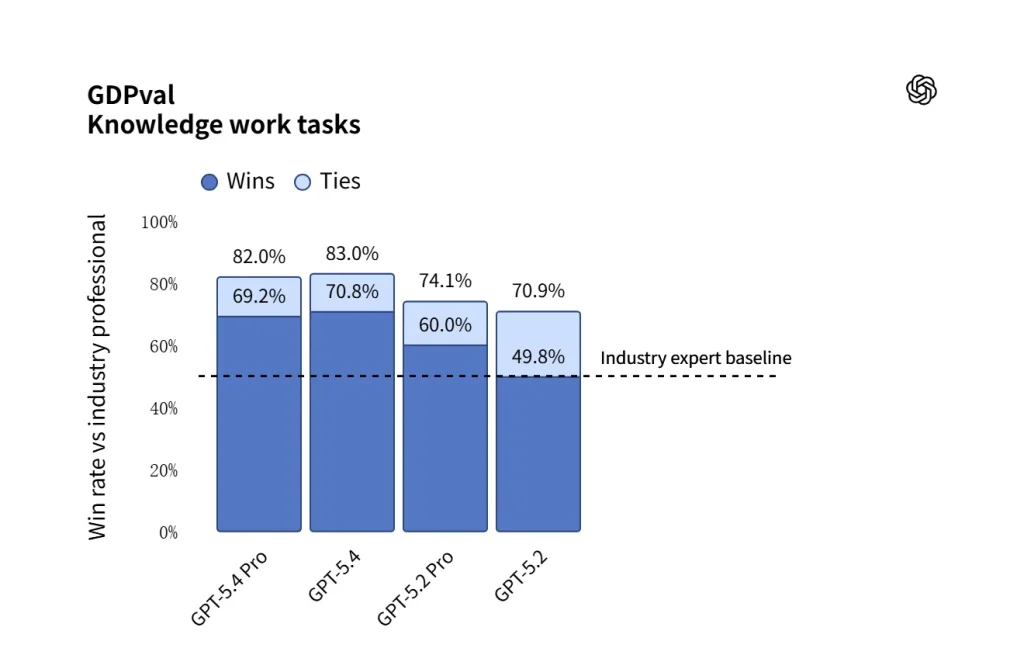
- GDPval (Professional Task Test): Across 44 occupational scenarios, GPT-5.4 met or exceeded the level of human professionals in 83% of tasks.
- OSWorld (Desktop Control Test): In tests controlling a desktop via screenshots, the success rate reached 75%, surpassing the human baseline of 72.4% for the first time.
- Hallucination Control: OpenAI stated that the hallucination rate is 33% lower than that of version 5.2. However, absolute error rates were not disclosed, and third-party evaluations show varying accuracy improvements across different vertical fields.
GPT-5.4 vs. Core Competitor (like Claude Opus 4.6)
| Evaluation Dimension | GPT-5.4 (Thinking) | GPT-5.3 (Codex) | Claude Opus 4.6 |
| Native Computer Use Success Rate | 75% | / | 72.70% |
| Professional Tasks (GDPval) | 83% | 70.90% | 76.50% |
| Standard Context Window | 1.05M (Exp) | 272K | 200K |
| Reasoning Mode Adjustment | Supported | Not Supported | Not Supported |
| Programming (SWE-bench) | 57.70% | 56.80% | 51.20% |
Real User Review: A Productivity Inflection Point
Matt Shumer, CEO of HyperWriteAI and OthersideAI, provided a high evaluation of GPT-5.4 after deep testing. He identified several advantages in production environments:
- Higher “Vibe Coding” Ceiling: The model significantly improves code generation quality under non-precise instructions. For complex machine learning tasks, such as adjusting data pipelines, the reliability has reached deliverable levels.
- Workflow Continuity: Due to optimized response speeds, the model maintains low latency during long logical chains, reducing cognitive load for developers.
- File Correlation Accuracy: Context retention is more stable when handling large project file associations, reducing logical errors in cross-file referencing.
Shumer noted that GPT-5.4 represents the first large-scale deployment of “high-intensity productivity” to professional workers. For professionals in Marketing, Sales, and RevOps, the core gap will no longer be basic software skills, but the efficiency of AI tool utilization and decision-making based on methodology.
How Professionals Should Adapt to GPT-5.4
As GPT-5.4 gains the ability to execute tasks directly, professionals must transition from “executors” to “strategic managers”:
- Test Workflow Automation: Leverage native computer use or workflow streamlined tool (like iWeaver) to convert repetitive administrative or data tasks into automated flows.
- Strengthen Requirement Articulation: The ceiling of AI execution depends on the user’s ability to describe needs accurately. Tools like the iWeaver prompt optimizer will become essential for enhancing output quality.
- Enhance Decision-Making and Aesthetics: Since AI can generate numerous solutions, human value will lie in using business experience and aesthetics to judge which solution best fits actual business needs.