
AI document extraction for financial services uses OCR, NLP, and machine learning to convert unstructured financial documents—statements, tax returns, contracts, and compliance filings—into structured, actionable data. In 2026, these tools reduce manual processing by up to 80%, improve accuracy, and enable real-time compliance in regulated environments.
What Is AI Document Extraction for Financial Services?
AI document extraction for financial services refers to the use of artificial intelligence—specifically OCR, natural language processing (NLP), and machine learning—to automatically read, classify, and pull structured data from financial documents. These documents include custodial statements, loan agreements, tax returns, KYC packs, compliance filings, and investor notices.
In 2026, the technology has matured significantly. We are no longer talking about basic template-matching OCR. Modern platforms handle unstructured PDFs, scanned images, handwritten notes, and multi-format documents with contextual understanding that rivals human analysts—at a fraction of the time.
85% of IT executives in banking now have a clear strategy for adopting AI, according to The Economist. Document extraction sits at the center of that strategy because it touches every operational workflow.
The core value proposition is straightforward: financial institutions process thousands of documents daily. When that processing relies on manual handling and exception queues, it creates bottlenecks that slow operations, increase error rates, and scale costs linearly with volume. AI-powered extraction breaks that linear relationship between volume and cost.
How AI Document Extraction Works: NLP, IDP, and Machine Learning
Natural Language Processing (NLP) in Finance
NLP teaches machines to understand human language as it appears in financial documents. Rather than simply scanning for keywords, NLP-based systems analyze sentiment, intent, and contextual meaning within textual data. This allows them to extract insights from documents that lack consistent formatting.
The six primary NLP applications in financial services:
- Risk assessments from credit memos and analyst reports
- Accounting and auditing automation
- Portfolio selection and optimization from research documents
- Extracting insights from unstructured data (emails, notes, filings)
- Financial document analysis (statements, contracts, agreements)
- Automating regulatory compliance checks
Intelligent Document Processing (IDP)
Intelligent document processing combines OCR, NLP, and machine learning into a single workflow that can scan, read, extract, categorize, and organize documents at scale. IDP goes beyond simple extraction—it understands document types, routes them to appropriate workflows, and validates extracted data against business rules.
IDP applications in financial services include:
- Regulatory compliance and reporting
- Valuation and benchmarking
- Collateral and loan management
- RWA optimization
- ESG reporting
- CLO, CMBS, RMBS analysis
- Bond analysis
- Asset/fund selection and onboarding
- Portfolio monitoring
- Fund administration and reporting
- Mortgage application review and analysis
- Customer onboarding and KYC verification
How OCR and Machine Learning Fit Together
OCR handles the initial conversion of images and scanned documents into machine-readable text. Machine learning models then classify the document type, identify relevant fields, and extract data points with measurable accuracy. Over time, these models improve as they process more documents specific to your organization.
The shift from rule-based extraction to ML-driven extraction means systems can handle documents they have never seen before—a critical capability when dealing with the inconsistent formats common in private markets.
Key Challenges AI Solves in Financial Document Processing
Manual Extraction Does Not Scale
Advisory firms and banks routinely process hundreds to thousands of custodial statements, brokerage PDFs, 401(k) records, tax returns, and client onboarding documents each month. Manual workflows—reading PDFs, copying data into spreadsheets—do not scale proportionally with client growth. This leads to slow onboarding, delayed portfolio analysis, and operational inefficiencies that directly impact revenue.
Errors Introduce Compliance and Client Risk
Small inaccuracies in data entry—incorrect cost basis, missing transactions, misclassified income—cascade into larger issues. These errors surface during audits, client reviews, or regulatory checks. With regulations like SEC Rule 204-2 mandating accurate recordkeeping, poor data quality creates both reputational and compliance risk.
Data Trapped in PDFs Limits Advisory Intelligence
Unstructured documents cannot directly feed into portfolio management systems, risk analytics tools, or compliance workflows. Critical client and portfolio data remains siloed unless manually extracted, preventing advisors from delivering timely, insight-driven advice.
The Unstructured Data Problem in Private Markets
Private capital operates without the standardization seen in public markets. Borrowers, administrators, and portfolio companies deliver financials in custom templates and inconsistent formats. This creates friction across underwriting, portfolio monitoring, reporting, and compliance. As deal volumes rise and timelines compress, the cost of manual data work becomes a competitive disadvantage.
Types of Document Extraction Financial Firms Need in 2026
The value of AI document data extraction depends on how well it handles different document types and how extracted data flows into actual workflows. Based on our analysis of leading implementations in 2026, there are three high-impact categories:
| Categoria | Portfolio & Brokerage Statement Extraction | Tax Document Extraction | Client Document & Meeting Intelligence |
|---|---|---|---|
| Document Types | Custodial statements from Schwab, Fidelity, Pershing; holdings, cost basis, account numbers, transaction data | Tax returns with income composition, deductions, capital gains, retirement contributions | Onboarding forms, meeting notes, account opening documents, emails, client communications |
| Core Challenge | Data locked in PDFs cannot feed into portfolio systems or risk tools without manual effort | Complex, dense data makes manual review time-intensive, delaying actionable insights | Information fragmented across formats and systems, difficult to capture consistently |
| What Tools Should Do | Be trained on financial statement formats; extract structured data directly into portfolio, risk, and compliance systems | Parse multi-page returns accurately; map data to planning and advisory workflows | Capture unstructured client data; integrate with CRM and compliance platforms |
Common Use Cases Across Financial Services
Onboarding, KYC, and Customer Verification
Document ingestion connects to sources where documents arrive—email, portals, APIs, or internal systems. Classification and routing automatically identifies document types and directs them into the correct workflow. This reduces KYC processing from days to hours.
Loan Processing and Credit Analysis
AI extracts data from financial statements, spreading it automatically into credit analysis templates. What once required hours of manual data entry now happens in minutes. Analysts upload financial statements once and receive structured, validated outputs automatically, with dozens of key metrics extracted and populated directly into portfolio management tools.
Contract and ISDA Analysis
Financial institutions use AI to digitize ISDA agreements and other complex contracts. NLP identifies key clauses, obligations, and risk factors across thousands of pages, enabling faster negotiation and compliance monitoring.
Regulatory Compliance and Reporting
Extracted data is validated against predefined rules for expected formats and compliance requirements. Systems check extracted data against operational and regulatory requirements before it moves downstream, routing exceptions and edge cases to human reviewers rather than failing silently.
Portfolio Monitoring and Fund Administration
For private equity and credit firms, AI extraction transforms static fund performance statements, LP notices, and annual reports into structured data that feeds directly into portfolio monitoring dashboards and investor reporting systems.
6 Best AI Document Extraction Tools for Financial Services in 2026
We evaluated the leading platforms based on accuracy, financial domain specificity, integration capabilities, compliance features, and scalability. Here is what we found:
| Attrezzo | Ideale per | Forza chiave | Integrazione | Compliance Features |
|---|---|---|---|---|
| Eigen (Sirion) | Enterprise banks, asset managers | Deep NLP for complex financial documents; ISDA digitization | API-based; connects to core banking systems | Audit trails, validation rules, regulatory reporting |
| StratiFi | RIAs and financial advisors | Purpose-built for advisory workflows; brokerage statement parsing | Portfolio management, risk analytics, CRM | SEC compliance, audit-ready outputs |
| Allvue Document IQ | Private credit and alternative investments | Financial spreading automation; Claira AI integration | Native integration with Allvue portfolio management | Human-in-the-loop validation, managed services |
| Carta | Alternative investments, fund managers | Multi-fund and FoF document handling; LP notice extraction | Native fund administration platform | Investor reporting compliance, data governance |
| Cloud Combinator (AWS) | Regulated enterprises needing custom IDP | End-to-end workflow automation; classification and routing | AWS ecosystem; APIs, portals, internal systems | Access control, traceability, auditability |
| iWeaver | Cross-functional teams needing flexible extraction | AI Agent that handles text, images, and documents without complex prompts | Outputs structured data as doc/pdf; connects to office workflows | Data validation, structured output formatting |
Why iWeaver Deserves Attention for Financial Document Workflows
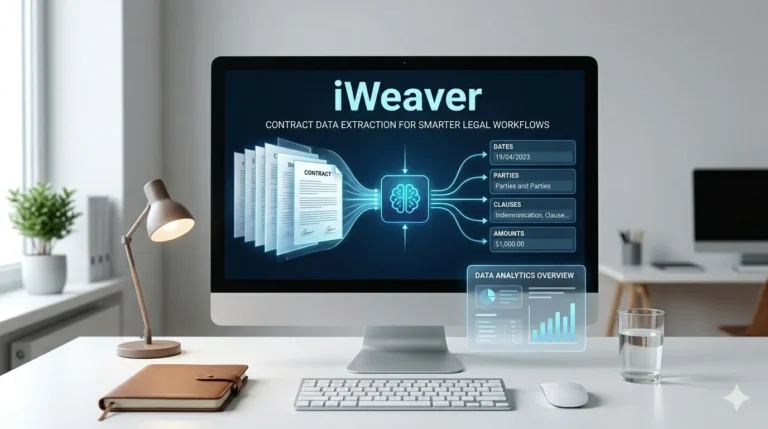
While enterprise platforms like Eigen and Allvue excel at large-scale institutional deployments, many financial teams need a more flexible tool that works across document types without requiring extensive configuration. iWeaver is a powerful AI Agent for office workflows that delivers results without complex prompts. It supports text, images, and documents as inputs, and outputs structured data as doc/pdf files.
For mid-size advisory firms or operations teams that handle diverse document types—from client onboarding forms to meeting notes to compliance filings—iWeaver provides extraction capabilities without the overhead of a full enterprise IDP deployment. We have found it particularly useful for teams that need to process varied financial documents quickly and get structured outputs they can immediately use in downstream systems.
Implementation: What a Typical Engagement Looks Like
Based on deployments we have observed across regulated financial institutions in 2026, a typical AI document extraction implementation covers these components:
- Document ingestion — Connecting to sources where documents arrive: email inboxes, client portals, APIs, or internal document management systems
- Classification and routing — Automatically identifying document types (statement, contract, tax form, KYC pack) and directing them into the correct processing workflow
- Estrazione di dati strutturati — Pulling specific data fields from unstructured documents with measurable accuracy targets (typically 90-98% depending on document complexity)
- Validation against business rules — Checking extracted data against compliance and operational requirements before downstream delivery
- Human-in-the-loop review — Routing exceptions and edge cases to qualified staff for approval rather than failing silently or passing errors downstream
- Downstream integration — Pushing validated data into core platforms, data stores, reporting systems, and compliance databases
All solutions should integrate with existing systems rather than replace them. The emphasis must be on accuracy, traceability, access control, and operating document automation within regulated environments.
AI-Driven Investment Strategies Enabled by Document Extraction
The downstream impact of automated extraction extends well beyond operational efficiency. When financial data flows automatically from documents into analytical systems, it enables:
- Faster credit decisions — Spreading financial statements in minutes rather than hours means credit committees receive complete data packages sooner
- Real-time portfolio monitoring — Automated extraction from borrower financials enables continuous covenant monitoring rather than quarterly manual reviews
- Enhanced due diligence — AI can process thousands of documents during acquisition due diligence in days rather than weeks
- Improved investor relations — Faster extraction from fund documents means LPs receive performance reports and capital call notices with less delay
- Competitive intelligence — Extracting and structuring data from public filings, research reports, and market documents at scale
Upskilling Your Team for AI Document Extraction
Technology alone does not solve the problem. Financial institutions that succeed with AI document extraction invest in preparing their teams for the transition. Based on successful implementations we have studied:
Roles That Evolve
Operations staff shift from data entry to exception handling and quality assurance. Analysts spend less time gathering data and more time interpreting it. Compliance teams move from manual document review to oversight of automated validation rules.
Training Priorities
- Understanding how AI models make extraction decisions (not black-box trust)
- Defining and maintaining validation rules that reflect current regulatory requirements
- Managing exception queues efficiently—knowing when to override AI decisions
- Providing feedback that improves model accuracy over time
Change Management
The most common failure mode is not technology—it is organizational resistance. Teams accustomed to manual processes need clear evidence that AI extraction improves their work rather than threatening their roles. Automation is not about replacing people; it is about shifting their time from data entry to decision-making.
Generative AI and LLMs in Financial Document Processing
Large language models (LLMs) have added a new dimension to document extraction in 2026. Beyond structured field extraction, LLMs can:
- Summarize lengthy credit agreements and highlight key risk factors
- Answer natural language questions about document contents
- Identify inconsistencies across related documents
- Generate structured outputs from completely unstructured narrative text
- Assist with document comparison and change detection
However, LLMs in financial services require careful implementation. Hallucination risk means outputs must be validated, and sensitive financial data requires appropriate security controls. The most effective 2026 implementations combine LLM capabilities with traditional extraction pipelines and human-in-the-loop validation.
The design philosophy that works: let AI handle the volume and aggregation, and let humans apply the insight and analysis. Technology scales data processing and enforces consistency; people focus on nuance, context, and judgment.
Compliance, Security, and Governance Considerations
Financial services operate in heavily regulated environments. Any AI document extraction deployment must address:
- Audit trails — Every extraction decision must be traceable and explainable
- Access control — Document data must be restricted based on role and need-to-know
- Data residency — Extracted data must comply with jurisdictional requirements
- Model governance — Changes to extraction models must follow change management procedures
- Accuracy measurement — Continuous monitoring of extraction accuracy with defined thresholds
- Error handling — Clear escalation paths when extraction confidence falls below acceptable levels
Solutions designed for regulated environments—like those offered through AWS Marketplace by Cloud Combinator—place particular emphasis on these controls. Engagements are scoped to specific document types, volumes, and integration requirements with compliance baked into the architecture.
Case Studies: Successful AI Document Extraction in Financial Services
Private Credit: Financial Spreading Automation
Allvue’s integration with Claira demonstrates the pattern. Analysts upload financial statements once and receive structured, validated outputs automatically. Dozens of key metrics are extracted and populated directly into portfolio management tools. What once required hours of manual data entry now happens in minutes, freeing analysts to focus on interpretation, analysis, and risk assessment.
Enterprise Banking: ISDA Digitization
Large banks have deployed Eigen’s platform to digitize thousands of ISDA agreements. The system extracts key terms, obligations, and counterparty details from complex legal documents, enabling faster renegotiation and more accurate exposure reporting.
RIA Firms: Client Onboarding Acceleration
Advisory firms using AI extraction tools report reducing client onboarding time from days to hours. Custodial statements from multiple providers are automatically parsed, with holdings, cost basis, and transaction history flowing directly into portfolio management and risk analysis platforms.
Alternative Investments: Fund Document Processing
Fund managers processing LP notices, capital call documents, and performance statements have automated extraction to handle the diversity of formats across hundreds of underlying investments. This eliminates the bottleneck that previously delayed investor reporting and portfolio analytics.
Best Practices for Implementing AI Document Extraction
- Start with high-volume, repetitive document types — Choose documents where manual processing creates the most pain and where format consistency is relatively high
- Define accuracy thresholds before deployment — Know what ‘good enough’ means for each document type and use case
- Build human-in-the-loop from day one — Do not plan to remove human review later; design it into the workflow from the start
- Measure time-to-decision, not just extraction speed — The value is in faster decisions, not faster data entry
- Integrate with existing systems — Extraction without downstream integration creates a new silo rather than eliminating one
- Plan for model maintenance — Document formats change, regulations evolve, and extraction models need ongoing tuning
- Ensure vendor transparency — Understand how your vendor’s models work, where data is processed, and what happens when accuracy degrades
The Future of AI Document Extraction in Financial Services
Looking ahead through 2026 and beyond, several trends are shaping the trajectory:
- Agentic workflows — AI systems that not only extract data but take downstream actions based on extracted information (routing, flagging, updating systems)
- Multi-modal extraction — Systems that combine text, table, image, and chart extraction from single documents
- Real-time processing — Moving from batch processing to continuous extraction as documents arrive
- Cross-document intelligence — Connecting extracted data across related documents to identify inconsistencies or build comprehensive views
- Embedded AI — Extraction capabilities built directly into the platforms financial teams already use, rather than standalone tools
The firms that gain competitive advantage will not be those with the most advanced AI models. They will be the ones that most effectively integrate extraction into their decision-making workflows—turning document processing from a cost center into an intelligence asset.
Domande frequenti
What is AI document extraction for financial services?
AI document extraction for financial services uses OCR, NLP, and machine learning to automatically read, classify, and extract structured data from financial documents like statements, contracts, tax returns, and compliance filings—replacing manual data entry with automated, validated workflows.
How does intelligent document processing differ from basic OCR?
Basic OCR converts images to text. Intelligent document processing (IDP) adds classification, contextual understanding, validation against business rules, and downstream integration. IDP understands what a document is, extracts relevant fields, validates accuracy, and routes data to appropriate systems.
What types of financial documents can AI extract data from?
AI extraction handles custodial statements, tax returns, loan agreements, ISDA contracts, KYC documents, LP notices, capital call documents, fund performance reports, compliance filings, onboarding forms, and brokerage PDFs from providers like Schwab, Fidelity, and Pershing.
How accurate is AI document extraction for financial data?
Modern AI extraction platforms achieve 90-98% accuracy depending on document complexity and consistency. Human-in-the-loop validation catches edge cases, and accuracy improves over time as models process more documents specific to your organization.
Is AI document extraction compliant with financial regulations?
Yes, when properly implemented. Compliant solutions include audit trails, access controls, data residency compliance, model governance, and human review for exceptions. Platforms designed for regulated environments build these controls into their architecture.
How long does it take to implement AI document extraction?
Implementation timelines vary from weeks to months depending on document types, volumes, integration requirements, and compliance needs. Starting with high-volume, repetitive document types allows faster initial deployment with expansion over time.
What is human-in-the-loop in financial document AI?
Human-in-the-loop means routing exceptions, low-confidence extractions, and edge cases to qualified staff for review and approval rather than passing errors downstream. It ensures accuracy and auditability while letting AI handle routine volume.
Can AI document extraction integrate with existing financial systems?
Yes. Modern platforms integrate via APIs with portfolio management systems, CRMs, risk analytics tools, compliance databases, and reporting platforms. The goal is pushing validated data into existing workflows rather than creating new silos.