一个

Kimi K2.5 刚刚发布:开源“Claude 杀手”重新定义原生多模态编码

目录

莉安娜
2026-01-29

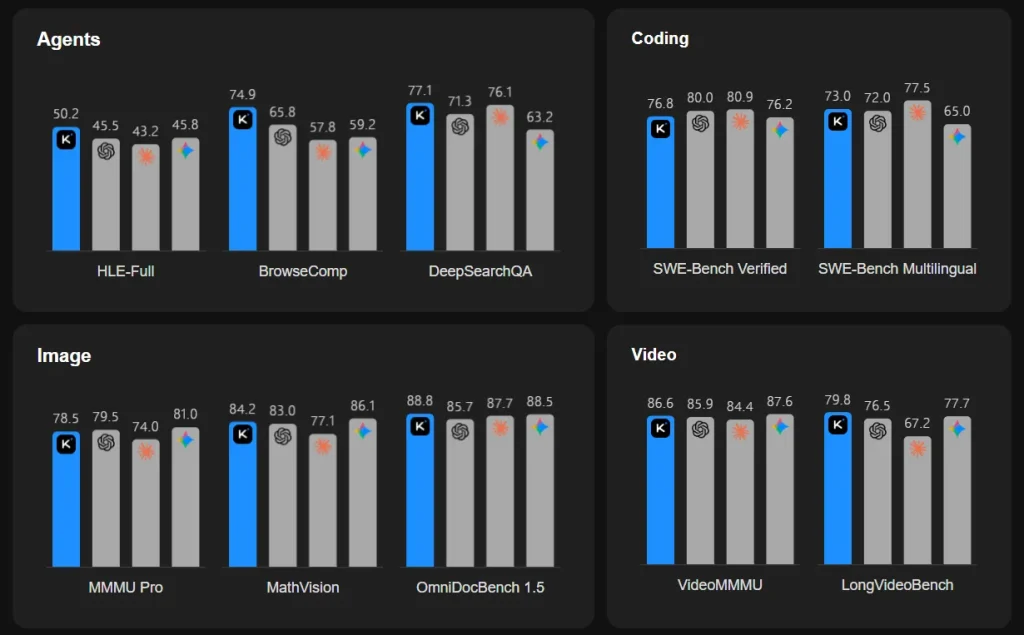
I recently conducted in-depth testing on Kimi K2.5, the latest release from 登月计划人工智能. My conclusion is straightforward: the core value of this update is not just a higher benchmark score, but the integration of native multimodal coding, parallel AgentSwarms, and end-to-end Office delivery into a deployable system. The official technical report defines it as the “most powerful open-source model to date,” and the technical layout revolves around these three pillars.

Test Insights: High-Quality Frontend Generation with Kimi K2.5

In my experience, frontend tasks are the best way to evaluate a model’s ability to understand visual intent, generate structured code, and restore motion details. I uploaded a complex screen recording of a web animation to Kimi K2.5, and it generated executable code that maintained high fidelity during transitions.

This performance is the result of a fundamental architectural shift. Before K2.5, most models used a modular approach, where an independent vision model extracted information and passed it to a text model. This process inevitably led to information loss. K2.5 utilizes a native multimodal architecture where visual capabilities are built directly into the model, minimizing data decay and allowing the model to accurately parse and generate based on fine-grained visual details.

Technical Specifications and Engineering Features of Kimi K2.5

According to the official technical documentation, the competitiveness of K2.5 is defined by three dimensions that dictate enterprise adoption strategies: capability boundaries, engineering costs, and compliance.

Training Data and Native Capabilities of K2.5

K2.5 underwent additional pre-training on the foundation of K2, covering approximately 15 trillion (15T) mixed-modality tokens. As a native multimodal solution, it possesses superior spatial awareness. When generating frontend code, this ensures the page layout remains highly consistent with the original image, preventing logical gaps or element misalignment.

MoE Architecture and Inference Efficiency in K2.5

The model utilizes a Mixture-of-Experts (MoE) architecture with a total of 1T parameters and 32B active parameters during inference. This design strikes a balance between top-tier intelligence and computational efficiency. Combined with a 256K context window and the 400M-parameter MoonViT vision encoder, K2.5 optimizes inference speed and memory usage while handling complex visual inputs.

Open Source Licensing and Compliance for K2.5

The weights and code for K2.5 are released under a Modified MIT License. For small to medium-sized enterprises and individual developers, this provides significant freedom. For large-scale commercial products (e.g., those with over 100 million MAU or $20 million monthly revenue), the license requires a “Powered by Kimi K2.5” attribution in a prominent area of the user interface.

Strategic Focus of Kimi K2.5: Validating Productivity in Coding and Office

Based on the technical report and my practical tests, Moonshot AI has focused its R&D on two high-value areas: programming and office productivity. Both fields require highly verifiable results that translate directly into ROI.

Frontend Development and UI Restoration

In frontend tasks, K2.5 outperformed 双子座3 Pro in my tests. I tasked it with replicating a card-stacking animation involving complex lighting and physical interactions. K2.5 provided a near-perfect solution in just three attempts, capturing lighting details that other models failed to resolve even after multiple iterations.

This efficiency shifts the cost structure of development. Previously, the time required to write complex animation code often led developers to skip fine visual details. With AI completing these tasks in minutes, high-end visual fidelity is now an operationally viable choice.

Office Collaboration and Productivity

Kimi K2.5 has been specifically fine-tuned on knowledge related to Word, Excel, and PPT. The AI industry is currently diverging into two directions: “Kill Time” products focused on entertainment, and “Save Time” products focused on utility. Kimi clearly belongs to the latter. For white-collar professionals, document and spreadsheet processing are high-frequency, repetitive tasks. The accuracy improvements in K2.5 translate directly into higher output per hour.

释放 Kimi K2.5 offers a new path forward amidst the ongoing debate over the utility of general LLMs. It identifies the bottlenecks in traditional office productivity and provides a clear engineering interface by combining native multimodality, video-to-code capabilities, and Agent Swarms.

At the Davos forum, Moonshot AI President Zhang Yutong noted that the team knew from day one they did not have the resources to simply “stack compute.” This strategy of precise market positioning and differentiation through efficiency is exactly how emerging AI firms can break through in a crowded market. For developers looking to implement enterprise-grade AI, K2.5 provides a controlled engineering cost with a high ceiling for intelligent task execution.

什么是 iWeaver?

iWeaver 是一个由 AI 代理驱动的个人知识管理平台,它利用您独特的知识库提供精确的见解并自动化工作流程,从而提高各个行业的生产力。

相关文章