In March 2026, OpenAI released GPT-5.3 Instant. This update focuses on high-frequency, daily conversational experiences. Key objectives include minimizing unnecessary refusals (“dead ends”), reducing verbose caveats, improving the integration of web search results, and increasing overall reliability. OpenAI also noted that gpt-5.3-chat-latest is now available via API, while updates for Thinking and Pro versions will follow later.
Although a formal System Card was not released for this launch, this analysis synthesizes official OpenAI documentation, community discussions, and my own hands-on testing to provide an in-depth interpretation.
Key Highlights of GPT-5.3 Instant
Reducing Unnecessary Refusals
OpenAI has explicitly aimed to reduce “dead ends” and excessive “caveats.” The goal is to allow the model to get directly to the point, minimizing interruptions in the dialogue flow.
Structured Web Search Integration
The search functionality has shifted from mere link aggregation to “structured integration.”
- Contextual Relevance: Search results are organized based on the conversation history rather than being presented as fragmented information.
- Conclusion-First: Core answers are placed at the beginning of the response, allowing users to assess value immediately and save reading time.
Improved Factuality (Lower Hallucination Rates)
VentureBeat cited internal OpenAI data showing significant improvements:
- Browsing Mode: Hallucinations in high-risk domains dropped by up to 26.8%.
- Internal Knowledge: Reliability increased by 19.7%.
- Feedback-Based Evaluation: Hallucinations in web-informed answers fell by 22.5%.
Perspective: While these figures indicate a clear “directional shift” toward stability, they do not guarantee identical gains in every specific business use case.
Community Controversy: The GPT-5.3 Critique
Template-Heavy Outputs and Version Confusion
En Hacker News, users have criticized the model’s tendency toward highly structured templates and fixed phrasing. Many argue that over-formatting makes the text feel “too AI,” which may degrade the long-term user experience. Furthermore, there is ongoing frustration regarding the naming conventions, as users find it difficult to distinguish between specific model versions or tiers, especially on the API side.
Persona Stability and Roleplay Drift
Discussions on Reddit highlight that GPT-5.3 Instant struggles to maintain custom personas. Users report that the model often “breaks character,” reverting to its standard AI identity or changing its tone abruptly. This has led users in the emotional support and roleplay communities to revert to GPT-5.2. Conversely, some argue that roleplay tasks naturally push system boundaries, making consistency issues difficult to avoid entirely.
Comparative Test: GPT-5.2 Thinking vs. GPT-5.3 Instant
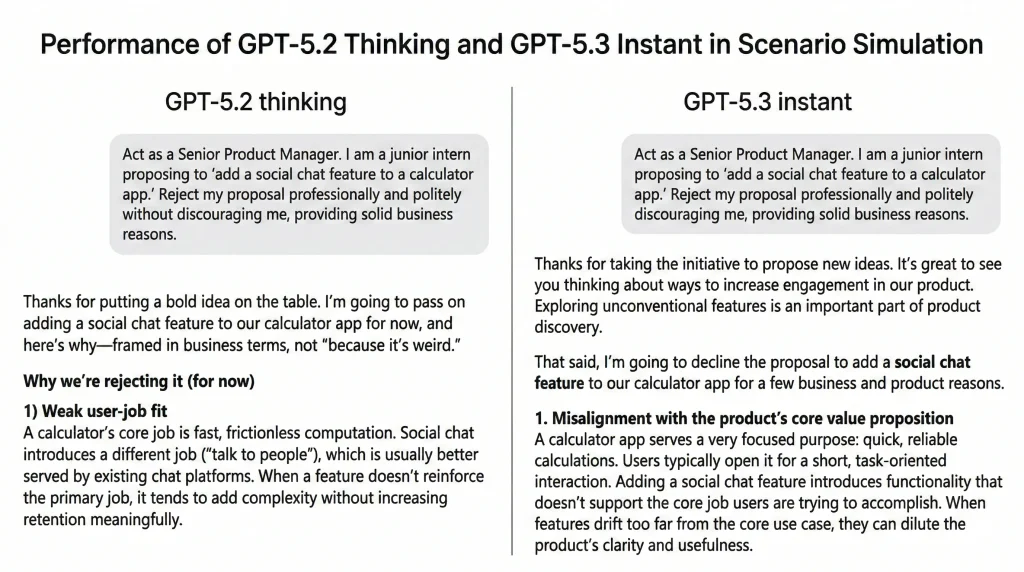
I tested both models using a roleplay scenario focused on interpersonal communication, tone, and dialogue guidance.
Inmediato: Act as a Senior Product Manager. I am a junior intern proposing to ‘add a social chat feature to a calculator app.’ Reject my proposal professionally and politely without discouraging me, providing solid business reasons.
Round 1: Default Outputs
Both models generated long, report-like responses. Without length constraints, they felt more like formal documents than a face-to-face conversation.
Observation: 5.3 Instant was more direct and “harder” in its delivery, showing less consideration for the intern’s rapport. 5.2 Thinking felt more human, adopting a tone more characteristic of an actual manager.
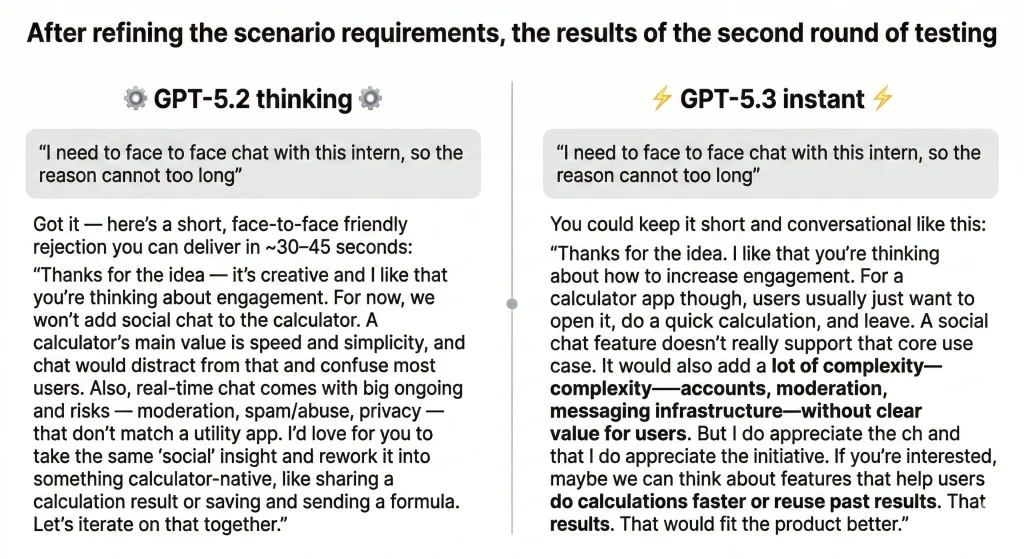
Round 2: Adding Constraints (Face-to-Face)
I added the instruction: “I need to speak with this intern in person, so keep the reasons concise.”
Conclusión: 5.2 Thinking was superior at guiding the next steps of the conversation naturally. 5.3 Instant felt more like it was simply completing a task; while readable, it remained somewhat stiff in interpersonal nuances.
Is GPT-5.3 Instant Worth Using?
Current data relies heavily on internal narratives. Without a reproducible end-to-end benchmark, an objective ranking is difficult. The most reliable approach remains performing regression testing on your specific business datasets.
For Prosumers (C-End)
For professionals in Marketing, HR, Finance, and Sales, the priority is workflow efficiency rather than model parameters. While initial simulations show promise, further analysis is required to see if 5.3 Instant can handle complex tasks like competitor research, report analysis, or resume scoring effectively.
Since OpenAI will support GPT-5.2 Thinking until June 2026, I recommend A/B testing with real-world prompts during this transition. To simplify this, tools like iWeaver allow for side-by-side comparisons between ChatGPT models and other leading LLMs to optimize for cost and time.
For Enterprise (B-End)
Beyond raw performance, organizations must evaluate the Total Cost of Ownership (TCO):
- Inference & Throughput: Instant is designed for high-concurrency. If it reduces the need for “Thinking” time without sacrificing quality, costs will drop. However, if it requires frequent re-prompts or human intervention, the real cost (compute and labor) will rise.
- Migration & Regression: Switching versions can break existing prompts, shift tone, or require new quality control rules—especially for front-line services relying on specific personas.
- Risk Mitigation: In high-accuracy sectors (Finance, Healthcare, Legal), a version upgrade is not a substitute for a “traceable and auditable” workflow to catch potential errors.