
As of May 25, 2026, OpenAI GPT-5.6 and Anthropic Claude Sonnet 4.8 have not been officially announced.
That does not mean the searches are meaningless. Both keywords are gaining attention because users expect the next wave of AI models to improve coding, research, document analysis, long-context reasoning, agent workflows, and business productivity.
The important question is not simply whether GPT-5.6 or Claude Sonnet 4.8 is available today. The better question is: when models keep improving, how should professionals build AI workflows that remain useful even when the underlying model changes?
For U.S. teams, analysts, marketers, founders, students, and knowledge workers, the answer is increasingly about workflow. A stronger model is helpful, but the real value comes when AI can collect information, understand it, summarize it, organize it, turn it into deliverables, and preserve it in a reusable knowledge base. That is where tools like iWeaver become relevant.
Fast Answer: Are GPT-5.6 and Claude Sonnet 4.8 Released?
| Model keyword | Official status on May 25, 2026 | What is confirmed | What is not confirmed |
|---|---|---|---|
| OpenAI GPT-5.6 | Not officially announced | OpenAI has officially released GPT-5.5 and GPT-5.5 Instant | GPT-5.6 release date, model card, API name, pricing, benchmarks, and capabilities |
| OpenAI GPT-5.5 | Officially announced | OpenAI positions GPT-5.5 for coding, knowledge work, research, documents, spreadsheets, and agentic tasks | GPT-5.5 does not confirm what GPT-5.6 will be |
| Anthropic Claude Sonnet 4.8 | Not officially announced | Anthropic has officially released Claude Sonnet 4.6 | Sonnet 4.8 release date, model card, API name, Claude Code performance, context window, and pricing |
| Anthropic Claude Sonnet 4.6 | Officially announced | Anthropic lists Sonnet 4.6 in official materials and model documentation | Sonnet 4.6 does not confirm Sonnet 4.8 specifications |
In short: GPT-5.6 and Claude Sonnet 4.8 are trending search topics, but they should be treated as unconfirmed model keywords until OpenAI or Anthropic publishes official release pages, documentation, or model IDs.
Why People Are Searching for OpenAI GPT-5.6
The interest in GPT-5.6 comes from three signals.
First, OpenAI has already launched GPT-5.5. OpenAI’s official GPT-5.5 announcement describes the model as stronger for real-world work, including agentic coding, online research, data analysis, creating documents and spreadsheets, operating software, and completing multi-step tasks across tools.
Second, GPT-5.5 Instant became the new default model in ChatGPT. OpenAI’s ChatGPT release notes say GPT-5.5 Instant started rolling out as the default ChatGPT model on May 5, 2026. For everyday users, that matters because default-model changes often affect speed, quality, context handling, and the general feel of ChatGPT.
Third, the AI market has trained users to expect rapid iteration. When OpenAI releases a mid-cycle model, developers, enterprises, and AI watchers naturally begin asking what comes next. For GPT-5.6, the search demand is really a question about OpenAI’s next step in agents, coding, documents, long-context reliability, and business productivity.
The careful way to phrase it is this: if GPT-5.6 appears, it may continue the direction suggested by GPT-5.5. But until OpenAI confirms it, GPT-5.6 capabilities should not be stated as fact.
Why People Are Searching for Anthropic Claude Sonnet 4.8
Claude Sonnet models have built a strong reputation among users who care about writing quality, coding workflows, long-context understanding, and Claude Code. That is why Claude Sonnet 4.8 has become a natural rumor target.
Anthropic’s official and verifiable model is Claude Sonnet 4.6. Anthropic’s announcement positions Sonnet 4.6 as a major model release, and Anthropic’s model documentation lists Sonnet 4.6 rather than Sonnet 4.8.
At the moment, Claude Sonnet 4.8 appears mainly in third-party speculation, leak analysis, and community discussion. Those sources can be useful for tracking market interest, but they should not be treated as official evidence.
For SEO and editorial accuracy, use language like:
- “Claude Sonnet 4.8 is rumored…”
- “As of May 25, 2026, Anthropic has not officially announced Claude Sonnet 4.8.”
- “Current official Anthropic documentation lists Sonnet 4.6, not Sonnet 4.8.”
That framing lets a blog capture search demand without turning speculation into a false product claim.
If GPT-5.6 and Claude Sonnet 4.8 Arrive, What Will They Compete On?
If OpenAI GPT-5.6 and Anthropic Claude Sonnet 4.8 eventually launch, the most important battlegrounds will likely be practical ones rather than model-name hype.
| Competition area | Why it matters for U.S. users and teams |
|---|---|
| Long-context reliability | Professionals need models to stay accurate across long documents, multi-file research, and extended conversations |
| Agentic task completion | Teams want AI to plan, execute, check, and revise work instead of only answering questions |
| Coding and automation | Developers care about debugging, repo-level context, test fixing, tool use, and long-running tasks |
| Document intelligence | Legal, finance, HR, consulting, and research teams need better PDF, report, contract, and meeting-note analysis |
| Knowledge memory | Users want AI systems that can preserve context, source material, preferences, and prior decisions |
| Multimodal input | Modern workflows include text, images, audio, video, web pages, slides, spreadsheets, and PDFs |
| Cost and latency | Businesses need predictable performance and pricing, not just the most powerful model in a demo |
This is why model upgrades affect the entire AI software market. Users no longer ask only, “Which model is smarter?” They ask, “Which system can turn model intelligence into repeatable work?”
The Real Issue: Model Upgrades Are Not Enough
For individual users, a new model may mean better answers. For teams, the model is only one layer of the stack.
A useful AI workflow needs at least five layers:
- Input: PDFs, Word documents, slides, web pages, images, audio, video, meeting transcripts, notes, and spreadsheets.
- Understanding: summarization, extraction, classification, comparison, Q&A, and key-point detection.
- Organization: notes, outlines, folders, mind maps, knowledge graphs, or knowledge base entries.
- Output: reports, briefs, action items, executive summaries, research memos, marketing drafts, or decision documents.
- Reuse: the ability to preserve source material and insights so future work does not start from scratch.
If an AI tool only answers one prompt at a time, even a powerful model can become a one-off productivity boost. The durable gain comes from a closed workflow: information goes in, knowledge gets structured, outputs become usable, and insights remain available for future work.
Where iWeaver Fits: Multi-Format Input + Workflow Closure + Knowledge Base
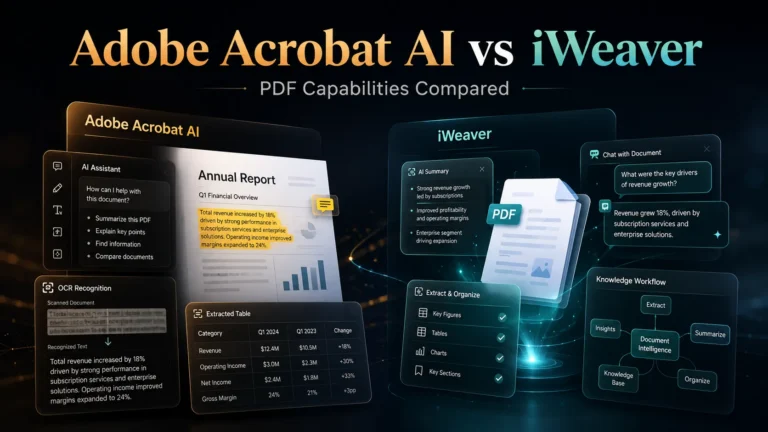
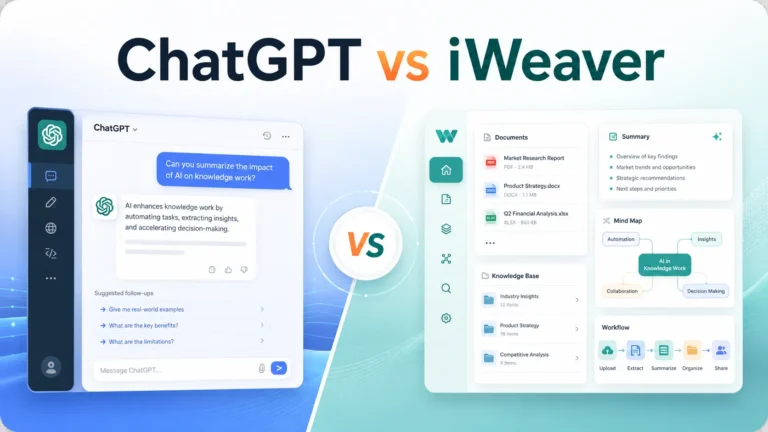
According to iWeaver’s official materials, iWeaver is not positioned as just another chatbot. It is built around AI agents, personal knowledge, multi-format inputs, summarization, report writing, and knowledge workflows.
iWeaver’s AI Summarizer page describes support for PDFs, documents, articles, web pages, video links, images, and meeting transcripts. It also highlights output types such as key takeaways, executive summaries, bullet-point summaries, action items, Q&A summaries, and mind maps.
That matters in a market where foundation models keep changing. Whether the next headline is GPT-5.6, Claude Sonnet 4.8, or something else, users still need a stable workspace that can:
- Gather source material from different formats.
- Separate confirmed facts from rumors.
- Turn long content into structured summaries.
- Create reports, briefs, notes, and mind maps.
- Preserve useful knowledge for the next project.
In other words, iWeaver’s value is not based on chasing one model name. It is based on helping users convert AI capability into repeatable knowledge work.
Practical Scenario: Tracking AI Model News
Practical scenario: an AI research team, product marketer, or founder in the U.S. wants to track GPT-5.6 and Claude Sonnet 4.8 without spreading unverified claims.
The workflow might look like this:
- Collect official OpenAI and Anthropic release pages.
- Save model documentation, help-center notes, third-party analysis, and community discussions.
- Separate confirmed model information from rumor or speculation.
- Build a comparison table covering release status, API availability, likely use cases, and editorial risk.
- Generate an internal brief, SEO outline, product update memo, or newsletter draft.
- Store the research in a knowledge base for future updates.
This is a practical scenario, not a verified customer case. It reflects how iWeaver’s official positioning can apply to fast-moving AI research workflows.
Practical Scenario: Writing Timely AI SEO Content
AI content teams face a familiar problem: speed matters, but accuracy matters more. A fast article can capture traffic, but an inaccurate one can damage trust.
For a topic like GPT-5.6 or Claude Sonnet 4.8, iWeaver can help a content team build a fact-check-first process:
- Import official sources and third-party coverage.
- Summarize what is confirmed, rumored, and unknown.
- Create an outline that answers the main search intent quickly.
- Generate FAQ sections for Google and AI answer engines.
- Keep the source notes available for future updates.
This workflow is especially useful for “rumor-aware” SEO content, where the article must rank for trending terms while still being careful with claims.
Should You Wait for GPT-5.6 or Claude Sonnet 4.8?
For most users, no. It is better to build a workflow that can adapt to new models than to pause work while waiting for unconfirmed releases.
Here is a practical approach:
- Individual users: use officially available models such as GPT-5.5, GPT-5.5 Instant, and Claude Sonnet 4.6, then follow official release notes.
- Developers: watch for model IDs, API availability, context limits, tool-use behavior, pricing, latency, and deprecation policies.
- Businesses: build durable workflows for knowledge management, document processing, review, and reporting. The model layer can change later.
- SEO and content teams: cover GPT-5.6 and Claude Sonnet 4.8 as trending keywords, but clearly label confirmed, rumored, expected, and speculative information.
Bottom Line
OpenAI GPT-5.6 and Anthropic Claude Sonnet 4.8 are not officially confirmed as of May 25, 2026. But the search interest around them says something important: users now expect AI models to do more than answer questions.
OpenAI’s GPT-5.5 release already points toward coding, research, documents, spreadsheets, software operation, and agentic work. Anthropic’s Sonnet lineup continues to draw attention from users who care about writing, coding, long context, and complex reasoning.
But for professionals and teams, the model is only the beginning. The real productivity gain comes from a system that can collect multi-format inputs, structure knowledge, close the workflow, generate useful outputs, and preserve what was learned.
That is the role iWeaver can play. Whether the next model headline is GPT-5.6, Claude Sonnet 4.8, or something else, the goal is the same: turn constantly improving AI capability into reliable research, writing, analysis, reporting, and decision workflows.
FAQ
Is OpenAI GPT-5.6 released?
No official OpenAI GPT-5.6 release was found as of May 25, 2026. OpenAI has officially announced GPT-5.5, and OpenAI’s release notes say GPT-5.5 Instant became the default ChatGPT model beginning May 5, 2026.
Is Anthropic Claude Sonnet 4.8 released?
No official Anthropic Claude Sonnet 4.8 release was found as of May 25, 2026. Anthropic’s official materials confirm Claude Sonnet 4.6, while Sonnet 4.8 appears mainly in leaks, speculation, and third-party commentary.
Which is better, GPT-5.6 or Claude Sonnet 4.8?
There is no reliable comparison yet because neither GPT-5.6 nor Claude Sonnet 4.8 has official model documentation, model cards, public stable benchmarks, API details, or pricing. A fair comparison should wait for official releases.
Should businesses wait for new AI models before building workflows?
Usually no. Businesses should build workflows around durable needs: document processing, knowledge management, review, reporting, and collaboration. New models can improve those workflows later, but waiting for unconfirmed releases slows down adoption.
How does iWeaver relate to GPT-5.6 and Claude Sonnet 4.8?
iWeaver is not simply a replacement for one foundation model. It is an AI knowledge workflow platform that helps users collect multi-format inputs, summarize content, generate notes and reports, create mind maps, and preserve knowledge. As models improve, tools like iWeaver help turn model capability into practical work.