에이

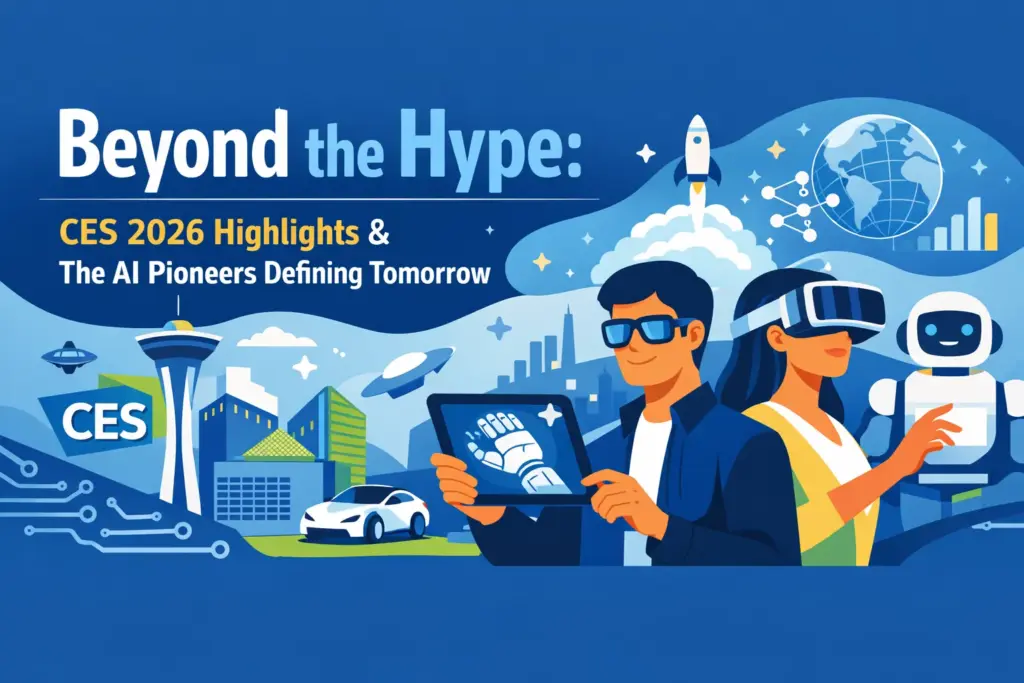
과장된 홍보를 넘어: CES 2026 주요 내용 및 미래를 선도하는 AI 개척자들

목차

리아나
2026-01-14

Compared to the aggressive “AI Reshapes Everything” marketing blitz of two years ago, the atmosphere at the CES 2026 halls has undergone a structural shift. Inside the LVCC Central Hall, consumer electronics giants like Samsung and LG are showing distinct signs of an innovation bottleneck. Product iterations are largely confined to display spec bumps and incremental feature tweaks, with a notable absence of disruptive new hardware forms. This sense of “stagnation” at the top signals that AI technology has passed the “Peak of Inflated Expectations” and entered a substantive phase of demystification.

Meanwhile, the very existence of AI in products has fundamentally changed. It is nearly impossible to find Products at CES that still hype AI as a standalone selling point. Instead, we are seeing the ubiquity of “Default AI.” AI has submerged into the underlying operating systems and basic control logic of devices, executing data processing, energy management, and interaction decisions without the user even noticing. This trend towards “infrastructure” indicates that the industry’s competitive focus has shifted from “feature availability” to “system stability and execution efficiency.”

The Compute Substrate: Substantive Breakthroughs in Edge Computing

While the application layer returns to pragmatism, the underlying compute architecture is migrating from the Cloud to the Edge. NVIDIA’s release of the Rubin supercomputing platform and six new chips was one of the key CES 2026 highlights. Crucially, their core technical metrics no longer solely chase linear growth in parameter size, but prioritize reducing edge-side inference latency and boosting power efficiency.

This hardware progression is the physical foundation that has enabled the flood of “offline intelligence” devices at this year’s show. It allows complex visual recognition and decision models to decouple from the cloud and run directly on local devices, effectively resolving the conflict between data privacy and real-time response speed.

Product Landscape: Which Models Will Define the Future?

Filtering out the marketing noise, the products that have survived and possess real commercial potential clearly point to four distinct go-to-market logics.

Physical AI: ROI-Driven Engineering Landing

The robotics sector showed the most significant improvement in engineering maturity. Boston Dynamics confirming mass production for Atlas, alongside the collective debut of the Chinese robotics legion (such as QiYuan and Stardust), proves that general-purpose humanoid robots are moving beyond the prototype phase.

Notably, market evaluation standards have shifted from “anthropomorphic realism” to “Task Execution ROI.”

  • Functional Specialization: Vita Power’s Vbot (automated following/transport) and Roborock’s G-ROVER (stair-climbing capabilities) represent engineering optimizations targeted at specific logistics and cleaning scenarios.
  • Simulation Training: Digital Twins and XR technologies are being widely used for Sim2Real (Simulation to Reality) training, drastically reducing the marginal cost of algorithm migration.

Silent Integration: Ambient Computing Replacing Wearables

In the digital health sector, contact-based wearables are facing challenges, while “Invisible Care” solutions based on ambient sensing are trending.

  • Non-contact Monitoring: Devices like the Sleepal AI Lamp leverage millimeter-wave radar and acoustic sensors to build a bedroom “environmental digital twin,” achieving physiological data collection without user perception.
  • Automated Closed-Loop: The value of data lies in intervention. IoT devices like SleepBot demonstrated a complete “Monitor-Analyze-Execute” loop, where the system automatically adjusts oxygen levels or physical support based on environmental data without user intervention. This automated logic solves the industry pain point of low user compliance.

Semi-AI Native: Refactoring Legacy Tool Efficiency

Rather than attempting to create entirely new hardware forms (like the AI Pin), more manufacturers are choosing to use AI to refactor the workflows of mature tools.

  • Process Automation: The Glyde smart clipper uses computer vision for spatial positioning and blade control; VOCCI Ring and TicNote achieve instant structuring of recorded content via on-device models.
  • Vertical Scenario Solutions: Mapfirst uses an Agent architecture to optimize map retrieval logic, while TalkCRM solves cross-language medical scheduling.
  • The logic behind these “Semi-AI Native” Products at CES is simple: leverage specific AI capabilities (like CV or NLP) to break through efficiency bottlenecks in legacy hardware, mining incremental value in established markets.

AI Play: Monetization via Sidestepping Technical Deficits

Given the current technical limitations of Large Models regarding long-term memory and deep emotional computing, some hardware vendors have abandoned the “Companion” positioning in favor of “Play.”

  • Instant Manufacturing: The WowNow AI vending machine combines AIGC with 3D printing, realizing immediate C2M (Consumer to Manufacturer) delivery.
  • Asset Activation: Buddyo Pod and Tonie Play utilize NFC technology and Role-Playing models to “activate” users’ existing physical IP (figurines, dolls).
  • This model avoids the risks associated with building deep human-machine relationships, turning instead to providing instant entertainment value and unlocking the value of IP stock for monetization.

Strategic Judgment: The Elevation of Competitive Dimensions

Synthesizing field observations and industry analysis, CES 2026 highlights three critical strategic signals for business leaders:

The Competitive Baseline has Shifted Upward

AI has become a baseline survival capability for enterprises, not a “moat” for differentiation. Future competitiveness depends on whether an organization has completed its structural restructuring and business process reengineering based on AI.

System Integration Over Single-Point Tech

As foundational model capabilities become commoditized, raw technical parameters are no longer barriers to entry. Core competitiveness has shifted to “System Integration Capability”—the deep coupling of hardware engineering, software algorithms, and on-the-ground service systems. Companies that can solve for weak network operation, power consumption control, and cross-device synergy will dominate the market.

Globalization & Localized Execution

The rise of Physical AI means technology must enter the messy, real physical world. This requires global expansion enterprises to possess extreme localized execution capabilities to deal with varying physical environments, regulations, and supply chains. Global innovation is now a multi-point phenomenon; building an open global ecosystem is more critical than going it alone.

CES 2026 served as a “Reality Check” for AI technology. The industry has bid farewell to the fantasy of “Magic” and returned to commercial fundamentals: cost, efficiency, yield, and repurchase rates. In the era of Default AI, only those enterprises capable of using engineering capabilities to solve concrete, real-world problems will survive the next industrial cycle.

iWeaver란 무엇인가요?

iWeaver는 고유한 지식 기반을 활용하여 정확한 통찰력을 제공하고 워크플로를 자동화하여 다양한 산업 분야에서 생산성을 높이는 AI 에이전트 기반의 개인 지식 관리 플랫폼입니다.

관련 기사