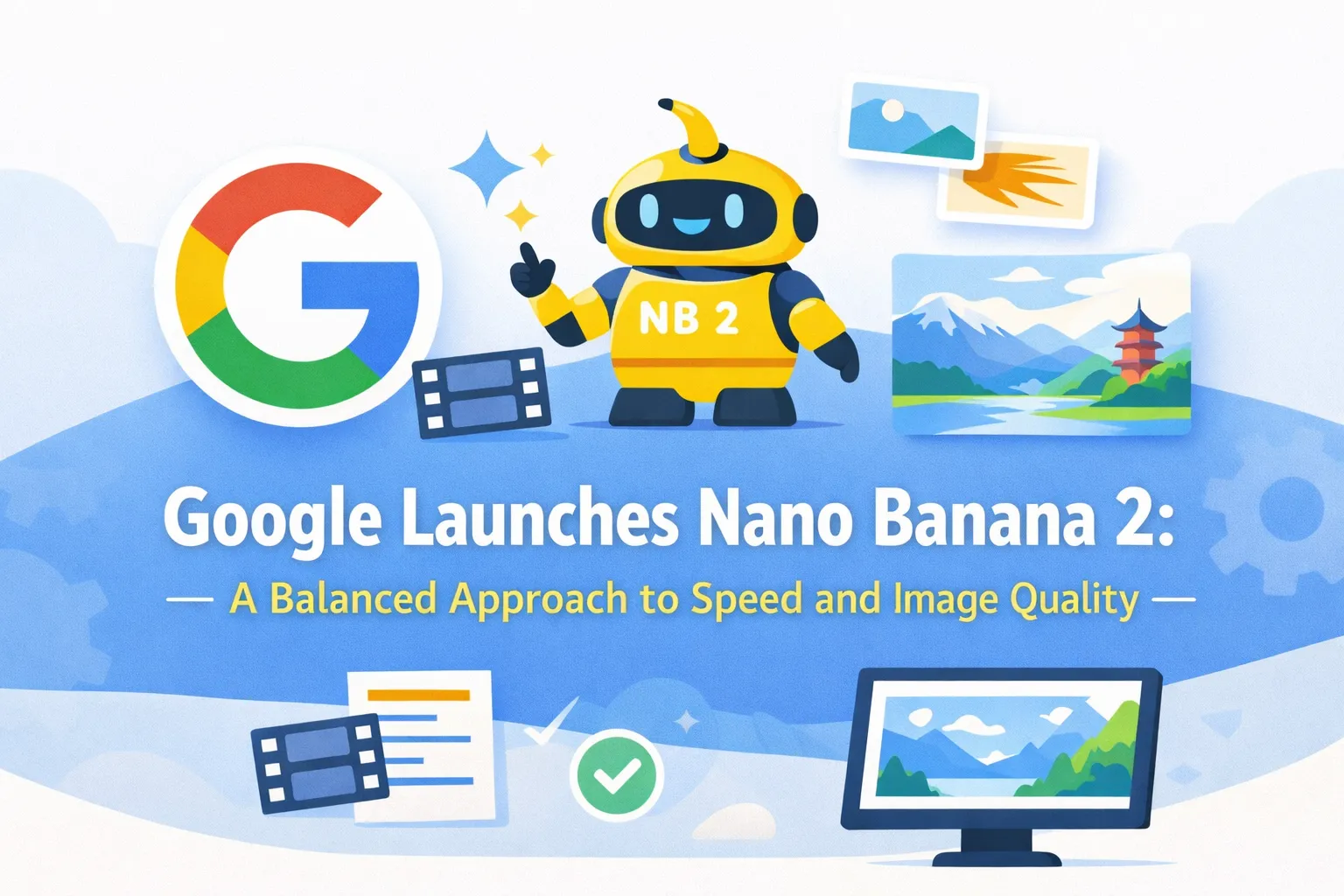
Google has officially released Nano Banana 2, positioning it as a high-performance upgrade within the Flash series. The model is designed to address a long-standing challenge in AI image generation: achieving strong visual quality without sacrificing generation speed.
Based on hands-on testing in the Gemini web interface, Nano Banana 2 maintains the fast response time typical of the Flash architecture while incorporating several advanced capabilities previously limited to the Pro version. This update makes higher-end image generation features accessible to a broader range of users under standard subscription tiers.
Key Features of Nano Banana 2
Nano Banana 2 builds upon the original architecture with expanded functionality and performance refinements:
Subject Consistency Control
The model can preserve visual consistency for up to five characters and fourteen objects within a single workflow. This is particularly useful for multi-element compositions and iterative design scenarios.
Real-Time Knowledge Integration
By leveraging Google Search, the model can retrieve up-to-date information and incorporate it into visual outputs. This supports time-sensitive content such as news-related visuals or current event graphics.
Improved Text Rendering
Text clarity within generated images has been enhanced, including support for multilingual localization. Integration with Google Ads provides additional guidance for advertising design workflows.
Adjustable Reasoning Levels
Users can modify reasoning intensity depending on task complexity. Higher instruction-following modes help maintain structural consistency during multi-step refinement processes.
Flexible Resolution and Aspect Ratios
Nano Banana 2 supports resolutions ranging from 512px to 4K, including extended formats such as 4:1 and 8:1. This enables outputs optimized for social media, banner ads, and large-screen displays.
Nano Banana 2 vs. Nano Banana Pro
Nano Banana 2 (Flash architecture) and Nano Banana Pro (Thinking architecture) target different production needs. While both represent upgrades over the original Nano Banana model, their performance priorities differ.
| Category | Nano Banana 2 (Flash) | Nano Banana Pro (Thinking) |
| Core Focus | Speed and subject consistency | Advanced reasoning and complex composition |
| Resolution Support | 512px–4K, extended ratios (4:1, 8:1) | 1K–4K, standard commercial ratios |
| Generation Speed | Typically ~2 seconds for draft output | Slower, optimized for deeper computation |
| Detail Rendering | Suitable for social media and prototyping | Suitable for commercial-grade production |
| Cost Efficiency | Available in standard subscriptions | Higher credit usage or Pro tier required |
| Ideal Use Cases | Rapid iteration, marketing creatives | Final production, scientific or technical visuals |
Real-World Testing Results
Portrait Generation Comparison
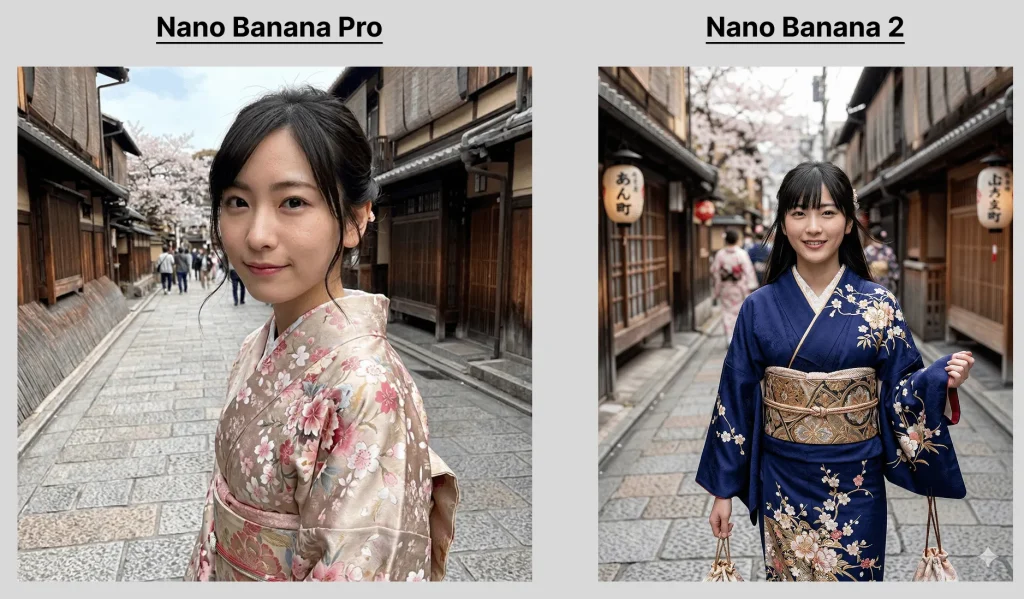
“Generate her walking on a street in Kyoto, wearing a kimono, close-up shot, clear skin texture”
Under default settings, Nano Banana Pro produced more stable skin detail and lighting transitions. Nano Banana 2 displayed mild smoothing artifacts in the initial output.
Refined prompt:
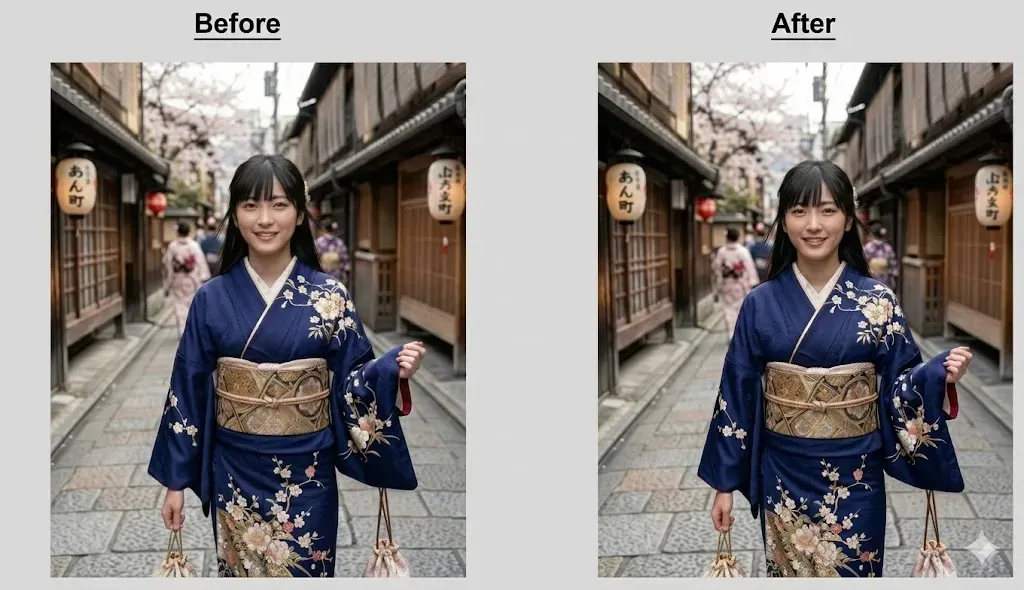
“Enhance realism while keeping the original scene and pose unchanged. Increase hair strands and skin texture detail.”
With this adjustment, the Flash version showed noticeable improvement in realism. However, at extreme detail levels, it still fell short of the Pro model, and overall sharpness remained moderate.
Commercial Banner Generation
For the task:
“Generate a 4:1 horizontal background image containing a specific brand logo.”
Nano Banana 2 completed generation in approximately one-quarter of the time required by the Pro model. While Nano Banana Pro demonstrated slightly better light gradation, both models performed similarly in text spelling accuracy.
In scenarios requiring frequent prompt refinement, Nano Banana 2 demonstrated a clear efficiency advantage.
How to Access Nano Banana 2
Official Access via Gemini
Nano Banana 2 is now integrated as the default image generation model for the Gemini application and is available to users free of charge.
Third-Party Platforms Supporting Nano Banana 2
Nano Banana
Advantages: Clean interface, supports text-to-image and image-to-image generation. Includes built-in prompt optimization tools and transparent credit usage tracking.
Limitations: No free plan available.
Pricing (Monthly): Basic: $9.99, Pro: $29.99, Max: $79.99(Annual subscriptions receive a 20% discount)
NanoBanana
Advantages: Supports style customization and size selection. Offers a free trial and includes a prompt library. Allows multi-model comparison using Seedance, Veo, and related models.
Limitations: Registration required. Credit consumption is not clearly displayed.
Pricing (Monthly): Pro: $9.9, Advance: $29.9
Lovart AI
Advantages: Enjoy up to 50% off select packages and access to Nano Banana 2 features. Supports multi-device creative workflows. Generates realistic images, ideal for business use.
Limitations: No free plan. Nano Banana 2 is only available under Pro or higher tiers.
Pricing (Monthly): Starter: $19, Basic: $32, Pro: $69, Unlimited: $149
Easemate AI
Advantages: Supports prompt saving and reuse. Integrates text, image, and video processing in one platform. Offers a free trial at a lower price.
Limitations: May not meet the detail requirements of high-precision commercial design tasks.
Pricing (Monthly): Lite: $8.9, Pro: $19.9
Risks and Considerations
Copyright and Attribution
Although Nano Banana 2 incorporates SynthID watermarking, large-scale image generation may place pressure on copyright monitoring systems.
Misinformation Risks
Lower generation costs and faster output increase the ease of producing misleading visual content, creating higher demand for real-time verification mechanisms.
Over-Adherence to Prompts
At higher reasoning levels, the model may strictly follow localized instructions, potentially affecting overall visual coherence.
Nano Banana 2 delivers measurable improvements in generation speed and feature integration, making it well suited for rapid iteration and high-volume creative workflows. For projects requiring maximum detail precision and advanced spatial reasoning, Nano Banana Pro remains the stronger option.
The two models serve distinct production needs. Selection should be based on output requirements, iteration frequency, and budget considerations.