
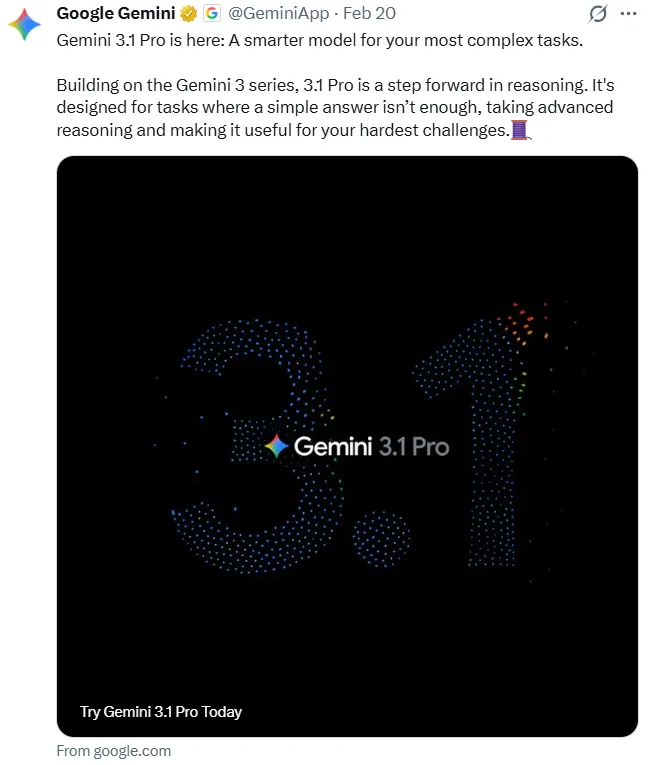
In February 20, Google officially launched its next-generation flagship model, Gemini 3.1 Pro. This technical review synthesizes hands-on testing, official documentation, and monitoring data from the third-party evaluator Artificial Analysis to provide an objective assessment of the model’s capabilities.
Core Reasoning and Benchmarking
In the evaluation process, I placed significant emphasis on the ARC-AGI-2 benchmark. Unlike conventional knowledge-based assessments, this test presents a series of novel logical geometric patterns that require the model to derive the correct output through deduction. This effectively measures a model’s capacity for original problem-solving, rather than the simple retrieval of information from its training data.
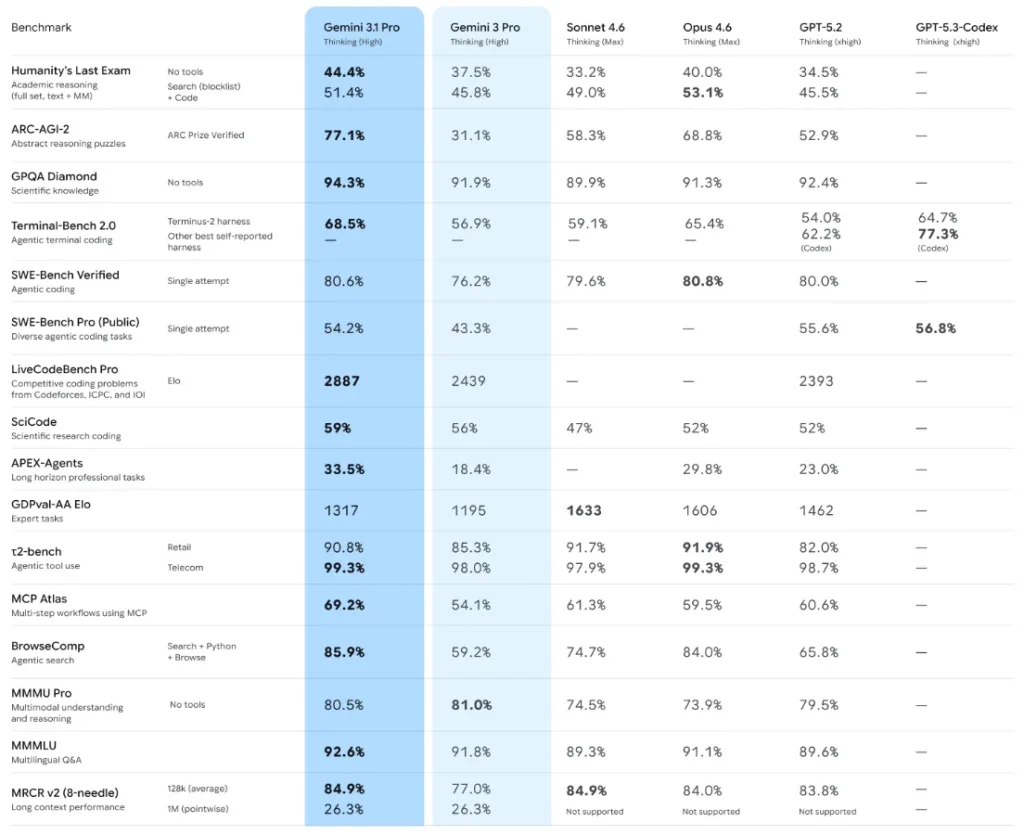
According to official benchmark data, Gemini 3.1 Pro recorded a score of 77.1%, which represents a twofold increase in performance compared to Gemini 3 Pro. This indicates a substantial advancement in deductive accuracy when encountering unfamiliar logical tasks. Furthermore, Gemini 3.1 Pro’s reasoning capabilities show a nearly 20% improvement over the recently released Claude Sonnet 4.6.
Competitive Performance Comparison
To objectively position Gemini 3.1 Pro within the current market, I compared its performance data against three leading industry competitors.
| Metric | Gemini 3.1 Pro | Claude Opus 4.6 | Claude Sonnet 4.6 | ChatGPT 5.2 |
| Logic Reasoning (ARC-AGI-2) | 77.10% | 68.80% | 58.30% | 52.90% |
| Scientific Reasoning (GPQA Diamond) | 94.30% | 91.30% | 89.90% | 92.40% |
| General Academic (HLE) | 44.40% | 40.00% | 33.20% | 34.50% |
| Software Engineering (SWE-Bench) | 80.60% | 80.80% | 79.60% | 80.00% |
| Multilingual (MMMLU) | 92.60% | 91.10% | 89.30% | 89.60% |
Data indicates that Gemini 3.1 Pro maintains a leading edge in logical deduction and scientific research. In software engineering tasks (SWE-Bench), its performance is statistically equivalent to Claude Opus 4.6.
Pricing and Cost-Efficiency Analysis
Pricing structures are a critical factor for enterprise-level adoption. The following table compares the cost per million (1M) tokens for input and output across the four major models.
| Model Name | Input Price (≤200k context) | Output Price | Key Notes |
| Gemini 3.1 Pro | $2.00 | $12.00 | 1M context support; highest ROI |
| Claude Opus 4.6 | $15.00 | $75.00 | Highest cost; optimized for long-form prose |
| Claude Sonnet 4.6 | $3.00 | $15.00 | Optimized for low-latency tasks |
| ChatGPT 5.2 | $5.00 | $15.00 | Low general barrier to entry |
The comparison reveals that Gemini 3.1 Pro delivers flagship performance at a significantly lower price point. Its input cost is only 13.33% of Claude Opus 4.6 and is even lower than that of Claude Sonnet 4.6. These figures represent a substantial financial advantage for organizations performing large-scale data analysis.
Engineering Performance in Practical Applications
During practical testing of programming and system architecture, I observed the model’s capacity for complex, multi-layered tasks.
- SVG Vector Engineering: The model can directly generate code for web-based SVG animations. SVG is a graphics format defined by mathematical code. Unlike raster images, it remains perfectly sharp at any scale and utilizes minimal file sizes. In my tests, the “mechanical linkage animations” generated by the model strictly adhered to physical logic.
- Long-Context Understanding: With support for a 1-million-token context window, the model can ingest hundreds of pages of technical documentation or entire software repositories in a single prompt for error detection or architectural refactoring.
How to Access Gemini 3.1 Pro for Free
Currently, both general users and developers can experience the capabilities of this model through the following four channels:
- Google AI Studio: This is Google’s primary sandbox for developers. By signing in with a Google account, you can access the Free of charge tier, which provides a fixed daily quota of API calls. This is the most direct way to test the model’s raw logic and code-generation responses.
- Gemini Web & App: Google has integrated the Gemini 3.1 Pro model into the standard Gemini interface. Users receive a limited daily allowance of advanced reasoning queries for free. High-frequency use or ultra-long document processing requires a Pro subscription.
- NotebookLM: This AI tool is a great choice for students and general consumers. It supports uploading PDF files or pasting web links, and its long context processing capabilities are available for free, enabling deep synthesis, logical summarization, and knowledge extraction from massive datasets.
- Google Cloud Free Program: New Google Cloud registrants typically receive a specific amount of free credits. These can be applied toward the Vertex AI platform to invoke the Gemini 3.1 Pro Preview in a production-grade environment.
Gemini 3.1 Pro has reached a top-tier industry standard in both logical reasoning and engineering implementation. By maintaining high performance while significantly lowering the cost barrier, Google has made flagship-level AI more accessible for large-scale applications. For users requiring complex code generation, scientific data analysis, or the processing of extensive documentation, Gemini 3.1 Pro is a pragmatic and powerful choice.