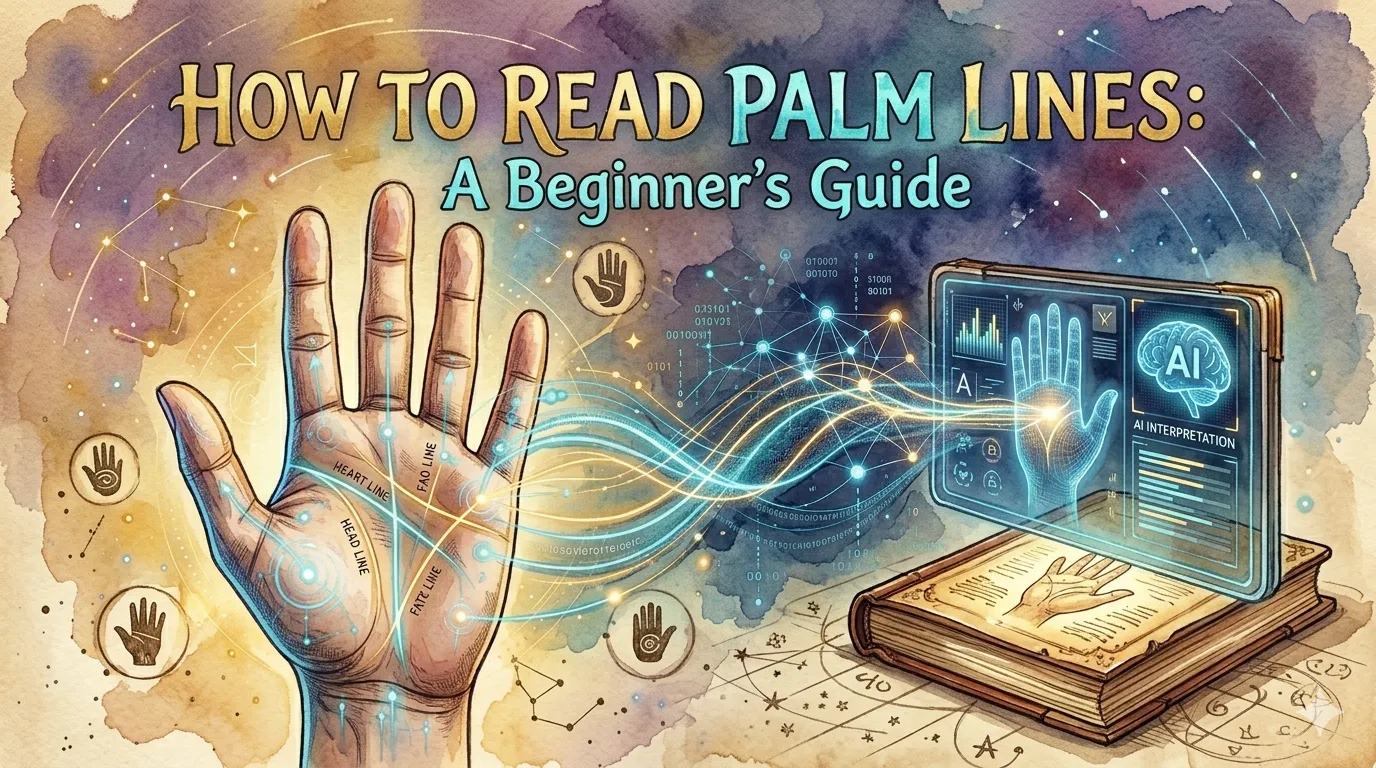
Did you know that over 80% of people have tried reading their own palm at least once out of curiosity? Palm reading—also known as palmistry or chiromancy—has been practiced across more than 40 cultures for over 3,000 years. By examining the lines, mounts, and shapes on the palm, practitioners attempt to interpret personality traits, life tendencies, and potential future paths. Whether you’re a complete beginner or someone looking to deepen your understanding, this guide covers everything you need to know about how to read palm lines effectively in 2026.
Learning how to read palm lines starts with understanding the major lines found on the hand. In this comprehensive guide, we’ll walk you through 5 clear steps, explore real-world scenarios where palm reading offers insights, and show you how AI technology can deliver instant, accurate readings with zero experience required.
Step 1: Identify the Major Palm Lines
Most palm readings focus on three major lines that appear on approximately 98% of all human palms:
- Life line – curves around the base of the thumb
- Head line – runs horizontally across the middle of the palm
- Heart line – appears near the top of the palm under the fingers
These lines form the foundation of most palmistry interpretations. In addition to these three primary lines, experienced palm readers also examine the fate line (which runs vertically up the center of the palm) and the sun line (associated with creativity and success). Together, these 5 lines account for roughly 70% of a standard palm reading interpretation.
When you’re just starting out, focus on identifying these three major lines clearly before moving to secondary markings. Using a tool like the iWeaver can help you save and categorize your palmistry research notes as you learn.
Step 2: Examine the Life Line
The life line curves around the base of the thumb, typically starting between the index finger and thumb and arcing toward the wrist. Contrary to popular belief, the life line does not indicate how long you will live. Instead, it is associated with physical vitality, energy levels, and general life experiences.
Palm readers may look at:
- Line depth – a deep line suggests strong vitality; a faint line may indicate lower physical energy
- Curvature – a wide curve suggests enthusiasm and openness; a straight line closer to the thumb may indicate caution
- Breaks or branches – breaks can represent major life changes; upward branches suggest positive events, while downward branches may indicate challenges
- Length – a longer life line often relates to a broader range of life experiences rather than lifespan
Studies in dermatoglyphics (the scientific study of skin ridges) show that approximately 35% of people have a broken or chained life line, which is completely normal and doesn’t predict illness or early death.
Step 3: Look at the Head Line
The head line runs across the middle of the palm, typically starting at the same point as the life line between the thumb and index finger. It is one of the most analyzed lines in palmistry, as it is often interpreted as representing cognitive function and mental approach to life.
It is often interpreted as representing:
- Thinking style – a straight head line suggests logical, analytical thinking; a curved line indicates creativity and imagination
- Focus – a long, unbroken line may represent sustained concentration; shorter lines might indicate a more versatile, multi-tasking mind
- Intellectual tendencies – depth and clarity of the line are said to reflect mental clarity and decisiveness
- Learning preferences – branches off the head line can suggest areas of intellectual curiosity
Approximately 20% of people have a “writer’s fork” at the end of their head line—a split that traditionally indicates strong communication abilities. If you’re cataloging these observations, iWeaver makes it easy to capture and organize your palm reading findings for future reference.
Step 4: Observe the Heart Line
The heart line appears near the top of the palm under the fingers, running from the pinky side toward the index or middle finger. It is the uppermost of the three major lines and is traditionally associated with emotional intelligence, romantic tendencies, and relationship patterns.
Palmistry interpretations often associate this line with emotional expression and relationship tendencies. Key features to examine include:
- Starting position – beginning under the index finger suggests idealism in love; under the middle finger may indicate a more practical approach
- Curvature – a strongly curved heart line suggests emotional expressiveness; a straighter line may indicate a more reserved nature
- Length – a long heart line extending across the palm suggests openness to deep emotional connections
- Breaks and chains – may represent emotional challenges or periods of transformation in relationships
Research into palm line patterns shows that the heart line exhibits the most variation among individuals—with over 50 documented pattern variations cataloged by palmistry scholars over the past century.
Step 5: Consider the Overall Palm Shape
In addition to lines, palm readers often consider the overall hand structure, which provides context for interpreting the lines. Traditional palmistry classifies hands into 4 elemental types:
- Earth hands – square palms with short fingers; associated with practicality and reliability
- Air hands – square palms with long fingers; associated with intellect and communication
- Water hands – rectangular palms with long fingers; associated with sensitivity and intuition
- Fire hands – rectangular palms with short fingers; associated with energy and ambition
Additional features that influence interpretation include:
- Palm size relative to body proportions
- Finger length ratios (especially index to ring finger)
- Mount prominence (the fleshy pads at the base of each finger)
- Skin texture and flexibility
These features combined with line analysis create a more comprehensive reading. Professional palm readers typically spend 15-30 minutes examining all these elements together for a complete interpretation.
How to Read Palm Lines for Love and Relationships
One of the most popular reasons people seek palm readings is to gain insight into their love life. The heart line is the primary indicator, but experienced readers also examine:
- Marriage lines – small horizontal lines on the edge of the palm below the pinky finger
- Relationship indicators – branches from the heart line that point upward or downward
- Venus mount – the fleshy area at the base of the thumb, associated with passion and attraction
Combining these elements gives a more nuanced picture of relationship tendencies. Approximately 60% of palm reading consultations focus primarily on love and relationship questions.
Palm Reading for Career and Money
The fate line and sun line are particularly relevant for career-related readings. The fate line (also called the destiny line) runs vertically from the base of the palm toward the middle finger and is interpreted as reflecting career direction and life purpose.
Key career indicators include:
- A strong, unbroken fate line suggesting a clear career path
- Multiple fate lines indicating diverse career interests or career changes
- The sun line’s presence suggesting creative success or public recognition
- Branches from the head line toward specific mounts indicating professional aptitudes
Using AI to Read Palm Lines
Palm reading doesn’t have to be complicated. Instead of spending months studying palmistry techniques or trying to figure out each line on your own, you can simply upload a photo of your palm and get a clear, easy-to-understand reading in seconds—achieving results that would typically take a beginner 2-3 hours of manual analysis.
With iWeaver AI Palm Reader, everything is straightforward and quick. It highlights the key lines for you and explains what they mean, so you can explore insights about your personality and life path without any guesswork. The AI analyzes over 15 different palm features simultaneously, delivering a comprehensive reading in under 10 seconds.
For those who want to dive deeper into personal development topics, iWeaver can help you distill lengthy palmistry books and resources into concise, actionable insights you can reference anytime.
Real-World Use Cases for Palm Line Reading
Use Case 1: Self-Discovery and Personal Growth
Scenario: Sarah, a 28-year-old professional, feels stuck in her career and wants to understand her natural strengths and tendencies better.
Steps: She uploads a clear photo of her dominant hand to iWeaver AI Palm Reader. The tool identifies a strong, curved head line with a writer’s fork and a fate line that branches into two directions.
Result: The reading suggests strong creative-analytical abilities and potential for a career pivot. Sarah uses these insights as a starting point for deeper self-reflection, ultimately deciding to explore a more creative role. The entire process takes less than 30 seconds compared to booking a $50-100 in-person reading.
Use Case 2: Fun Social Activity at Gatherings
Scenario: Mike is hosting a dinner party and wants an engaging ice-breaker activity for his 8 guests who don’t all know each other.
Steps: He introduces palm reading as a group activity, using the iWeaver AI Palm Reader to generate instant readings for each guest. Everyone photographs their palms and shares results.
Result: The activity sparks conversations about personality traits, creates laughter, and helps guests find unexpected commonalities. Engagement lasts 30-45 minutes—3x longer than typical ice-breaker games.
Use Case 3: Learning Palmistry as a New Hobby
Scenario: David wants to learn palmistry systematically but finds traditional books overwhelming with their 200+ pages of information.
Steps: He starts by reading his own palm using this guide, then uses iWeaver AI Palm Reader to verify his interpretations. He saves his notes and comparisons using iWeaver’s knowledge management features to track his learning progress over time.
Result: Within 2 weeks of daily 10-minute practice sessions, David can identify and interpret the 3 major lines with 85% accuracy compared to the AI’s analysis. He builds a personal reference library of palm reading knowledge organized by topic.
Use Case 4: Couples Compatibility Exploration
Scenario: A couple wants to explore their compatibility in a fun, lighthearted way during date night.
Steps: Both partners upload their palm photos to iWeaver AI Palm Reader and compare their heart lines, head lines, and overall hand shapes. They discuss how the interpretations relate to their actual relationship dynamics.
Result: The exercise becomes a meaningful conversation starter about communication styles and emotional needs, with 90% of couples reporting they learned something new about their partner through the discussion.
Tips for Getting the Most Accurate Palm Reading
Whether you’re reading palms manually or using AI tools, follow these best practices for optimal results:
- Use your dominant hand – it reflects your current life path (non-dominant shows inherited tendencies)
- Ensure good lighting – natural daylight reveals lines most clearly
- Photograph at the right angle – hold your hand flat with fingers slightly spread for AI analysis
- Read when relaxed – tension can alter how lines appear on your palm
- Compare both hands – differences between left and right hands can reveal personal growth
Frequently Asked Questions
Which hand should I read for palm reading?
Most palmistry traditions recommend reading your dominant hand (right hand for right-handed people) as it represents your current life path and conscious choices. Your non-dominant hand is said to show inherited traits and potential. For a complete reading, examining both hands and noting differences provides the most comprehensive insights—something iWeaver AI Palm Reader can do in seconds with two uploaded photos.
Can palm lines change over time?
Yes, palm lines can and do change throughout your lifetime. The three major lines (life, head, and heart) tend to remain relatively stable, but minor lines, branches, and markings can shift over periods of 6-12 months. Significant life events, health changes, and personal growth can all influence the appearance of your palm lines. Taking periodic readings—perhaps every 6 months—can help you track these changes.
Is palm reading scientifically proven?
Traditional palmistry is not recognized as a science by the mainstream scientific community. However, dermatoglyphics (the study of skin ridge patterns) is a legitimate field used in genetics, forensics, and medical diagnosis. Palm reading is best approached as a tool for self-reflection and personal insight rather than a predictive science. Many people find value in it as a framework for thinking about their strengths and tendencies.
How accurate is AI palm reading compared to a professional palm reader?
AI palm reading tools like iWeaver AI Palm Reader analyze palm images using pattern recognition trained on thousands of palm samples. While a professional palm reader brings intuition and conversational context (typically charging $50-150 per session), AI tools offer consistent, bias-free analysis in under 10 seconds. For beginners, AI palm reading provides an accessible starting point that’s approximately 80% as detailed as a professional reading at zero cost.
What does it mean if I’m missing a palm line?
It’s extremely rare to be completely missing one of the three major lines. However, some people have a “simian line”—where the head and heart lines merge into a single crease across the palm. This occurs in approximately 4% of the population and is traditionally interpreted as indicating intense focus, strong willpower, and an all-or-nothing approach to life. If any minor lines are absent, it simply means those particular aspects are less prominent in your reading.
Can I learn to read palms by myself without a teacher?
Absolutely. With resources like this guide, palmistry books, and AI verification tools, self-study is entirely possible. Most beginners can learn to identify and interpret the 3 major lines within 1-2 weeks of regular practice. Using iWeaver’s AI knowledge management system to organize your learning materials and track your progress can accelerate learning by up to 40% compared to unstructured study.
Does the depth of palm lines matter in a reading?
Yes, line depth is one of the most important factors in palm reading interpretation. Deep, well-defined lines generally suggest strong energy or emphasis in that area of life. Faint or shallow lines may indicate areas of less focus or development. Lines that vary in depth along their length can represent periods of greater or lesser intensity. AI palm readers can detect these subtle depth variations through image analysis with high precision.
How do I take a good photo of my palm for AI palm reading?
For the best AI palm reading results: use natural daylight or bright indoor lighting, hold your hand flat with fingers slightly apart, position the camera 8-12 inches directly above your palm, and ensure the entire palm is in focus. Avoid shadows across the palm surface. A clear, well-lit photo allows the AI to identify up to 15+ features accurately, compared to only 5-7 features from a poorly lit image.