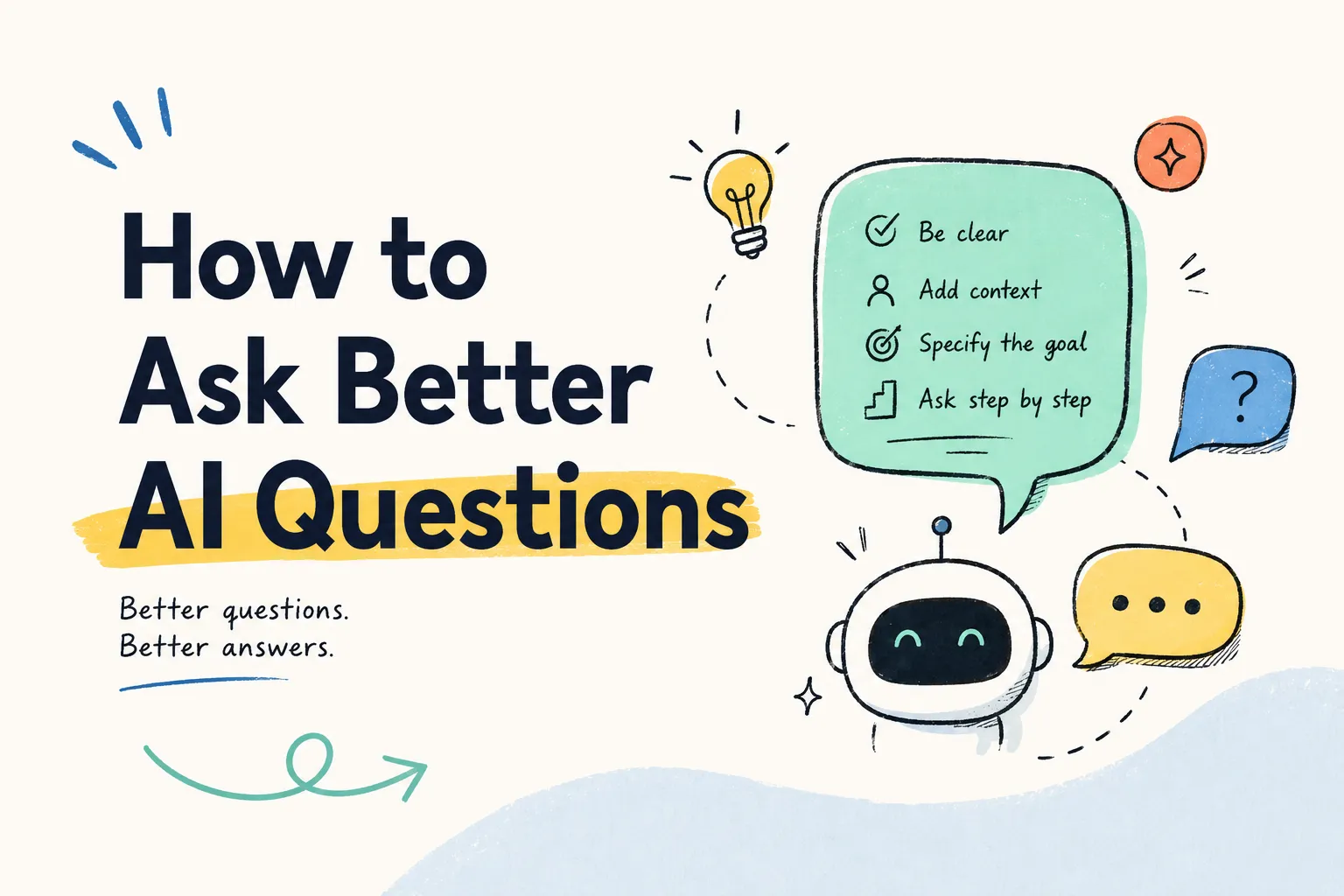
A good study prompt does more than request an answer. It tells the AI what you are learning, what you already know, which material to use, how it should interact with you, and how you will check the result.
The aim is not the most polished AI response. It is better understanding and stronger independent performance.
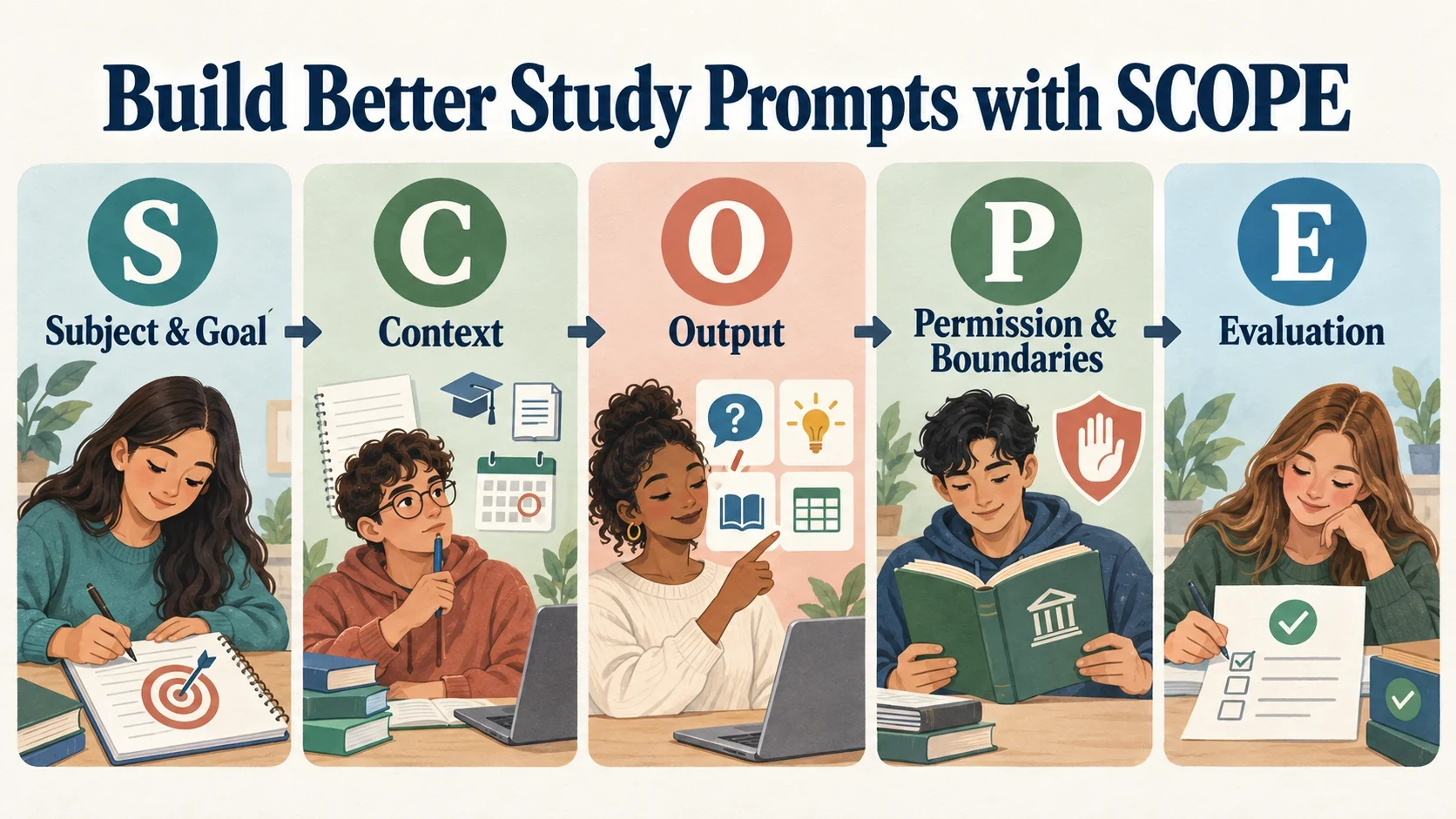
Use the SCOPE prompt formula
Build a learning prompt with five parts:
- S — Subject and goal: What are you studying, and what should you be able to do?
- C — Context: What level, assignment, deadline, and prior knowledge matter?
- O — Output or interaction: Do you need questions, hints, an explanation, a table, or feedback?
- P — Permission and boundaries: Which sources may the AI use, and what must it avoid doing?
- E — Evaluation: How will you check understanding and accuracy?
I am preparing for an introductory economics exam and need to distinguish a movement along a demand curve from a shift in demand. I understand price changes but confuse the non-price factors. Use only the notes I provide. Ask me two diagnostic questions, explain my gap with one example, then give me a new scenario to solve. Do not reveal the answer until I respond. End by listing the note section that supports the explanation.
Why vague prompts produce weak studying
“Teach me economics” gives the system no level, goal, source, or stopping point. “Write my essay” removes the work that an essay is meant to assess.
A focused prompt narrows the task and makes the output testable. It also reduces—but does not eliminate—the risk of irrelevant or invented information.
Prompts for understanding a difficult concept
Explain [concept] for a [level] student. First ask what I already understand. Use one analogy, then explain where the analogy breaks down. Finish with two questions that test application.
Compare [concept A] and [concept B] in a table using definition, mechanism, example, and common misconception. Use only [course source] and quote no more than necessary.
I will explain [concept] in my own words. Identify the first inaccurate or missing step, ask me to correct it, and give a hint only if I am stuck.
The third prompt makes your explanation—not the AI’s prose—the center of the activity.
Prompts for practice and active recall
Create six questions from the uploaded chapter: two recall, two application, and two comparison questions. Ask one at a time and adapt the next question to my answer.
Give me a worked example similar to this problem but with different values. Hide the final answer. After I respond, compare my method step by step.
Run a ten-minute oral review. Ask short questions, track topics I miss, and finish with a targeted revision list.
Specify whether the source includes the answers. Otherwise, the system may generate questions that go beyond your course.
Prompts for writing feedback
When AI assistance is allowed, ask for diagnosis rather than replacement.
Read my introduction and identify the thesis, evidence promised, and any term that needs definition. Do not rewrite the paragraph.
Act as a skeptical reader. Ask three questions about gaps in my reasoning. Do not add new claims or sources.
Mark sentences that are unclear or repetitive. Explain the problem in each, then let me revise before offering another suggestion.
Check your assignment policy before using AI on assessed writing. Keep your drafts and disclose assistance when required.
Prompts for research and source checking
Turn my topic into five search queries using synonyms and related concepts. Do not provide citations.
From the source I uploaded, extract the author’s main claim, method, evidence, limitations, and publication details. Label anything not stated as “not found.”
List the factual claims in my paragraph. For each, suggest the type of primary or authoritative source needed for verification. Do not invent URLs or references.
AI can help you plan a search, but you must open and read the sources you cite.
Prompts for math, science, and coding
Do not solve the assigned problem. Check my working and identify the earliest step that does not follow from the previous one. Ask me what rule applies.
Create a new problem that tests the same method at the same difficulty. After I attempt it, show a full solution and compare our approaches.
Explain this error message and ask me to predict the fix before showing code. Keep the example smaller than my assignment.
Use tests, calculations, and course references to verify the response. Working-looking code and neat equations can still be wrong.
Prompts for planning study time
I have [days], [minutes per day], and these topics: [list]. Build a revision plan that alternates retrieval practice, problem solving, and short review. Put weaker topics earlier and include one catch-up block.
Turn this exam outline into a checklist. Ask me to rate confidence from 1–5, then allocate practice time based on importance and confidence.
Do not confuse a detailed schedule with actual study. The plan should lead quickly to retrieval and practice.
Improve a prompt through one revision loop
After the first response, do not just say “make it better.” Diagnose the mismatch:
- “The explanation assumes calculus; restate it using algebra only.”
- “The questions test definitions. Replace three with scenarios.”
- “You used outside information. Revise using only the uploaded notes.”
- “Give a hint, not the complete solution.”
- “Separate verified source content from your example.”
Specific feedback teaches you how the task is structured.
Prompt safely and honestly
Do not include personal, confidential, or restricted information. Check the assignment’s AI rules. Never request fake citations, fabricated data, concealed AI use, or work designed to evade detection.
iWeaver’s AI Study Agent can use notes, files, links, or screenshots to create explanations and practice activities. Give it a clear learning goal and source boundary, then verify the output against the original material.
For the broader judgment skills behind this process, read AI literacy for students.
A final prompt checklist
Before sending, check that the prompt names the learning goal, relevant context, allowed source, type of interaction, boundaries, and a way to test understanding. After receiving the response, check whether you can perform the task without the AI.
The best student prompt does not make the AI do more. It makes the learning activity clearer, more interactive, and easier to verify.