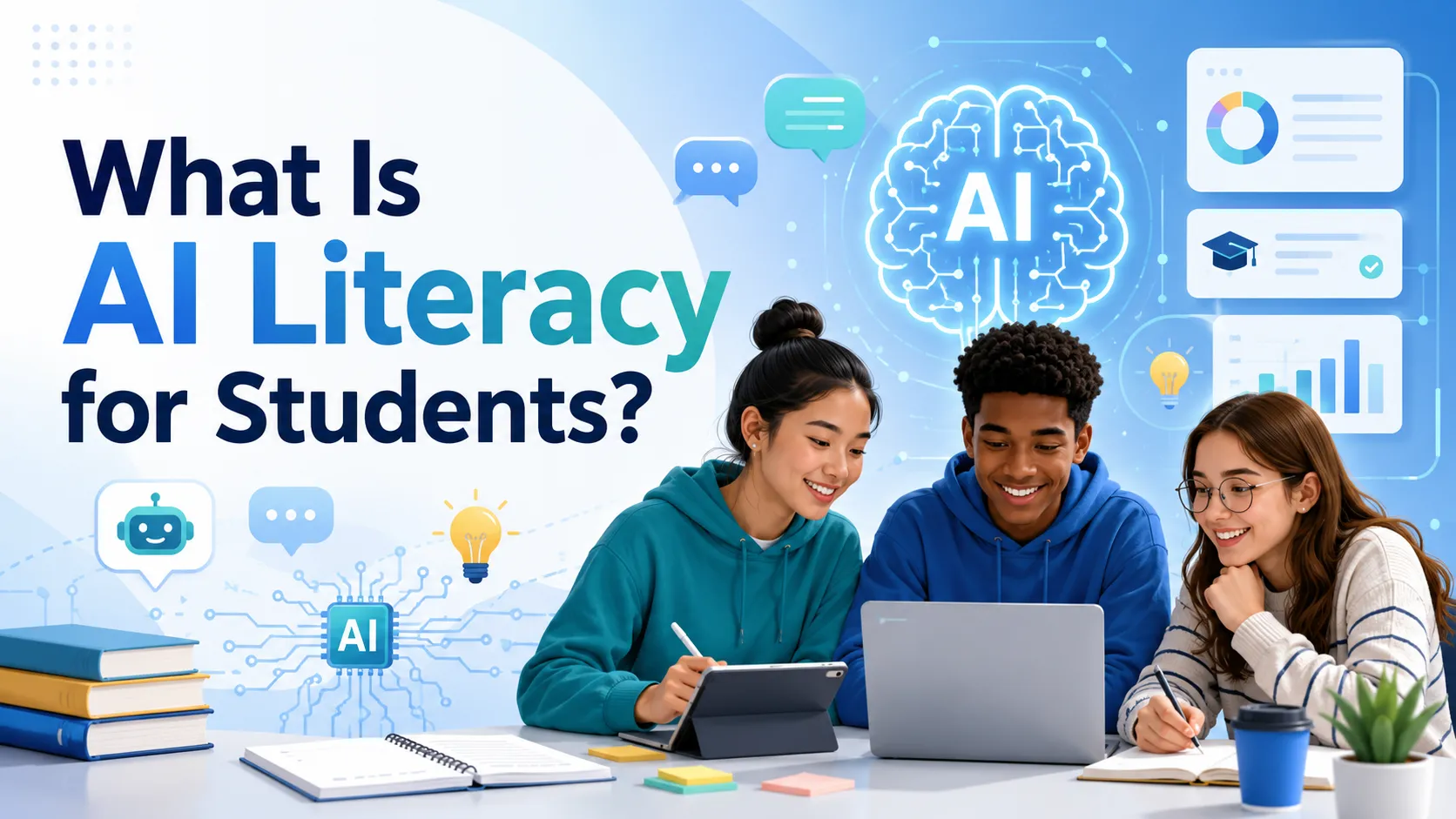
AI literacy is the ability to understand, use, question, and evaluate artificial-intelligence tools. For students, it is not just knowing how to write prompts. It includes recognizing what AI can get wrong, protecting personal information, following course rules, checking evidence, and deciding when the tool helps learning—or replaces it.
International education frameworks increasingly treat AI literacy as both a technical and ethical competency. UNESCO’s AI competency framework for students emphasizes a human-centered mindset, ethics, AI techniques and applications, and system design. The practical framework below turns those broad ideas into six everyday skills.
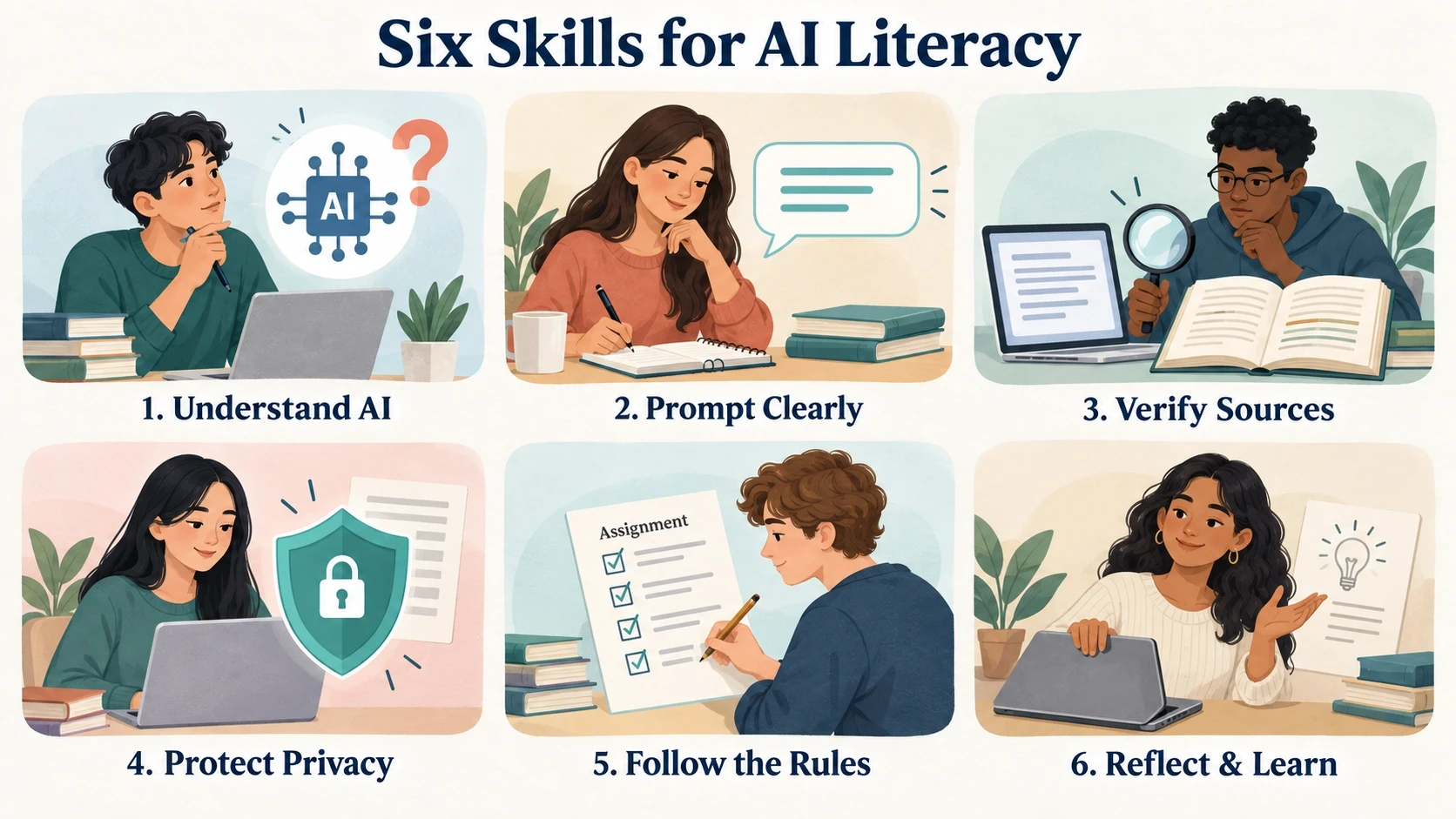
1. Understand what the tool is doing
Generative AI predicts and produces outputs from patterns in data. It can explain, summarize, draft, classify, and create examples, but a fluent answer is not proof that the content is true.
Students should be able to distinguish among:
- a search result that points to a source;
- a generated explanation that may contain errors;
- a calculator or specialist tool with a defined function;
- a recommendation shaped by assumptions; and
- an original source such as a study, book, dataset, or historical document.
Before trusting an answer, ask: What kind of system produced this, and what evidence can I inspect?
2. Prompt for learning, not just output
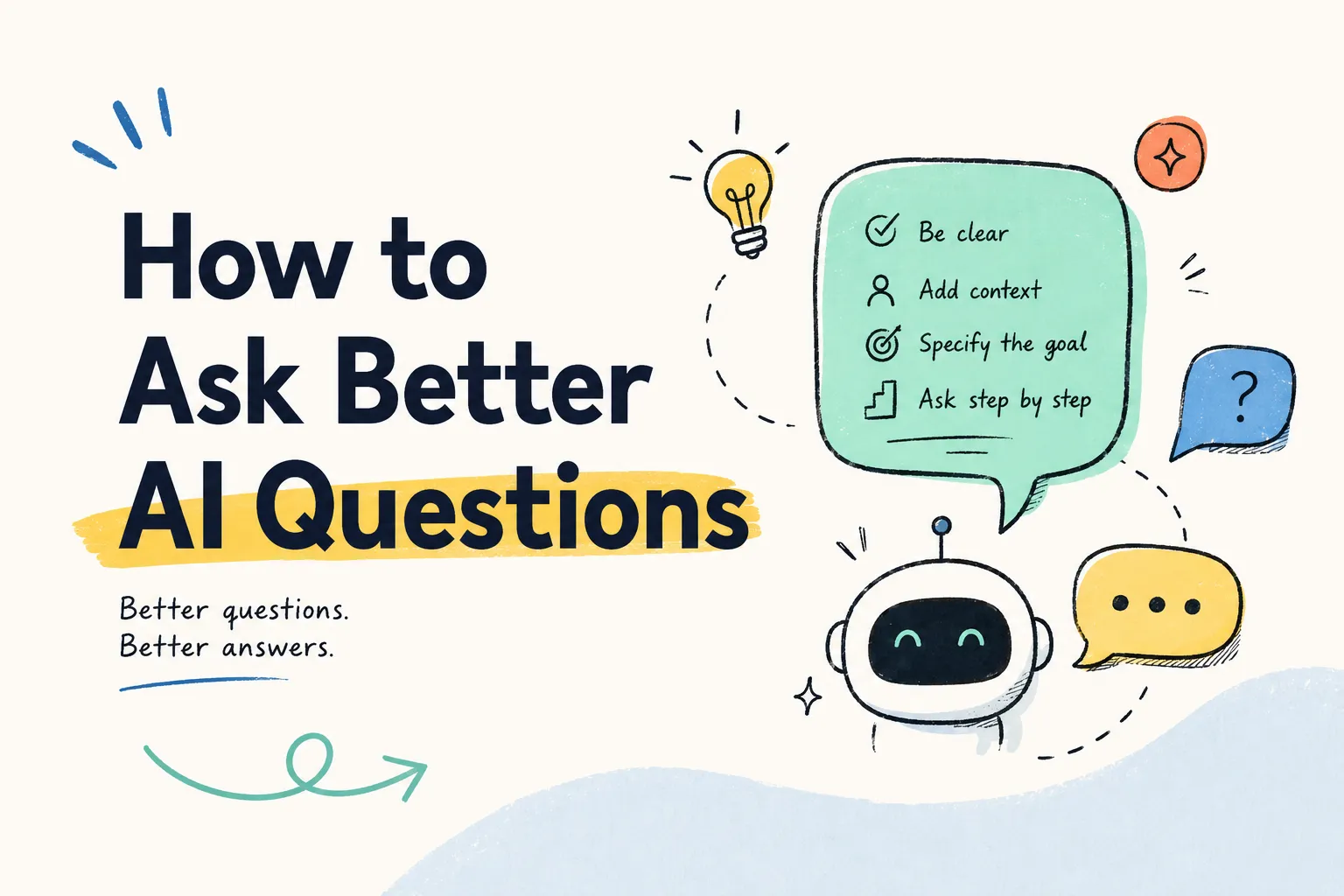
A strong learning prompt states the goal, relevant context, source boundaries, desired interaction, and how the result should be checked.
Instead of:
Explain photosynthesis.
Try:
I am reviewing high-school biology and understand that plants use light, water, and carbon dioxide. Ask me three diagnostic questions first. Then explain only the parts I misunderstand, using one simple diagram description and a short practice question. Do not give the practice answer until I attempt it.
This turns AI from an answer dispenser into a study partner. For reusable formulas and examples, see the prompting guide for students.
3. Verify claims and sources
AI can invent citations, confuse similar concepts, use outdated information, or sound certain when evidence is mixed. Verification is therefore part of the task, not an optional final step.
Use a simple check:
- Mark every fact that matters to your argument.
- Find the original or an authoritative source.
- Confirm that the source actually supports the wording.
- Check the date and context.
- Rewrite the claim in your own words and cite the source you read.
Never cite a source you did not open. If you cannot verify a generated claim, remove it or label the uncertainty.
4. Protect privacy and intellectual property
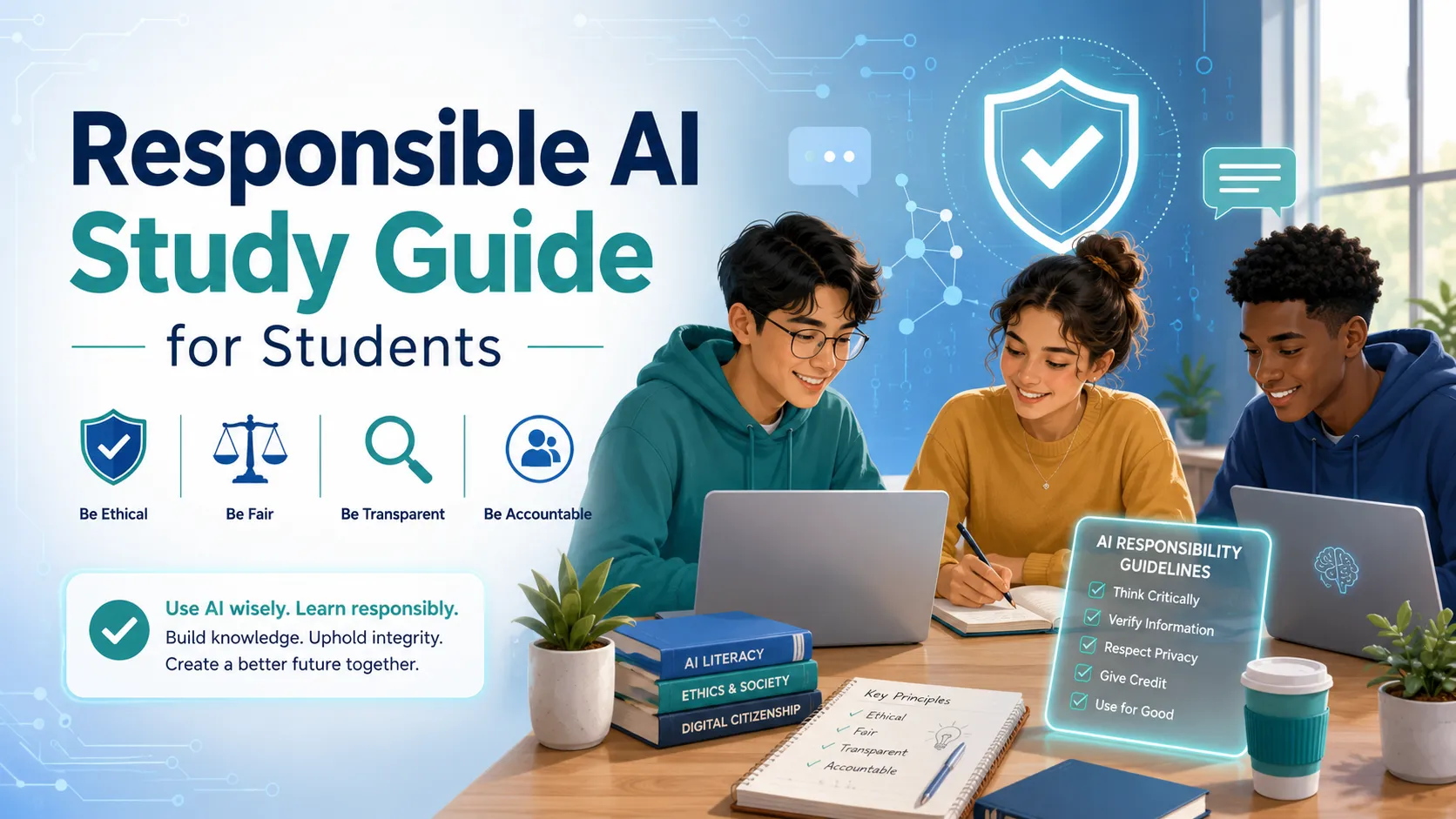
Do not paste personal identifiers, private messages, unpublished research, patient or client information, passwords, assessment answers, or confidential workplace material into an AI tool without explicit authorization.
Review the tool’s current privacy and data-use settings rather than assuming that all services handle information the same way. When possible, remove names and unnecessary details. Use institution-approved tools for protected coursework or research data.
Copyright also matters. Generated text and images may reflect material in training data, while uploaded readings may have usage restrictions. Follow course, library, and platform rules when sharing or transforming content.
5. Follow academic-integrity rules
Allowed AI use varies by school, course, teacher, and assignment. A tool that is acceptable for brainstorming in one class may be prohibited in another assessment.
Before using AI, check the syllabus and assignment instructions. If the rule is unclear, ask the instructor. Keep a record of prompts and outputs when disclosure is required.
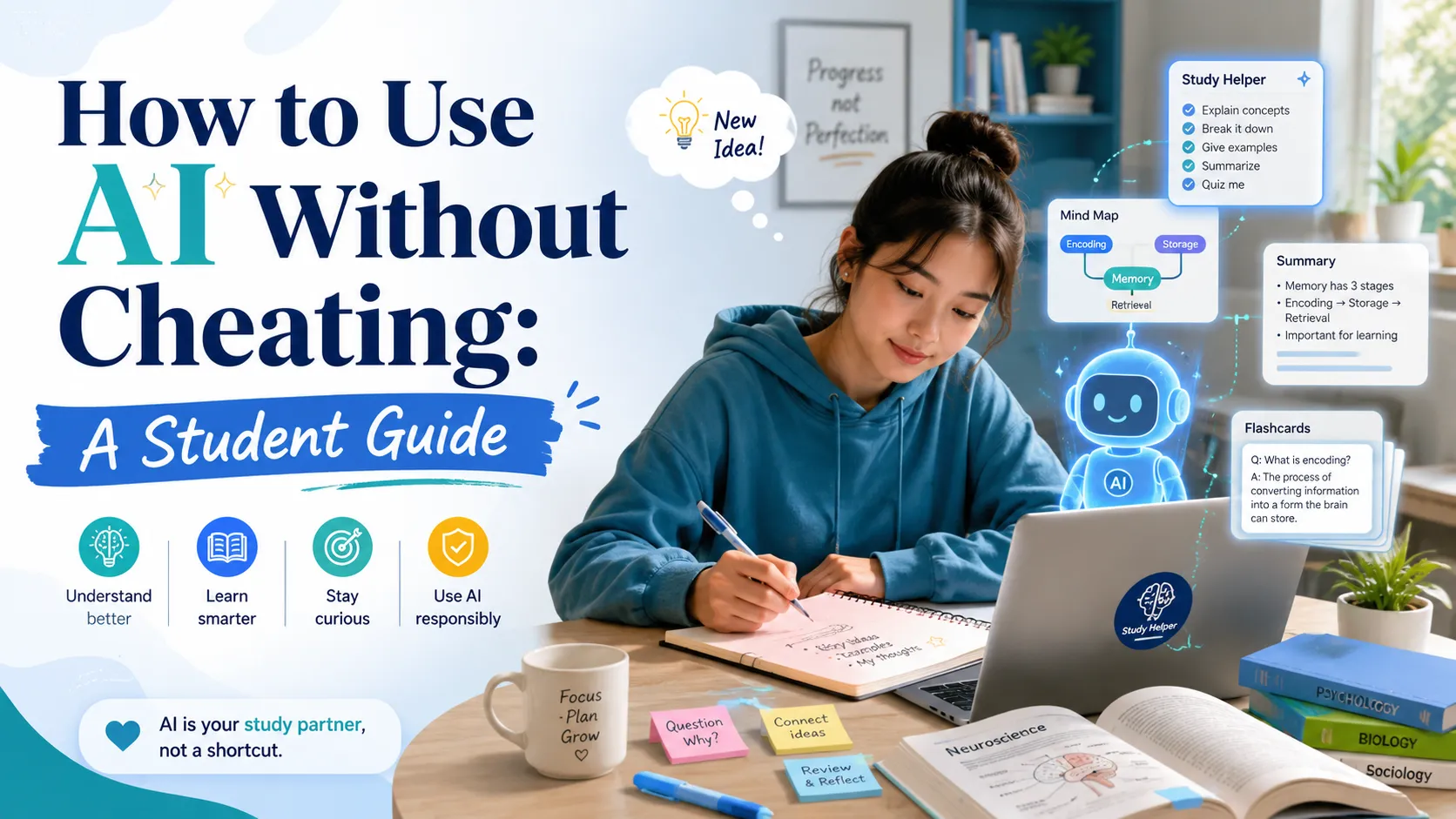
A useful boundary is authorship: if the submitted work is supposed to show your reasoning, the reasoning and final decisions must be yours. AI may help you practice, question, or revise when allowed; it should not create work you represent as independently produced.
Read how to use AI without cheating for a task-by-task decision guide.
6. Reflect on whether learning happened
An efficient output can hide weak understanding. After using AI, close the tool and test yourself:
- Can I explain the idea without looking?
- Can I solve a new problem?
- Can I identify an error in a sample answer?
- Can I say which evidence changed my view?
- Can I describe what the AI contributed?
If not, use the tool again for questions, hints, counterexamples, or practice—not for a more polished answer.
A practical student workflow
Imagine you are studying the causes of the French Revolution.
First, read the assigned material and write a brief explanation from memory. Next, ask AI to identify gaps in your explanation without rewriting it. Verify any factual suggestions against the textbook and trusted sources. Then ask for comparison questions or a timeline with blank entries. Complete those tasks yourself and record how AI was used if your course requires disclosure.
The work remains yours because the tool supports retrieval, feedback, and practice rather than replacing the analysis.
Using iWeaver as a learning aid
iWeaver’s AI Study Agent can work with course materials to create explanations, study plans, outlines, and practice activities. The same integrity rules still apply: use authorized material, specify that the tool should guide rather than complete assessed work, verify important content, and keep your own reasoning visible.
A suitable instruction is:
Use only the uploaded class notes. Ask me questions that reveal gaps in my understanding. Give hints before explanations, and do not write an assignment response for me. At the end, list any claims I should verify in the original material.
An AI-literacy self-check
You are developing AI literacy when you can explain why an answer may be unreliable, improve a prompt without hiding the learning task, verify a claim in a source, protect sensitive data, follow the correct policy, and describe what you learned independently.
The goal is not to use AI for everything or avoid it entirely. It is to make deliberate choices—knowing what the system contributes, what it cannot guarantee, and which parts of the work must remain human.