Using AI is not automatically cheating. The boundary depends on the assignment rules, what the tool does, what you submit, and whether you are honestly representing your own learning.
A simple principle helps: use AI to strengthen the learning process, not to impersonate learning you did not do. Your school’s policy and your instructor’s directions always take priority over a general online guide.
The three-question integrity check
Before using AI, ask:
- Is it allowed? Check the syllabus, assignment instructions, exam rules, and institution policy.
- What learning is being assessed? Identify the skill you are expected to demonstrate—analysis, writing, calculation, coding, research, or something else.
- Would the output misrepresent my contribution? If you submit generated reasoning or wording as your own, you may cross the line even if the facts are correct.
If the rules are unclear, ask the instructor before using the tool. “I did not know” may not protect you from an academic-misconduct process.
Green, yellow, and red uses of AI
These categories are examples, not universal policy.
Green: usually learning-focused
- asking for a simpler explanation after reading the course material;
- generating practice questions you answer yourself;
- requesting hints rather than full solutions;
- comparing your explanation with a checklist of concepts;
- creating a study schedule from your deadlines;
- practicing a language conversation; or
- receiving feedback on a draft when feedback tools are allowed.
Yellow: check the exact rule
- brainstorming an assessed topic;
- creating an outline for an essay;
- rewriting sentences or translating your work;
- debugging assessed code;
- summarizing required readings;
- generating citations or a bibliography; or
- using AI during collaborative work.
These uses may be allowed, restricted, or require disclosure. Ask rather than assume.
Red: likely to misrepresent learning
- asking AI to complete an exam or prohibited take-home assessment;
- submitting generated text, code, calculations, or analysis as your own;
- inventing sources, data, lab observations, interviews, or quotations;
- using “humanizer” tools to hide prohibited AI use;
- sharing another student’s work or confidential assessment material; or
- ignoring a direct no-AI instruction.
A five-step method for honest AI use
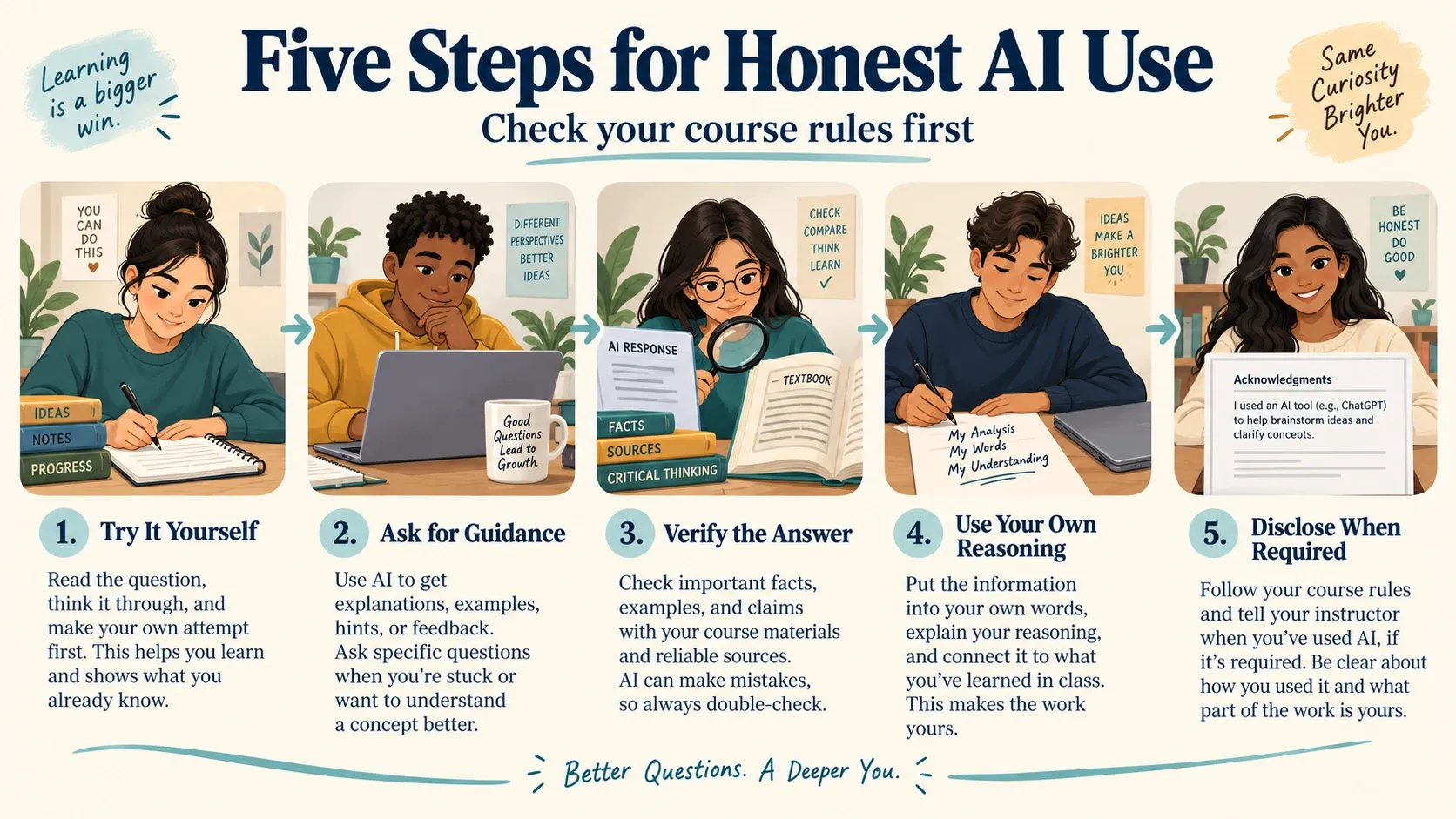
1. Make your own first attempt
Read the material, solve part of the problem, or sketch an outline before opening the tool. This creates evidence of your thinking and reveals where help is actually needed.
2. Ask for guidance, not replacement
Use prompts that preserve the task:
Do not solve this equation. Identify the first step where my working goes wrong and ask me what I should try next.
Read my thesis statement and list two questions a skeptical reader might ask. Do not rewrite the thesis.
Quiz me on the uploaded chapter one question at a time. Wait for my answer and explain mistakes using the chapter.
3. Check the response
AI can produce incorrect explanations and fabricated references. Compare claims with course materials and original sources. Work through calculations yourself. Run and understand code rather than accepting a working-looking block.
4. Transform feedback through your own reasoning
Do not copy the response into the assignment. Close it, reconsider the problem, and write or solve in your own process. You should be able to explain and defend the final work without the tool.
5. Disclose use when required
Follow the specified citation or acknowledgment format. If no format is provided, a transparent note might state the tool, purpose, date, and how you verified or changed the output.
Example:
I used an AI assistant on September 28, 2026, to generate practice questions and identify unclear sentences in an early draft. I verified factual claims against the assigned readings and wrote the submitted analysis myself.
Do not use this sample if your course requires a different format.
Honest AI use in common assignments
Essays
Use AI for questions, counterarguments, or feedback when allowed. Keep source reading, argument selection, evidence evaluation, and final prose under your control. Never cite a source you have not opened.
Math and science problems
Ask for a hint, a comparable example, or an explanation of one step. Then solve the assigned problem yourself. Generated calculations can be confidently wrong.
Coding
Request explanations of errors or small examples when permitted. Read every line, test it, and be ready to explain design choices. Do not submit generated code when the assessed skill is independent implementation.
Research
AI can help generate search terms or organize notes. It cannot replace reading the sources. Verify authors, titles, dates, quotations, and findings in the original material.
Language learning
Practice dialogue, request grammar explanations, or compare revisions. If translation or rewriting is restricted, keep it out of assessed work.
Use iWeaver as a tutor, not a ghostwriter
iWeaver’s AI Study Agent can organize class materials, explain concepts, create study plans, and generate practice activities. Tell it to use only your authorized materials, ask questions before giving explanations, and avoid drafting the submitted response.
For a fuller process covering privacy, bias, verification, and disclosure, use the responsible AI study guide.
Keep a simple AI-use log
Record the date, tool, assignment, prompt purpose, output used, verification steps, and disclosure requirement. This takes a few minutes and helps you explain your process if a teacher asks.
A log is not permission. It is documentation of use that was already permitted.
What if you are accused of cheating?
Stay factual. Review the policy and academic-misconduct procedure. Preserve drafts, notes, version history, sources, prompts, and allowed-use instructions. Explain your process without altering evidence. If your institution offers a student adviser or appeal process, follow the official route.
Do not assume an AI detector result proves authorship one way or another. The relevant evidence is the policy, the work process, and the institution’s review procedure.
Using AI honestly means keeping the learning visible. Check permission, make your own attempt, ask for limited support, verify the response, and disclose use when required. If the tool performs the skill you were supposed to demonstrate, step back and change the way you are using it.