
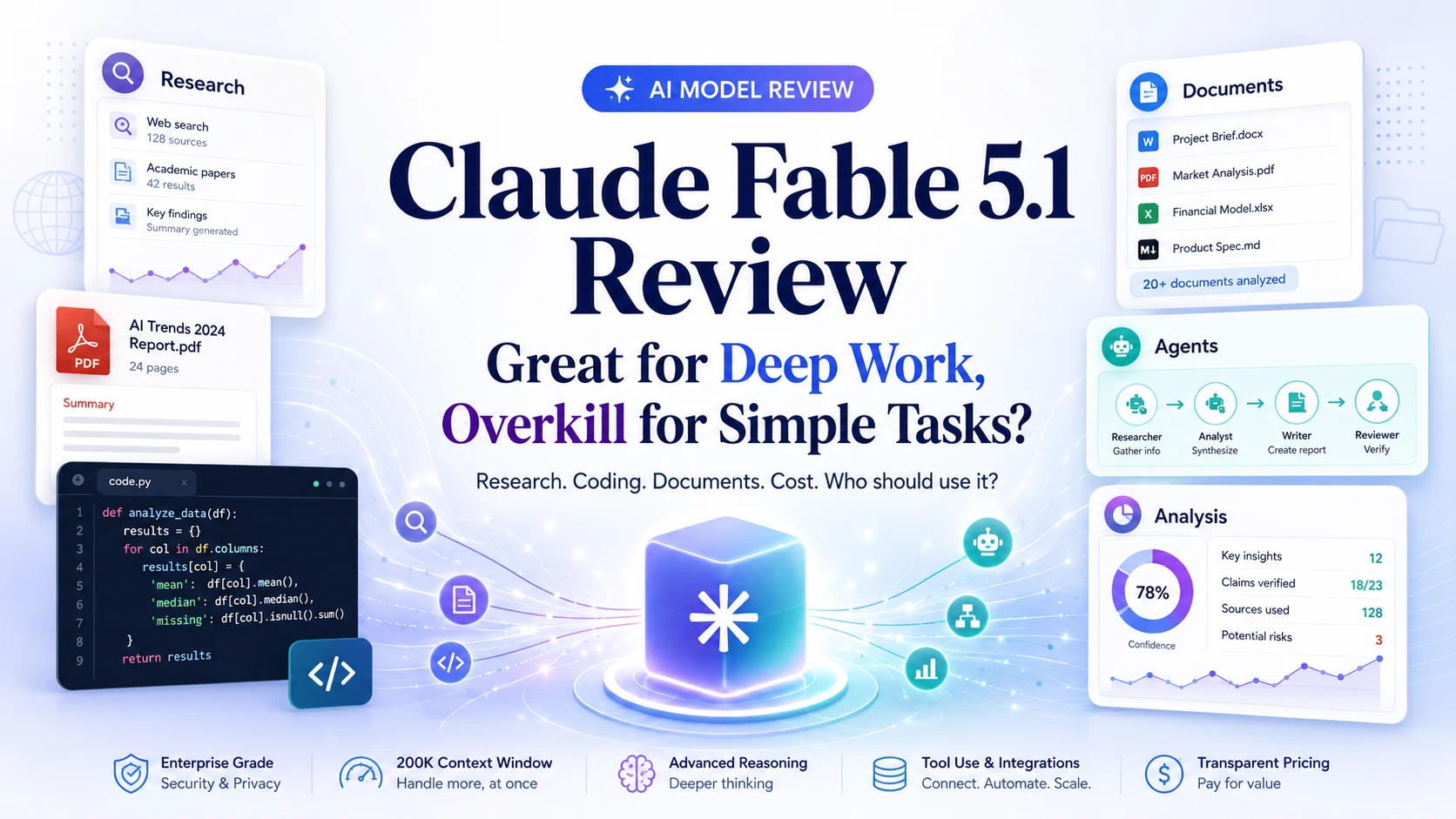
Claude Fable 5.1 is Anthropic's new model for some of its hardest reasoning and long-running work.
But that does not automatically mean you should use it for everything.
The better question is:
When does paying for Fable 5.1 actually make sense?
Anthropic itself recommends starting with Claude Opus 5 for most workloads and moving to Fable 5.1 when the task needs more demanding reasoning or longer-running agentic work.
That tells us something important.
Fable 5.1 is a specialist, not an everyday default.
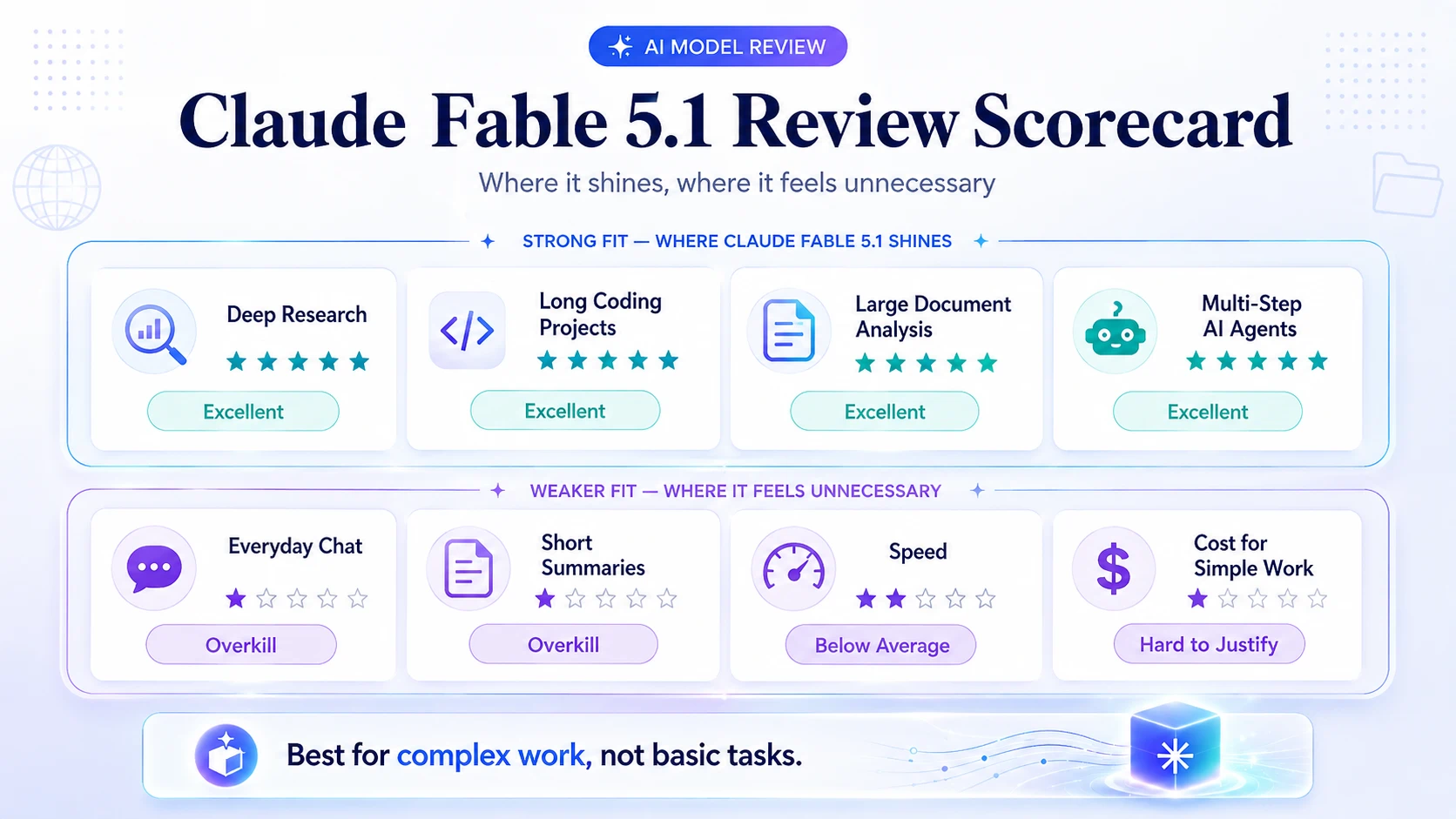
Claude Fable 5.1 Review at a Glance
| Area | Our Take |
|---|---|
| Deep research | Excellent |
| Long coding projects | Excellent |
| Large document analysis | Excellent |
| Multi-step AI agents | Excellent |
| Everyday chat | Overkill |
| Short summaries | Overkill |
| Speed | Below average |
| Cost for simple work | Hard to justify |
This is an editorial assessment based on Fable 5.1's published capabilities and intended use cases, not an independent benchmark score.
1. It Stays With Difficult Problems Longer
This is probably the best reason to use Fable 5.1.
Many AI tasks are easy at the beginning.
The problems appear later.
Take debugging as an example:
Read logs → inspect code → form a hypothesis → test it → fail → check another service → find the root cause → verify the fix
A weaker workflow may stop after finding a plausible explanation.
Fable 5.1 is designed to keep going.
Anthropic says the model can plan work, use tools, recover when a step fails, and continue through jobs that can take hours or span multiple applications.
That is a much more useful upgrade than simply producing a slightly better first answer.
2. Research Is One of Its Best Use Cases
Fable 5.1 also makes sense when research goes beyond summarization.
Compare these two tasks:
Simple
Summarize this 20-page report.
Complex
Compare these five reports, find where their conclusions disagree, trace the evidence behind each claim, and recommend which position is better supported.
The first task can be handled by many AI models.
The second requires much more:
- source comparison
- reasoning across documents
- checking assumptions
- revisiting evidence
- deciding what deserves more attention
Anthropic specifically lists multistep research as one of Fable 5.1's stronger areas.
For researchers, analysts, consultants, and other knowledge workers, this is where the model starts to become interesting.
3. It Is Better Suited to Real Documents
Documents are rarely just clean blocks of text.
Important information may sit inside:
- charts
- tables
- diagrams
- slides
- screenshots
- financial statements
Fable 5.1 can process text and image inputs, and Anthropic highlights its ability to understand charts, diagrams, and tables inside files and PDFs.
That makes it more practical for:
| Work | Example |
|---|---|
| Finance | Annual reports and financial tables |
| Research | Papers with charts and figures |
| Consulting | Reports and presentation decks |
| Technical work | Architecture diagrams |
| Analytics | Dashboards and data tables |
For document-heavy work, this may matter more than another benchmark point.
4. It Can Handle a Lot of Context
Fable 5.1 supports a 1M-token context window and up to 128K output tokens.
That gives it plenty of room for:
- large document collections
- long codebases
- research libraries
- project histories
- extended agent sessions
But there is an important catch.
More context is not always better context.
If you give the model 100 loosely related files, duplicated reports, and outdated notes, it still needs to work out what matters.
A large context window gives you capacity.
It does not organize your information for you.
Where Fable 5.1 Falls Short
The model is powerful.
There are still several reasons not to use it for every task.
1. It Is Expensive
Claude Fable 5.1 currently costs:
| Token Type | Price |
|---|---|
| Input | $10 / 1M tokens |
| Output | $50 / 1M tokens |
| Cache read | $0.25 / 1M tokens |
For difficult research, coding, or agentic work, that price may be reasonable.
For tasks such as:
- rewriting an email
- creating ten headlines
- summarizing a short article
- simple brainstorming
- answering a basic question
it is hard to justify.
A cheaper model will usually do the job.
2. It Is Not the Fastest Claude
Anthropic lists Fable 5.1's comparative latency as slower.
By comparison, Opus 5 is listed as moderate and Sonnet 5 as fast.
That tradeoff makes sense when the task needs deep reasoning.
It makes less sense when you just want a quick answer.
If speed matters more than squeezing out the strongest reasoning, Fable 5.1 may not be the right model.
3. It Still Needs Good Context
A smarter model does not make poor source material disappear.
Imagine asking it to analyze:
30 reports + 15 webpages + meeting notes + old research + several videos
The model may technically be able to fit all of that into context.
But the real question is:
Should all of it be there?
Probably not.
Source selection and organization still matter.
This is especially important when you are paying premium rates for the reasoning step.
A Smarter Fable 5.1 Workflow with iWeaver
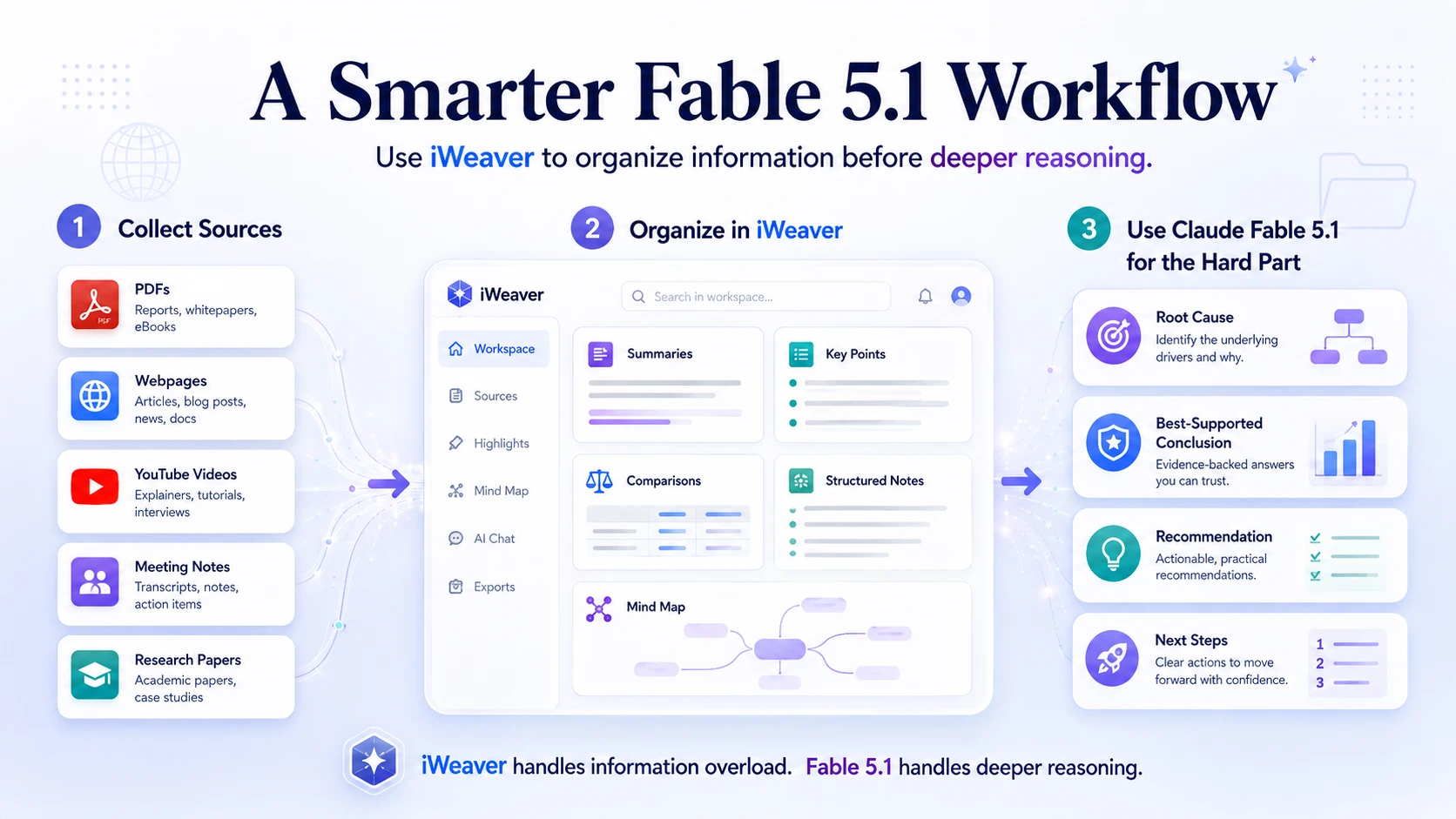
Instead of using Fable 5.1 for every part of a research workflow, it can make more sense to split the job.
Step 1: Collect the Information
Your source material may include:
- PDFs
- reports
- webpages
- YouTube videos
- images
- meeting notes
- research papers
Step 2: Organize It in iWeaver
With iWeaver, you can summarize large files, extract important information, compare sources, ask questions across your materials, and turn useful findings into structured notes or mind maps.
This helps answer an important question before deeper reasoning begins:
What information actually deserves the model's attention?
Step 3: Use Fable 5.1 for the Hard Part
Once the source material is cleaner, use a model like Fable 5.1 for questions such as:
Where do these reports contradict one another?
Which conclusion has the strongest evidence?
What is the most likely root cause?
What should we do next?
This gives each tool a clearer job:
iWeaver → collect, understand, and organize
Fable 5.1 → investigate, reason, and decide
You do not need premium reasoning for every PDF summary.
Save it for the parts where deeper reasoning actually changes the result.
Good Fit
Researchers
Especially when a project involves many sources, conflicting evidence, or multiple rounds of investigation.
Developers
For large codebases, difficult debugging, code review, performance work, and long autonomous coding tasks.
Analysts
When the job goes beyond extracting numbers and requires connecting evidence to a decision.
AI Agent Builders
Fable 5.1 is designed specifically for long-running tasks involving tools, recovery, and multiple steps.
Document-Heavy Knowledge Workers
Finance, consulting, legal, research, and technical teams may benefit from its stronger document and visual understanding.
Who Probably Does Not Need It?
You probably do not need Fable 5.1 if most of your AI use looks like:
- “Rewrite this email.”
- “Summarize this article.”
- “Give me five title ideas.”
- “Fix this short paragraph.”
- “Explain this simple concept.”
These tasks are not bad use cases for AI.
They simply do not need one of Anthropic's most expensive models.
Claude Fable 5.1 Review: Pros and Cons
| Pros | Cons |
|---|---|
| Strong for long-running tasks | Expensive |
| Good fit for deep research | Slower than other Claude models |
| Handles complex document work | Overkill for simple tasks |
| Large 1M-token context | Large context still needs organization |
| Designed for agentic workflows | Premium reasoning can use more resources |
| Much cheaper cache reads | Not the best default for every workload |
Should You Use Fable 5.1 Instead of Fable 5?
If you already use Fable 5, the answer depends heavily on your workflow.
The newer model becomes more compelling if you rely on:
- repeated large contexts
- long coding agents
- multi-step research
- extended tool use
- difficult tasks that require recovery
For the detailed migration differences, see our Claude Fable 5.1 vs Fable 5 comparison.
What About GPT-5.6 Sol?
Choosing between providers is a different question.
Fable 5.1 makes a strong case for difficult, long-running reasoning.
GPT-5.6 Sol makes different tradeoffs around tools, production workflows, and API pricing.
We break those differences down in Claude Fable 5.1 vs GPT-5.6 Sol.
If you only want the release highlights first, start with Claude Fable 5.1: 5 Changes That Matter.
Final Verdict
Claude Fable 5.1 is impressive.
But its value is easy to misunderstand.
You do not need it because your chatbot answers should sound slightly better.
You need it when the work itself is difficult.
If a project requires many sources, repeated investigation, tool use, verification, and dozens of steps, Fable 5.1 starts to make sense.
If your task ends after one or two prompts, it probably does not.
The most practical workflow may be to use tools like iWeaver to collect and organize your information first, then bring in Fable 5.1 only when the problem genuinely needs deeper reasoning.
That is a better use of a premium model than sending every task to the most powerful option available.