
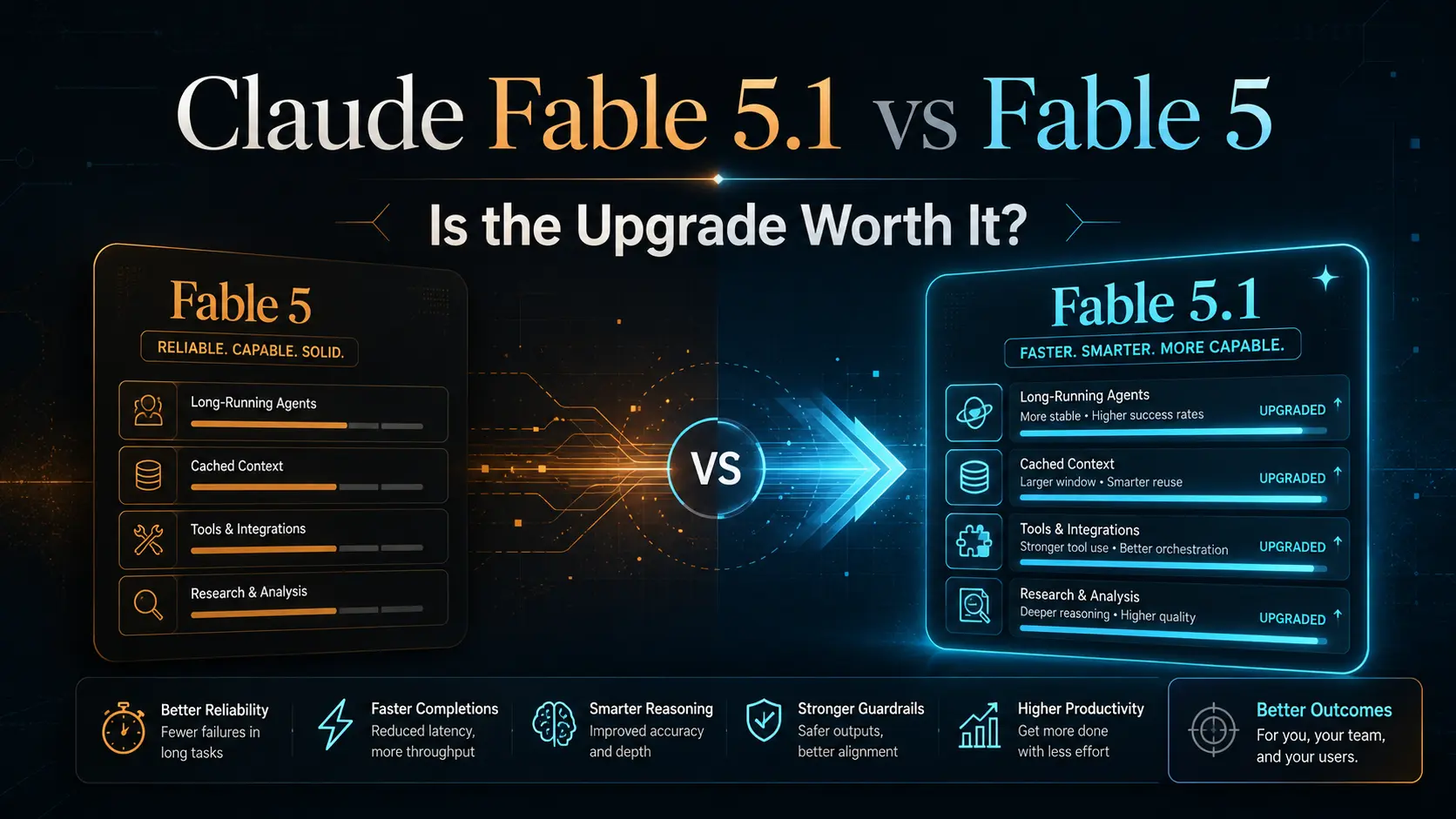
The name Fable 5.1 makes this sound like a small update.
For existing Fable 5 users, the more useful question is:
Does it change enough to justify moving an existing workflow?
In many cases, yes.
The base input and output prices stay the same, but Fable 5.1 improves long-running work, makes cached context much cheaper, and adds several controls that matter more to developers and AI-agent builders than casual users.
If you are completely new to the release, start with our Claude Fable 5.1 overview.
Fable 5.1 vs Fable 5 at a Glance
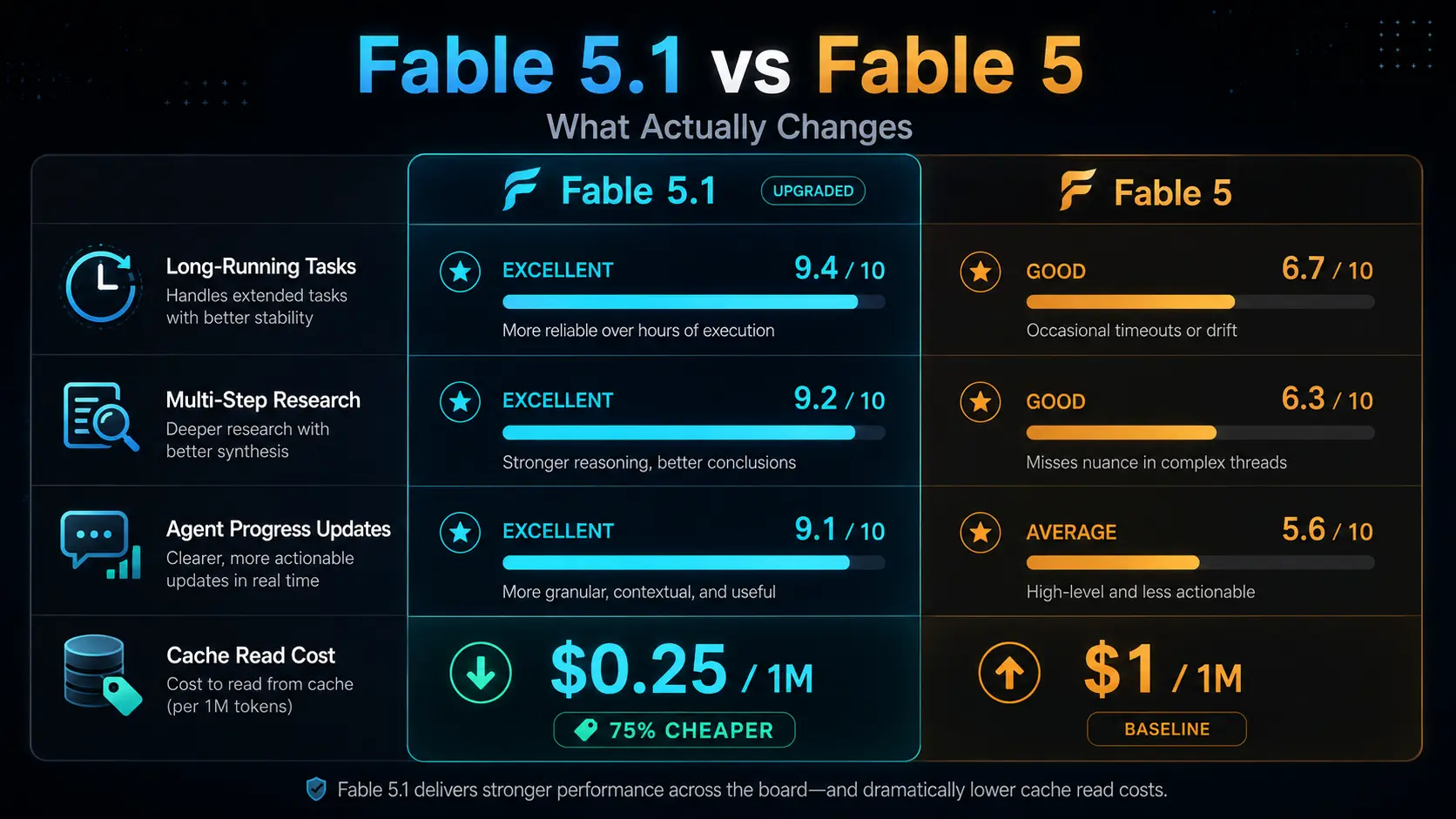
| Feature | Claude Fable 5.1 | Claude Fable 5 |
|---|---|---|
| Input price | $10 / 1M | $10 / 1M |
| Output price | $50 / 1M | $50 / 1M |
| Cache read | $0.25 / 1M | $1 / 1M |
| Long-running tasks | Improved | Strong |
| Multi-step research | Improved | Strong |
| Agent progress updates | Yes | No |
| Per-message effort control | Beta | More limited |
| Migration changes | Yes | — |
The biggest difference is not the headline token price.
It is what happens when Claude needs to keep working for a long time.
1. Fable 5.1 Is Better at Sustained Work
Fable 5 was already designed for difficult tasks.
Fable 5.1 pushes further into long-horizon execution.
A real AI-agent workflow rarely looks like:
Prompt → Answer
It is more likely to look like:
Plan → Use tool → inspect result → adjust → retry → verify → continue
That difference matters.
The longer a task runs, the more chances there are for the model to:
- lose track of the original goal
- choose the wrong tool
- stop after a plausible answer
- fail to recover from an error
- repeat work unnecessarily
Fable 5.1 is designed to perform better across these longer sequences.
For teams using Claude for coding, research, debugging, or autonomous agents, this may be the strongest reason to upgrade.
2. Research Gets a More Noticeable Boost
The biggest gains also appear in tasks that require repeated investigation.
Instead of:
Summarize this document.
Think:
Compare these reports, find the disagreement, verify the supporting evidence, and explain which conclusion is stronger.
That is a very different task.
Fable 5.1 is better suited to:
- multi-source research
- long technical investigations
- complex document analysis
- research that requires repeated checking
- workflows where the model needs to decide what to investigate next
If your team uses Claude mainly for short content generation or isolated questions, this upgrade may feel much smaller.
3. The Real Cost Change Is Prompt Caching
The standard API prices remain unchanged.
Fable 5
Input: $10 / 1M tokens Output: $50 / 1M tokens Cache read: $1 / 1M tokens
Fable 5.1
Input: $10 / 1M tokens Output: $50 / 1M tokens Cache read: $0.25 / 1M tokens
That means cache reads are now 75% cheaper.
This is a much bigger deal for some workloads than it looks.
Imagine an AI agent repeatedly using the same:
- codebase
- company documentation
- research library
- system instructions
- project history
- internal knowledge base
If that context stays mostly the same, cheaper cache reads can materially lower the cost of keeping it available.
Who benefits most?
| Workflow | Impact |
|---|---|
| One-off chat | Low |
| Short writing tasks | Low |
| Repeated document analysis | Medium |
| Coding agents | High |
| Long research agents | High |
| Persistent knowledge workflows | High |
The more context you reuse, the more attractive Fable 5.1 becomes.
4. Fable 5.1 Adds More Control for Agent Workflows
The upgrade is also about how developers manage long tasks.
Fable 5.1 adds features such as:
- per-message effort controls
- turn-scoped system messages
- progress updates between tool calls
- lower cache-read pricing
- improved support for long-running work
These are not features most casual Claude users will notice immediately.
For an AI agent that may run for 30 minutes or longer, they matter much more.
Progress Updates Are Especially Useful
A long-running AI agent can be doing useful work while looking completely frozen.
Progress updates make it easier to show that the model is still:
- researching
- checking files
- running tools
- verifying results
- moving to the next step
That improves the user experience without requiring the model to expose private reasoning.
5. Developers Should Check Migration Changes First
Fable 5.1 should not automatically be treated as a simple model-ID replacement.
There are several behavior changes developers should test before moving production workloads.
Forced Tool Use
Some forced tool-choice patterns may behave differently or return errors.
If your agent relies heavily on forcing a particular tool at a particular step, test that flow carefully.
Thinking Blocks
Thinking blocks created by Fable 5.1 may not behave the same way when a conversation switches back to earlier Claude models.
This matters for applications that dynamically route one conversation between several Claude models.
Editing Conversation History
Editing earlier conversation turns can affect existing thinking blocks.
For long-running agents, append-only conversation histories may therefore be safer.
6. Your Knowledge Layer Should Not Depend on the Model
There is another reason to think carefully about upgrades.
Your knowledge should not have to move every time your model changes.
Suppose your project includes:
- 40 PDF reports
- meeting notes
- webpages
- YouTube videos
- old research
- internal documentation
If all of that knowledge only exists inside one Claude conversation, changing models becomes messy.
A more flexible setup is to keep the knowledge layer separate.
With iWeaver, you can organize your source material into reusable knowledge:
Sources → Summaries → Key Points → Comparisons → Structured Notes → Mind Maps
Then the reasoning model becomes replaceable.
Today you may use Fable 5.
Tomorrow you may move to Fable 5.1.
Later, you may use another model for part of the workflow.
Your underlying research does not need to be rebuilt every time.
This becomes increasingly useful as teams start switching between several frontier models depending on the task.
A Practical Upgrade Workflow
Instead of moving everything at once, test Fable 5.1 in stages.
Step 1: Keep Your Source Layer Stable
Keep documents, research, and extracted knowledge organized in iWeaver or another persistent knowledge workspace.
Step 2: Run the Same Tasks on Both Models
Use a small real-world test set.
For example:
- one long research task
- one debugging task
- one multi-document analysis
- one tool-heavy agent workflow
- one repeated-context task
Step 3: Compare Real Outcomes
Do not compare only the answer quality.
Measure:
- task completion
- number of human corrections
- total token use
- cache savings
- latency
- failure recovery
Step 4: Move the Workloads That Benefit
You do not have to migrate everything.
Keep simple workflows where they are.
Move the tasks that actually benefit from the new model.
Should You Upgrade?
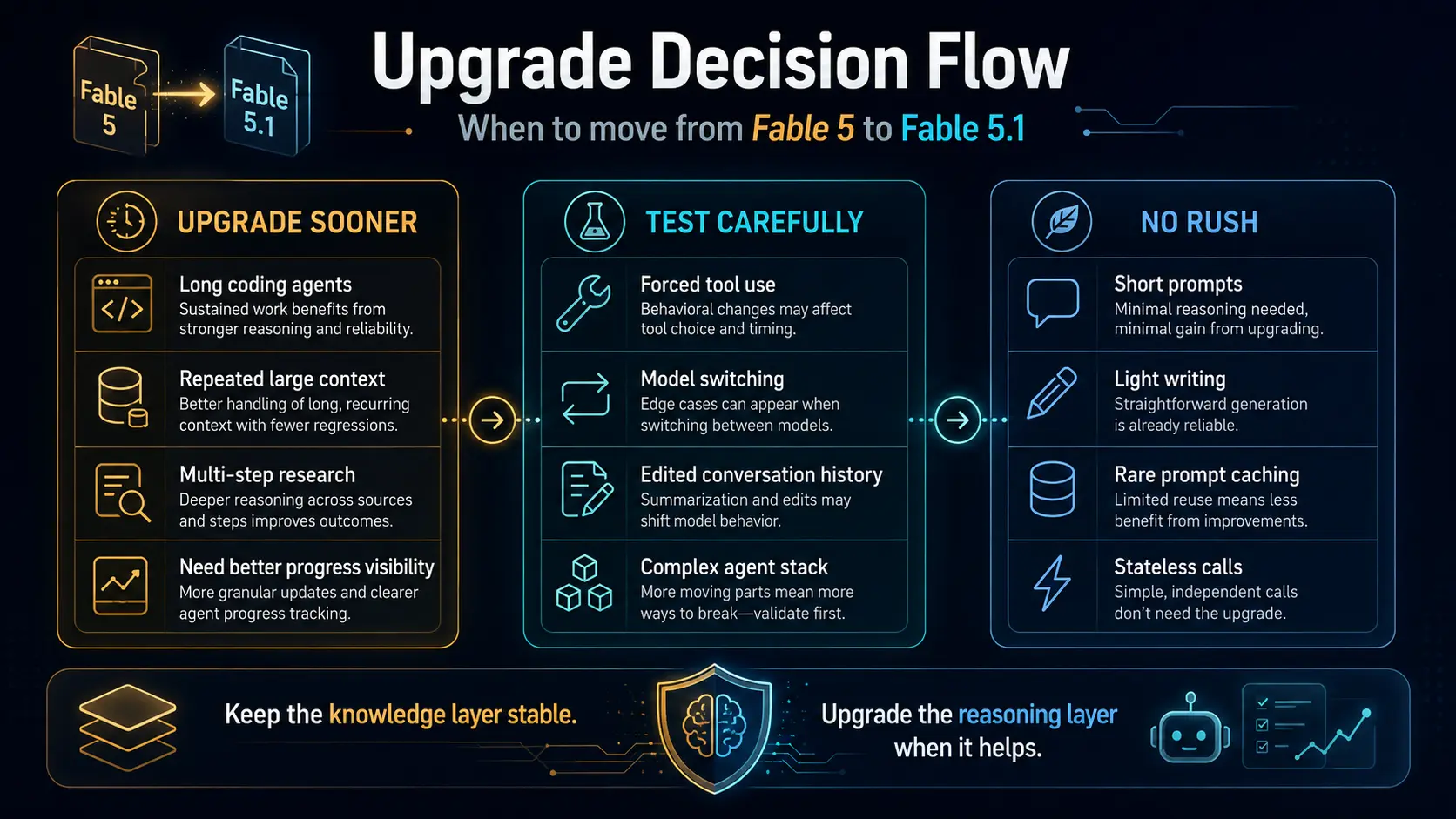
Upgrade sooner if you:
- run long coding agents
- do multi-step research
- repeatedly reuse large context
- need better agent progress visibility
- regularly push Fable 5 close to its limits
Test carefully first if you:
- force specific tool calls
- switch Claude models within one conversation
- edit earlier conversation history
- have a complex existing agent stack
No Rush If You:
- mostly ask short questions
- do lightweight writing
- rarely use prompt caching
- use stateless API calls
- do not run long agent workflows
Fable 5.1 vs Fable 5: Upgrade Checklist
Before changing your production default:
- Run the same eval set on both models
- Test every important tool-call path
- Check thinking-block behavior
- Test conversation-history changes
- Measure cache savings
- Compare total task cost
- Test several effort settings
- Roll out gradually
The important metric is not:
Which model looks better in one response?
It is: Which model completes your real workflow with less intervention?
What If You Are Also Considering GPT-5.6 Sol?
Then this becomes a different decision.
Upgrading from Fable 5 to Fable 5.1 is mostly about improving an existing Claude workflow.
Choosing between Anthropic and OpenAI is a broader question involving:
- reasoning
- tools
- pricing
- production workflows
- document creation
- agent architecture
We cover that separately in Claude Fable 5.1 vs GPT-5.6 Sol.
For a general evaluation of the new model itself, see our Claude Fable 5.1 review.
Final Verdict
For casual users, Fable 5.1 may feel like an incremental upgrade.
For teams building long-running agents, it is more meaningful.
The strongest reasons to migrate are:
better sustained execution
cheaper reusable context
more control over long-running workflows
If your workflow ends after one or two prompts, there is no urgent reason to move.
If your AI spends hours working through tools, files, research, and repeated context, Fable 5.1 deserves a serious test.
And whatever model you choose, keeping your research and knowledge in a separate workspace such as iWeaver makes future model changes much easier.
Keep the knowledge stable. Upgrade the reasoning layer when it actually helps.