
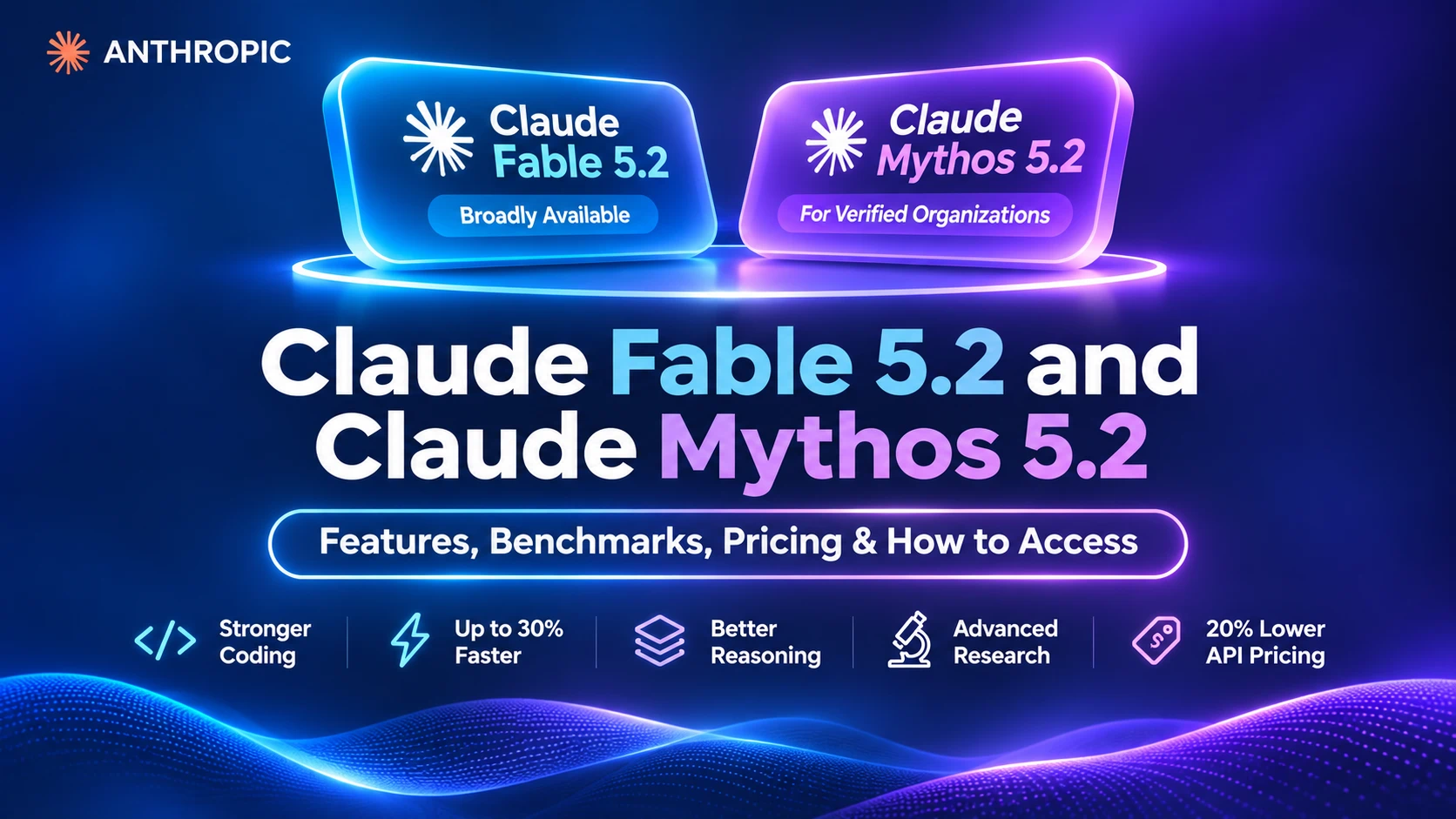
Anthropic released Claude Fable 5.2 and Claude Mythos 5.2, bringing significant improvements in coding, scientific research, reasoning, and complex technical workflows.
The headline changes are hard to ignore: up to 30% faster output generation, a 20% reduction in standard API pricing, and stronger performance across several demanding benchmarks.
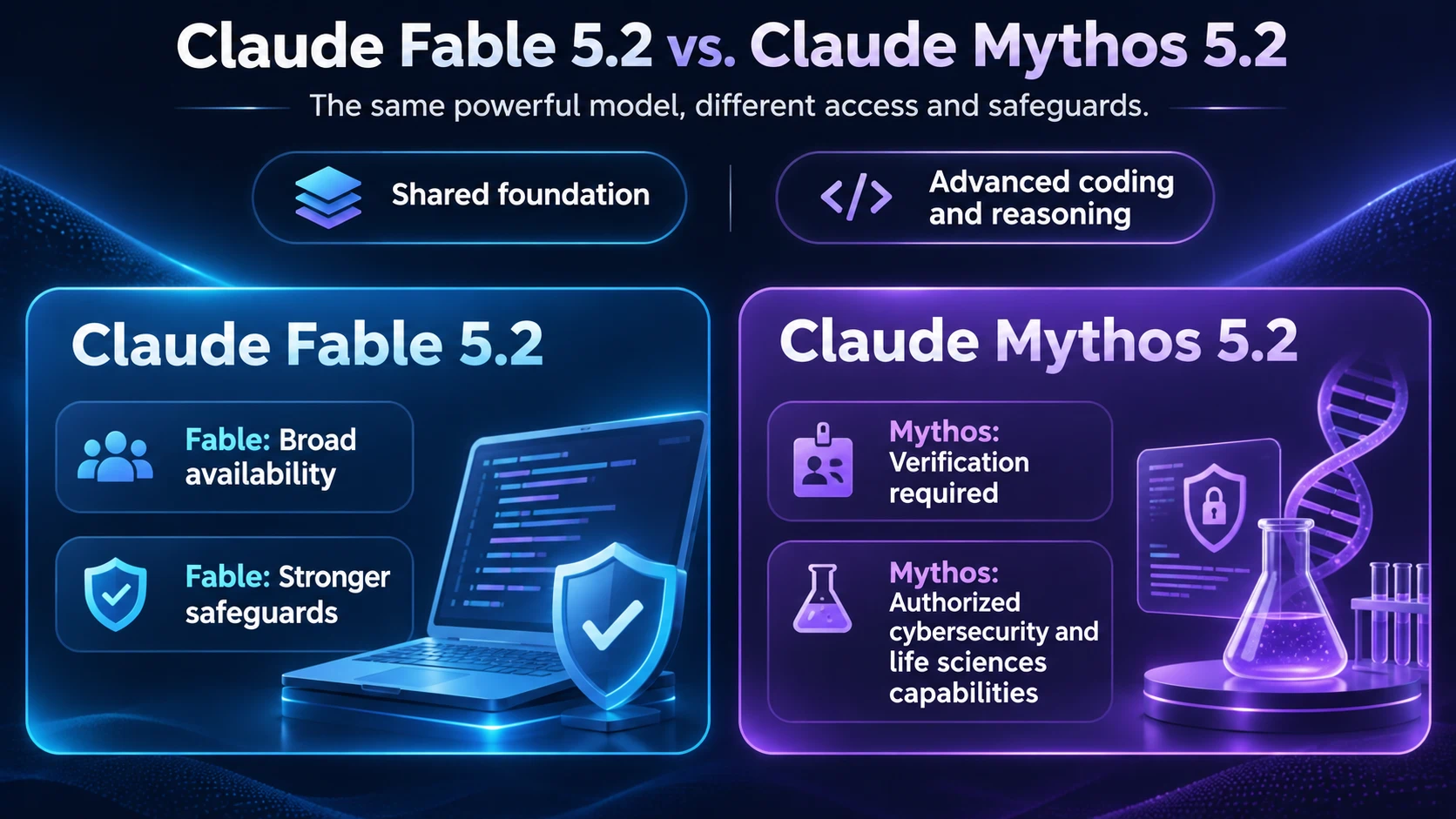
But there's an important distinction. Fable 5.2 and Mythos 5.2 share the same underlying AI model. What separates them is how Anthropic manages access to sensitive cybersecurity and biological research capabilities.
Here's what changed, how the two models compare, and whether you actually need them.
What Are Claude Fable 5.2 and Mythos 5.2?
Claude Fable 5.2 and Mythos 5.2 are Anthropic's latest frontier models designed for especially difficult technical and research problems.
Unlike models optimized primarily for everyday conversations, these releases focus on tasks that may require extended reasoning, complex code execution, tool use, and multiple rounds of experimentation.
Claude Fable 5.2 is the broadly available version. It includes safeguards that restrict certain high-risk cybersecurity and biological research activities.
Claude Mythos 5.2 provides specialized capabilities for verified organizations working in cybersecurity and life sciences.
| Feature | Claude Fable 5.2 | Claude Mythos 5.2 |
|---|---|---|
| Underlying model | Shared foundation | Shared foundation |
| Main audience | Developers, engineers, researchers | Verified security and life sciences teams |
| Coding and reasoning | Advanced | Advanced |
| Cybersecurity capabilities | Restricted by safeguards | Extended authorized capabilities |
| Biological research | Restricted in sensitive areas | Available for approved research |
| General availability | Broadly available | Verification required |
| Standard API pricing | $8 input / $40 output | $8 input / $40 output |
API prices are per million tokens. Access and safeguards differ even though the underlying model is shared.
What's New in Claude Fable 5.2?
1. Stronger Coding and Software Engineering
Coding is one of the clearest areas of improvement.
On FrontierCode 2.0, which evaluates whether AI-generated code changes meet the standards required for real open-source projects, Fable 5.2 scored 49.1% at Xhigh effort, compared with 32.4% for Fable 5.1.
Anthropic also reported a production migration from Python to Rust conducted by agents running an earlier version of Fable 5.2. The migrated service started approximately 26 times faster.
In another experiment, Fable coordinated more than 1,000 AI subagents to build a prototype operating system capable of booting on a laptop.
These examples point toward a change in how advanced coding assistants are used. Instead of handling isolated code suggestions, models are increasingly being tested on end-to-end engineering projects.
That doesn't eliminate the need for code review, security checks, or human approval.
2. Faster Responses and Better Efficiency
Fable 5.2 and Mythos 5.2 generate output up to 30% faster than their 5.1 predecessors, according to Anthropic.
They also introduce an optional fast mode that can increase token generation speed by up to 2.5 times.
For developers running long coding sessions or multi-agent workflows, faster generation can reduce waiting between iterations.
However, faster output isn't necessarily cheaper. Fast mode costs twice the standard token rate, so teams should evaluate whether the time saved justifies the additional expense.
3. Scientific Research and Mathematical Reasoning
Some of the most ambitious claims in Anthropic's announcement concern research.
The company reports that Fable 5.2 contributed to solving two open theoretical physics problems involving black holes and quantum gravity.
It also coordinated approximately 1,000 agents to formalize a proof of Fermat's Last Theorem in 30 hours. Formalization means converting a mathematical proof into a form that software can verify step by step; it is not the same as discovering the theorem's original proof.
Meanwhile, Mythos 5.2 helped develop a computational approach to modeling complex viral protein structures, with Anthropic reporting accurate models for 28 of 34 tested capsids.
These results suggest growing opportunities for AI-assisted scientific work. They remain specific reported research demonstrations, however, rather than evidence that the models can independently solve arbitrary scientific problems.
Claude Fable 5.2 Benchmarks: How Much Better Is It?
Anthropic published comparisons spanning programming, business workflows, reasoning, and research.
| Benchmark | Fable 5.1 | Fable 5.2 |
|---|---|---|
| FrontierCode 2.0 | 32.4% | 49.1% |
| FrontierSWE v2 | 56.3% | 69.9% |
| AutomationBench | 31.4% | 51.4% |
| Humanity's Last Exam (with tools) | 65.6% | 74.2% |
| Chartography (without tools) | 44.8% | 73.4% |
Source: Results generally reflect each model's highest available effort setting and should not be interpreted as identical-cost comparisons.
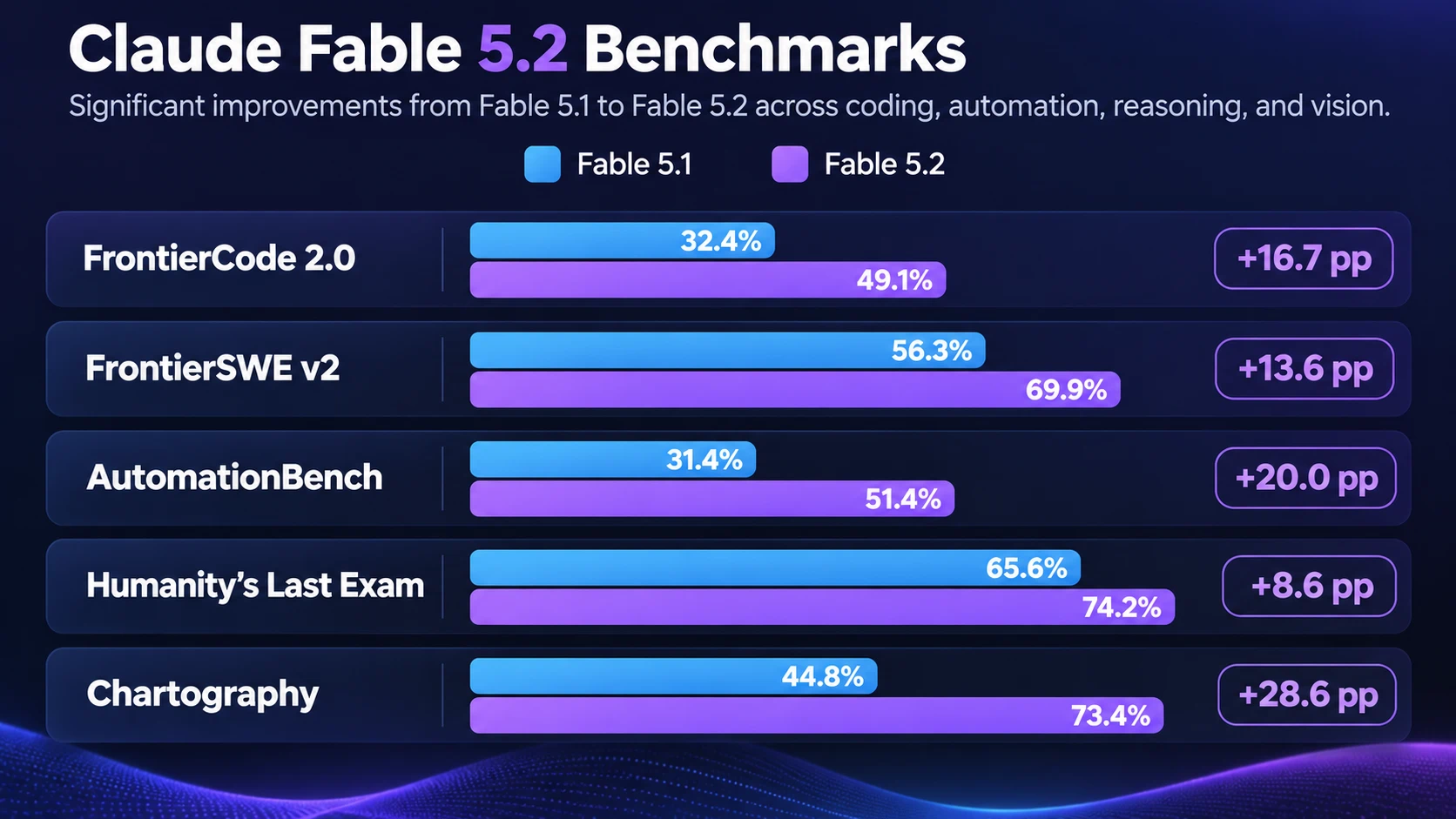
For knowledge workers, chart interpretation and business workflow performance may be particularly interesting. They relate to tasks such as analyzing reports, interpreting figures, and working through multi-step information problems.
Still, benchmark scores have limitations. Performance depends on task complexity, available tools, reasoning settings, and how results are evaluated.
A higher benchmark score should be a reason to test a model on your own workflow, not a guarantee of better results in every situation.
Claude Fable 5.2 and Mythos 5.2 Pricing
Anthropic has reduced standard API prices compared with the previous generation.
| Pricing per 1M tokens | 5.1 generation | 5.2 generation |
|---|---|---|
| Standard input | $10 | $8 |
| Standard output | $50 | $40 |
| Fast mode input | — | $16 |
| Fast mode output | — | $80 |
The new standard prices represent a 20% reduction in both input and output costs.
For businesses processing large volumes of information, this could make advanced reasoning workflows more economical.
Actual costs will still depend on token consumption, effort settings, caching, tool use, and the number of attempts required to complete a task.
Claude Mythos 5.2: Why Is Access Restricted?
Claude Mythos 5.2 is particularly relevant to cybersecurity professionals and biological researchers.
Anthropic says the new model can identify, reproduce, and help fix software vulnerabilities more effectively than previous generations.
Its reported CVE Rediscovery result reached 89.6%, compared with 78.3% for Mythos 5.1.
These capabilities can help authorized defenders investigate weaknesses, but they also introduce misuse risks.
For that reason, Anthropic limits direct Mythos access through its Cyber Verification Program and Life Sciences Verification Program.
Fable 5.2 retains stronger safeguards in these domains. Anthropic reports that its updated safeguards also produce fewer unnecessary blocks than Fable 5.1.
The approach reflects a broader AI industry challenge: providing useful advanced capabilities while managing the risks associated with increasingly capable models.
How to Access Claude Fable 5.2 and Mythos 5.2
Claude Fable 5.2 is available through supported Claude services and major cloud platforms, including Amazon Web Services, Google Cloud, and Microsoft Azure.
Developers can use the model identifier:
claude-fable-5-2
Anthropic also announced temporary additional Fable usage for eligible paid Claude subscribers during launch week.
Claude Mythos 5.2 requires access through the appropriate verification programs, although Claude Enterprise customers can use Claude Security, which incorporates capabilities from Anthropic's broader model family.
Availability through Anthropic does not mean every third-party AI platform has already integrated these models.
Fable 5.2 vs. Opus 5.5: Which Should You Choose?
Despite Fable 5.2's impressive capabilities, Anthropic does not recommend using it for everything.
For most everyday programming and knowledge tasks, the company recommends starting with Claude Opus 5.5.
Fable 5.2 makes more sense when a task becomes difficult enough to justify additional reasoning resources.
Consider Fable 5.2 for complicated software migrations, extended research problems, complex engineering analysis, or multi-agent coordination.
For routine writing, document summaries, ordinary coding, and straightforward questions, a less expensive model may be sufficient.
The practical decision is not simply which model has the highest score. It's which model provides reliable results for the time and budget available.
What Does This Mean for Research and Knowledge Work?
The release highlights how AI is moving from generating individual answers toward handling longer, more connected workflows.
But even when models become better at reasoning, people still need to understand the documents, research, and data behind important decisions.
That is where an organized information workflow becomes useful.
With iWeaver, you can:
- Use an AI Knowledge Base to explore questions across your selected documents and references.
- Review academic methods, findings, and limitations with the Research Paper Analyzer.
- Examine financial reports, ratios, and trends through Financial Statement Analysis.
These tools help turn scattered source materials into structured notes and analysis that can be checked against the originals.
They complement the broader shift toward more capable AI systems without requiring every document task to use the most computationally intensive model.
Is Claude Fable 5.2 better than Claude Opus 5.5?
Fable 5.2 performs better on many advanced benchmarks, especially difficult coding and research tasks. However, Anthropic recommends Opus 5.5 as the starting point for most routine coding and knowledge work.
What is the difference between Claude Fable 5.2 and Mythos 5.2?
Both share the same underlying model. Fable includes stronger safeguards for sensitive cybersecurity and biology tasks, while Mythos offers specialized access to verified organizations working in these fields.
Is Claude Fable 5.2 free?
Anthropic has made Fable 5.2 broadly available, but usage depends on the relevant Claude plan, platform limits, or API billing arrangement. Broad availability does not mean unlimited free access.
How much does Claude Fable 5.2 cost?
Standard API pricing starts at $8 per million input tokens and $40 per million output tokens. Optional fast mode costs $16 and $80 respectively.
Can anyone use Claude Mythos 5.2?
No. Direct access is restricted to eligible organizations through Anthropic's verification programs. Certain Mythos-powered security capabilities are also available through Claude Enterprise offerings.
Claude Fable 5.2 and Mythos 5.2 represent a meaningful step toward AI systems that can handle larger, more demanding technical projects.
The improvements in coding, scientific research, and reasoning are noteworthy, especially alongside lower standard API prices.
But the most important takeaway may be how these models are intended to work: stronger models for the hardest problems, smaller models for routine tasks, and human oversight throughout.
For everyday research and document-heavy work, the immediate priority remains the same—organize your sources, examine the evidence, and turn information into something useful.
Explore iWeaver to summarize, analyze, and organize your research materials in one AI workspace.