

Anthropic released Claude Opus 5.5 and introducing the first model in its new Claude 5.5 family.
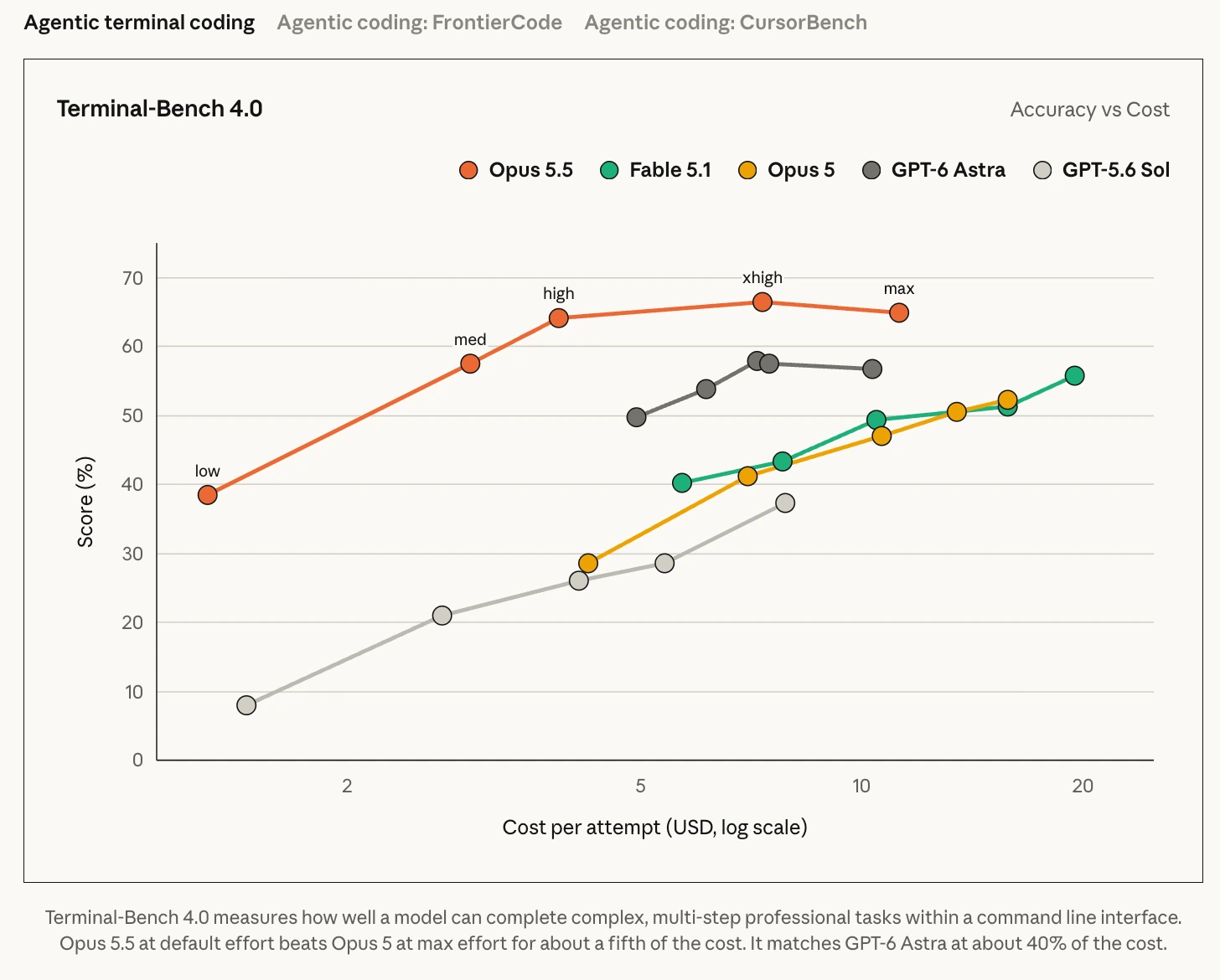
The update is aimed squarely at demanding work: large coding projects, long-running AI agents, research, data analysis, and professional knowledge tasks. Anthropic says Opus 5.5 reaches roughly Claude Fable 5.1-level performance on many workloads while costing significantly less to run than the previous Opus 5.
For developers, the headline improvements are not just higher benchmark scores. Claude Opus 5.5 also brings lower token costs, a 1 million-token context window, up to 128K output tokens, adaptive thinking, and a faster optional mode.
Claude Opus 5.5 at a Glance
| Specification | Claude Opus 5.5 |
|---|---|
| Release date | September 22, 2026 |
| API model ID | claude-opus-5-5 |
| Context window | 1M tokens |
| Maximum output | 128K tokens |
| Batch API max output | 300K tokens, beta |
| Input price | $4 / 1M tokens |
| Output price | $20 / 1M tokens |
| Cache read | $0.20 / 1M tokens |
| Thinking | Adaptive, always on |
| Default effort | Medium |
| Knowledge cutoff | June 2026 |
| Input | Text and images |
| Output | Text |
Anthropic lists Claude Opus 5.5 as its latest Opus model and positions it for long-running agentic coding and knowledge work.
What’s New in Claude Opus 5.5?
1. Better Performance on Long, Complex Coding Tasks
Coding is one of the clearest areas Anthropic is targeting with this release.
Instead of focusing only on isolated coding questions, Opus 5.5 is designed for tasks that may involve many files, tools, decisions, and repeated steps.
Anthropic reports that an early tester used the model to audit and fix a 200,000-line codebase in under three hours, compared with more than 20 hours for Opus 5 in the same example. Anthropic also tested the model on a C-to-Rust rewrite of HAProxy, where Opus 5.5 completed the work faster and at a lower reported cost than Fable 5.1.
- Large codebase migrations
- Repository-wide refactoring
- Debugging across multiple files
- Automated code reviews
- Long-running coding agents
- Software maintenance and testing
The bigger story is therefore not simply “better coding answers.” It is Claude becoming more practical for engineering work that needs to stay coherent over many steps.
Claude Opus 5.5 Benchmarks
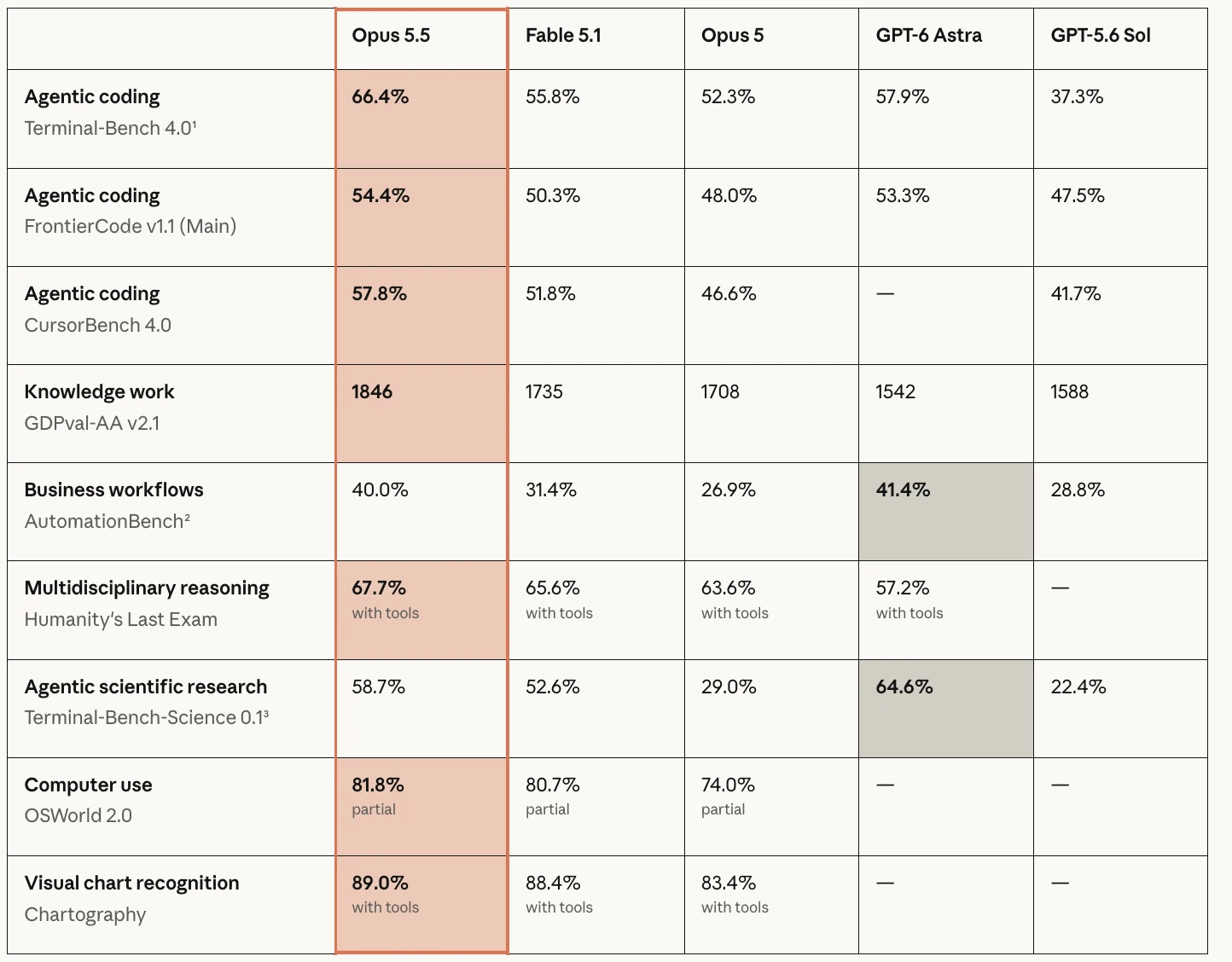
Anthropic published benchmark results covering coding, business workflows, reasoning, knowledge work, and computer use.
| Benchmark | Opus 5.5 | Opus 5 | GPT-6 Astra |
|---|---|---|---|
| Terminal-Bench 4.0 | 66.4% | 52.3% | 57.9% |
| FrontierCode v1.1 | 54.4% | 48.0% | 53.3% |
| GDPval-AA v2.1 | 1846 | 1708 | 1542 |
| AutomationBench | 40.0% | 26.9% | 41.4% |
| Humanity’s Last Exam | 67.7% | 63.6% | 57.2% |
| Terminal-Bench-Science 0.1 | 58.7% | 29.0% | 64.6% |
These numbers show why individual benchmark results need context. Opus 5.5 leads GPT-6 Astra in Anthropic’s published Terminal-Bench, FrontierCode, GDPval-AA, and Humanity’s Last Exam results. But GPT-6 Astra scores higher on AutomationBench and Terminal-Bench-Science in the same table.
Claude Opus 5.5 Pricing
Pricing may be one of the most important upgrades.
Claude Opus 5.5 costs:
- $4 per million input tokens
- $20 per million output tokens
- $5 per million tokens for 5-minute cache writes
- $0.20 per million tokens for cache reads
By comparison, Claude Opus 5 costs $5 per million input tokens and $25 per million output tokens. Cache reads on Opus 5 cost $0.50 per million tokens.
| Model | Input | Output |
|---|---|---|
| Claude Opus 5.5 | $4 / 1M | $20 / 1M |
| Claude Opus 5 | $5 / 1M | $25 / 1M |
The raw token price is therefore 20% lower. Anthropic says the total cost reduction can reach around 40% for typical workloads because Opus 5.5 also tends to use fewer tokens to finish a task.
That matters especially for agents that repeatedly call tools, read large contexts, and run for extended periods.
1M Context Window and 128K Output
Claude Opus 5.5 keeps the large context capacity introduced in recent Claude models.
It supports a 1 million-token context window and up to 128K output tokens in a standard request. The Batch API also supports up to 300K output tokens in beta.
A larger context window can be useful when working with:
- Large code repositories
- Research collections
- Long reports
- Multiple documents
- Contracts and financial material
- Extended agent histories
For document-heavy workflows, tools such as iWeaver AI Summarizer can also help turn large collections of PDFs, documents, videos, and other source material into structured summaries and key points before deeper analysis.
Claude Opus 5.5 Fast Mode
Users who care more about latency can also use Fast Mode.
Anthropic says Fast Mode can run Opus 5.5 at up to 2.5 times the standard speed in Claude Code and on the Claude Platform.
The trade-off is price:
- $8 / 1M input tokens
- $40 / 1M output tokens
That is twice the standard API token price, so Fast Mode makes the most sense when response time matters more than minimizing cost.
Claude Opus 5.5 vs Opus 5: What Actually Changed?
The upgrade is more meaningful than a simple version-number bump.
Compared with Opus 5, Opus 5.5 offers:
| Area | Change |
|---|---|
| Coding | Stronger on long-running and multi-file tasks |
| Agent workflows | Better efficiency across extended tasks |
| Input price | $5 → $4 per million tokens |
| Output price | $25 → $20 per million tokens |
| Cache reads | $0.50 → $0.20 per million tokens |
| Context | Remains 1M tokens |
| Maximum output | Remains 128K |
| Thinking | Adaptive thinking is always on |
Developers migrating existing Opus 5 applications should note that Opus 5.5 also introduces several behavioral changes. For example, thinking can no longer be disabled, and some tool-use behavior has changed. Anthropic recommends checking its migration documentation before simply replacing the model ID in production applications.
Where Is Claude Opus 5.5 Available?
Claude Opus 5.5 is available through the Claude Platform using: claude-opus-5-5
Anthropic also lists support through Amazon Bedrock, Google Cloud, Microsoft Foundry, and Claude Platform on AWS. Consumer access is available across supported Claude paid plans.
Try Claude Opus 5.5 on iWeaver
You can also try Claude Opus 5.5 on iWeaver without setting up an API. iWeaver provides free daily credits, so you can test the model with real tasks such as document analysis, research, writing, summarization, and other knowledge workflows before deciding whether it fits your needs.
For users who simply want to experience Claude Opus 5.5 without managing API keys, billing, or development setup, this is an easy way to get started.
Is Claude Opus 5.5 Worth Using?
Claude Opus 5.5 is most interesting if your work involves tasks that are both complex and long-running.
For short questions or lightweight generation, using an Opus-class model may still be unnecessary. But for large coding projects, document-heavy research, business analysis, autonomous agents, and workflows where mistakes or repeated retries become expensive, the combination of stronger performance and lower token costs is significant. The release also changes the competitive picture among frontier models. Claude Opus 5.5 now sits between Anthropic’s highest-end Fable models and cheaper Sonnet-class options while competing directly with models such as GPT-6 Astra on advanced coding and agent workloads.
That makes the next comparison especially interesting: Claude Opus 5.5 vs GPT-6.