

Claude Sonnet 5.5 and Claude Opus 5.5 are separated less by a simple “good versus better” hierarchy than by the shape of the task. Anthropic positions Sonnet as the faster, lower-cost choice for well-scoped everyday work, while Opus is intended for complex, open-ended problems that require careful judgment over many steps. Sonnet costs half as much per standard input and output token, yet it comes surprisingly close to Opus on several published evaluations.
A benchmark can show whether a model succeeded in a controlled setting, but it may not capture how reliably the model manages ambiguity or keeps competing constraints in view during a long project. Choosing between the two is a routing decision: use the least expensive model that meets the task’s quality and risk requirements.
Sonnet 5.5 vs Opus 5.5 at a Glance
| Detail | Claude Sonnet 5.5 | Claude Opus 5.5 |
|---|---|---|
| Release date | September 28, 2026 | September 22, 2026 |
| Standard input price | $2 per 1M tokens | $4 per 1M tokens |
| Standard output price | $10 per 1M tokens | $20 per 1M tokens |
| Cache read price | $0.20 per 1M tokens | $0.20 per 1M tokens |
| Cache write price | $2.50 per 1M tokens | $5 per 1M tokens |
| Stated role | Fast, well-scoped everyday work | Complex work requiring sustained judgment |
| API model name | claude-sonnet-5-5 |
claude-opus-5-5 |
The figures above come from Anthropic’s official announcements for Sonnet 5.5 and Opus 5.5. They are standard API rates; fast mode, regional inference, cloud platforms, and subscription access can follow different pricing or usage rules.
What the Benchmarks Actually Show
Sonnet 5.5 is close to Opus 5.5 on several Anthropic-reported evaluations, but the lead changes by task. That is precisely why the two models should not be reduced to a single score.
| Benchmark | Sonnet 5.5 | Opus 5.5 |
|---|---|---|
| Terminal-Bench 4.0 | 70.6% | 66.4% |
| FrontierCode 1.1 Main | 46.2% at Max | 54.4% |
| CursorBench 4.0 | 55.5% | 57.8% |
| GDPval-AA v2.1 | 1844 | 1846 |
| AA-Briefcase v1.1 | 1811 | 1822 |
Sonnet leads in the published Terminal-Bench result, while Opus leads on FrontierCode, CursorBench, GDPval-AA, and AA-Briefcase. The tiny GDPval-AA gap is notable, but Anthropic explicitly says Opus remains clearly stronger in its own and external testers’ experience on complex, open-ended work requiring sustained judgment. Benchmark configurations and effort settings also differ, so a two-point numerical gap should not be mistaken for a complete capability verdict.
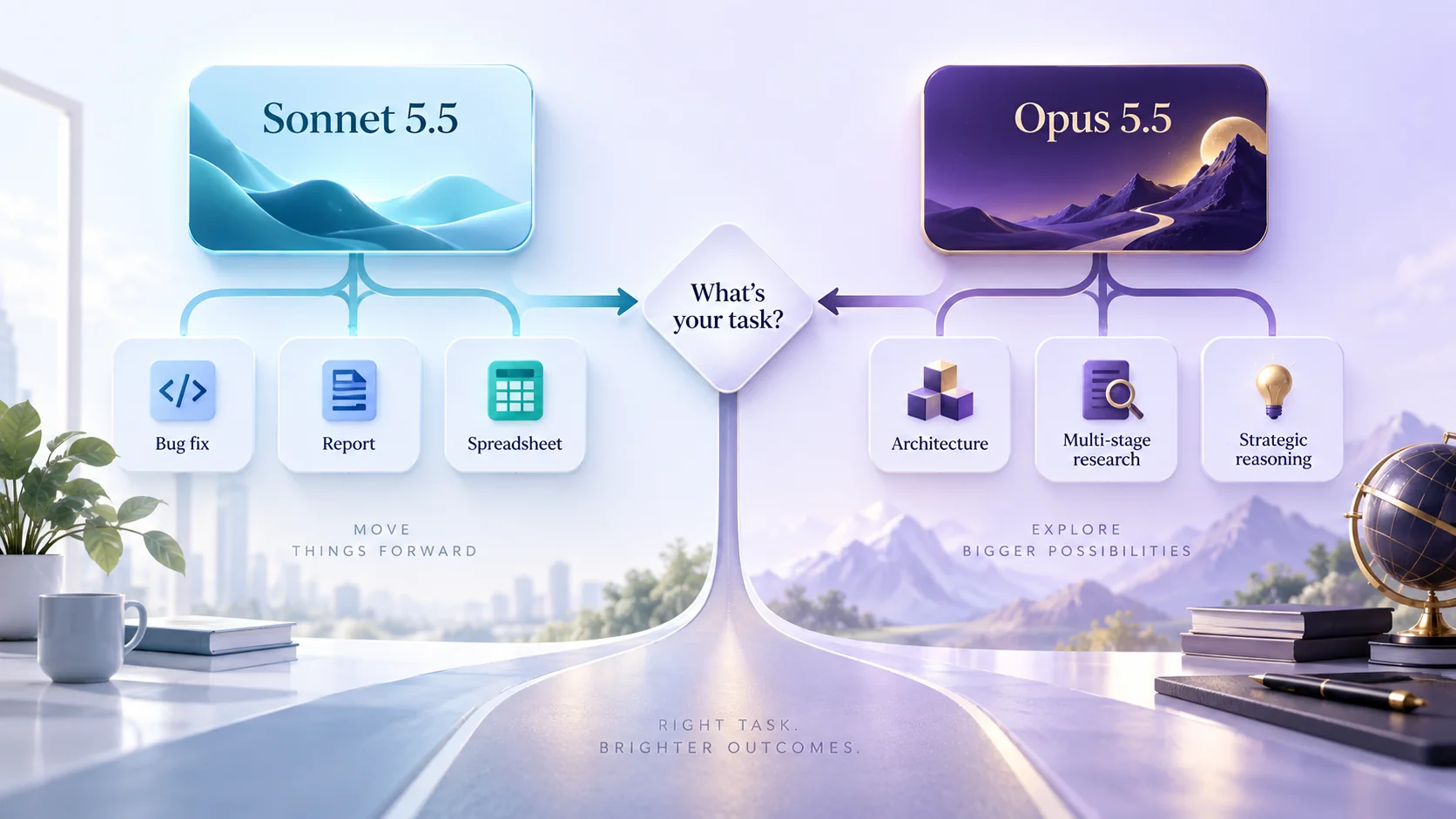
Sonnet makes sense when success can be described clearly and checked without extensive interpretation. Examples include fixing a reproducible bug, transforming a known dataset, summarizing a defined collection of documents, drafting a presentation from approved findings, or applying a consistent rewrite across many files. These tasks may still be demanding, but they have boundaries and a recognizable finish line.
The price difference becomes important at volume. Standard input and output tokens cost half as much as Opus, while cache reads cost the same. Anthropic also says Sonnet 5.5 generates output more than 30% faster than Sonnet 5, although it does not present that statement as a direct speed comparison with Opus 5.5. Teams should measure latency under their own load rather than assume the tier name predicts response time in every environment.
For recurring workflows, Sonnet’s adjustable effort can help control cost. Lower effort may be suitable for classification, formatting, or routine drafts; higher effort may be justified for code changes or analysis that needs more checking. The important practice is to set acceptance tests and escalate difficult cases instead of using maximum effort for everything.
When Opus 5.5 Earns Its Higher Price
Opus is the stronger candidate when the model must define the problem as it works. A complex code migration, cross-functional strategy, multi-stage investigation, or ambiguous analysis may require the model to revisit assumptions, balance constraints, and maintain coherence over a long chain of actions. These are the situations Anthropic means by “sustained judgment.”
The value calculation also changes with risk. If a senior reviewer must spend hours repairing a plausible but subtly wrong answer, saving on tokens was a false economy. Opus may be worth the higher rate when one successful run avoids significant rework, but it should still be evaluated against explicit criteria; a premium label does not remove the need for source checks, tests, and human approval.
Coding: Route by Scope, Not by Prestige
For coding, start with the task boundary. Sonnet is a strong default for a localized bug, a well-specified endpoint, test generation, or a contained refactor. Opus is more defensible for architectural work, multi-repository coordination, a migration with incomplete requirements, or an investigation where the root cause is unknown.
Run both models on a representative sample before formalizing the route. Score correctness, regression risk, unnecessary edits, test quality, elapsed time, token use, and reviewer effort. Anthropic’s FrontierCode note is relevant here: more reasoning can lead an agent to make changes outside the requested scope, so quality includes knowing when to stop.
Research and Document Work
Sonnet’s near-Opus scores on Anthropic’s knowledge-work evaluations make it a compelling choice for structured document workflows. If the job is to compare five reports, extract specified fields, or turn approved notes into a deck outline, Sonnet may deliver the required quality at a lower cost. Opus becomes more attractive when the sources conflict, the research question evolves, or the model must make and defend difficult interpretive choices.
Whichever model you select, source preparation often determines output quality. Duplicate files, unclear versions, and missing context can undermine even a strong model. iWeaver’s AI Summarizer can help organize mixed files and links into summaries, key points, executive briefs, or structured notes before the higher-level analysis begins. This is a complementary information workflow; it does not imply that either Claude model is currently selectable inside iWeaver.
A Practical Routing Rule
Use Sonnet first when the task has clear inputs, a clear deliverable, and a straightforward validation method. Escalate to Opus when the problem remains ambiguous after clarification, spans many dependent stages, carries a high cost of error, or repeatedly fails your Sonnet acceptance tests. This approach usually gives a more useful cost-quality balance than choosing one model for every request.
The final decision should be based on completed-task economics. Track total tokens, cache use, retries, latency, reviewer time, and failure severity across real examples. Sonnet 5.5’s benchmark gains make it a credible everyday default; Opus 5.5 remains the deliberate choice when complexity and judgment justify paying more. To explore the lower-cost model in detail, see Claude Sonnet 5.5: Benchmarks, Pricing, Features & What’s New, or continue with How to Use Claude Sonnet 5.5.