
DeepSeek Harness has shipped another update.
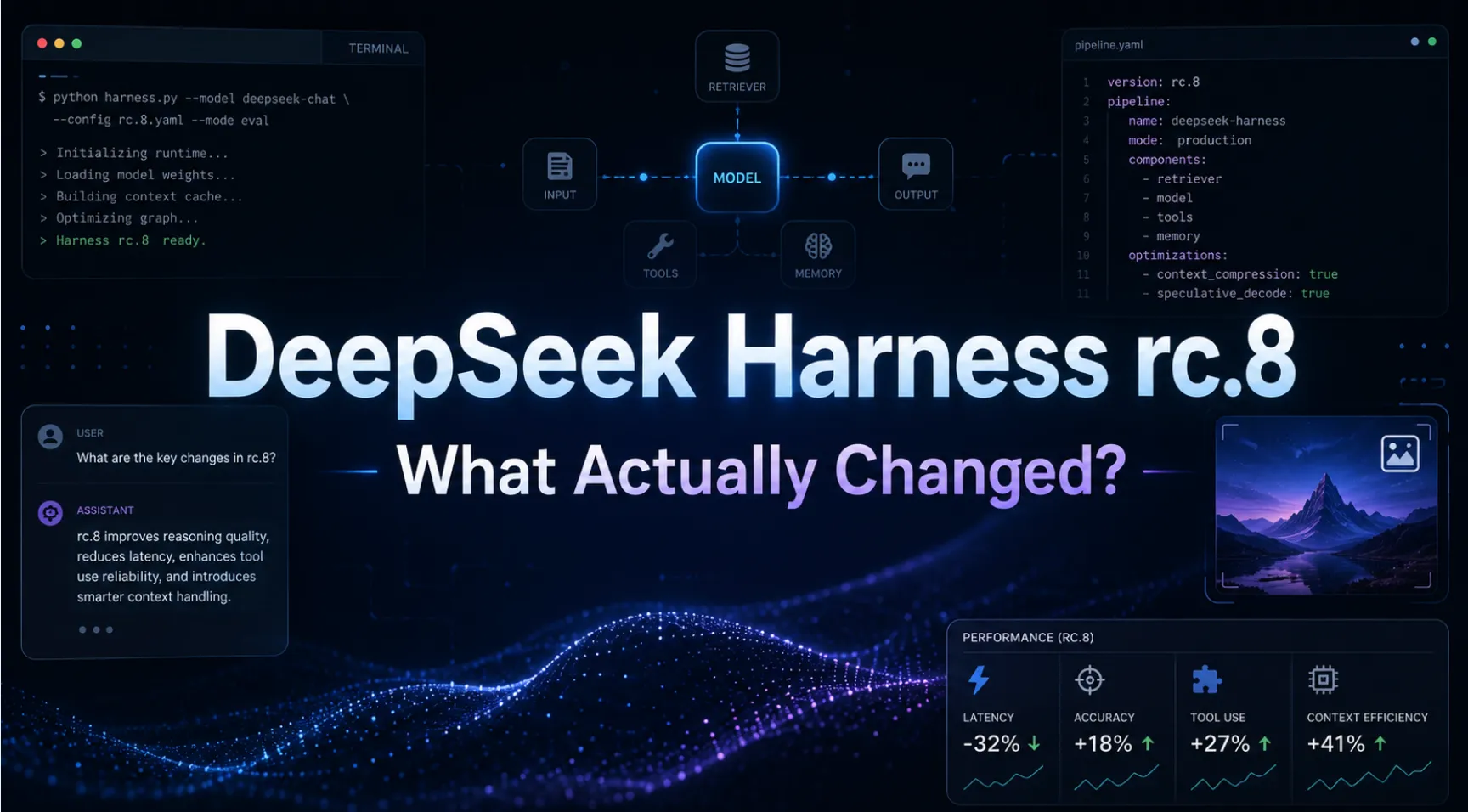
On August 20, the project released v0.1.0-rc.8, only two days after the previous release candidate. The update brings better multimodal handling, improved subagent support, Windows terminal fixes, faster tool calls, and a number of performance changes.
On paper, it looks like another fairly normal release.
But DeepSeek Harness is getting more attention among developers for a bigger reason: people are starting to ask whether the harness around a model matters almost as much as the model itself.
That makes rc.8 worth a closer look.
If you are new to the project, you can also check the official DeepSeek Harness introduction.
DeepSeek Harness Is More Than a Coding UI
DeepSeek describes the project with a simple idea:
Agent = Model + Harness
The model handles reasoning and generation. Harness handles everything around it: tools, terminals, planning, permissions, sessions, storage, subagents, and task execution.
Another core principle is “Everything is a Plugin.”
That means DeepSeek Harness is designed less like a fixed coding assistant and more like a modular Agent runtime.
This is also why developers keep comparing it with Claude Code, Codex, OpenCode, and similar tools.
The question is no longer only:
Which model is better?
It is also:
Which environment helps the model work better?
Early community discussions around DeepSeek models have already shown that the same model can feel noticeably different depending on the harness used around it.
Multimodal Support Gets Better
One of the biggest rc.8 changes is improved multimodal support.
The DeepSeek model adapter can now be configured for native image requests. Commands such as /goal and /plan support text-and-image input, while the @ menu can reference files and sessions more easily.
The update also fixes failures caused by oversized images or too much accumulated image data in longer conversations.
This makes Harness much better prepared for workflows involving screenshots, diagrams, UI mockups, and other visual inputs.
There is one important detail, though.
This does not mean DeepSeek V4 itself has suddenly become a native vision model.
DeepSeek's public API documentation still describes its own chat-completions route as text-only. The rc.8 change is better understood as improving the multimodal pipeline inside Harness, especially when users connect models or providers that support image input.
That distinction matters because DeepSeek Harness can work with more than just DeepSeek models. It also supports OpenAI, Anthropic, and compatible third-party endpoints.
In other words, Harness is becoming multimodal even when the model underneath it may vary.
Claude Code and Codex Can Now Work as Subagents
Another interesting change is how DeepSeek Harness treats other coding agents.
Claude Code and Codex can now be installed as Profile Bundles and used as subagents.
Codex also gains a non-interactive permission mode and support for multiple named instances.
This makes it easier to imagine workflows where one main Agent manages the task while several specialized subagents work on different parts of a repository in parallel.
The new reportDelivery behavior improves this further. A subagent can report its result back to the parent task when it finishes instead of forcing the parent to repeatedly check its status.
This is an important shift.
Claude Code and Codex are not necessarily just competitors to DeepSeek Harness. They can also become components inside a larger orchestration layer.
That said, early user feedback suggests that multi-agent workflows are still one of the rougher areas of the product. The architecture is promising, but DeepSeek Harness is still officially in developer preview.
Developers Are Watching Token Costs Closely
One topic that comes up frequently in overseas discussions is token usage and cache hit rate.
Agentic coding can consume huge amounts of context. The Agent may repeatedly read repository files, tool definitions, previous messages, plans, and tool outputs.
That means the efficiency of the harness can directly affect cost.
Some early DeepSeek Harness users have reported very high cache hit rates during long coding sessions, sometimes above 90%. These reports are anecdotal rather than controlled benchmarks, but they highlight an important point.
When comparing DeepSeek Harness with Claude Code, Codex, OpenCode, or another environment, simply comparing model prices is not enough.
A more useful test would compare:
- total input tokens
- cached versus uncached tokens
- output tokens
- completion time
- final task quality
using the same repository, model, and task.
A cheaper model can still become expensive if the surrounding Agent repeatedly sends unnecessary context.
Is DeepSeek Harness Better Than Claude Code or Codex?
Not yet in any universal sense.
Community feedback remains mixed.
Some users believe the official Harness gets more consistent results from DeepSeek models. Others still prefer Claude Code or Codex because their coding workflows feel more mature and predictable.
That is probably the right way to look at the market right now.
Claude Code and Codex are primarily polished coding products.
DeepSeek Harness is trying to become something broader: a programmable Agent runtime where models, tools, subagents, permissions, and workflows can all be swapped or extended.
It gives developers more flexibility, but flexibility also brings more configuration and more opportunities for things to break.
Windows Users Get a Useful Upgrade
Windows support also improves in rc.8.
DeepSeek Harness now supports persistent PowerShell sessions, with the feature enabled by default in the Minimal preset.
Previously, losing shell state between commands could make Windows workflows frustrating. Developers might repeatedly need to restore working directories, environment variables, virtual environments, or local services.
Persistent sessions make those workflows feel much closer to using a normal terminal.
There are still Windows-related edge cases appearing in community discussions, so this is an improvement rather than a sign that Windows support is completely finished.
Smaller Fixes That Matter in Daily Use
rc.8 also includes several quality-of-life improvements.
If a user cancels a streaming response, the part already generated can now remain available as context for follow-up questions or branched sessions.
OpenAI-compatible gateway support has also been improved, which should help developers using custom model providers or internal gateways.
The web_search tool now supports concurrent queries, reducing the time needed for multi-keyword research.
Running dsh web locally can also open the browser automatically, removing a small but repetitive setup step.
None of these changes is dramatic on its own, but together they make longer Agent sessions smoother.
Back Up Before Upgrading
One rc.8 change deserves special attention.
DeepSeek has optimized the SQLite backend to improve read/write performance, reduce storage size, and speed up session forking.
However, the updated storage format is not compatible with previous versions.
Existing indexes will be rebuilt after upgrading, and older workspace data may not migrate cleanly.
If you already use DeepSeek Harness for meaningful work, backing up important sessions or workspace data before upgrading is a good idea.
This is also a reminder that the project is still a developer preview. Breaking changes are expected.
DeepSeek Is Treating Harness as Its Own Product
DeepSeek has also published clearer branding rules around the project.
Developers can describe products as “built on DeepSeek Harness” or “compatible with DeepSeek Harness,” but unauthorized projects should not use the full trademark in their product names.
DeepSeek recommends using the abbreviation DSH when naming ecosystem projects.
This may sound like a minor legal detail, but it says something about DeepSeek's ambitions.
Harness is gradually being positioned as more than a side project attached to the DeepSeek models.
It is becoming its own platform.
Why rc.8 Matters
The most interesting part of rc.8 is not the PowerShell update, image support, or even subagents.
It is the direction they point toward.
DeepSeek appears to be treating the runtime around the model as a first-class product.
Models can be swapped. Tools can be added. Other coding agents can become subagents. Visual inputs can move through the same workflow. Sessions can be forked, replayed, and managed independently.
There are still plenty of rough edges, especially around compatibility, multi-agent reliability, token usage, and preview-version upgrades.
So DeepSeek Harness is probably not something every developer should move their entire workflow to today.
But it is becoming increasingly worth testing.
Because as Agent systems become more complex, the most important question may no longer be simply which model are you using?
It may be what is running around that model?