
DeepSeek released DeepSeek-V4-Flash-Vision-Exp, an experimental multimodal model available through its API. It accepts both text and images, bringing screenshot understanding, chart analysis, OCR-style tasks and other visual workflows into the V4 Flash family.
The benchmark numbers are getting most of the attention. DeepSeek says its multimodal agent performance is now close to Claude Opus 4.8.
But there is another part of the launch that may matter more to developers: a single image uses no more than 384 input tokens and is charged at the same token rate as V4 Flash.
For AI agents that need to repeatedly look at screenshots, interfaces or document pages, that could make visual workflows considerably cheaper.
What Is DeepSeek V4 Flash Vision Exp?
The new model is available through the API under:
deepseek-v4-flash-vision-exp
DeepSeek describes it as an experimental visual understanding model, rather than a replacement for the standard V4 Flash.
Its main change is straightforward: V4 Flash can now work with visual information directly.
Developers can send mixed text-and-image inputs through Chat Completions, Messages and Responses APIs. Images can be passed through Base64, external URLs or DeepSeek's new Files API.
This opens up workflows such as:
-
analyzing screenshots
-
understanding charts and diagrams
-
extracting information from document images
-
inspecting user interfaces
-
combining visual inputs with agent tools
-
letting coding agents review the interfaces they generate
DeepSeek says its pure-text capabilities remain roughly in line with the regular V4 Flash, while performance improves significantly on tasks that require visual understanding.
DeepSeek Says It Is Close to Claude Opus 4.8
One of the biggest claims in the announcement is the comparison with Anthropic's Claude Opus 4.8.
In DeepSeek's published multimodal agent evaluations, the two models trade wins rather than one consistently beating the other.
| Benchmark | DeepSeek V4 Flash Vision Exp | Claude Opus 4.8 |
|---|---|---|
| Agents' Last Exam | 27.3 | 25.7 |
| ZeroBench | 35.0 | 34.0 |
| ApexBench | 36.5 | 39.4 |
| Chartography | 64.3 | 65.0 |
DeepSeek leads on Agents' Last Exam and ZeroBench, while Opus 4.8 stays ahead on ApexBench and Chartography.
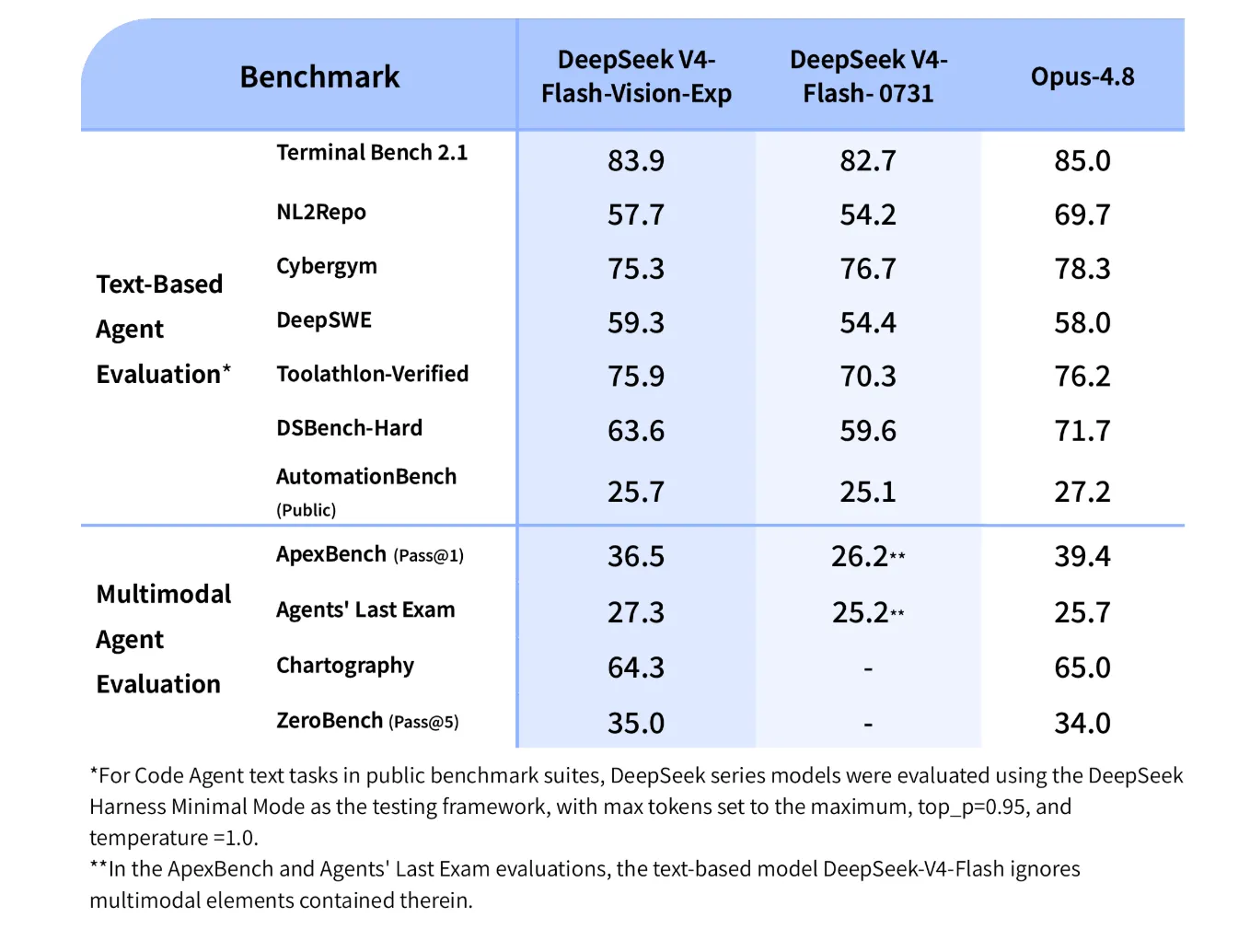
It should not, however, be read as proof that DeepSeek has matched Claude across every vision task. These are provider-published evaluations, and independent testing will still be needed for real-world OCR, small-text recognition, visual hallucinations, UI navigation and long-running agent tasks.
There is also an important timing detail: Opus 4.8 is no longer Anthropic's newest Opus model. Anthropic launched Claude Opus 5 on July 24, 2026, positioning it as an improvement over Opus 4.8 in coding and agentic work.
So the new DeepSeek model is being compared with a strong recent Claude model, but not Anthropic's latest generation.
The 384-Token Image Limit Is the More Interesting Part
Benchmarks make better headlines. The image-token design may have a bigger impact on actual applications.
DeepSeek converts images into tokens before inference, with each image capped at 384 tokens. Large images are automatically resized, which keeps their input cost predictable.
That matters because visual agents often need more than one image.
Imagine a browser agent completing a task across 30 different screens. A coding agent may repeatedly capture screenshots as it changes a UI. A document workflow might process dozens of scanned pages or charts.
In those situations, image-processing cost can accumulate quickly.
DeepSeek's approach makes repeated visual observations unusually lightweight from a token perspective.
The trade-off is resolution. Compressing a large screenshot into a limited visual token budget means very small text, dense spreadsheets or detailed diagrams may lose information. Cheap vision does not automatically mean perfect high-resolution vision.
That is one of the areas developers should test before relying on the model in production.
How Does It Compare With Gemini 3.7 Flash?
Google is another obvious comparison.
Gemini 3.7 Flash became generally available on August 13 and is currently Google's latest Flash model. It is natively multimodal and supports text, images, video, audio and PDFs, alongside built-in features such as function calling, code execution, Search grounding and computer use.
That makes the two Flash models slightly different propositions.
Gemini 3.7 Flash offers a broader multimodal and tool ecosystem.
DeepSeek V4 Flash Vision Exp currently looks more narrowly focused on bringing inexpensive image understanding into agent workflows.
The DeepSeek release therefore isn't necessarily about beating Gemini feature-for-feature. Its appeal is the combination of vision, agent capability and aggressive image-token efficiency.
For developers processing large volumes of screenshots or visual observations, that is an interesting positioning.
The New Files API Matters Too
DeepSeek also launched a Files API alongside the vision model.
Instead of sending the same image repeatedly, developers can upload it once and reference it later using a file_id. DeepSeek says the Files API itself is free and is designed to reduce bandwidth when the same image is reused across multiple requests.
That sounds like a small infrastructure feature, but it makes sense for agent workflows.
An agent may need to return to the same screenshot, diagram or source image several times while completing a longer task. Reusing an uploaded file makes that workflow cleaner and avoids repeatedly transferring the same data.
Where V4 Flash Vision Exp Could Be Useful
The most interesting applications go beyond asking, “What's in this picture?”
A coding agent could generate a webpage, inspect the screenshot and then fix layout problems.
A browser agent could look at an interface before deciding what action to take.
A business agent could interpret a dashboard or chart before triggering another workflow.
A document system could combine text extraction with visual understanding of tables, diagrams and scanned pages.
This is the broader shift happening across AI models: from models that simply see images to agents that can see, reason and act.
DeepSeek V4 Flash Vision Exp fits directly into that trend.
Should You Use It Now?
For experiments, absolutely.
For production workloads, more testing is needed.
The model still carries the “Exp” label, and DeepSeek itself describes it as experimental. Developers should pay particular attention to small-text recognition, dense interfaces, visual hallucinations and performance after automatic image resizing.
The bigger question is not whether DeepSeek has built the world's best vision model.
It's whether V4 Flash Vision Exp can deliver good-enough visual understanding at a cost that makes high-volume multimodal agents practical.
If it can, the 384-token image cap may end up being more important than the benchmark comparison that grabbed the headlines.
FAQ
What is DeepSeek V4 Flash Vision Exp?
DeepSeek V4 Flash Vision Exp is an experimental multimodal version of V4 Flash that supports text and image inputs through the DeepSeek API.
Does DeepSeek V4 Flash support images?
The regular V4 Flash remains a text-focused model. Developers can use deepseek-v4-flash-vision-exp when visual input is required.
How many tokens does one image use?
DeepSeek says an image can consume up to 384 input tokens, with larger images automatically resized before processing.
Is DeepSeek V4 Flash Vision Exp better than Claude Opus 4.8?
Not universally. In DeepSeek's published multimodal agent benchmarks, V4 Flash Vision Exp wins some tests while Opus 4.8 wins others. Independent real-world comparisons are still needed.
Is DeepSeek V4 Flash Vision Exp better than Gemini 3.7 Flash?
They currently target somewhat different strengths. Gemini 3.7 Flash supports a broader range of multimodal inputs and built-in tools, while DeepSeek's new model stands out for its low image-token ceiling and focus on multimodal agent workflows.