
DeepSeek V4 Pro is attracting attention for three headline numbers: 1.6 trillion total parameters, 49 billion active parameters, and a one-million-token context window. Those specifications are impressive, but they do not answer the most useful question: what work does the model make easier?
The answer is more specific than “anything involving a lot of text.” DeepSeek V4 Pro is designed for difficult reasoning, coding, knowledge, and agentic tasks in which a model must retain constraints and act across multiple steps. Its smaller sibling, V4 Flash, targets faster and more economical processing.
This guide explains the differences, separates advertised capacity from usable performance, and shows how to evaluate DeepSeek V4 Pro on real document, research, and agent workflows.
What is DeepSeek V4 Pro?
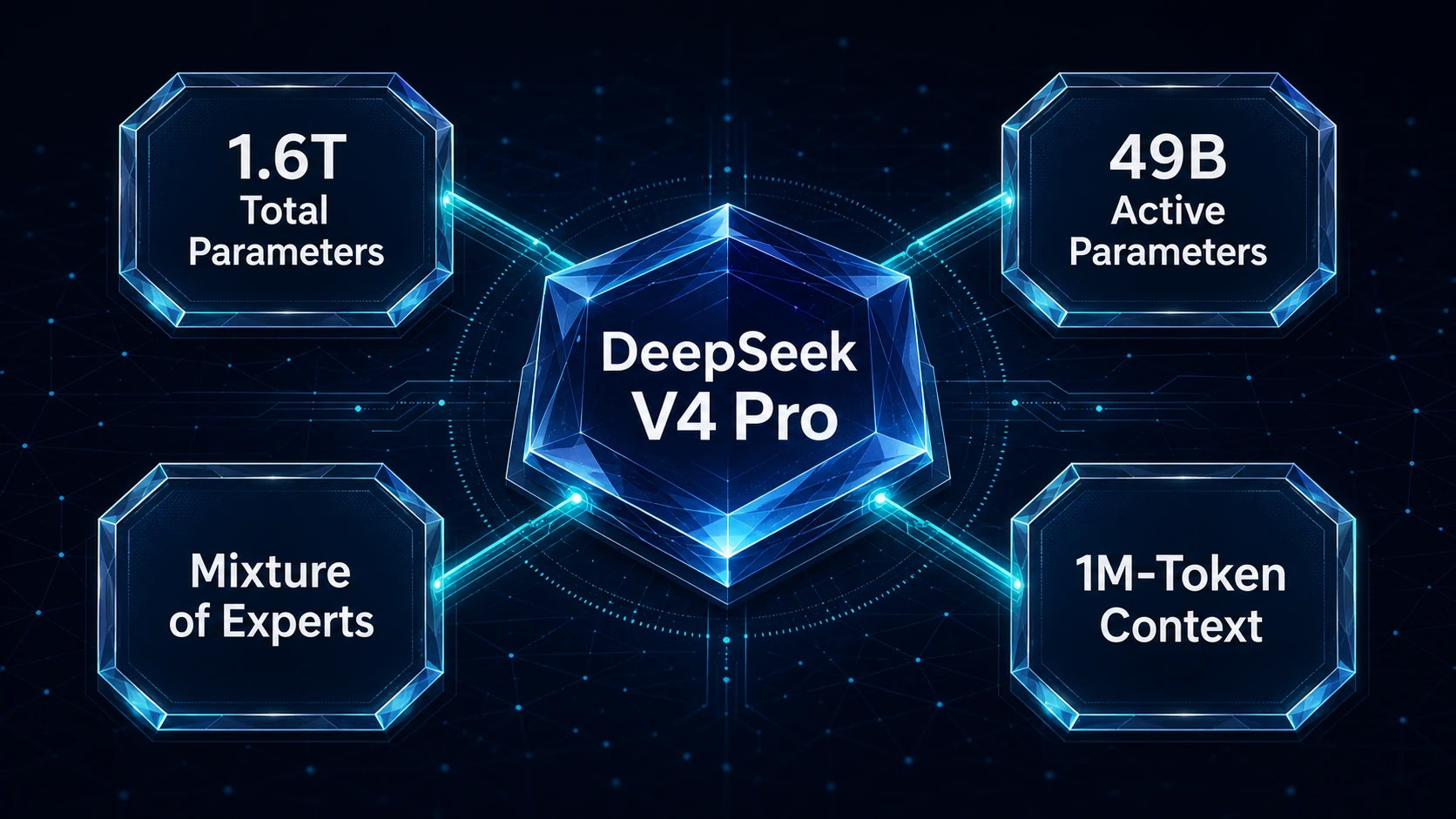
| Model | Total parameters | Active parameters | Context window | Best suited to |
|---|---|---|---|---|
| DeepSeek V4 Pro | 1.6T | 49B | 1M tokens | Complex reasoning, coding, knowledge, and agent tasks |
| DeepSeek V4 Flash | 284B | 13B | 1M tokens | Fast, high-volume, and simpler agent tasks |
In a Mixture-of-Experts architecture, only a portion of the total model is activated for each token. That design aims to provide broad model capacity without paying the full compute cost of all 1.6 trillion parameters on every inference step.
DeepSeek also uses token-wise compression and DeepSeek Sparse Attention to reduce the compute and memory burden of long-context processing. The company’s official V4 release documentation says both models support thinking and non-thinking modes, JSON output, tool calls, and OpenAI- and Anthropic-compatible API formats.
What is new in DeepSeek V4 Pro?
A one-million-token standard context window
The jump to one million tokens is the most visible change. In principle, it allows a single request to include a substantial codebase, multiple books, a collection of papers, or an extended project record.
But nominal context length and usable context are not the same thing. Long-context models must do more than retrieve one hidden fact. They must connect information across distant sections, identify conflicts, preserve instructions, and distinguish current material from outdated versions.
Independent long-context research has also found that models can perform well on simple “needle” retrieval while degrading on multi-hop reasoning at extreme lengths. The practical lesson is straightforward: do not evaluate V4 Pro by asking whether it accepts a huge prompt. Evaluate whether it produces a traceable answer from the right parts of that prompt.
Stronger agentic coding and tool use
DeepSeek positions V4 Pro as its stronger option for agentic coding. These tasks go beyond generating a code snippet. The model may need to inspect a repository, plan a change, edit multiple files, call external tools, interpret an error, and run a second attempt.
The official materials report strong performance across coding, mathematics, STEM, and agent benchmarks. Those results are useful indicators, but benchmark comparisons should be read with their harness, reasoning level, tool access, and token budget. A “Max” configuration may not behave like the default API setting or cost the same amount per successful task.
Thinking and non-thinking modes in one model
DeepSeek V4 Pro supports both modes through the same model. According to the Thinking Mode documentation, thinking is enabled by default and developers can control reasoning effort.
Use non-thinking mode for extraction, classification, rewriting, routing, and straightforward questions. Use thinking mode for multi-constraint planning, complex debugging, mathematical reasoning, or analysis that requires several dependent steps.
Sending every request through the highest reasoning setting can increase latency and token use without improving simple outputs. A task router is often more valuable than a one-model-for-everything policy.
Open weights and broad API compatibility
DeepSeek has published V4 model weights on Hugging Face. The API can also be called using OpenAI Chat Completions and an Anthropic-compatible interface, reducing integration work for teams with existing clients.
Open weights do not make the 1.6T model easy to run. Hardware, quantization quality, parallel inference, memory, and operations remain significant considerations. Most teams should validate the business case through an API before investing in self-hosting.
DeepSeek V4 Pro pricing
DeepSeek’s pricing page lists separate rates for cached input, uncached input, and output. At the time of review, the official table displayed the following promotional rates per one million tokens:
| Usage | V4 Pro price |
|---|---|
| Cached input | $0.003625 |
| Uncached input | $0.435 |
| Output | $0.87 |
Prices can change, so verify the official DeepSeek pricing page before publishing a comparison or forecasting spend.
The cached-input rate is particularly important for agents that reuse a long system prompt, stable code context, or the same document collection. Good prompt and cache design can affect costs as much as the model choice itself.
Still, token price is not the complete bill. Long contexts, maximum reasoning effort, repeated tool calls, and failed runs can multiply usage. Compare models using:
total model cost ÷ number of accepted task results
That measure captures both price and reliability.
DeepSeek V4 Pro benchmarks: how strong is it?
DeepSeek reports that V4 Pro leads open models across several reasoning, math, STEM, coding, knowledge, and agent evaluations while approaching top closed models. Its Hugging Face model page and technical report provide the detailed score tables.
An independent evaluation by the U.S. National Institute of Standards and Technology’s Center for AI Standards and Innovation found DeepSeek V4 Pro broadly comparable to GPT-5 in its test set. That result is useful because it adds an external perspective, but it still does not prove equal performance across every domain.
When reading benchmark comparisons, check five details:
- Was the result produced by the model developer or an independent evaluator?
- Which reasoning setting was used?
- Did the models have the same tools and token budgets?
- Was the score based on one attempt or several?
- Does the benchmark resemble your real task?
The last question matters most. A model that excels at software engineering may not be the best choice for factual research, multilingual writing, or document extraction.
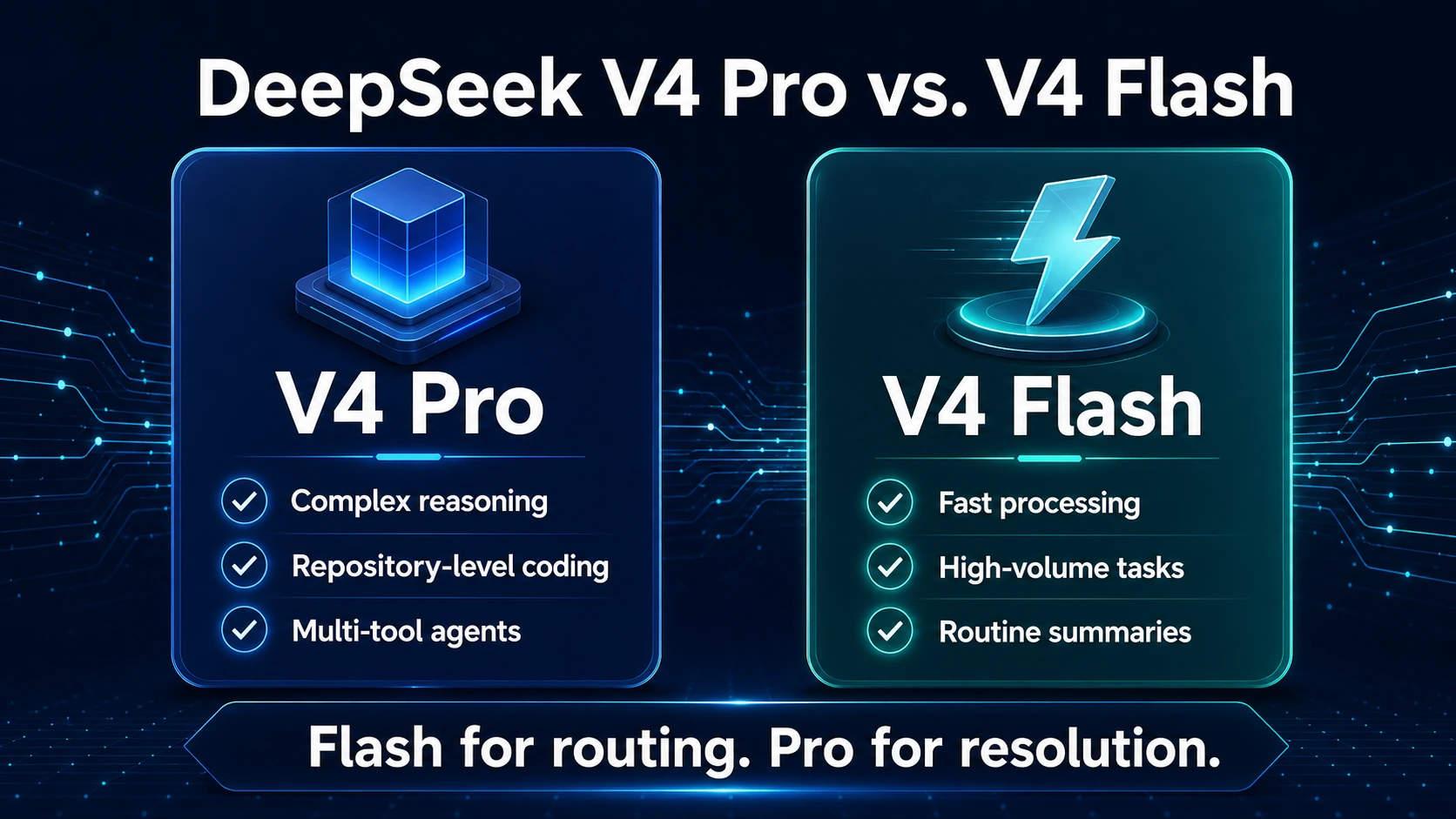
DeepSeek V4 Pro vs. V4 Flash: which should you use?
| Workload | Recommended approach | Why |
|---|---|---|
| Classification and extraction | V4 Flash | High volume and easy verification favor speed |
| Routine summaries | V4 Flash | Pro-level reasoning is usually unnecessary |
| Large document screening | Flash first, Pro for hard cases | A tiered workflow controls cost |
| Repository-level code changes | V4 Pro | Multi-step reasoning and recovery matter |
| Complex research synthesis | V4 Pro | Cross-source analysis is the core task |
| High-concurrency agents | Test both | Throughput, retries, and task cost decide the winner |
| High-stakes material | V4 Pro plus expert review | A stronger model does not remove the need for validation |
A practical pattern is Flash for routing, Pro for resolution. Let V4 Flash classify the request, extract structure, and identify uncertainty. Escalate only the difficult portion to V4 Pro.
Four practical uses for the 1M-token context window
1. Analyze a software repository
Combine architecture documents, relevant modules, test failures, and logs. Ask the model to trace dependencies before proposing changes. Verify every cited file and run the tests after modification.
2. Compare a body of research
Process papers and technical reports together to identify agreement, conflicting methods, and evidence gaps. Require source-level references in the output; never accept a generated citation without opening the original paper.
3. Review a long-running project
Bring together dated meeting notes, requirement changes, decisions, and status reports. Ask V4 Pro to identify changed assumptions and unresolved actions. Remove duplicates and clearly label document dates first.
4. Inspect contracts and policy collections
Compare clauses, attachments, and policy versions to surface inconsistencies or missing language. AI can accelerate review, but its output is not legal advice and should not replace qualified counsel.
The limitations that 1M-context headlines miss
First, more context can amplify poor data. Duplicate files, stale drafts, and unclear source labels make a confident but incorrect synthesis more likely.
Second, output quality may decline as a task becomes more diffuse. A focused 100,000-token collection can outperform an unstructured one-million-token dump.
Third, benchmark performance depends on configuration. The strongest published score may use a high reasoning setting and a specialized agent harness that differs from your production environment.
Finally, open-weight deployment is a separate engineering problem. The model’s size means that “available to download” and “economical to serve privately” are very different claims.
Turn long context into organized knowledge with iWeaver
The most reliable long-document workflow begins before the model prompt. Sources need to be collected, deduplicated, labeled, and reduced to material evidence.
iWeaver helps knowledge workers transform documents, webpages, and research material into structured summaries, key points, and reusable outputs. For academic or technical material, the AI Paper Summarizer can extract research questions, methods, and findings before a deeper cross-paper comparison.
This creates a clearer division of work:
- iWeaver organizes the source material;
- a reasoning model analyzes the structured evidence;
- a person verifies citations and approves consequential conclusions.
In that workflow, the value of a million-token context window is not that it can absorb everything. It is that it can work across a well-prepared evidence set without losing the larger picture.
Is DeepSeek V4 Pro worth using?
DeepSeek V4 Pro belongs on the evaluation list for complex code work, long-document analysis, research synthesis, and multi-tool agents. V4 Flash is likely the better default for high-volume summaries, rewriting, extraction, and straightforward automation.
Before replacing an existing model, run 20 to 50 representative tasks and record first-pass success, manual correction time, latency, and cost per accepted result. If V4 Pro reduces failures and review work enough to justify its higher usage, it is a meaningful upgrade. If not, its benchmark lead may have little operational value.
If your priority is less about coding benchmarks and more about conversational freedom, XPT offers a more open-ended AI chat experience with fewer unnecessary refusals.
Frequently asked questions
How large is DeepSeek V4 Pro’s context window?
DeepSeek lists a one-million-token context window for both V4 Pro and V4 Flash. Check current API documentation for maximum output and request-specific limits.
Is DeepSeek V4 Pro open source?
DeepSeek has released open model weights on Hugging Face. Review the latest repository license and usage terms before modifying or deploying the model.
Is V4 Pro always better than V4 Flash?
No. V4 Pro is aimed at harder reasoning and agentic tasks. V4 Flash can be faster and less expensive for simpler or high-volume workloads.
Can I upload an entire knowledge base into the 1M context window?
The model can accept a large collection, but raw capacity does not guarantee accurate synthesis. Deduplicate files, label sources and dates, and define a focused task first.
Can DeepSeek V4 Pro replace human review?
No. It can accelerate research, coding, and document analysis, but experts should verify important citations, code changes, and high-stakes conclusions.