
Google is moving fast with Gemini.
On September 2, Google released Gemini 3.8 Flash, just three weeks after Gemini 3.7 Flash.
This is not simply another small Flash update.
Google is pushing the model further into long-horizon coding, autonomous AI agents, complex reasoning, and enterprise workflows while trying to keep the speed and cost advantages that made Flash useful in the first place.
So what actually changed, and is Gemini 3.8 Flash worth using?
What Is Gemini 3.8 Flash?
Gemini 3.8 Flash is Google's latest general-purpose Flash model.
It is designed mainly for:
- software engineering
- AI agents
- multi-step reasoning
- knowledge work
- multimodal understanding
- high-volume AI applications
The model accepts text, images, video, audio, and PDFs as input.
It also supports a 1,048,576-token input context window and up to 65,536 output tokens, making it suitable for large codebases, long documents, and workflows that need to keep a lot of information in context.
Google also offers low, medium, and high thinking levels, giving developers more control over the balance between reasoning quality, latency, and cost.
What’s New in Gemini 3.8 Flash?
The simplest way to describe the update is this:
Gemini 3.8 Flash is willing to work harder on difficult tasks.
On complex requests, the model can take additional reasoning steps, call tools repeatedly, check its progress, and refine its answer instead of rushing toward a result.
That matters most when a task cannot be solved with a single prompt.
Better Long-Horizon Coding
Coding is one of the biggest upgrades in Gemini 3.8 Flash.
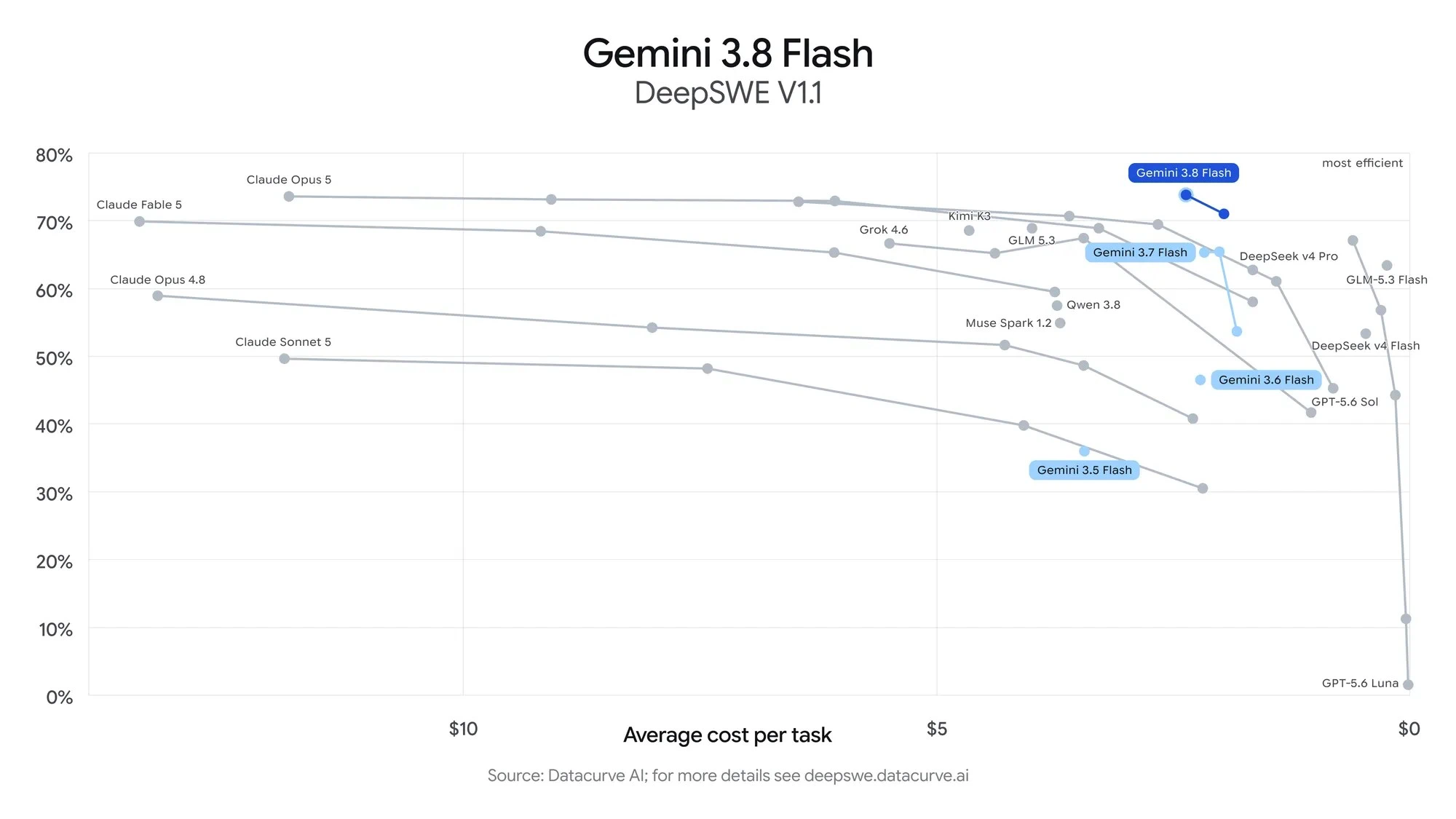
Google highlights DeepSWE v1.1, a benchmark designed around original, long-horizon software engineering tasks rather than short code-generation prompts.
In DataCurve's current leaderboard, Gemini 3.8 Flash at high effort reaches about 74% task performance, with an average cost of around $2.36 per task.
The cost-performance balance is especially interesting.
Claude Opus 5 reaches a similar result on the current leaderboard at around 74%, but with an average cost of about $11.84 per task. GPT-5.6 Sol scores around 73% at roughly $6.46 per task.
That does not mean Gemini will always be cheaper in every coding workflow, but it shows why Google is positioning 3.8 Flash as a model for agentic coding at scale.
Real software development rarely means generating one isolated function.
An AI coding agent may need to:
- inspect an existing repository
- understand dependencies
- modify several files
- run tests
- identify failures
- revise the code
- confirm that the final result works
Gemini 3.8 Flash is being optimized for exactly this kind of longer workflow.
Stronger AI Agents
The same improvement applies to AI agents.
A useful agent needs to do more than answer one question correctly. It may need to search, read files, call APIs, execute code, compare results, and keep track of the original goal across dozens of steps.
Google describes Gemini 3.8 Flash as a model built for autonomous agents and complex enterprise workflows. It supports tools including:
- function calling
- code execution
- file search
- Google Search grounding
- URL context
- computer use in preview
This makes 3.8 Flash increasingly relevant for workflows where AI is expected to actually complete work rather than just generate text.
Better Multi-Step Reasoning
Reasoning is another area where Gemini 3.8 Flash moves forward.
On HLE-Verified, a benchmark focused on multidisciplinary expert reasoning, Gemini 3.8 Flash scores 54.9%.
That puts it slightly ahead of several frontier models in Google's published comparison:
- Gemini 3.8 Flash: 54.9%
- GPT-5.6 Sol: 54.5%
- Claude Opus 5: 54.4%
- Gemini 3.7 Flash: 53.6%
- GPT-5.6 Terra: 51.1%
- Claude Sonnet 5: 31.0%
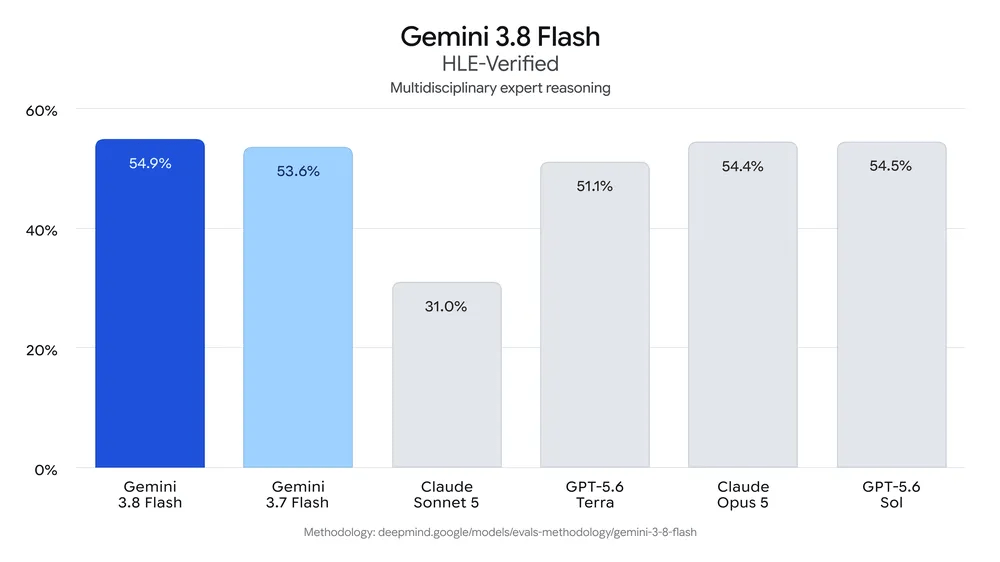
The difference between 53.6% and 54.9% may not look dramatic on its own.
What matters more is that Google is getting this level of reasoning from a Flash model designed around lower latency and scalable deployment.
That makes 3.8 Flash more interesting for research, analysis, finance, legal workflows, and other tasks where a model needs to work through several connected steps before producing an answer.
Gemini 3.8 Flash vs Gemini 3.7 Flash
For simple questions, the difference between 3.7 and 3.8 may not always feel huge.
The upgrade becomes more noticeable as tasks get longer and more complicated.
| Feature | Gemini 3.7 Flash | Gemini 3.8 Flash |
|---|---|---|
| Everyday questions | Fast | Fast |
| Long-horizon coding | Strong | Improved |
| AI agents | Capable | More persistent |
| Complex reasoning | Strong | Improved |
| Tool use | Supported | More agent-focused |
| Context window | 1M | 1M |
| Maximum output | 64K | 64K |
| Best for | Speed-first workloads | Complex agentic workloads |
Google's model card also points out one important trade-off: at higher effort levels, Gemini 3.8 Flash may sometimes use more tokens in order to maximize performance. So 3.8 is not automatically the better option for every simple task.
If your main goal is minimizing token use on straightforward requests, an older Flash model may still make sense.
How Much Does Gemini 3.8 Flash Cost?
Gemini 3.8 Flash launched at the same introductory API price as Gemini 3.7 Flash:
- Input: $0.75 per 1 million tokens
- Output: $3.75 per 1 million tokens
However, price per token is only one part of the cost equation.
Because Gemini 3.8 Flash can perform additional reasoning and tool calls on difficult tasks, a complex job may consume more tokens than it would with a lower-effort model.
The better question is therefore not simply:
Which model has the lowest token price?
It is:
How much does it cost to successfully complete the whole task?
The DeepSWE results are useful for exactly this reason. They compare task performance with actual average cost rather than looking only at API pricing.
There is also an upcoming pricing change to keep in mind.
Google says the current introductory pricing expires on December 31, 2026. Starting January 1, 2027, pricing is scheduled to increase to:
- Input: $1.50 per 1 million tokens
- Output: $7.50 per 1 million tokens
Developers planning large-scale deployments should factor that into longer-term cost calculations.
What Is Gemini 3.8 Flash Cyber?
Google also released a second model alongside Gemini 3.8 Flash: Gemini 3.8 Flash Cyber.
This is a specialized cybersecurity model designed for areas such as:
- vulnerability discovery
- vulnerability research
- code security
- automated patching
Unlike the standard Flash model, Gemini 3.8 Flash Cyber is currently being provided to approved trusted defenders through Google's Fairwind Program.
Its CyberGym results are particularly notable.
On CyberGym Pass@1, which evaluates autonomous vulnerability discovery in C/C++ code, Gemini 3.8 Flash Cyber scores 86.2%.
That compares with:
- Gemini 3.8 Flash Cyber: 86.2%
- GPT-5.5-Cyber: 85.6%
- Mythos 5: 83.8%
- GPT-5.6 Sol: 83.6%
- Gemini 3.5 Flash Cyber: 77.5%
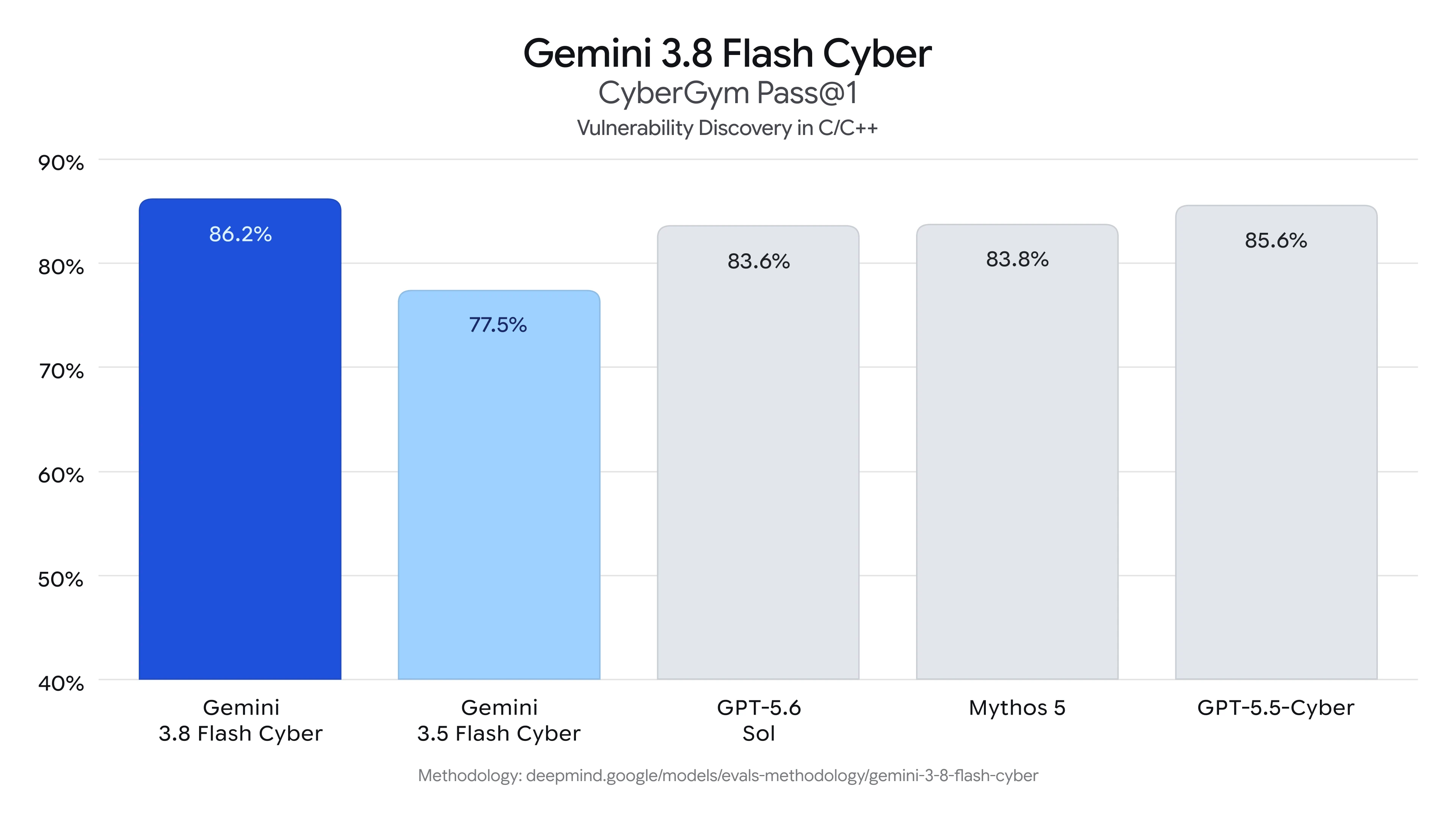
The jump from 77.5% with Gemini 3.5 Flash Cyber to 86.2% with 3.8 Flash Cyber is substantial.
Google also tested the model internally across complex codebases covering 20 programming languages, where it achieved a vulnerability-discovery success rate above 70%.
The Cyber version is not simply a security setting inside regular Gemini 3.8 Flash.
It is a separate specialized model with more permissive cybersecurity capabilities and tighter access controls.
For regular users, the bigger takeaway is that cybersecurity training appears to be contributing to the shared coding and reasoning improvements behind the Gemini 3.8 generation. Google says both variants are powered by the same foundational intelligence. Where Can You Use Gemini 3.8 Flash?
Gemini 3.8 Flash is already generally available.
Developers can use it through:
- Gemini API
- Google AI Studio
- Google Antigravity
- Android Studio
Enterprise users can access it through Gemini Enterprise, while Google AI Pro and Ultra subscribers can use 3.8 Flash across products including the Gemini app and AI Mode in Google Search.
For API users, the model ID is: gemini-3.8-flash
Want to try it yourself? Use Gemini 3.8 Flash for free with iWeaver and see how it handles your documents, research, and everyday AI tasks.
Who Should Try Gemini 3.8 Flash?
Gemini 3.8 Flash looks most useful if your work involves:
- coding across larger repositories
- autonomous coding agents
- multi-step research
- large documents
- complex analysis
- tool-heavy AI workflows
- multimodal inputs
- enterprise automation
If you mainly use AI for short rewriting, translation, or simple Q&A, the jump from Gemini 3.7 Flash may feel smaller.
But for longer jobs, 3.8 Flash is much more interesting.
The key change is not simply that the model gives a better first answer.
It is becoming better at staying with a difficult task until the work is done.
What About Research and Knowledge Work?
A powerful model is only one part of a useful AI workflow.
If your work starts with PDFs, research papers, reports, websites, videos, or large collections of source material, tools such as iWeaver can help organize that information before deeper analysis.
Instead of repeatedly uploading the same sources into different chats, you can turn them into summaries, structured notes, mind maps, and reusable knowledge, then continue working from that foundation.
For open-ended brainstorming, storytelling, roleplay, or creative conversations where you want fewer unnecessary interruptions, XPT takes a different approach and focuses more on flexible AI conversations.
As models become more capable, the question is becoming less about finding one AI that does everything.
It is increasingly about choosing the right model and workflow for the job.
Is Gemini 3.8 Flash Worth It?
For coding and AI agents, yes, it is one of Google's most interesting Flash updates so far.
The three benchmark areas tell a fairly consistent story:
- DeepSWE shows stronger long-horizon software engineering at a competitive task cost.
- HLE-Verified shows Flash-level models getting closer to larger frontier models on expert reasoning.
- Gemini 3.8 Flash Cyber shows how far the same generation has moved in specialized coding and security tasks.
Benchmarks are never the same as real-world performance, and Gemini 3.8 Flash still has familiar limitations such as hallucinations, occasional slowdowns, and potentially higher token use at stronger reasoning settings.
But the direction is clear.
Flash is no longer just Google's fast, lightweight option.
With Gemini 3.8 Flash, it is increasingly becoming a model built to handle real, multi-step work at scale.