
Google has introduced Gemini 4 Carbon, its latest frontier AI model. Arriving just two weeks after Gemini 4 Argon's broader rollout, Carbon brings notable improvements in complex reasoning, coding, cybersecurity, and long-running AI agent tasks.
The headline result is a score of 59 on the Artificial Analysis Intelligence Index v5.0, putting Gemini 4 Carbon ahead of Claude Opus 5.5 and GPT-6 Astra in that evaluation.
But there's an important catch: despite the impressive benchmark results, Gemini 4 Carbon is not yet generally available.
Here's what Google has announced, how Carbon compares with other leading AI models, what it costs, and when users can expect access.
What Is Gemini 4 Carbon?
Gemini 4 Carbon is Google's newest frontier AI model, developed by Google DeepMind as a more capable successor to Gemini 4 Argon.
Its main focus is handling difficult tasks that require sustained reasoning, multiple steps, and reliable execution.
Unlike AI models primarily optimized for short conversations or quick responses, Carbon is designed for workloads that can continue over extended periods.
Google reports that its internal teams have used Carbon for engineering tasks lasting several days, including investigating complicated software bugs and developing fixes across large codebases.
The model also offers improvements in:
-
Advanced reasoning: Working through difficult problems involving multiple dependencies.
-
Agentic coding: Planning, writing, debugging, and improving code across multiple steps.
-
Cybersecurity: Identifying vulnerabilities, assessing risks, and generating software patches.
-
Multimodal understanding: Processing different types of input, including text, images, audio, and video.
-
Long-running AI agents: Continuing complex workflows while following user instructions and project constraints.
According to Artificial Analysis, Carbon supports a context window of approximately one million tokens, making it suitable for evaluating extensive source materials and complex technical contexts.
Gemini 4 Carbon Benchmarks: How Powerful Is It?
One of the biggest reasons Gemini 4 Carbon is attracting attention is its performance against other leading AI models.
According to the updated Artificial Analysis Intelligence Index v5.0, Carbon currently occupies the top position.
Gemini 4 Carbon vs Claude Opus 5.5 vs GPT-6 Astra
| AI Model | Intelligence Index v5.0 |
|---|---|
| Gemini 4 Carbon (High) | 59 |
| Claude Opus 5.5 (Max) | 58 |
| GPT-6 Astra (Max) | 57 |
| Gemini 4 Argon (High) | 50 |
Source: Artificial Analysis and Google DeepMind, October 28, 2026. Scores refer to the reported reasoning configurations.
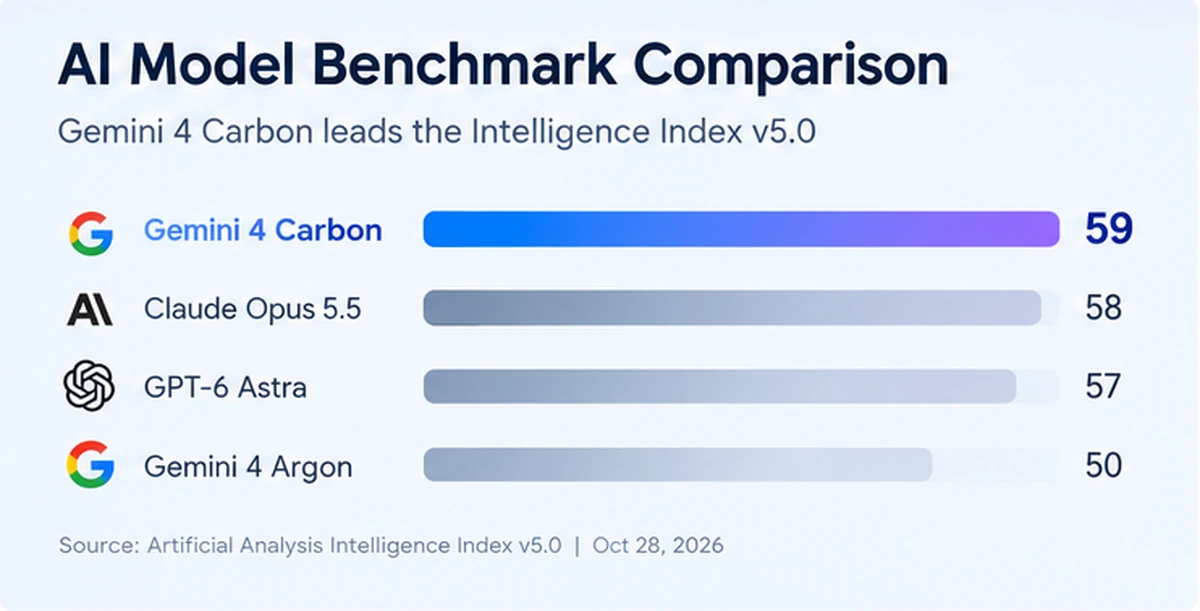
Artificial Analysis reports that Carbon leads four of the index's nine component evaluations, with particularly strong results in reasoning, scientific tasks, and knowledge-related assessments.
However, the overall ranking should not be interpreted as proof that Carbon wins every individual task.
For example, Artificial Analysis ranks Claude Opus 5.5 ahead of Carbon on its Coding Agent Index. Other models also retain advantages on specific software engineering and computer-use evaluations.
The practical conclusion is that Carbon performs particularly well across a broad range of difficult tasks, but choosing the right model still depends on the work being done.
What's New in Gemini 4 Carbon?
1. Better Performance on Long-Running AI Agent Tasks
A major improvement in Gemini 4 Carbon is its ability to handle tasks that cannot be completed in a single response.
Many real-world workflows involve several stages. An AI assistant may need to examine information, identify missing details, test possible solutions, revise its approach, and produce a final result.
These workflows become more difficult as the number of steps increases.
Google says Carbon is better equipped to persist through unsuccessful attempts and complete complex engineering tasks without losing track of the original objective.
This matters for AI agents working on large software projects, multi-stage research, and other tasks where following a plan is as important as generating an answer.
2. Major Improvements in Cybersecurity
Cybersecurity is one of the most distinctive areas of Gemini 4 Carbon's release.
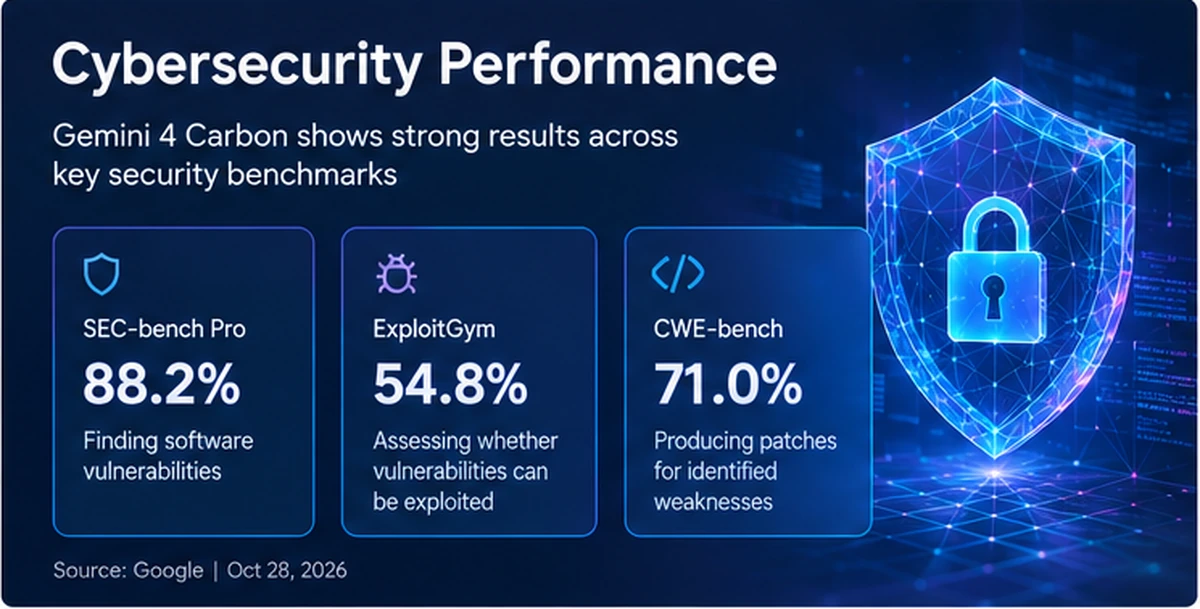
| Cybersecurity Benchmark | Gemini 4 Carbon Result | What It Measures |
|---|---|---|
| SEC-bench Pro | 88.2% | Finding software vulnerabilities |
| ExploitGym | 54.8% | Assessing whether vulnerabilities can be exploited |
| CWE-bench | 71.0% | Producing patches for identified weaknesses |
Source: Google's October 28 announcement. These are reported benchmark results, not guarantees of performance in production environments.
Google also reports that Carbon achieved more than twice the secure-code generation success rate of Argon in its internal tests.
This could be important for developers and security teams seeking to automate portions of code review, vulnerability assessment, and remediation.
However, cybersecurity evaluations are especially sensitive to testing conditions. The results do not mean that Carbon can automatically secure an entire application or replace professional security reviews.
3. More Reliable Coding and Problem-Solving
Carbon is designed to work on software engineering problems that require more than generating individual code snippets.
For instance, fixing a subtle bug in a large application may require understanding the surrounding code, identifying dependencies, testing assumptions, and checking whether the proposed fix introduces other problems.
Google reports improvements in these kinds of extended coding workflows.
Carbon also reached 1,769 Elo on WebDev Arena, placing fourth in the ranking reported at launch.
These results suggest meaningful progress, although coding benchmarks measure different abilities and do not always predict performance on a particular development project.
4. Stronger Instruction Following and Safety
Google has also focused on reducing problems that occur when AI agents operate for long periods.
In internal evaluations, the company reports that Carbon:
-
Reduced unsupported claims by approximately 50% compared with Argon.
-
Reduced cases where the model exceeded its assigned scope by 26%.
-
Reduced cases where it failed to complete appropriate parts of a task by 29%.
-
Achieved a 0% attack success rate in the evaluated Gray Swan indirect prompt-injection benchmark.
These figures are promising, but the distinctions between different evaluations matter.
For example, Artificial Analysis found that Carbon improved accuracy on its AA-Omniscience evaluation while its measured hallucination rate increased from 4% for Argon to 11% for Carbon.
That does not necessarily contradict Google's findings because the evaluations measure different behaviors. It does demonstrate why a single reliability statistic cannot describe every situation.
Users should continue checking important outputs against reliable sources, particularly when working with financial documents, security-sensitive systems, or scientific research.
Gemini 4 Carbon vs Gemini 4 Argon: What's the Difference?
Gemini 4 Carbon builds on the foundation established by Gemini 4 Argon, but the improvements go beyond general reasoning performance.
| Feature | Gemini 4 Carbon | Gemini 4 Argon |
|---|---|---|
| Announcement | October 28, 2026 | September 30, 2026 |
| Intelligence Index v5.0 | 59 | 50 |
| Main emphasis | Advanced reasoning, cybersecurity, long-running agents | General frontier reasoning and complex workflows |
| Secure-code generation | More than 2x Argon's success rate in Google's internal tests | Baseline for Google's comparison |
| General availability | Limited initial rollout | Broader availability |
| Standard API pricing | $4 input / $20 output | $4 input / $20 output |
Pricing is per million tokens. Carbon's announced introductory rates are lower, as explained below.
The most meaningful difference is not simply that Carbon scores higher.
Carbon places greater emphasis on completing difficult multi-stage tasks and maintaining reliable behavior when working on complex systems.
For developers, that could make it attractive for long-running coding agents and security workflows. For researchers and business users, improvements in reasoning and information handling may also be useful once the model becomes broadly accessible.
If you're already using Argon, you can explore our Gemini 4 Argon comparison guide to understand where the existing model fits different workflows.
Gemini 4 Carbon Pricing: How Much Does It Cost?
Google has announced introductory API pricing for Gemini 4 Carbon, matching the initial pricing offered for Argon.
| Token Type | Introductory Price | Standard Price |
|---|---|---|
| Input tokens | $2 / 1M | $4 / 1M |
| Output tokens | $10 / 1M | $20 / 1M |
| Cached input tokens | 95% discount | 95% discount |
The introductory pricing represents a 50% discount relative to the standard rates.
Google has not confirmed when the introductory period will end.
Importantly, these are announced API prices, not proof that developers can already access Carbon through a public API.
Actual usage costs will also depend on the number of tokens processed, the amount of generated output, caching, and the configuration of the application.
For AI agents that process large amounts of context or perform extended tasks, the total cost per completed task may be more useful than the input-token price alone.
Gemini 4 Carbon Release Date: When Can You Use It?
Google officially announced Gemini 4 Carbon on October 28, 2026.
However, its announcement date and public availability date are not the same.
Google says the initial rollout begins with a limited group of cybersecurity defenders, followed by additional trusted partners through its Fairwind Program.
The company plans to expand access to developers, businesses, and consumers after further evaluation and refinement of its safeguards.
As of October 29, 2026:
-
Gemini 4 Carbon has been officially announced.
-
Initial access is limited to selected participants.
-
General availability has not been announced.
-
Google has not provided a confirmed public release date.
Users should refer to Google's official Gemini announcements for changes in availability rather than assuming Carbon is already accessible in every Gemini product.
What Could Gemini 4 Carbon Mean for AI Productivity?
Although much of Google's announcement focuses on coding and cybersecurity, the model's progress also raises interesting questions about everyday AI workflows.
More capable reasoning models may help make multi-step tasks more practical, especially when work involves reviewing substantial amounts of information.
Consider three examples.
Research and Document Analysis
Researchers often work with multiple papers, technical reports, and supporting documents.
An effective AI workflow needs to do more than summarize each source independently. It should distinguish findings from interpretations, compare conflicting evidence, and preserve references to the original material.
Better long-horizon reasoning could support these tasks, although Carbon's effectiveness in specific research workflows still needs to be tested.
Financial and Business Research
Business analysis frequently requires combining information from reports, spreadsheets, and supporting documents.
The challenge is not only processing a large volume of material but also retaining the relationships between figures, assumptions, and conclusions.
Advances in long-context reasoning and instruction following could help AI agents produce more consistent analyses, provided the results are checked against the underlying evidence.
Multi-Step Knowledge Work
Many professional workflows involve gathering information, making comparisons, drafting an output, and revising it after reviewing feedback.
Models that handle dependencies and project constraints more reliably may reduce the amount of manual correction required.
However, model intelligence and workflow design are different things. Even a highly capable model benefits from well-organized source material, clear instructions, and verification steps.
Organize Your Research with iWeaver
While Gemini 4 Carbon's broader rollout is still pending, you can work with existing AI tools to make information-heavy tasks easier to manage.
For example, iWeaver's AI PDF Summarizer helps turn long research papers, reports, and other PDF documents into structured summaries and key points.
You can also use Chat with PDF to ask questions about documents, locate specific information, and compare details across multiple sources.
The goal is straightforward: keep your research organized and your conclusions connected to the documents behind them.
Frequently Asked Questions About Gemini 4 Carbon
Is Gemini 4 Carbon officially released?
Google officially announced Gemini 4 Carbon on October 28, 2026. Its initial rollout is limited to selected cybersecurity defenders and trusted partners. It is not yet generally available.
Is Gemini 4 Carbon better than Gemini 4 Argon?
Carbon scores 59 on the Artificial Analysis Intelligence Index v5.0, compared with Argon's 50. Google also reports improvements in secure coding, cybersecurity, and long-running agent tasks. Whether Carbon is better for a particular workflow requires task-specific evaluation.
Is Gemini 4 Carbon better than GPT-6 Astra?
Gemini 4 Carbon leads GPT-6 Astra on the Artificial Analysis Intelligence Index v5.0, scoring 59 versus 57. However, GPT-6 Astra performs better on certain individual evaluations, including FrontierSWE 2. Neither model is the universal winner across every task.
Is Gemini 4 Carbon free?
Google has not announced a generally available free-access option for Carbon. Its announced introductory API pricing starts at $2 per million input tokens and $10 per million output tokens. Public access and consumer pricing have not been fully detailed.
Does Gemini 4 Carbon support multimodal input?
Artificial Analysis lists text, image, video, and speech input support, with text output and an approximately one-million-token context window. Availability of these features through specific Google products may depend on the eventual rollout.
Can I use Gemini 4 Carbon in Google AI Studio?
As of October 29, 2026, Google has not announced general public access to Gemini 4 Carbon in AI Studio. Developers should check official availability updates before planning integrations.
Can Gemini 4 Carbon replace cybersecurity professionals?
No. Its reported benchmark gains suggest potential value in assisting with vulnerability detection, assessment, and patching, but production security work still requires authorization, validation, and professional oversight.
Why Gemini 4 Carbon Matters
Gemini 4 Carbon arrives at a time when the AI industry is increasingly focused on models that can carry out extended tasks rather than simply respond to individual prompts.
Its lead on the Artificial Analysis Intelligence Index v5.0 is notable, but the more interesting developments may be its improvements in cybersecurity, multi-step engineering, and long-running agent behavior.
The remaining question is how consistently those improvements translate into real workflows once more developers and businesses have access.
For now, Carbon looks like an important step in Google's frontier-model development. Its broader impact will become clearer when independent users can test it across everyday professional tasks.