
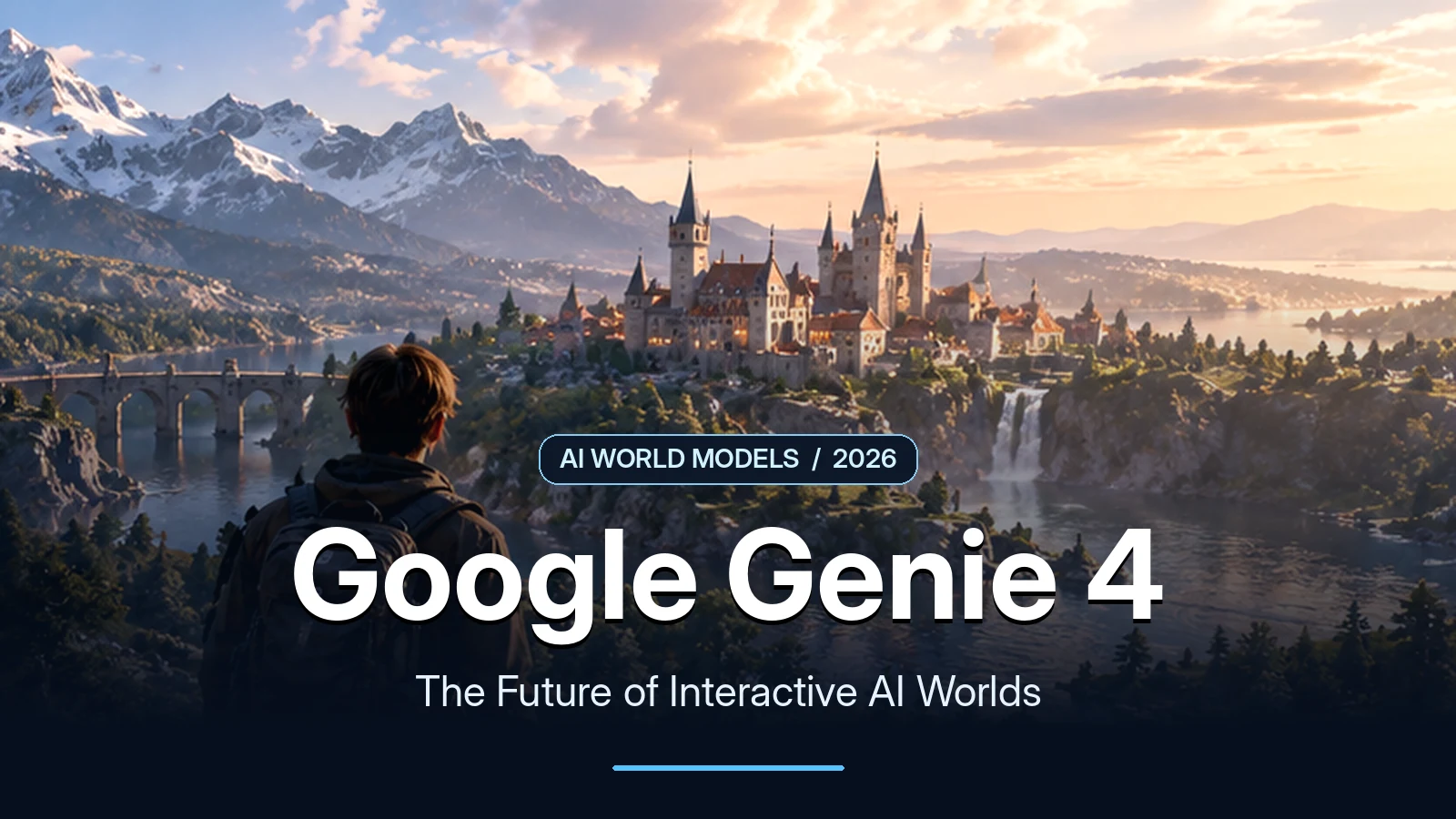
Google DeepMind has introduced Genie 4, its latest AI world model, bringing real-time world simulation closer to the experience of exploring a living, interactive environment. Genie 4 combines photorealistic visuals, realistic physics, native audio, and natural language controls to create virtual worlds that respond as users interact with them.
Unlike conventional AI video generators, which produce predetermined sequences, Genie 4 allows users to explore and modify a generated environment while it is running. A scene can change in response to a new instruction, a character can react to an unexpected event, and the surrounding world can evolve along with the user's actions.
The announcement is significant for more than visual content creation. Google sees world models as an important foundation for training intelligent agents, testing robots, and developing AI systems that can understand how actions affect physical environments.
Here's what Genie 4 can do, how it compares with Genie 3, and what users should know about accessing the new model.
What Is Google Genie 4?
Google Genie 4 is a generative AI world model developed by Google DeepMind that creates interactive, simulated environments in real time. Instead of generating a static image or a finished video, it produces an evolving world that users can navigate and influence through keyboard controls and natural language instructions.
Imagine exploring a snowy mountain landscape while the weather changes around you. You could ask the AI to introduce another character, adjust the camera perspective, or change the environment without starting an entirely new generation.
The key difference lies in how the model responds. Traditional AI-generated video largely follows a predetermined timeline. Genie 4 generates what happens next based on the current environment, user actions, and the events unfolding within the simulation.
Google's official Genie 4 announcement describes the model as a step toward more realistic and controllable world simulation, supported by technologies from the Gemini model family.
What's New in Genie 4? Five Major Features
1. Real-Time World Editing with Natural Language

Users can describe changes in ordinary language, such as introducing a person, changing the weather, or moving the camera. Gemini interprets those instructions in the context of the current scene, helping the simulation adapt without requiring the user to rebuild the environment.
For creative professionals, this could change how early ideas are evaluated. Instead of generating several separate videos to compare different settings, a director could experiment with lighting, character placement, and environmental changes within an interactive scene.
Google's demonstrations show how natural language can become an ongoing creative control rather than simply the initial instruction used to generate content.
2. More Realistic Physics and Human Movement
Realistic movement has long been a challenge for generative AI, particularly when objects interact with their surroundings.
Genie 4 introduces improvements in how it simulates physical behavior, including collisions, aerodynamics, and environmental motion. Objects can react to forces, while generated characters can move and respond more naturally within their environments.
The improvements to human movement are especially important. A character in a simulated environment needs to do more than look convincing in a single frame. Their movements should remain plausible as they walk, react to obstacles, or respond to events around them.
Although Genie 4 is not yet a perfect physics simulator, these advances make its generated environments potentially more useful for prototyping, experimentation, and interactive experiences.
3. Native Audio and Interactive Dialogue

Rather than adding a separate soundtrack after the visual content is created, the model can generate ambient sounds, music-like audio, and dialogue as the world evolves.
A forest simulation might include wind moving through trees, while a coastal environment could feature the sound of waves. More importantly, virtual characters can respond through generated speech that adapts to user actions and events.
This capability could make AI-generated environments more immersive, particularly for interactive storytelling, educational experiences, and early game prototypes.
However, Google acknowledges that audio accuracy remains an area of ongoing development, so the quality and consistency of these interactions should not be treated as fully solved.
4. Gemini-Powered Reasoning and Multi-Step Actions
Genie 4 also incorporates reasoning capabilities from Google's Gemini models, moving beyond visual realism toward more coherent simulated events.
According to Google DeepMind, Gemini 3.8 Flash can act as a guiding agent while Genie 4 generates the environment. It observes the changing scene, breaks goals into smaller steps, evaluates progress, and adapts its plan when circumstances change.
Google has also experimented with combining Genie 4 and Gemini 4 Argon for robotics-related simulations. In one research demonstration, the models coordinate a sequence of actions involving a humanoid robot playing checkers.
This approach points toward an important direction in AI development: combining reasoning systems that plan actions with generative world models that simulate their possible consequences.
5. Photorealistic Interactive Environments
Beyond its new reasoning and audio capabilities, Genie 4 aims to make simulated worlds look and behave more convincingly.
Google's demonstrations feature a range of visually distinct environments, from realistic outdoor landscapes to highly stylized scenes. Users can move through these worlds while the model continues producing the surrounding environment.
For designers, this offers a different kind of creative workflow. Rather than evaluating an environment through screenshots or a prerecorded flythrough, they could explore it directly and experiment with changes in real time.
The result is not yet equivalent to a finished game or professional simulation engine, but it represents a meaningful advance in AI-generated interactive content.
Genie 4 vs. Genie 3: What's the Difference?
Google introduced Genie 3 in August 2025 as a general-purpose world model capable of generating navigable environments in real time. Genie 3 could produce simulations at 720p and 24 frames per second, with environmental consistency lasting for a limited period.
Genie 4 builds on that foundation with a stronger emphasis on realism, natural language control, native audio, and the integration of reasoning models.
| Feature | Genie 3 | Genie 4 |
|---|---|---|
| Real-time navigation | Supported | Supported |
| Visual realism | Interactive generated worlds | Improved photorealism and movement |
| Natural language control | Initial prompts and limited world events | More flexible changes during simulation |
| Native real-time audio | Not a core capability | Ambient audio, music-like sounds, and dialogue |
| Human behavior | Basic simulated interactions | Improved movement and reactions |
| Gemini integration | More limited | Gemini-guided reasoning and event planning |
| Simulation duration | Limited to short sessions | Still limited to a few minutes |
| Availability | Project Genie access | Trusted-tester preview, with broader access planned |
The most important change is not necessarily how long the model can generate content. Genie 4 is designed to make the simulated world more responsive, realistic, and capable of supporting complex interactions.
Google has not yet established that these improvements translate into reliable performance across every environment or application. Independent testing will be important as access expands.
How to Access Google Genie 4
As of October 29, 2026, Genie 4 is not generally available to all users. Google has started offering access to a limited group of trusted testers as a research preview.
The company plans to expand availability through Project Genie, beginning with Google AI Ultra subscribers. Early access is also planned for selected partners using the Gemini API and Google AI Studio.
For users interested in trying the model, the current process is straightforward:
- Visit the official Google DeepMind Genie 4 page.
- Find the Project Genie waitlist.
- Submit the requested information to express interest in early access.
- Follow official announcements for eligibility, rollout dates, and developer availability.
Joining the waitlist does not guarantee immediate access. Google has not announced a general public release date or comprehensive standalone pricing for Genie 4.
Users should also distinguish between Genie 4 and the existing Project Genie experience, which may still offer access to earlier technology depending on their account and rollout status.
What Can You Use Genie 4 For?
Although Genie 4 remains experimental, its potential applications extend beyond entertainment. Google has been working with testers across creative industries, journalism, education, gaming, and engineering to explore how interactive world models might fit into real workflows.
Game Development and Interactive Prototyping
Game developers could use Genie 4 to experiment with environments and gameplay concepts before committing resources to a conventional production pipeline.
A designer might describe a landscape, explore the resulting environment, and adjust its appearance or interactive elements through prompts. This would make it easier to communicate early design ideas and test creative directions.
It would not eliminate the need for conventional game engines, programming, or quality assurance. Instead, Genie 4 could serve as an additional prototyping tool.
Filmmaking and Creative Previsualization
Filmmakers often need to understand how a scene will look before investing in a full production.
With Genie 4, creative teams could experiment with camera movement, settings, atmosphere, and character behavior within a simulated environment. Different concepts could be explored interactively rather than recreated from scratch for every revision.
Google describes this as a promising use case for previsualization, especially during early creative development.
Robotics and AI Agent Training
One of the most consequential long-term applications involves robotics.
Training physical robots requires significant time, equipment, and careful safety controls. Simulated environments can help researchers evaluate behaviors and explore situations before transferring those approaches to real-world systems.
By combining world simulation with Gemini-powered reasoning, Genie 4 could contribute to more varied training and testing environments for AI agents.
However, simulated behavior is not the same as reliable physical-world performance. Robotics applications will still require validation against real-world conditions.
Education and Immersive Learning
Interactive world models also create possibilities for education.
Students might eventually explore simulated historical settings, observe physical phenomena, or experience scenarios that would otherwise be difficult to reproduce in a classroom.
Researchers and educators would need to verify historical and scientific accuracy, especially because generative simulations can produce plausible-looking details that do not correspond to reality.
For now, these applications remain emerging opportunities rather than established educational products.
What Are Genie 4's Current Limitations?
Despite the impressive demonstrations, Genie 4 remains an experimental technology with several important limitations.
Visual consistency: Objects and environmental details may change unexpectedly, particularly during longer sessions or after multiple complex instructions.
Simulation duration: Genie 4 currently supports interactions lasting a few minutes rather than extended, continuous experiences.
Physical accuracy: More convincing physics does not guarantee scientifically accurate results in every situation.
Text and spatial accuracy: Legible text and faithful representations of real-world locations remain difficult for the model.
Complex interactions: Coordinating several independent agents or complicated actions within one shared environment continues to present challenges.
Google also says that generated Genie 4 video and audio will include SynthID watermarking to help identify AI-generated media.
These limitations matter for anyone evaluating the model for research or professional use. Realistic visual output should not automatically be interpreted as proof that a simulation is physically or factually accurate.
Why Genie 4 Matters for the Future of AI
Genie 4 illustrates a broader change in artificial intelligence: the growing interest in models that can represent environments, respond to actions, and simulate how events unfold over time.
Large language models are particularly useful for working with information, instructions, and reasoning tasks. Video generation models produce visual sequences. World models introduce another dimension by allowing an AI system to represent an environment that changes through interaction.
The connection between Genie and Gemini is particularly interesting because it brings these capabilities closer together. Gemini helps interpret goals and plan actions, while Genie 4 generates the sensory environment in which those actions take place.
This combination could eventually help AI agents learn through simulated experience, explore alternative decisions, and test complex sequences before acting in the physical world.
The development also reinforces an important distinction between generating convincing content and building reliable systems. For world models to become useful beyond demonstrations, they will need stronger consistency, accurate interactions, and performance that can be evaluated independently.
Genie 4 is a significant research step, but those challenges remain open.
Follow Genie 4 Updates and Research with iWeaver
As world models develop, keeping track of official announcements, technical explanations, and demonstrations can require reviewing information across several sources.
iWeaver's AI Website Summarizer can help organize key information from public research articles and announcements, including Google's Genie 4 updates. Instead of repeatedly reading long technical pages, you can extract the main concepts, compare explanations, and ask follow-up questions about the material.
For video-based research, the iWeaver YouTube Video Summarizer can turn supported YouTube demonstrations and expert discussions into structured notes, transcripts, and key takeaways.
These tools do not generate Genie 4 worlds or provide access to the model. They help researchers, students, and technology enthusiasts understand and organize information about emerging AI technologies.
Frequently Asked Questions About Google Genie 4
What is Google Genie 4?
Google Genie 4 is an AI world model developed by Google DeepMind. It generates interactive virtual environments in real time and allows users to explore and modify them through controls and natural language instructions.
When was Genie 4 released?
Google announced Genie 4 on October 27, 2026. It initially became available as a limited research preview for trusted testers, with broader access planned.
Is Google Genie 4 free?
Google has not announced a generally available free version of Genie 4. Planned consumer access begins with Google AI Ultra subscribers through Project Genie, while selected developer partners are expected to receive early access through Google's development platforms.
How do I use Genie 4?
Currently, interested users can join the waitlist linked from Google's official Genie 4 page. The announced experience involves navigating a generated world and using natural language prompts to modify the environment in real time. Availability depends on Google's rollout.
Can Genie 4 generate video games?
Genie 4 can generate explorable interactive environments and help creators experiment with game concepts. However, it is not a complete replacement for a game engine, and its short simulation sessions and consistency limitations make it unsuitable for treating as a finished game development platform.
What is the difference between Genie 4 and Gemini?
Genie 4 specializes in generating interactive simulated worlds. Gemini is a family of AI models that supports tasks including reasoning and multimodal understanding. Certain Gemini models work alongside Genie 4 to interpret instructions, plan actions, and guide complex simulated events.
Is Genie 4 better than Genie 3?
Genie 4 introduces native audio, enhanced realism, more natural human movement, and more flexible real-time editing. However, it remains experimental, and comprehensive independent comparisons are still limited.
Final Thoughts
Google Genie 4 represents another step toward AI systems that can do more than produce text, images, or video. Its combination of interactive world generation, real-time audio, and Gemini-powered reasoning demonstrates how generative AI may evolve toward dynamic environments that respond to human actions.
For game developers and filmmakers, the immediate opportunity lies in faster exploration of creative concepts. For researchers working on robotics and AI agents, the longer-term opportunity is to develop richer environments for experimentation and training.
Genie 4 is not yet a widely available consumer product, and its current limitations should remain part of any evaluation. Nevertheless, the direction is clear: AI-generated environments are becoming more interactive, and world models are emerging as an increasingly important area of AI research.