
Grok 4.6 has arrived, but the launch is moving faster than the documentation.
SpaceXAI announced the model through its official X account on August 12, 2026, and early access is appearing across parts of the Grok ecosystem. Yet, at the time of writing, SpaceXAI has not published the kind of complete launch page, model card, and API documentation that accompanied Grok 4.5.
That distinction matters. Grok 4.6 is not merely a rumor, but many claims circulating about its context window, benchmark lead, and pricing are still based on screenshots or early community reports. Here is what we can responsibly say now—and what you should test before changing your workflow.
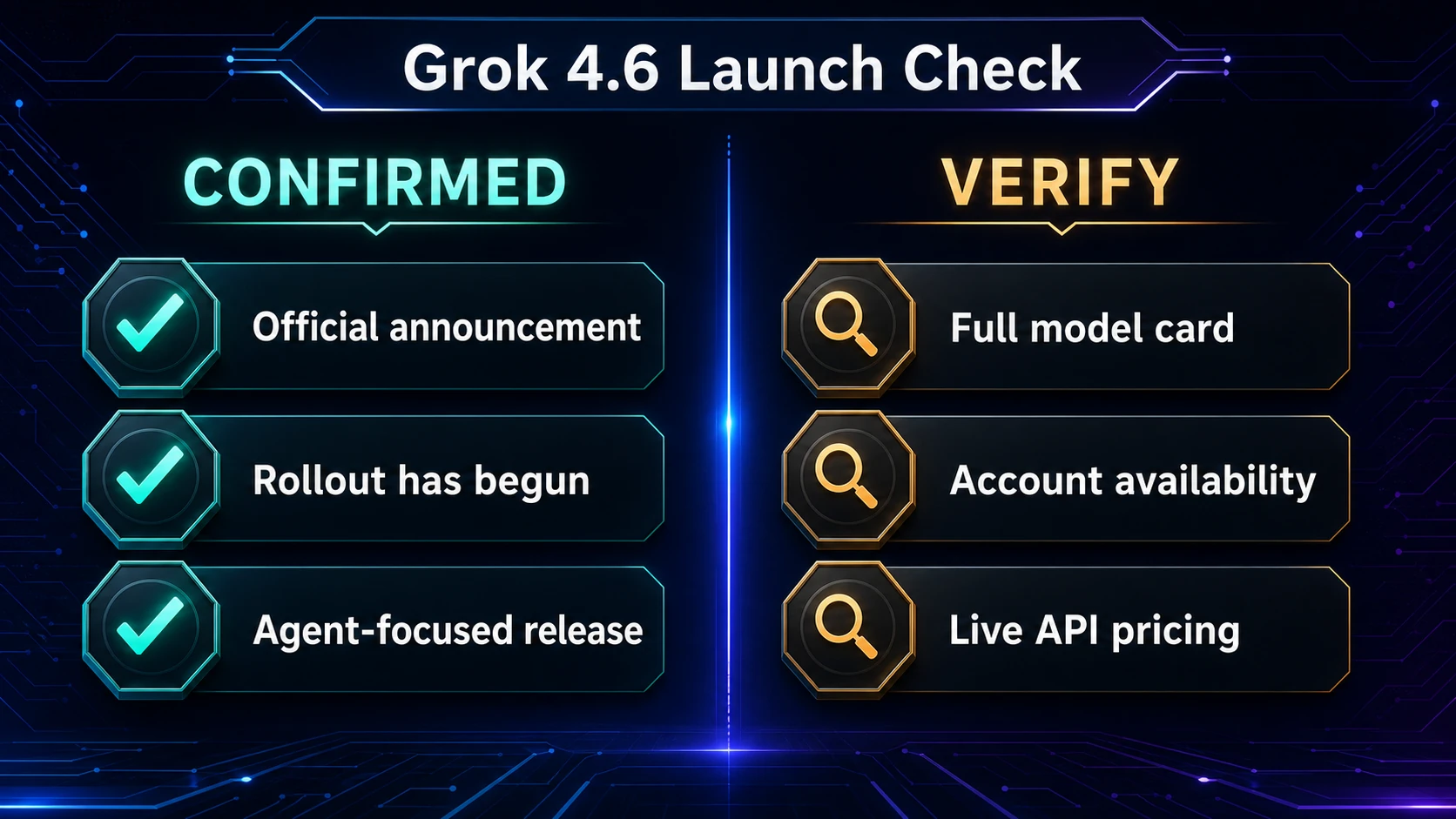
Yes, with an important qualification: SpaceXAI has publicly announced Grok 4.6, and the model is entering rollout, but availability may differ by product, account, region, and API access.
The safest way to describe the current status is:
Grok 4.6 has been announced and is rolling out, but a complete public technical package is not yet available.
Users should check the model picker in Grok, the SpaceXAI developer console, and official documentation rather than assuming that every account already has access.
Grok 4.6 at a glance
| Question | Current status |
|---|---|
| Has SpaceXAI announced Grok 4.6? | Yes |
| Is it available to every user? | Not yet confirmed |
| Is there a full official model card? | Not publicly available at publication time |
| Are benchmark results circulating? | Yes, but methodology and independent replication matter |
| Is API pricing confirmed? | Check the live SpaceXAI pricing page before budgeting |
| Should teams migrate immediately? | Test with a limited workload first |
This cautious framing is more useful than repeating a leaderboard headline. For most people, the real question is not whether Grok 4.6 wins a benchmark. It is whether the model completes their actual tasks with fewer failures, fewer retries, and a reasonable total cost.
What may have changed from Grok 4.5?
To understand Grok 4.6, start with the direction established by its predecessor. In the official Grok 4.5 announcement, SpaceXAI positioned the model around coding, agentic tasks, engineering, and knowledge work—not just conversational answers.
Grok 4.5 was also made the default model in Grok Build, where it could work across code and office documents. The next version therefore needs to be judged as an agentic work model, not simply as a chatbot update.
Four areas deserve attention.
1. More reliable multi-step execution
A model can answer a coding question correctly and still fail when asked to inspect a repository, modify several files, run checks, and recover from an error. Agent reliability depends on planning, tool use, constraint retention, and verification across many steps.
Early Grok 4.6 discussion emphasizes gains on complex agent tasks. Until SpaceXAI publishes detailed methods and independent evaluators reproduce the results, those numbers should be treated as promising evidence—not a universal guarantee.
For users, a better test is simple: give Grok 4.5 and 4.6 the same real task and measure how often each reaches a valid result without intervention.
2. Better performance per completed task
API price per million tokens is only one component of cost. An agent that uses fewer steps, produces less unnecessary output, and needs fewer retries may be cheaper even when its token price is unchanged.
SpaceXAI priced Grok 4.5 at $2 per million input tokens and $6 per million output tokens. Some early reports suggest that Grok 4.6 retains similar base pricing, but teams should verify the live SpaceXAI pricing page before making procurement decisions. Long-context rates, cached input, and platform-specific charges can change the final bill.
The most useful metric is cost per successfully completed task, not cost per token.
3. Stronger long-context behavior
A large context window can hold a codebase, a research collection, or months of project records. It does not automatically mean that the model will retrieve the right detail or reason accurately across the entire input.
When official Grok 4.6 context specifications are fully documented, evaluate three separate abilities:
- retrieving a precise fact from a long input;
- connecting evidence across several distant sections;
- following an instruction given near the beginning after many tool calls.
These tests reveal usable context more effectively than the advertised maximum alone.
4. A closer link between real-time search and agent workflows
Grok can decide to search public X posts and the wider web when responding to a query. That gives it a natural advantage for fast-moving topics, but it also exposes the model to unverified posts, recycled screenshots, and partial accounts of events.
The X Help Center explicitly warns that Grok may present incorrect facts or miss context. Real-time access should therefore be treated as a discovery layer. Important claims still need to be checked against official announcements, original documents, or authoritative reporting.
Grok 4.6 benchmarks: what should you believe?
Benchmark screenshots are useful for identifying where a model may have improved. They are less useful when separated from the test harness, reasoning setting, token budget, tool access, and cost.
Before accepting a Grok 4.6 benchmark claim, ask:
- Was the result published by SpaceXAI, an independent evaluator, or an anonymous account?
- Did all models receive equivalent tools and compute budgets?
- Is the score pass@1, best-of-many, or the result of repeated attempts?
- Does the comparison include the cost and number of agent steps?
- Can the test be reproduced on a public dataset?
A five-point gain may be meaningful. It may also disappear on a different harness or task distribution. The gap between a benchmark and real work is especially large for agents, where one incorrect tool call can invalidate an otherwise impressive run.
Who should consider Grok 4.6?
Grok 4.6 is most relevant to people whose work benefits from current web information or sustained multi-step execution:
- Developers working on repository-level debugging, code changes, and agentic engineering;
- Researchers and analysts tracking fast-moving discussions across X and the web;
- Product and operations teams synthesizing feedback, market signals, and emerging events;
- Content teams investigating a trend before verifying facts for publication.
It should not be treated as an automatic final authority. Legal, medical, financial, security, and academic claims still require qualified review and primary-source verification.
How to test Grok 4.6 before switching
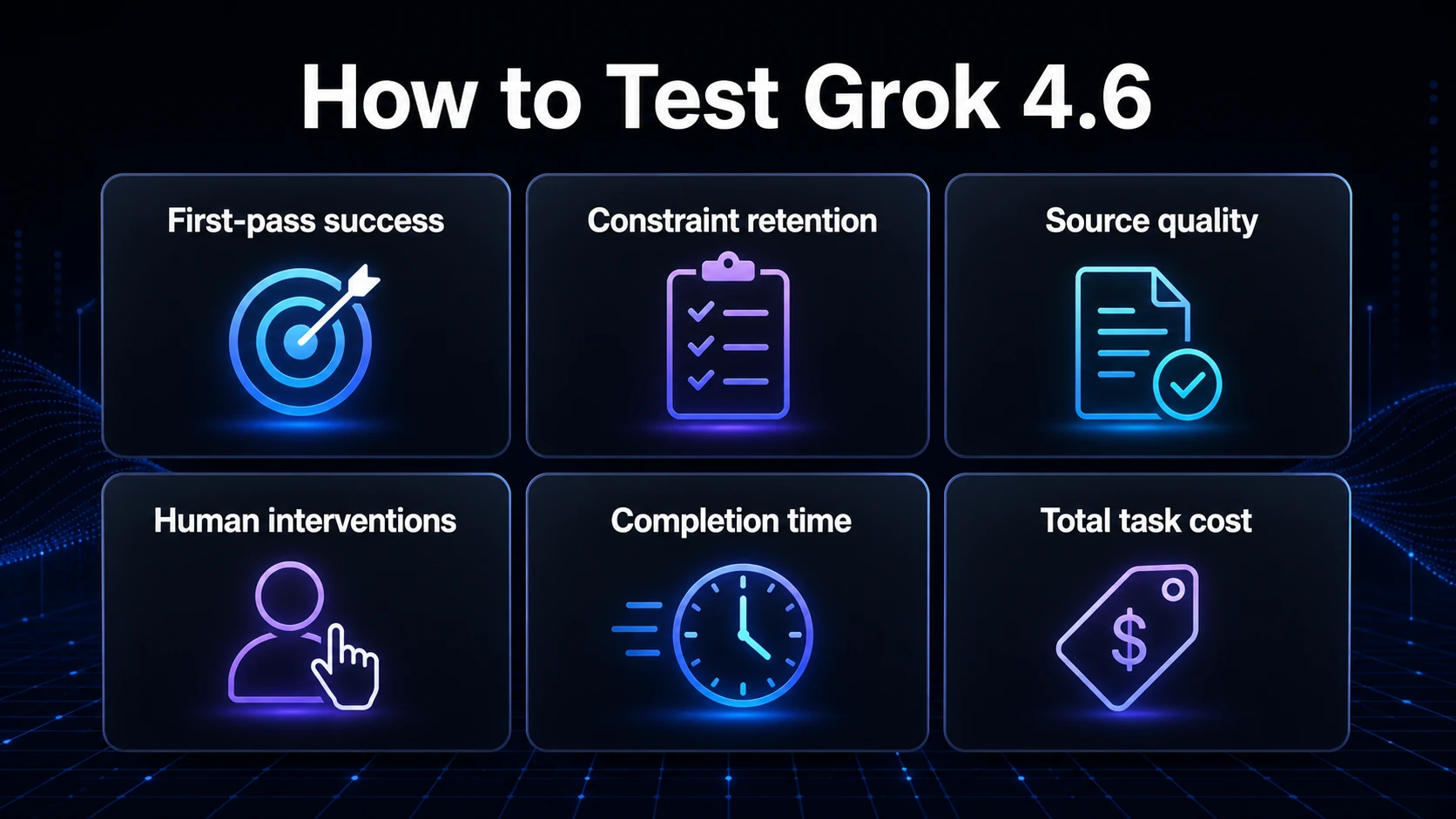
For each task, compare Grok 4.5 and Grok 4.6 on:
| Metric | What to record |
|---|---|
| First-pass success | Did the initial result meet the acceptance criteria? |
| Constraint retention | Did the model follow format, scope, and safety requirements? |
| Source quality | Can important claims be traced to original sources? |
| Intervention count | How often did a person need to correct the run? |
| Completion time | How long did the full task take? |
| Total cost | What did one accepted result actually cost? |
Run each task more than once. Agent outputs can vary, so a single impressive demo is not enough to establish reliability.
Turn scattered Grok 4.6 updates into a usable research brief
New-model information is usually fragmented across launch posts, documentation, benchmark pages, videos, and community discussion. Keeping those sources in separate tabs makes it easy to lose track of which claim came from where.
With iWeaver, you can bring saved reports, web material, PDFs, and internal test notes into one research workflow, then turn them into structured summaries, comparisons, and follow-up questions. iWeaver’s AI workflow for knowledge workers is designed to help organize complex material into reusable outputs rather than leave it as a pile of links.
For a model launch, use three evidence labels in your notes:
- Confirmed: stated in an official model page, documentation, or pricing page;
- Observed: reproduced in your own controlled test;
- Unverified: reported by a community member or third party but not yet documented.
That simple structure makes a fast-moving launch much easier to follow without confusing speculation with product fact.
Should you switch to Grok 4.6 now?
Individual users can start with low-risk tasks as soon as the model appears in their account. API teams should wait until access, pricing, rate limits, and model behavior are documented, then run a limited production trial.
The best reason to adopt Grok 4.6 will not be a headline claiming that it is the new top model. It will be evidence that the model completes your work more reliably, with less human intervention and a better cost-to-result ratio.
Until the full model card and independent evaluations arrive, Grok 4.6 is best viewed as a credible new release with promising early signals—and several important details still to verify.
If conversational freedom matters more than benchmark scores, XPT provides a less-restricted alternative for open-ended AI conversations.
Frequently asked questions
Is Grok 4.6 available now?
SpaceXAI has announced Grok 4.6 and rollout has begun. Availability may vary across Grok, developer accounts, plans, platforms, and regions.
Is Grok 4.6 better than Grok 4.5?
Early reports point to stronger complex-task and agent performance, but the size of the improvement depends on the workload. Compare both models on repeated real tasks before deciding.
How much does Grok 4.6 cost?
Check SpaceXAI’s live pricing page and developer console. Do not assume that every Grok 4.5 rate, long-context tier, or cached-input price carries over unchanged.
Can Grok 4.6 research breaking news?
Grok can use public X posts and web search to identify recent information. Because fast-moving sources may be wrong or incomplete, verify material claims using original announcements and authoritative sources.
Should a company migrate its API workload immediately?
No. Confirm the API model identifier, rates, limits, data terms, and output stability, then begin with a small percentage of low-risk traffic.