

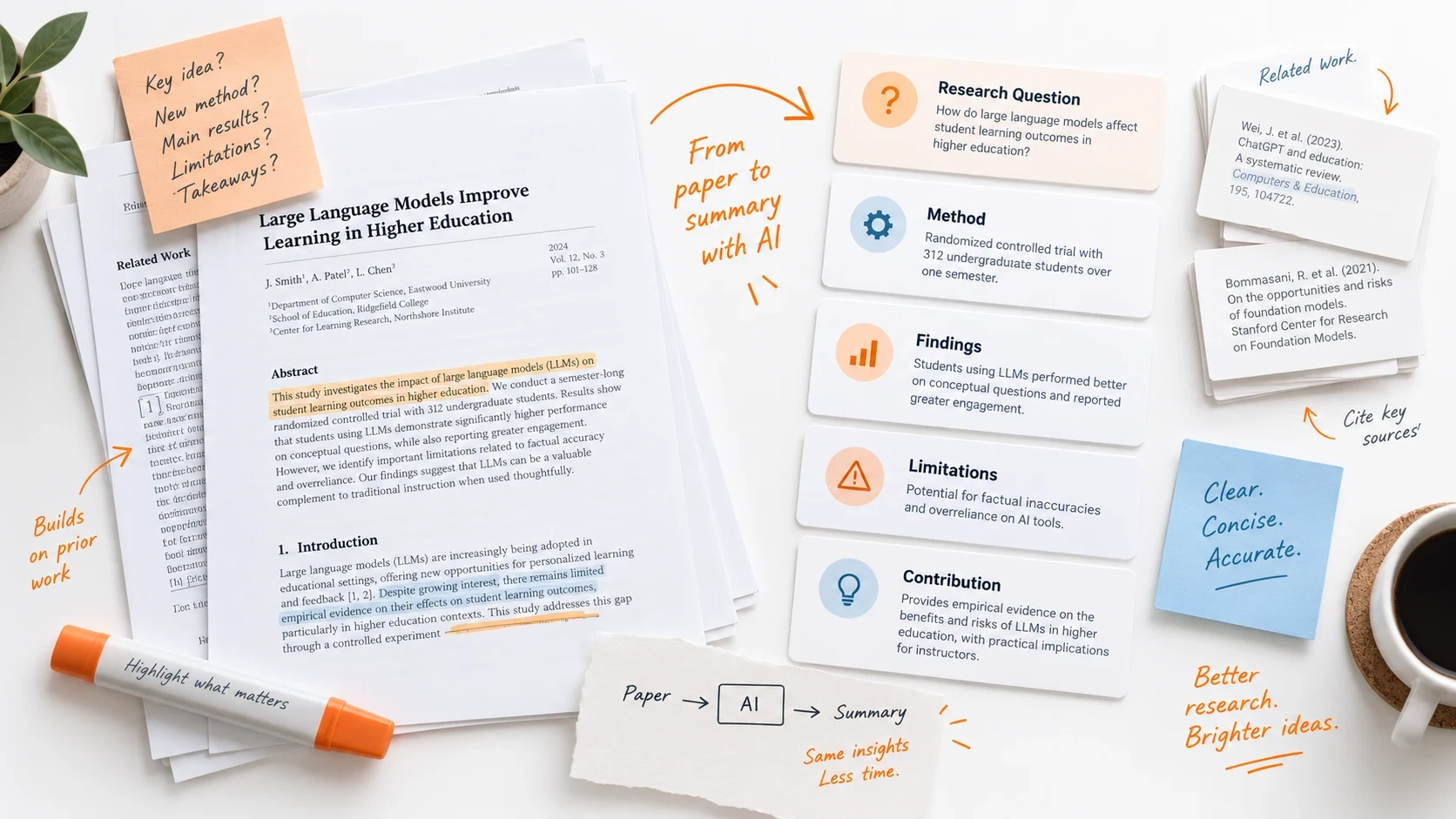
To summarize a research paper, identify its research question, explain how the study was conducted, report the main findings, and preserve the limitations that affect those findings. Then write a concise account in your own words and check it against the original paper.
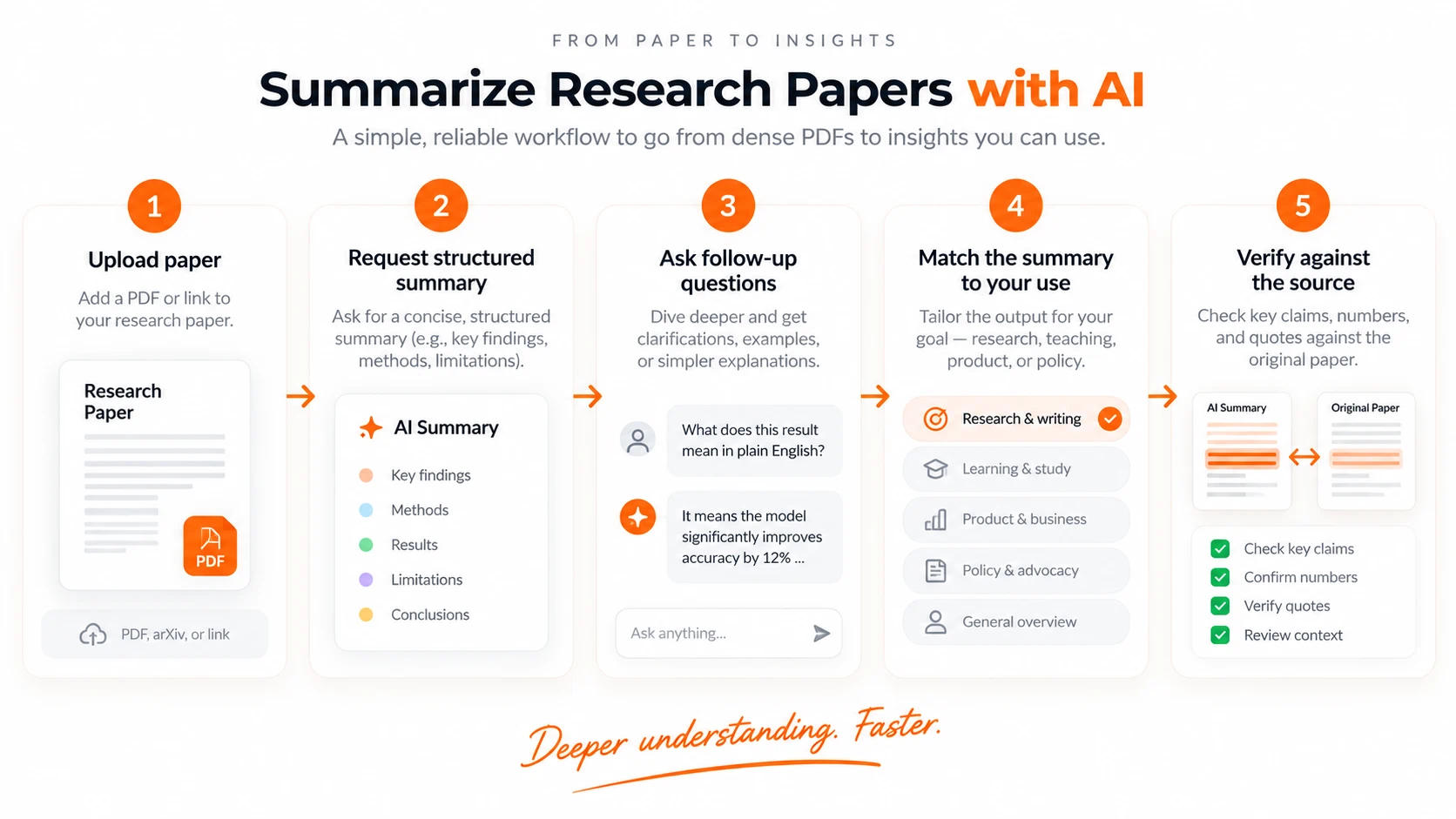
With iWeaver, you can start by uploading the paper, requesting a structured summary, and asking follow-up questions about difficult sections. The practical goal is a summary you can use in a reading note, seminar discussion, or literature review—with a clear distinction between what the researchers found and what you think it means.
Here is a workflow you can follow with one paper before applying it to a larger reading list.
What should a research paper summary include?
A useful summary explains the study well enough that someone can understand its contribution and boundaries. Rewriting the abstract alone may leave out details you need for your assignment or research question.
The University of Connecticut’s guide to summarizing a research article recommends covering the question, methods, results, and implications while writing in your own words.
Use these fields as your starting structure:
| Field | Question your summary should answer |
|---|---|
| Research question | What did the authors investigate? |
| Context | What problem or gap motivated the work? |
| Method | What design, data, sample, or analytical approach did they use? |
| Main findings | What did the study actually report? |
| Limitations | What constrains the interpretation or application of the findings? |
| Contribution | What does this paper add to the topic? |
Adapt the fields to the article. A theoretical paper may need an account of its argument and assumptions. A review may need its search scope and synthesis method rather than a participant sample.
Step 1: Upload the paper to iWeaver
Open iWeaver’s AI Paper Summarizer and supply the research paper. The agent is designed to turn academic papers into structured summaries and research highlights.
Use the full paper when available. If you only have an abstract, label the output as an abstract summary; it cannot reliably represent methods or limitations absent from that text.
Before requesting the summary, note the paper’s title, authors, year, and DOI or original location. Keep the source open so you can check the output without searching for it again.
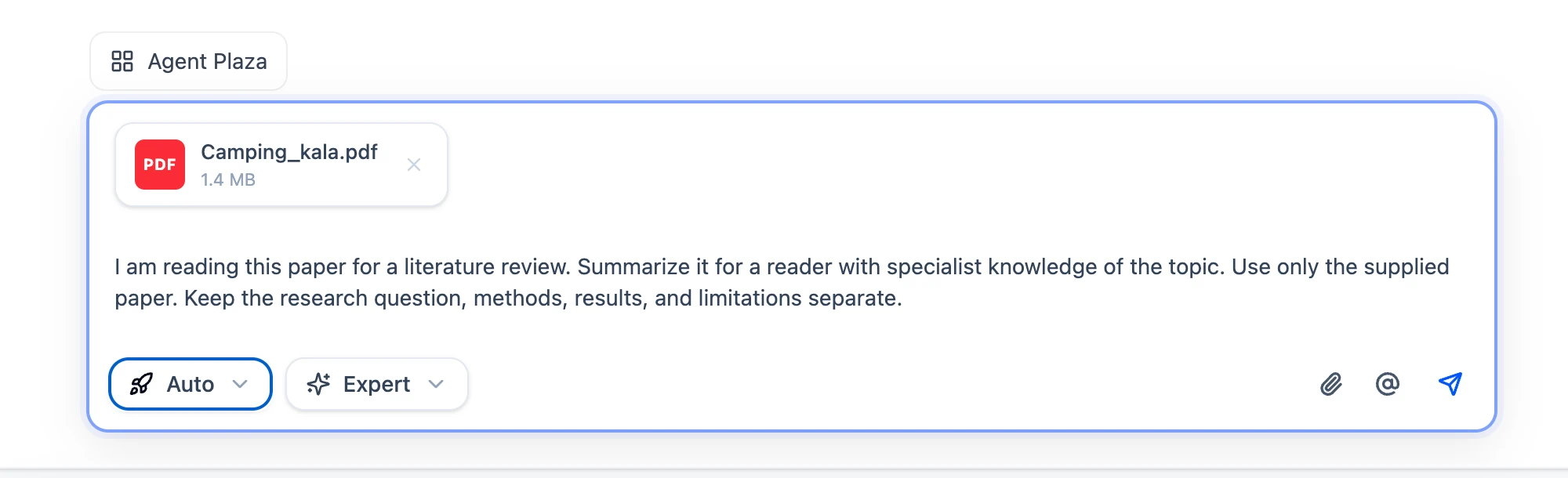
For a first pass, state your purpose:
I am reading this paper for [a seminar / a literature review / background research]. Summarize it for a reader with [beginner / intermediate / specialist] knowledge of the topic. Use only the supplied paper. Keep the research question, methods, results, and limitations separate.
Checkpoint: Confirm that the response identifies the correct paper and that the material includes the sections you need. If a scan or table is unreadable, supply a clearer version or the relevant text before relying on the summary.
Step 2: Request a structured summary before shortening it
An extremely short first response can hide the very details you need to understand the study. Start with a structured account, then compress it after review.
Use this prompt in iWeaver:
Summarize this research paper using these headings: research question, motivation, study design, data or participants, main findings, author-stated limitations, and contribution. Preserve essential numbers, units, comparison groups, and time periods. Where available, identify the section or passage supporting each main finding. Write “not reported in the supplied material” when a detail is missing. Do not invent references or turn an association into a causal claim.
Read the methods and findings together. A result is easier to misinterpret when separated from the sample, measurement, or setting that produced it.
If the paper reports several studies, ask for one row per study before requesting an overall summary. This helps keep different samples and results from being merged into a single account.
Step 3: Ask follow-up questions about unclear sections
Suppose the overview makes sense, but you still cannot explain how the authors measured the outcome. Ask about that detail directly.
iWeaver’s Chat with PDF offers a document question-and-answer workflow. Supply the paper there if you need to examine a specific passage through focused questions.
Useful follow-ups include:
- “How did the authors define and measure the main outcome?”
- “Explain this methods paragraph in plain language, keeping its technical meaning.”
- “Which results support the conclusion, and which leave uncertainty?”
- “Separate limitations explicitly stated by the authors from possible concerns you infer.”
- “What does this paper leave unanswered about my research question?”
Ask one focused question at a time when the method is difficult. Check any quoted passage or section reference in the original; requesting a reference does not establish that it is correct.
Checkpoint: You should be able to describe what the authors did and what they found without simply repeating the AI response. If you cannot, return to the relevant section and ask a narrower question.
Step 4: Match the summary to its intended use
The same paper can support several different outputs. Choose the format before asking iWeaver to produce the final version.
| Your task | Useful output | Detail to prioritize |
|---|---|---|
| Decide whether to read closely | A short overview | Question, method, finding, relevance |
| Prepare for a seminar | Structured notes | Reasoning, definitions, limitations, questions |
| Build a literature review | A comparison-ready entry | Design, population, outcomes, contribution |
| Brief a colleague | A concise paragraph | What changed in your understanding and why |
For a literature review, try:
Using the reviewed summary, create a literature-review note with: citation details available in the paper, research question, design, sample or data, key result, limitations, and relevance to [my topic]. Keep my interpretation in a separate field. Do not add missing bibliographic details.
For a short paragraph, try:
Rewrite the reviewed summary in approximately 180 words. Preserve the research question, study design, main finding, and most important limitation. Remove background detail before removing qualifications. Use neutral academic language and my own wording rather than copying sentences from the paper.
Treat the word count as an editing target. Follow your assignment’s requirements when they differ.
Step 5: Check the summary against the paper
Review the claims that carry the most meaning: the sample, method, main result, and conclusion. This is where you catch a polished sentence that overstates the evidence.
The following is an invented example for illustration, not a finding from a real study:
Source description: A survey of 240 students found an association between self-reported study planning and course grades. The authors noted that the design could not establish causality.
An overstated summary would say:
Study planning improves students’ grades.
A more faithful version would say:
In a survey of 240 students, self-reported study planning was associated with course grades. The observational design did not establish whether planning caused the difference.
Before saving your own summary, check:
- Names, dates, sample sizes, units, and numerical results match the paper.
- Findings are attributed to the correct study or comparison group.
- The wording preserves uncertainty and the study’s scope.
- The authors’ conclusions are separate from your evaluation.
- Any quotation matches the original exactly.
- The paper’s citation information is retained and checked.
If the summary is for assessed work, follow the applicable rules for AI assistance and attribution. Cite the paper you summarized.
Step 6: Make the reviewed summary easier to reuse
Save the final note alongside the source and include the question it helps answer. “Relevant to my review because it examines self-reported planning” is more useful than a title alone.
When you need an overview of the argument, use iWeaver’s Text to Mind Map to organize the reviewed notes visually. Supply the corrected summary and arrange it around the question, method, findings, and limitations.
Keep the original paper available. A map helps you see the structure; the source remains the place to verify a claim.
How long should a research paper summary be?
Use the length required by the task. A screening note may be one paragraph, while a seminar or literature-review note needs more detail. Preserve the question, approach, key finding, and important qualification before adding background.
Can I summarize a research paper from its abstract?
You can summarize the abstract, but label it accordingly. Read the full text before claiming to describe details that the abstract does not contain.
Can iWeaver write the first draft of the summary?
Yes. Use the paper summarization workflow for the draft, then ask focused questions and check the result against the source. Your review determines whether the final note faithfully represents the paper.
How do I summarize several papers without mixing them up?
Summarize each paper using the same fields and retain its identifier. Then compare the reviewed entries. Keep differences in population, method, and outcome visible instead of treating similar topic labels as equivalent evidence.
Start with one paper in iWeaver, generate the structured draft, and verify its central claims. Once the format works for your reading task, reuse the prompt for the next paper.