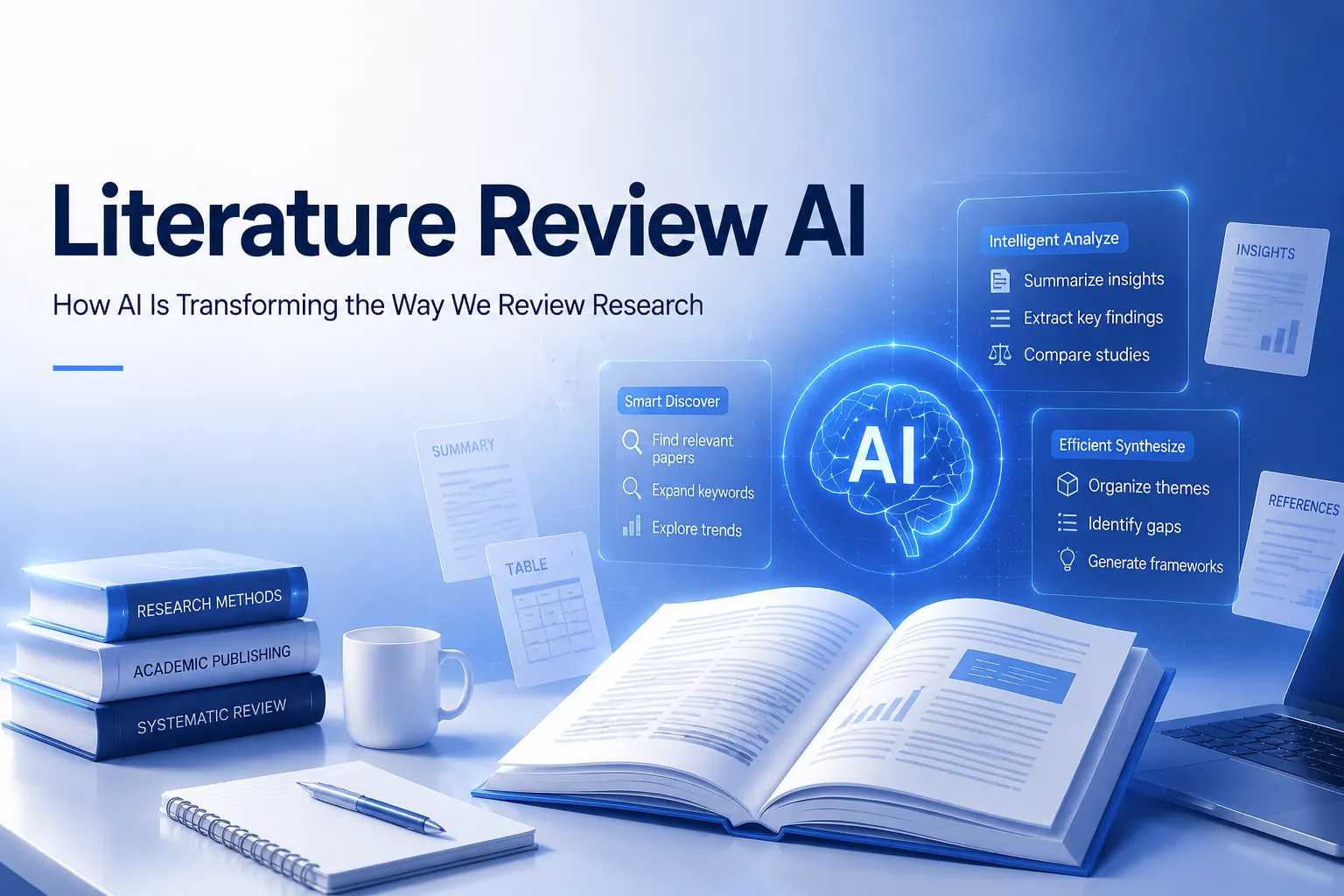
Literature review AI tools use semantic search, natural language processing, and machine learning to help researchers discover relevant papers, extract key data, screen sources, and synthesize findings. In 2026, leading platforms like Elicit, SciSpace, and Consensus can reduce review time by up to 80% while maintaining citation-level transparency.
What Is Literature Review AI and Why Does It Matter in 2026?
A literature review AI is any artificial intelligence tool designed to assist researchers in discovering, screening, extracting data from, and synthesizing academic papers. Instead of manually combing through hundreds of PDFs, you feed a research question into the tool and receive organized, citation-backed summaries.
I’ve watched this space evolve rapidly. In 2026, these tools have moved far beyond simple keyword matching. They now use semantic search across 100+ million papers, generate structured research reports, and even automate the screening phases of systematic reviews.
The core value proposition hasn’t changed: spend less time finding and organizing papers, more time thinking critically about them.
AI doesn’t replace the researcher’s judgment. It removes the mechanical bottlenecks that slow down evidence synthesis.
How Do AI Tools for Literature Reviews Actually Work?
Most literature review AI platforms share a common architecture. Understanding it helps you choose the right tool and use it effectively.
Semantic Search Over Academic Databases
Unlike traditional Boolean search, semantic search understands the meaning behind your query. You don’t need exact keywords. Elicit, for example, searches over 138 million academic papers and 545,000 clinical trials using this approach.
Automated Screening and Relevance Scoring
After retrieving candidate papers, AI models score each paper’s relevance to your specific research question. Tools like Elicit provide screening recommendations with supporting quotes extracted directly from the source text.
Data Extraction Into Structured Tables
Rather than reading each paper end-to-end, AI extracts specific data points—sample size, methodology, key findings—into customizable tables. This mirrors the data extraction phase of a systematic review but completes it in minutes rather than weeks.
Synthesis and Report Generation
The most advanced tools in 2026 generate multi-section research reports with sentence-level citations. SciSpace offers Standard, High Quality, and Deep Review modes depending on how thorough you need the synthesis to be.
Best Literature Review AI Tools Compared (2026)
We evaluated the most widely used platforms based on database size, key features, accuracy validation, and pricing transparency. Here’s how they stack up:
| Tool | Database Size | Key Features | Best For | Free Tier |
|---|---|---|---|---|
| Elicit | 138M+ papers, 545K clinical trials | Semantic search, screening automation, research reports, alerts, library organization | Systematic reviews, thesis-level projects | Yes (limited) |
| SciSpace | 270M+ papers | Literature review modes (Standard/High Quality/Deep), chat with PDF, paraphraser, citation generator, AI detector | Quick summaries and multi-mode reviews | Yes |
| Consensus | 200M+ papers | Consensus Meter, evidence-based answers, scientific agreement visualization | Finding scientific consensus on specific questions | Yes |
| Research Rabbit | Semantic Scholar index | Visual paper networks, author mapping, collection-based discovery | Exploratory discovery and citation mapping | Yes (fully free) |
| iWeaver | Supports uploaded documents + web sources | AI Agent for structured output (doc/pdf), handles text/images/documents without complex prompts | Organizing extracted data into polished deliverables | Yes |
Step-by-Step: How to Conduct a Literature Review With AI in 2026
Here’s the workflow I recommend based on testing these tools across multiple research projects this year.
- Define your research question clearly. AI tools perform best with specific, well-scoped questions. Add a question mark—SciSpace explicitly recommends this for better results.
- Run semantic searches across multiple platforms. Use Elicit for breadth (138M+ papers) and Consensus for gauging scientific agreement. Don’t rely on a single tool’s index.
- Screen results using AI relevance scores. Elicit provides screening recommendations with extracted supporting quotes. Review these before committing papers to your final list.
- Extract data into structured tables. Use Elicit’s customizable column extraction or SciSpace’s data extraction feature to pull specific variables from each paper.
- Visualize connections between papers. Research Rabbit excels here—feed in your seed papers and discover related work through citation network visualization.
- Generate a synthesis report. Use SciSpace’s Deep Review mode or Elicit’s report feature to produce a first draft with sentence-level citations.
- Organize and export your findings. This is where iWeaver adds significant value. Upload your extracted data, summaries, and notes into iWeaver, and its AI Agent produces structured documents (PDF or DOC) without requiring complex prompts. It handles mixed inputs—text, images, tables—and outputs publication-ready files.
- Verify and refine manually. Always check AI-generated claims against the original sources. No tool is 100% accurate, and human oversight remains essential.
How Accurate Are AI Literature Review Tools?
Accuracy is the make-or-break factor. Elicit has published external validation studies showing their reports match expert-generated systematic review data at high rates. They claim to be the most accurate AI product for scientific research and back this with public evaluation data.
Key accuracy features to look for:
- Sentence-level citations (not just paper-level references)
- Extracted quotes alongside AI-generated summaries
- Transparency about confidence levels
- Ability to trace any claim back to its source PDF
SciSpace and Consensus also provide direct citations, but their validation methodologies are less publicly documented as of early 2026.
The safest approach: treat AI outputs as a first pass. Verify critical claims in the original papers before including them in your manuscript.
AI for Systematic Reviews: Can It Replace Manual Screening?
Systematic reviews are the gold standard of evidence synthesis—and also the most time-consuming. Researchers using Elicit report up to 80% time savings on screening and data extraction phases.
However, “time savings” doesn’t mean “full automation.” In 2026, AI partially supports the search and report generation stages but fully automates screening recommendations and data extraction. You still need human reviewers to make final inclusion/exclusion decisions, especially for Cochrane-level rigor.
Where AI Excels in Systematic Reviews
- Title and abstract screening with relevance scoring
- Full-text data extraction into predefined templates
- Identifying duplicate studies across databases
- Flagging potential conflicts of interest or methodological weaknesses
Where Human Judgment Remains Essential
- Defining inclusion/exclusion criteria
- Assessing risk of bias
- Interpreting conflicting findings
- Writing the narrative synthesis
How to Choose the Right AI Literature Review Tool
Your choice depends on your research stage and depth requirements. Here’s a decision framework:
- Quick evidence check on a specific question? → Consensus (Consensus Meter shows agreement levels)
- Exploratory discovery of a new field? → Research Rabbit (visual citation networks)
- Comprehensive systematic review? → Elicit (screening + extraction + reports at scale)
- Multi-mode literature synthesis with PDF chat? → SciSpace (Standard to Deep Review)
- Turning messy research notes into structured deliverables? → iWeaver (AI Agent outputs clean docs without complex prompting)
Limitations and Ethical Considerations
No guide on literature review AI is complete without addressing the risks.
Hallucination risk: All large language models can generate plausible-sounding claims that aren’t in the source material. Tools with sentence-level citations (Elicit, SciSpace) mitigate this but don’t eliminate it.
Database coverage gaps: No single tool indexes every journal. Grey literature, conference proceedings, and non-English sources are often underrepresented.
Academic integrity: Most universities in 2026 require disclosure when AI tools are used in the research process. Check your institution’s policy—George Mason University, for example, maintains detailed guidance on academic integrity and AI.
Over-reliance: AI can create a false sense of completeness. A tool returning 200 relevant papers doesn’t mean those are the only 200 relevant papers in existence.
What’s New in Literature Review AI for 2026
Several developments distinguish 2026 from previous years:
- Multi-step agentic workflows: Tools now chain multiple actions (search → screen → extract → synthesize) without manual intervention between steps.
- Research alerts: Elicit’s Alerts feature monitors new publications matching your research questions and delivers relevance-ranked summaries to your inbox.
- Deeper customization: Elicit Reports let you control which papers and what information appear in generated reports—a major leap beyond generic summaries.
- Integration with office workflows: Tools like iWeaver bridge the gap between research discovery and document production, accepting mixed inputs and producing structured PDFs without requiring users to write complex prompts.
- AI detection alongside generation: SciSpace now offers both AI writing assistance and an AI detector, acknowledging the dual need for productivity and integrity verification.
Frequently Asked Questions
Can AI write a literature review for me?
AI can generate draft literature reviews with citations, but these require human verification, critical analysis, and revision. Think of AI as producing a structured first draft, not a finished manuscript.
What is the best free AI tool for literature reviews in 2026?
Research Rabbit is completely free and excellent for discovery. Elicit, SciSpace, and Consensus all offer free tiers with limited usage. For organizing outputs into documents, iWeaver also provides a free tier.
Is it ethical to use AI for a literature review?
Yes, when disclosed appropriately. Most institutions require transparency about AI tool usage. The key ethical line: AI assists the process, but the intellectual contribution (interpretation, argumentation) must be yours.
How many papers can AI literature review tools analyze at once?
Elicit can find up to 1,000 relevant papers and analyze up to 20,000 data points in a single workflow. SciSpace and Consensus handle hundreds of papers per query depending on your subscription tier.
Do AI literature review tools work for non-English research?
Coverage varies. SciSpace supports multiple languages in its interface, but most tools primarily index English-language publications. Non-English coverage is improving but remains a limitation in 2026.
Can I use AI tools for a Cochrane systematic review?
AI tools can assist with screening and data extraction, but Cochrane protocols still require documented manual processes for final decisions. Use AI to accelerate the workflow, then document your human verification steps.
Frequently Asked Questions
Can AI write a literature review for me?
AI can generate draft literature reviews with citations, but these require human verification, critical analysis, and revision. Think of AI as producing a structured first draft, not a finished manuscript.
What is the best free AI tool for literature reviews in 2026?
Research Rabbit is completely free and excellent for discovery. Elicit, SciSpace, and Consensus all offer free tiers with limited usage. For organizing outputs into documents, iWeaver also provides a free tier.
Is it ethical to use AI for a literature review?
Yes, when disclosed appropriately. Most institutions require transparency about AI tool usage. The key ethical line: AI assists the process, but the intellectual contribution must be yours.
How many papers can AI literature review tools analyze at once?
Elicit can find up to 1,000 relevant papers and analyze up to 20,000 data points in a single workflow. SciSpace and Consensus handle hundreds of papers per query depending on your subscription tier.
Do AI literature review tools work for non-English research?
Coverage varies. SciSpace supports multiple languages in its interface, but most tools primarily index English-language publications. Non-English coverage is improving but remains a limitation in 2026.
Can I use AI tools for a Cochrane systematic review?
AI tools can assist with screening and data extraction, but Cochrane protocols still require documented manual processes for final decisions. Use AI to accelerate the workflow, then document your human verification steps.