
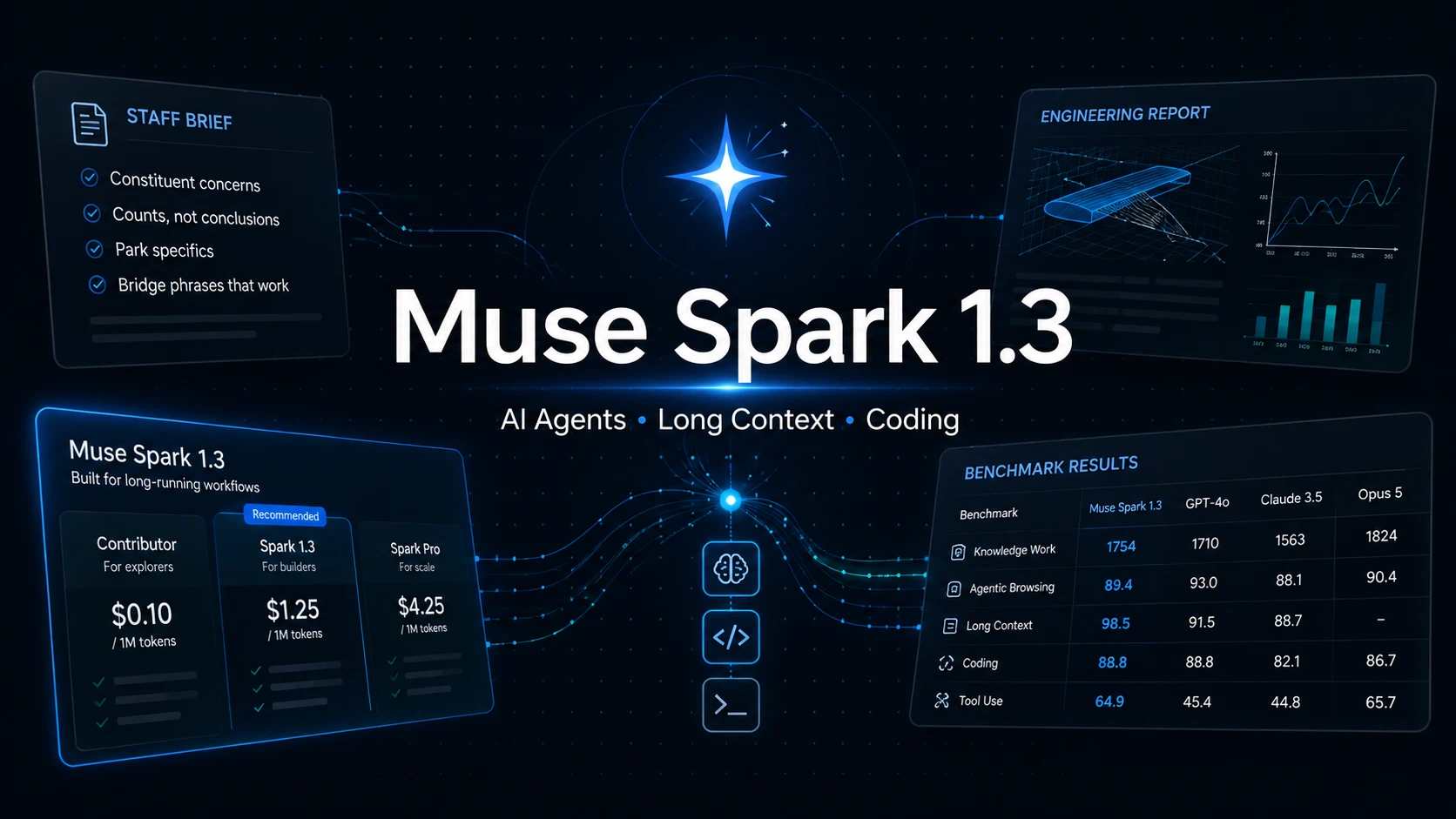
Meta has released Muse Spark 1.3, and this update is less about making another chatbot slightly smarter.
It is about making AI better at actually finishing work.
Released on September 2, Muse Spark 1.3 focuses heavily on long-running AI agents, coding, tool use, long context, and complex workflows.
Meta also says the new model is more efficient than Muse Spark 1.2, using roughly 20% fewer tool calls and 25% fewer tokens in comparisons by its engineers.
That may be one of the most practical improvements in this release.
What Is Muse Spark 1.3?
Muse Spark 1.3 is the latest model in Meta's Muse Spark family.
It is designed for tasks that require more than a single prompt and response, including:
- long-running AI agents
- software engineering
- research and web browsing
- computer use
- business automation
- long-context retrieval
- complex document workflows
Muse Spark 1.3 is available through Muse Code and the Meta Model API.
It also supports a 1 million token context window, giving the model enough room to work across large codebases, long documents, multiple files, and extended agent sessions.
The bigger change, however, is not simply how much information it can hold.
It is what the model can do with that information over time.
Muse Spark 1.3 Is Built for Longer AI Workflows
One of the biggest problems with AI agents is task drift.
A model may start with the right goal, complete several steps correctly, and then slowly forget an important requirement as the workflow gets longer.
Muse Spark 1.3 is designed to reduce that problem.
Meta says the model is better at maintaining detailed instructions across long tasks, working with messy or conflicting information, correcting gaps in its own plan, and keeping track of what it has already learned.
It can also handle multiple workflows inside the same long conversation without confusing a new request with an earlier task.
From Source Files to a Finished Deliverable
Meta's own examples show what this looks like beyond normal chat.
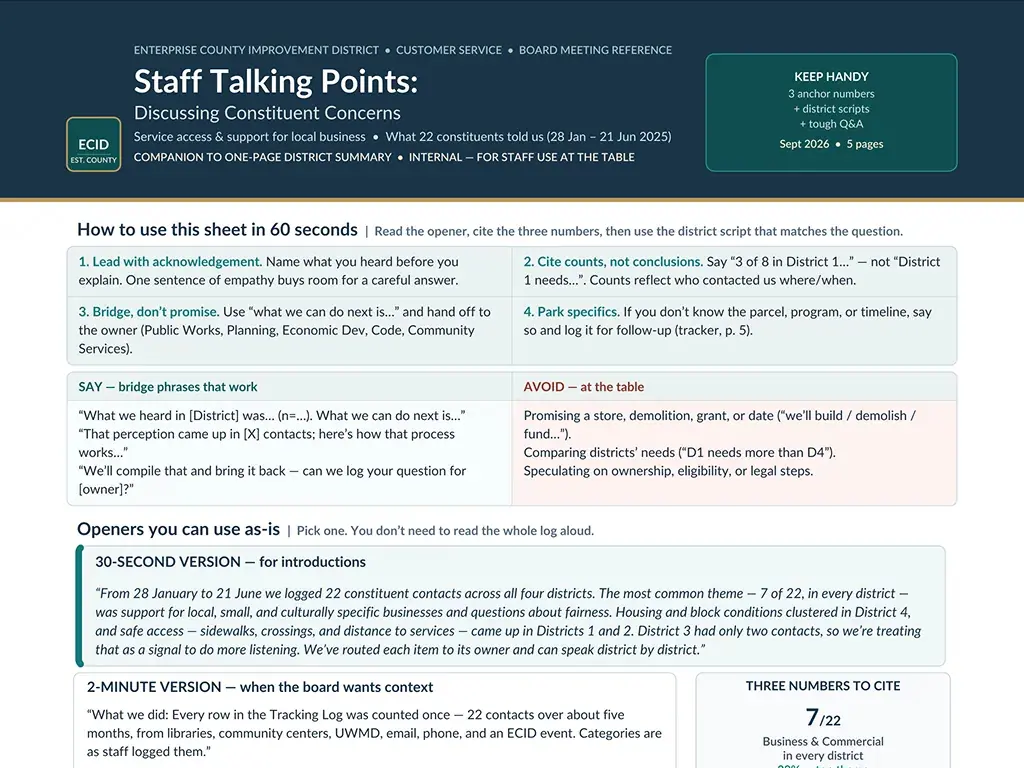
In one test, Muse Spark 1.3 was given an Excel file containing constituent feedback and asked to turn it into material that staff could use at a board meeting.
The final output was not just a summary in a chat window.
It produced a structured PDF with talking points, key numbers, district-specific guidance, phrases staff could use, and reminders about what not to promise.
This is closer to the direction AI agents are heading.
Instead of:
Prompt → Answer
the workflow becomes:
Files → Understand → Analyze → Organize → Create → Deliver
For real work, that difference matters.
Muse Spark 1.3 Can Handle More Complex Multimodal Tasks
Long workflows are not limited to spreadsheets and documents.
Another example from Meta asks Muse Spark 1.3 to act as a mechanical engineer working on an experimental aircraft assembly.
The model receives preliminary CFD simulation results and a STEP file containing a CAD model. It is then asked to interpret the material, explain the simulation environment, extract engineering metrics, build tables and diagrams, discuss aerodynamic implications, and produce a final PDF report.
The resulting document combines technical explanations, visualizations, tables, charts, and engineering context.
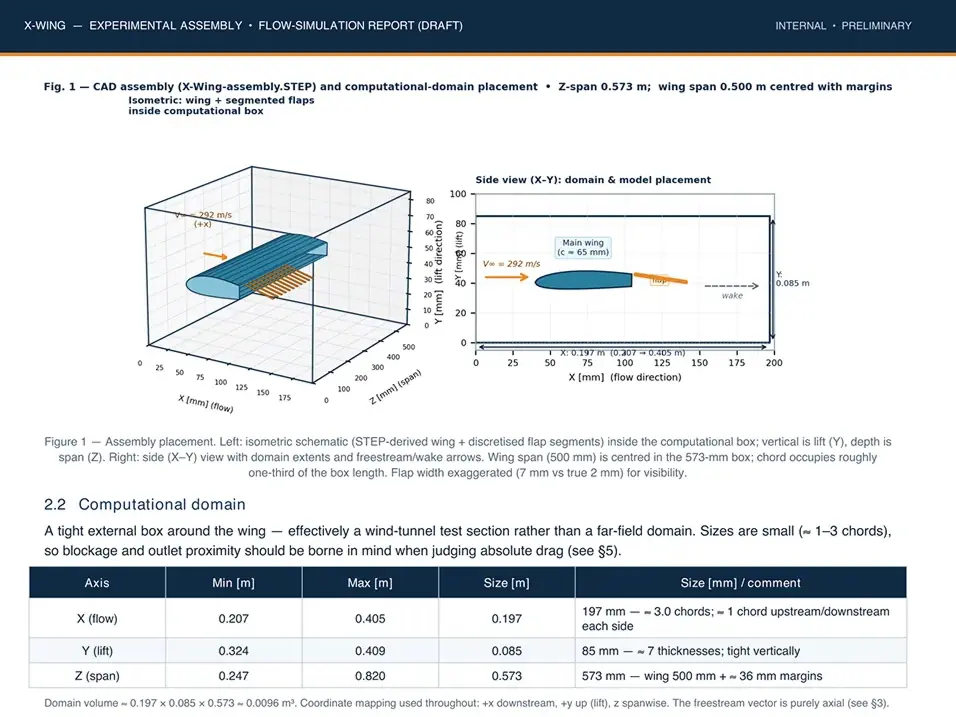
This example is useful because it shows what "multimodal agent" increasingly means.
The goal is not simply to recognize an image or summarize a PDF.
A useful agent needs to understand several types of input, preserve important details, reason across them, and turn the result into something another person can actually use.
Muse Spark 1.3 Benchmarks
Meta's evaluation of Muse Spark 1.3 covers three areas that matter most for this release:
- AI agents
- long context
- coding
The overall picture is strong, although Muse Spark 1.3 does not lead every benchmark.
Agent Performance
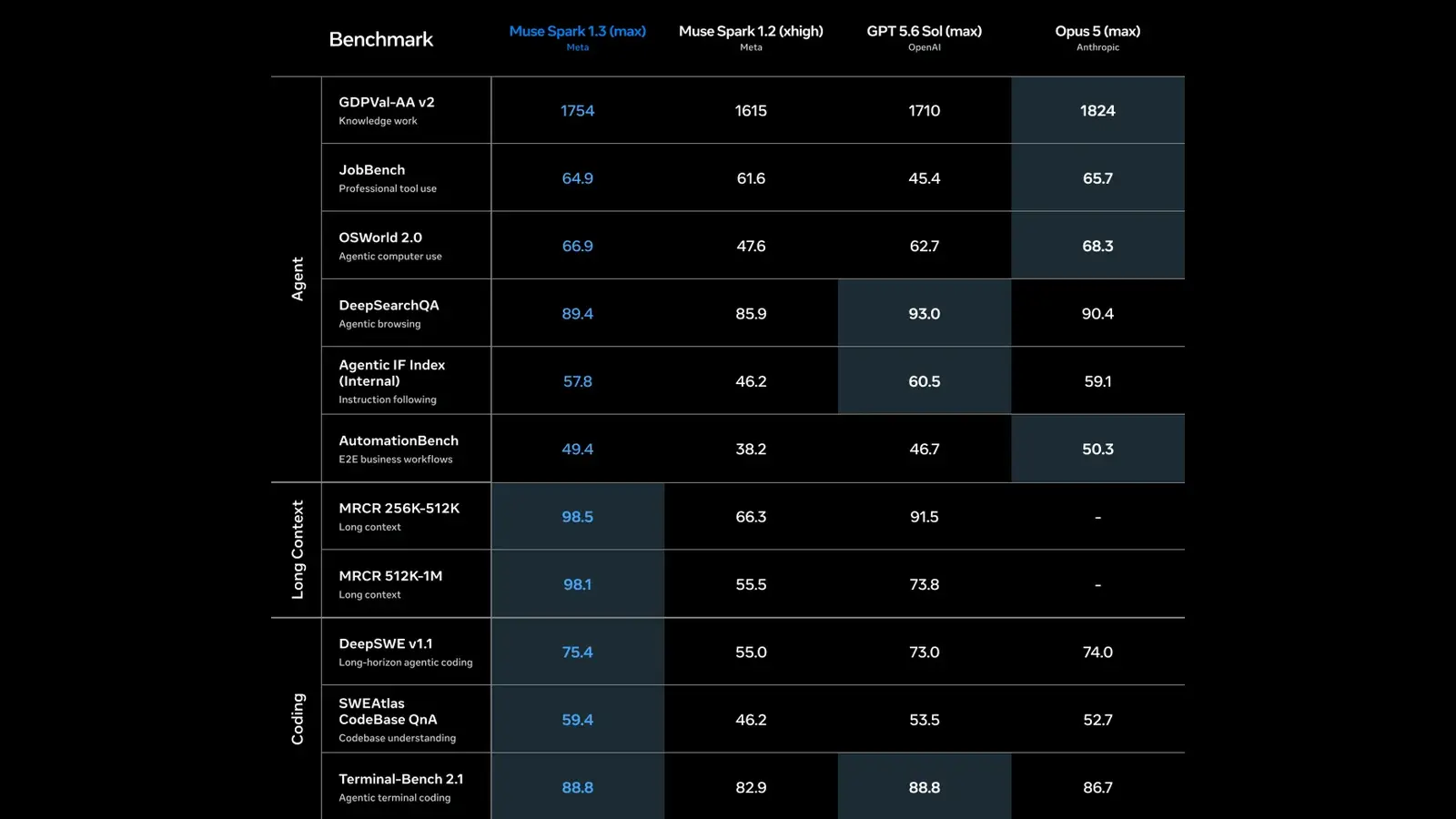
On OSWorld 2.0, which tests long-horizon computer-use workflows, Muse Spark 1.3 scores:
66.9
That is a large increase from Muse Spark 1.2 at 47.6 and ahead of GPT-5.6 Sol at 62.7, although Claude Opus 5 remains slightly higher at 68.3.
The model also reaches:
- 64.9 on JobBench
- 89.4 on DeepSearchQA
- 57.8 on Meta's Agentic IF Index
- 49.4 on AutomationBench
The important point is not that Muse wins every row. It does not.
What stands out is how consistently 1.3 improves over Muse Spark 1.2 across different types of agent work.
Long Context Is a Major Upgrade
The long-context numbers are especially noticeable.
On MRCR:
| Benchmark | Muse Spark 1.3 | Muse Spark 1.2 | GPT-5.6 Sol |
|---|---|---|---|
| MRCR 256K–512K | 98.5 | 66.3 | 91.5 |
| MRCR 512K–1M | 98.1 | 55.5 | 73.8 |
That is a very large jump from Muse Spark 1.2.
A 1M context window is only useful if the model can still find and use information buried deep inside it.
These results suggest Meta has put substantial work into improving retrieval across very long contexts rather than simply increasing the maximum context size.
For large codebases, research collections, long conversations, and document-heavy agents, that could be one of Muse Spark 1.3's biggest strengths.
Coding Also Moves Forward
Muse Spark 1.3 performs well across several coding evaluations.
On DeepSWE v1.1, a long-horizon software engineering benchmark, the model scores 75.4, compared with:
- Muse Spark 1.2: 55.0
- GPT-5.6 Sol: 73.0
- Claude Opus 5: 74.0
It also reaches 59.4 on SWEAtlas CodeBase QnA, ahead of the other models shown in Meta's comparison.
On Terminal-Bench 2.1, Muse Spark 1.3 and GPT-5.6 Sol both score 88.8, while Claude Opus 5 reaches 86.7.
These results fit the main theme of the release:
Muse Spark 1.3 is becoming much more capable when coding requires multiple steps rather than a single code-generation request.
One important detail is worth noting: Meta's published benchmark table uses the max reasoning configuration for Muse Spark 1.3.
At launch, Meta says its previously available reasoning modes are available immediately, while max reasoning will arrive after additional safety testing.
So benchmark performance should not automatically be treated as identical to every configuration currently available to users.
Muse Spark 1.3 Uses Fewer Tool Calls
Benchmarks are useful, but one of the most practical improvements may not appear in a leaderboard.
Meta says that, compared with Muse Spark 1.2, its engineers found Muse Spark 1.3 used approximately:
- 20% fewer tool calls
- 25% fewer tokens
The model also tends to take fewer unnecessary turns and produce less verbose code.
Why does that matter?
Imagine a coding agent trying to fix a bug.
A less efficient workflow might look like:
Search → inspect → search again → edit → inspect → undo → search → edit → test → edit again
A better agent may identify the problem earlier and reach the same result with fewer actions.
Each unnecessary tool call costs time and money.
It also creates another opportunity for the workflow to fail.
This applies far beyond coding. Research agents, browser agents, business automation tools, and personal assistants all benefit when the model can choose more useful actions earlier.
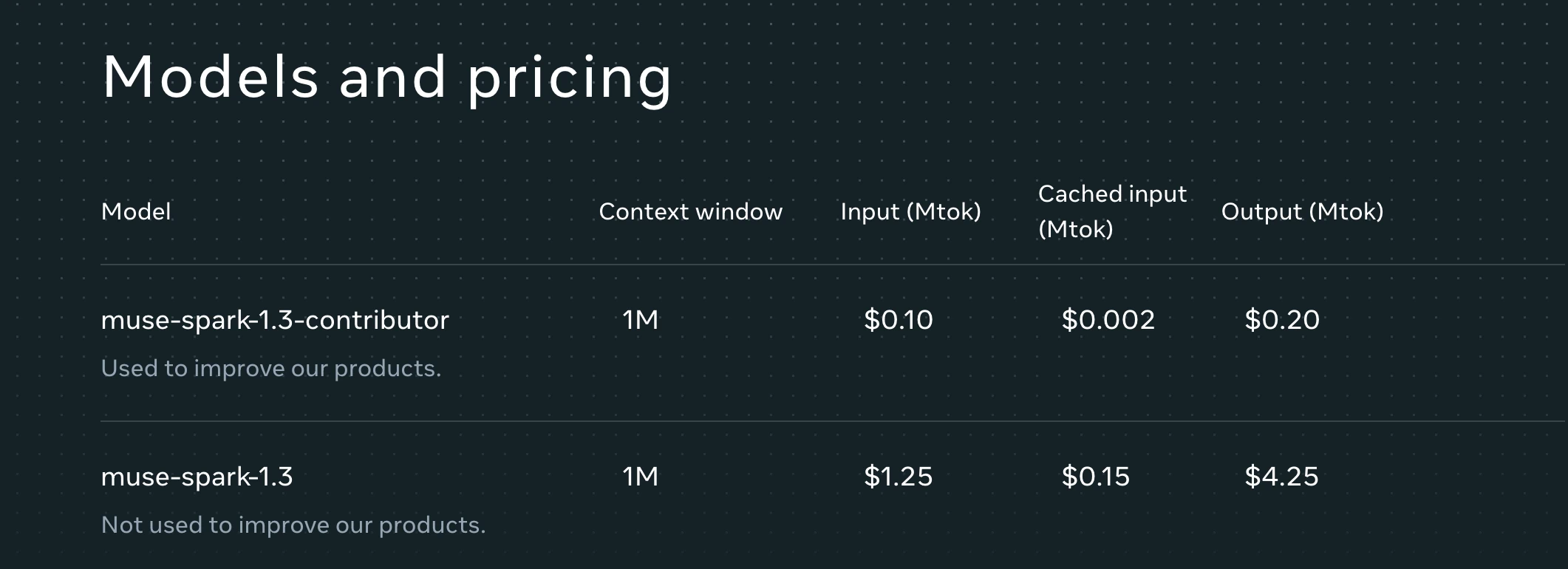
Muse Spark 1.3 Pricing
Muse Spark 1.3 comes with two noticeably different pricing options in Meta Model API.
Both support a 1M context window.
Standard Muse Spark 1.3
For the standard muse-spark-1.3 model:
| Usage | Price per 1M tokens |
|---|---|
| Input | $1.25 |
| Cached input | $0.15 |
| Output | $4.25 |
Meta labels this version as not used to improve its products.
Muse Spark 1.3 Contributor
There is also a much cheaper:
muse-spark-1.3-contributor
Its pricing is:
| Usage | Price per 1M tokens |
|---|---|
| Input | $0.10 |
| Cached input | $0.002 |
| Output | $0.20 |
The trade-off is important.
Meta labels the Contributor option as used to improve its products.
That makes the contributor tier unusually inexpensive, but it will not be appropriate for every workload, especially when data handling or privacy requirements matter.
For developers, it is worth choosing the model tier based on more than token price alone.
Muse Spark 1.3 vs Muse Spark 1.2
This release is less about one dramatic new feature and more about improving the whole workflow.
| Feature | Muse Spark 1.2 | Muse Spark 1.3 |
|---|---|---|
| Long-running agents | Strong | More reliable |
| Long instruction following | Good | Improved |
| Multitasking | Capable | Better task separation |
| Tool use | Strong | More efficient |
| Tool calls | Baseline | ~20% fewer in Meta tests |
| Token usage | Baseline | ~25% fewer in Meta tests |
| Long context retrieval | Good | Major improvement |
| Coding | Strong | Better on long-horizon tasks |
| Asking for clarification | Supported | More proactive |
The best way to describe the change may be:
Muse Spark 1.3 wastes less effort while doing more complicated work.
It Also Knows When Not to Act
Another less flashy improvement may matter a lot in real-world agent deployments.
Muse Spark 1.3 is trained to collaborate more actively with the user.
If a prompt is ambiguous, it can ask for clarification.
If it gets stuck, it can request help.
Before taking a consequential action, it is more likely to confirm what the user wants.
Meta also says the model has improved awareness of what it knows, what it does not know, and when it has reached a limitation instead of simply inventing an outcome.
An agent that knows when to stop can be more useful than one that tries to automate everything.
Is Muse Spark 1.3 Open Source?
Not yet.
Muse Spark 1.3 is currently available through Meta's own services rather than as an open-weight release.
However, Meta has confirmed that a Muse Spark open-weights release is on its roadmap.
No release date has been announced.
That will be one of the biggest things to watch next, especially for developers who want to run, customize, or fine-tune Muse Spark outside Meta's hosted API.
Where Can You Use Muse Spark 1.3?
Muse Spark 1.3 is currently available through:
- Muse Code
- Meta Model API
Muse Code is the more obvious option for developers who want an agentic coding experience.
Meta Model API is aimed at developers building Muse Spark into their own products and workflows.
For now, the strongest use cases appear to be:
- coding agents
- research agents
- computer-use agents
- enterprise automation
- large-document workflows
- long-running tasks
- multimodal analysis
- applications that need a 1M context window
What Does Muse Spark 1.3 Mean for Everyday AI Work?
Muse Spark 1.3 reflects a bigger shift happening across AI.
For the last few years, models were often judged by one question:
How good is the answer?
Agentic AI adds several more:
Can it understand the files?
Can it remember the requirements?
Can it choose the right tools?
Can it recover when something goes wrong?
Can it produce the final deliverable?
That is why examples such as the engineering report and staff talking-points document are useful.
They show a move from AI-generated text toward AI-completed workflows.
For people whose work begins with PDFs, reports, webpages, videos, and other source material, iWeaver takes a similar workflow-first approach by helping turn scattered information into summaries, structured notes, mind maps, and reusable knowledge.
For more open-ended brainstorming, storytelling, and creative conversations, XPT focuses on a different side of the AI experience, with more flexible conversations and fewer unnecessary interruptions.
As the models improve, choosing the right workflow is becoming just as important as choosing the model itself.
Should You Try Muse Spark 1.3?
Muse Spark 1.3 looks particularly interesting if you use AI for:
- software engineering
- long-context research
- complex document work
- AI agents
- automation
- computer use
- workflows involving multiple tools
The benchmark improvements are strong, particularly in long context and coding.
But the more meaningful changes may be the less dramatic ones:
fewer unnecessary tool calls, lower token use, better instruction retention, and a better sense of when the model should ask the user for help.
Those improvements make an AI agent easier to trust and easier to run at scale.
Final Thoughts
Muse Spark 1.3 is a good example of where the AI model race is heading.
The next generation of models will not be judged only by how impressive a single response looks.
They will also be judged by whether they can:
- stay on task
- work across multiple files
- use tools efficiently
- remember long instructions
- recognize mistakes
- deliver something useful at the end
Muse Spark 1.3 shows clear progress on all of those fronts.
It does not lead every benchmark, and the max reasoning configuration used in Meta's published comparison is not yet the default experience available to everyone.
But compared with Muse Spark 1.2, the direction is clear.
Meta is turning Muse Spark from a capable model into a more practical agent for real work.