
Alibaba's Qwen team has released Qwen3.8-Flash-Next with open weights.
This release is worth watching for more than just speed or price.
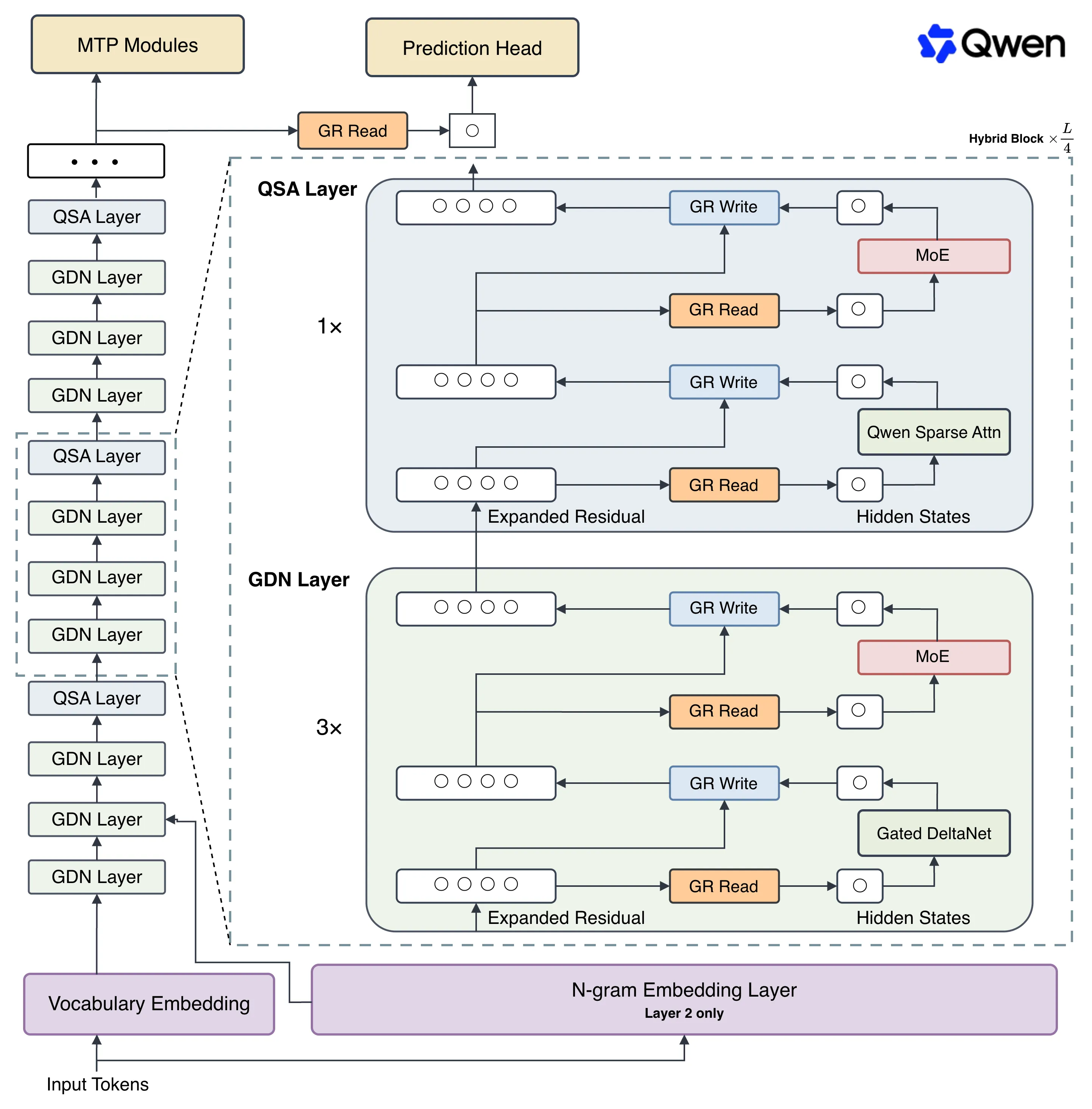
Qwen says Qwen3.8-Flash-Next is also an early preview of the architecture planned for Qwen4. It introduces changes to attention, residual connections, embeddings, and model optimization, with one clear goal: do more work with less compute.
For most users, there is no need to understand every technical detail.
The important changes are easier to explain:
- Around 6B parameters are activated per token
- Context can scale to about 1 million tokens
- Coding and agent benchmarks are stronger
- Multimodal and computer-use capabilities have improved
- QSA reduces the cost of long-context processing
- API pricing is designed for high-volume workloads
Qwen3.8 Flash is not simply another faster model.
It looks increasingly designed for long tasks, AI agents, and workflows that need to process a lot of information.
What Is Qwen3.8 Flash?
Qwen3.8-Flash-Next is a multimodal Mixture-of-Experts (MoE) model.
The main model has 125B parameters, plus another 51B parameters for N-gram embeddings.
But it does not activate the whole model for every token.
Only around 6B parameters are activated per token.
The basic idea is simple:
The model is large, but it only uses the parts it needs for each step.
That is one of the main benefits of an MoE architecture.
Qwen says Qwen3.8-Flash-Next takes only around one ninth of the training cost of Qwen3.7-Plus, while delivering stronger results in coding and office tasks.
For users, this points to a bigger change in AI development.
Models do not always need to become more expensive to become more capable.
Smarter use of compute can matter just as much as model size.
Qwen3.8-Flash-Next supports 262,144 tokens natively and can be extended to around 1 million tokens with YaRN.
That makes it useful for tasks such as:
- long PDFs and reports
- large codebases
- research across many sources
- long-running AI agents
- extended conversations
- cross-document analysis
Long context, however, normally comes with a cost.
The more information a model needs to process, the more expensive attention can become.
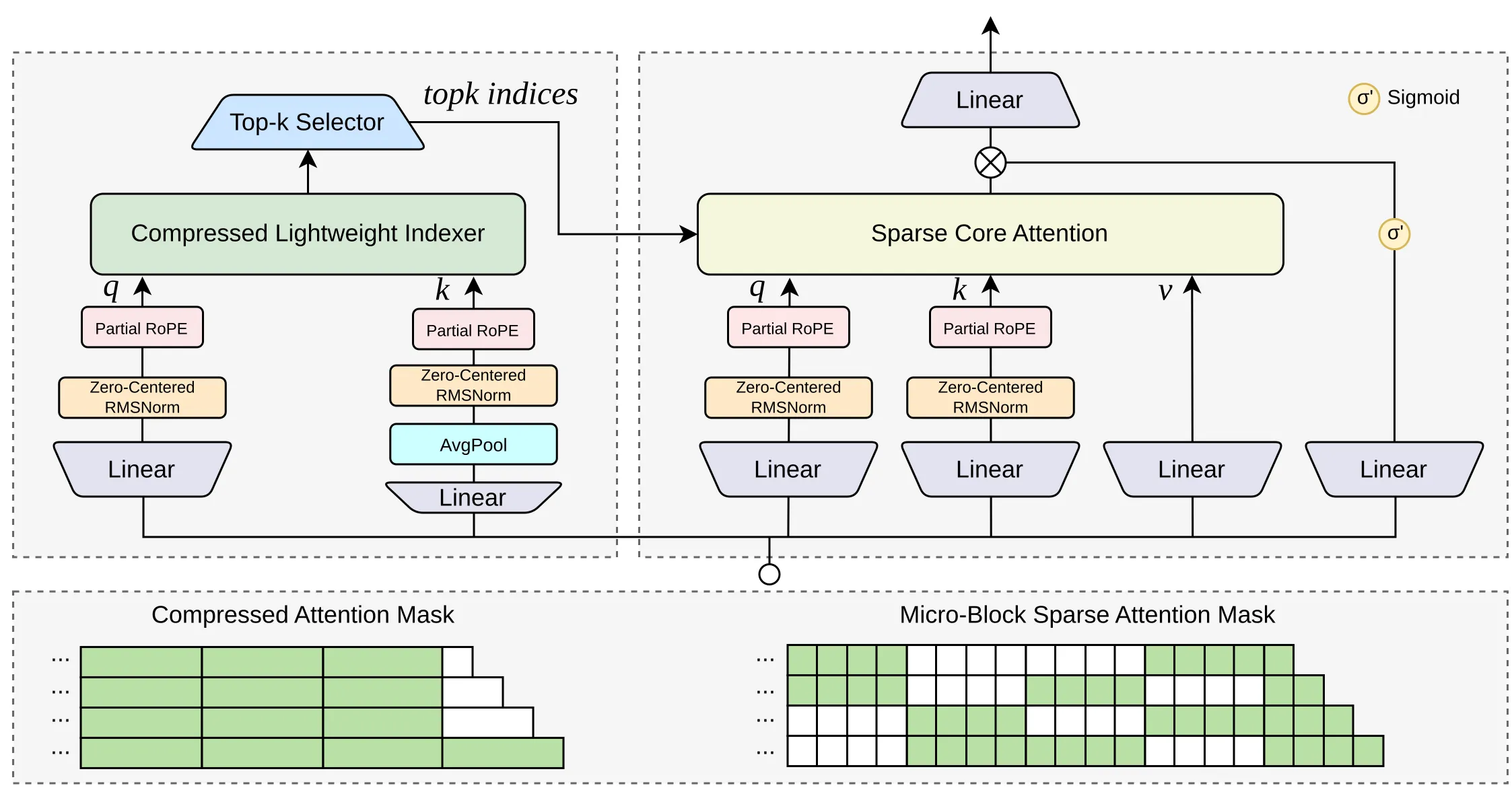
Qwen addresses this with Qwen Sparse Attention (QSA).
Instead of giving the same amount of attention to everything in the context, QSA first identifies the most relevant regions and focuses more compute there.
A simple way to think about it:
Instead of rereading every page of a 500-page book, the model first finds the chapters most likely to contain the answer.
At a 1M-token context length, the QSA Attention Kernel delivered:
- up to 7.6× faster Prefill
- up to 4.9× faster Decode
In a serving test with a 90% Prefix Cache hit rate, Qwen3.8-Flash-Next reached 8.6× the Prefill throughput of Qwen3.7-Plus at 1M tokens.
So the 1M context window is not only about supporting a bigger number.
Qwen is also trying to make long-context AI much more efficient.
How Does Qwen3.8 Flash Perform?
Qwen has published a broad set of benchmark results covering coding, agents, reasoning, and professional tasks.
Some of the most notable results include:
| Benchmark | Qwen3.8-Flash-Next |
|---|---|
| DeepSWE 1.1 | 58.7 |
| SWE-bench Pro | 62.5 |
| SWE-bench Multilingual | 81.0 |
| CoWorkBench | 73.9 |
| JobBench | 55.7 |
| Toolathlon Verified | 73.5 |
| GPQA Diamond | 91.7 |
| LiveCodeBench v6 | 91.9 |
One important point stands out:
Qwen3.8 Flash is not only focused on coding.
It also performs strongly on office work, agent tasks, tool use, and professional workflows.
For example, on CoWorkBench, which measures long-horizon office and productivity tasks, Qwen reports:
| Model | CoWorkBench |
|---|---|
| Qwen3.8-Flash-Next | 73.9 |
| Qwen3.8-27B | 70.7 |
| Claude Opus 4.6 Max | 68.2 |
| Qwen3.7-Plus | 65.1 |
| DeepSeek-V4-Flash-0731 | 45.1 |
These results come from Qwen's published benchmark table. They are useful for comparing performance on specific tests, rather than making a broad claim that one model is better at everything.
Multimodal Performance Is Improving Too
Qwen3.8 Flash is also a multimodal model.
Its official results include:
| Benchmark | Qwen3.8-Flash-Next |
|---|---|
| ClawEval-MM Pass@3 | 64.4 |
| RecreationBench | 49.9 |
| AndroidWorld | 84.5 |
| OSWorld 2.0 Partial | 52.3 |
| Vision2Web | 64.0 |
| ERQA | 72.3 |
The 84.5 score on AndroidWorld is especially interesting.
AndroidWorld measures how well a model can interact with Android environments and complete tasks.
This shows where Qwen is heading.
AI models are moving beyond:
answering a question
toward:
understanding a task, using tools, and completing the work.
That is becoming a major part of the AI agent race.
What Are Reddit and X Users Watching?
Official benchmarks tell one side of the story.
Reddit and X discussions tend to focus more on everyday use.
Over the past few days, several topics have come up repeatedly:
Can a 125B model actually run locally?
What does 6B active really mean?
Can the N-gram embedding table be offloaded to system RAM?
How fast is it with a long context?
On Reddit's LocalLLaMA community, much of the early discussion has focused on quantization, memory requirements, and whether the N-gram embeddings make this architecture easier to run on local hardware.
Early tests are also appearing on X.
One RTX 4090 test using 110GB of system RAM reported around 21 tokens per second of decode speed with a context window of roughly 250K tokens.
Results will naturally vary depending on the quantization, GPU, RAM, offloading setup, and inference software.
But the interesting shift is already clear.
A 100B+ model no longer automatically means:
data center only.
Local AI users are already testing these models on high-end consumer hardware.
Qwen3.8 Flash Is More Than a Coding Model
It is easy to look at SWE-bench and describe Qwen3.8 Flash as another coding model.
The official results suggest something broader.
Qwen is also investing heavily in:
- long-running office tasks
- tool use
- multimodal understanding
- computer use
- mobile agents
- long-context analysis
This matches a larger change in how people use AI.
The old request was often:
"Answer this question."
The newer request is becoming:
"Finish this task."
The second one is much harder.
An AI agent may need to read files, understand a webpage, inspect an image, use a tool, and then continue based on the result.
That is why efficiency and long context matter so much.
For Documents and Research: Try iWeaver
Benchmarks are useful, but most users are not choosing AI tools just to compare scores.
The bigger question is:
How can these model capabilities fit into a real workflow?
If you regularly work with:
- PDFs
- Word documents
- webpages
- images
- audio
- video
- research material
- multiple files
you can try iWeaver.
iWeaver is built for knowledge work and complex content.
It brings different types of information into one AI workspace, where you can move through a workflow such as:
Summarize → Understand → Analyze → Organize → Create
You might upload a long report and extract the key points.
Then add several webpages and compare what different sources are saying.
Or combine meeting audio, PDFs, and images and turn them into structured notes.
These are exactly the kinds of workflows where long context and multimodal AI become useful.
Because users do not really need “1 million tokens.”
They need:
a faster way to turn complex information into something useful.
For Open-Ended Creation: Try XPT
Not every AI workflow starts with an existing document.
Sometimes it starts with an idea.
For example:
- brainstorming
- story writing
- roleplay
- character creation
- image generation
- worldbuilding
- open-ended conversations
For these kinds of tasks, you can try XPT for more on open-ended AI creation and ongoing conversations.
The workflow is closer to:
Idea → Chat → Story → Character → Image → Keep Exploring
If iWeaver is mainly about:
understanding and organizing existing information
XPT is more about:
taking a new idea further
As Qwen, Claude, GPT, Gemini, DeepSeek, and other model families continue to improve, the differences between the underlying models will keep changing.
For everyday users, another question is becoming just as important:
Can the AI product actually help me finish the task?
Why Qwen3.8 Flash Matters
The most interesting part of Qwen3.8 Flash is not one benchmark score.
It is the direction behind the whole release.
Longer context.
Stronger agents.
Better multimodal capabilities.
Lower compute costs.
And a more efficient architecture.
Qwen's published results already show clear gains across coding, office work, tool use, multimodal tasks, and long-context efficiency.
And Qwen3.8-Flash-Next is also an early preview of the architecture planned for Qwen4.
That makes this more than a normal Flash-series update.
It gives us a clear look at where Qwen is going next:
not simply bigger AI, but more capable AI that uses compute more efficiently.