
Qwen3.8-Max has quickly become one of the most discussed AI model releases of 2026.
Alibaba’s Qwen team officially introduced it as the company’s “most capable model to date.” With approximately 2.4 trillion total parameters, Qwen3.8-Max is positioned as a flagship model for autonomous coding, professional work, long-horizon agents, and multimodal intelligence.
The official announcement also provides several details that were missing during the preview period. Qwen has now published API pricing, language and vision benchmark results, examples of long-running agent tasks, and a timeline for releasing open model weights.
The result is more than another chatbot update. Qwen3.8-Max reflects a wider shift from AI models that generate isolated answers to AI agents that can plan, use tools, inspect their own work, and complete complex projects.
What Is Qwen3.8-Max?
Qwen3.8-Max is Alibaba’s latest flagship model in the Qwen family. It is designed for advanced reasoning, software development, multimodal analysis, professional workflows, and autonomous agent tasks.
The model was initially available under the identifier:
qwen3.8-max-preview
The preview gave developers early access but left several questions unanswered, particularly around standard API pricing, open-weight availability, and comprehensive benchmark performance.
Those details became clearer in the official Qwen3.8-Max announcement published on August 3.
Qwen describes the model as a new benchmark for “coding and cowork,” emphasizing four core areas:
- Autonomous software development
- Professional-quality deliverables
- Long-horizon planning and execution
- Native multimodal agent intelligence
Qwen3.8-Max therefore is not positioned merely as a larger conversational model. It is intended to operate as the reasoning engine behind AI systems that work with code, documents, visual interfaces, external tools, and extended task histories.
Qwen3.8-Max Key Features
Approximately 2.4 Trillion Parameters
The headline specification for Qwen3.8-Max is its reported 2.4-trillion-parameter scale.
That makes it one of the largest models publicly announced by the Qwen team. However, total parameters should not be confused with the number of parameters used for every response.
If the model uses a mixture-of-experts architecture, only part of the complete network may be activated for an individual request. Real-world performance also depends on:
- The number of active parameters
- Training data quality
- Reinforcement learning methods
- Tool-use accuracy
- Context management
- Inference infrastructure
- Response latency
- Reliability across repeated tasks
The parameter count demonstrates the model’s scale, but it does not prove that Qwen3.8-Max will outperform every competing model in every scenario.
Autonomous Coding
According to Qwen, Qwen3.8-Max can sustain more than ten days of self-evolving software development.
The company presents an example in which the model moves from an empty folder to a production-ready project with limited human intervention. A public project trace is available through the GitHub repository linked in the official announcement.
This is a more demanding task than generating a short function or fixing a single bug. Long-running autonomous coding may require a model to:
- Understand the product objective.
- Design an appropriate architecture.
- Create and edit multiple files.
- Install or configure dependencies.
- Run tests and interpret errors.
- Review the resulting application.
- Correct implementation problems.
- Continue iterating without losing the original goal.
The demonstration is a vendor-provided example rather than an independent benchmark. Even so, it illustrates the type of extended development workflow Qwen3.8-Max is designed to support.
Long-Horizon Agent Work
Qwen also highlights two unusually long agent scenarios:
- More than 500 turns of chip-design optimization
- A 365-day simulated e-commerce strategy
These examples are intended to demonstrate closed-loop adaptive learning. In this type of workflow, an agent does not simply produce a one-time plan. It repeatedly observes results, updates its strategy, and decides what to do next.
A capable long-horizon agent must preserve important context while avoiding the accumulation of irrelevant history. It also needs reliable memory, progress tracking, tool permissions, validation rules, and recovery mechanisms.
The model is only one part of that system. Agent performance also depends on the surrounding software and workflow design.
Native Multimodal Intelligence
Qwen3.8-Max supports text, image, and video inputs.
Qwen describes vision as a continuous feedback loop rather than a single input channel. A visual agent may repeatedly:
- Observe an interface
- Identify the current state
- Decide on the next action
- Operate a tool
- Inspect the result
- Detect an error
- Correct its previous action
This is particularly relevant to browser automation, software testing, document processing, interface review, and workflows that combine written instructions with visual information.
One-Million-Token Context
Public Qwen Code integration records have listed a context window of approximately one million tokens for Qwen3.8-Max.
A context window of this size can support:
- Large software repositories
- Collections of research papers
- Lengthy business documents
- Extended agent histories
- Multiple files and data sources
- Long videos or transcripts
However, more context does not automatically produce a better answer. Very large inputs can increase latency and make it more difficult for the model to focus on relevant evidence.
For better results, users should still organize their materials, remove unrelated information, summarize completed stages, and ask the model to cite the files or passages supporting important conclusions.
Qwen3.8-Max Language and Agent Benchmarks
Qwen published an official benchmark chart comparing Qwen3.8-Max with Opus 4.8, Fable 5, GPT-5.6 Sol, and Qwen3.7-Max.
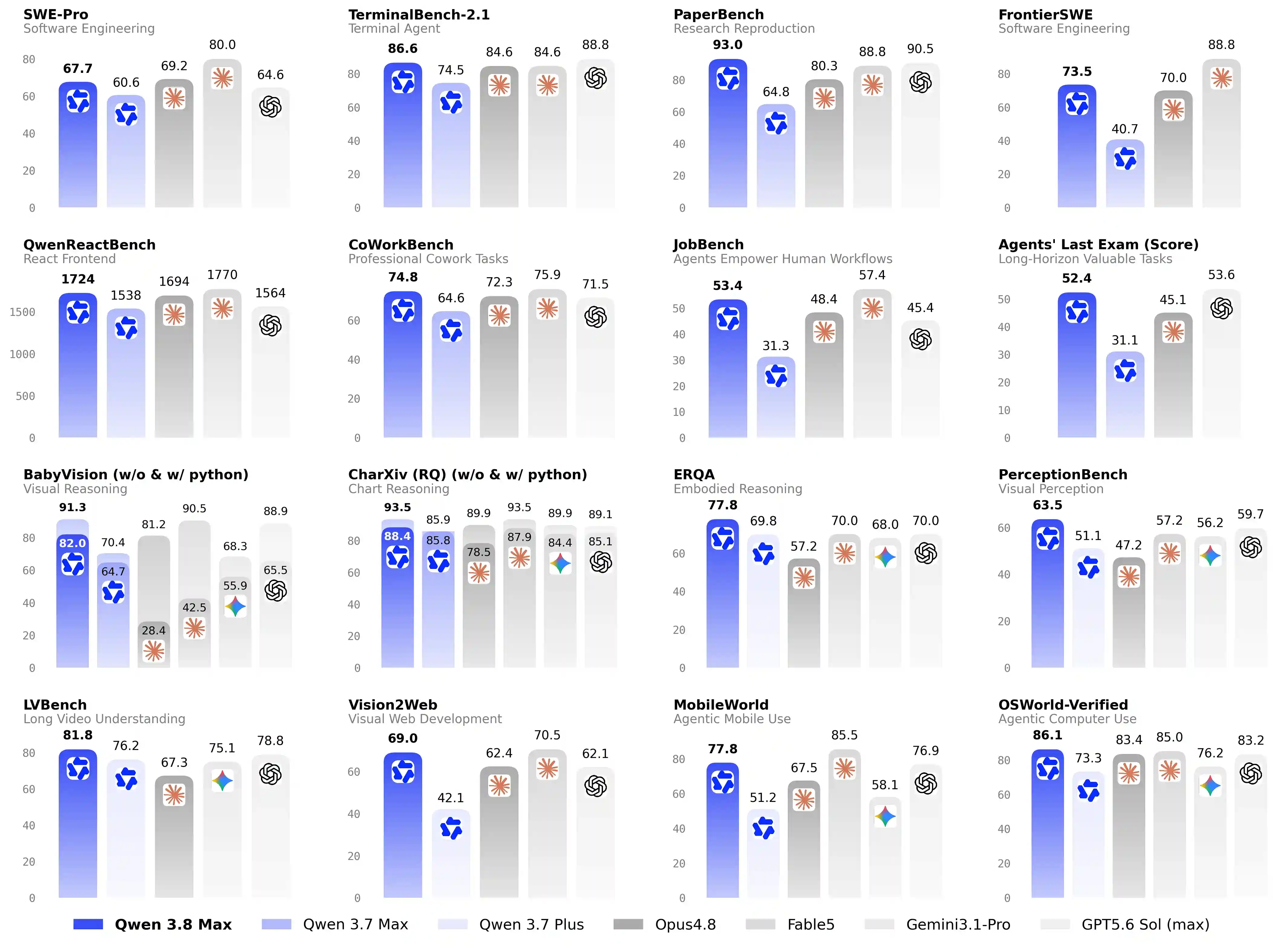
Selected Qwen3.8-Max results include:
| Benchmark | Qwen3.8-Max score |
|---|---|
| Terminal Bench 2.1 | 89.8 |
| FrontierSWE | 73.5 |
| PaperBench | 83.0 |
| AndroidBench | 75.1 |
| QwenSWEBench | 80.7 |
| QwenCoderBench | 58.4 |
| QwenReactBench | 1,724 |
| QwenSVGBench | 1,713 |
| CoWorkBench | 74.8 |
| WorkSpaceBench | 67.7 |
| JobBench | 53.4 |
| SkillsBench | 70.2 |
| GPQA Diamond | 92.6 |
| MMLU-Pro | 92.9 |
| LongBench v2 | 68.3 |
The chart indicates substantial gains over Qwen3.7-Max in several categories.
For example, the reported Terminal Bench 2.1 score rises from 74.5 for Qwen3.7-Max to 89.8 for Qwen3.8-Max. Its CoWorkBench result increases from 64.8 to 74.8, while WorkSpaceBench rises from 61.4 to 67.7.
The model also reports strong general-reasoning results, including 92.6 on GPQA Diamond and 92.9 on MMLU-Pro.
Qwen3.8-Max does not lead every benchmark in the table. Other models retain higher scores in some software engineering and professional-agent evaluations. The results therefore support describing Qwen3.8-Max as highly competitive, but not universally superior.
These figures were published by Qwen. Independent testing is still necessary before drawing conclusions about production performance.
Qwen3.8-Max Multimodal Benchmarks
Qwen released a separate benchmark chart covering multimodal reasoning, visual agents, document intelligence, spatial understanding, visual grounding, and video tasks.
Selected results include:
| Benchmark | Qwen3.8-Max score |
|---|---|
| MMMU-Pro | 82.3 |
| MathVision | 95.2 / 97.7 |
| LogicVista | 91.9 |
| SLAKE | 90.8 |
| OSWorld-Verified | 86.1 |
| AndroidWorld | 85.3 |
| Parametric CAD Bench | 91.5 |
| OmniDocBench 1.5 | 92.1 |
| RealWorldQA | 88.0 |
| MMStar | 85.9 |
| CountQA | 82.4 |
| Dense200 | 87.0 |
| VideoMME with subtitles | 90.4 |
| VideoMMMU | 88.7 |
| MLVU | 90.8 |
The results suggest that Qwen3.8-Max is not simply a language model with an image-upload feature. It is being optimized for tasks where visual information affects planning and tool use.
Benchmarks such as OSWorld-Verified and AndroidWorld test parts of this agent workflow. They require the model to understand an interface and determine how to interact with it.
Qwen3.8-Max reports strong performance across many of these evaluations, although it does not lead every visual-agent benchmark. High scores in document understanding or visual question answering also do not automatically guarantee reliable computer control.
Watch Qwen3.8-Max in Action
Want a closer look at Qwen3.8-Max and how it compares with other leading open models? Watch the video below for a practical breakdown of its capabilities, benchmark performance, and potential real-world applications.
Qwen3.8-Max API Pricing
The official announcement lists the following API prices:
| Usage type | Official price |
|---|---|
| Input | $2.00 per million tokens |
| Output | $6.00 per million tokens |
| Implicit caching | $0.25 per million tokens |
This is an important update from the preview period, when standard per-token pricing was not clearly available.
The implicit caching price may be useful for agents that repeatedly access the same repository, system instructions, company documents, or conversation history.
Actual workflow costs will still depend on:
- Input context size
- Reasoning length
- Generated output
- Number of tool calls
- Failed attempts and retries
- Context caching behavior
- Human review requirements
Companies should therefore calculate cost per completed task instead of comparing models only by their advertised token rates.
A model with inexpensive tokens can still be costly if it requires repeated corrections. A more expensive model may deliver better value if it completes the task correctly on the first attempt.
Is Qwen3.8-Max Open Source?
In its August 3 announcement, Qwen stated that the open weights of Qwen3.8-Max would be released the following week.
The team also announced an open-weight Qwen3.8-27B model.
Until the weights and license are actually published, the most accurate description is:
Qwen has officially announced an imminent open-weight release for Qwen3.8-Max and Qwen3.8-27B. Developers should verify the final repository, license, checkpoints, and deployment requirements once the release becomes available.
Local deployment of a model with 2.4 trillion total parameters would require substantial infrastructure. The smaller 27B model may be more practical for individual developers, research teams, and businesses with limited GPU capacity.
Who Should Use Qwen3.8-Max?
Software Development Teams
Qwen3.8-Max may be useful for:
- Exploring unfamiliar repositories
- Planning architecture changes
- Editing multiple files
- Debugging complex failures
- Running tests
- Building complete applications
- Operating long-running coding agents
Before allowing the model to change production code, teams should test whether it follows repository instructions, uses the correct working directory, limits edits to the requested scope, and validates its changes.
Research and Content Teams
The model’s long context and multimodal capabilities may support:
- Research synthesis
- Competitive analysis
- Document review
- Video analysis
- Knowledge extraction
- Report generation
A tool such as iWeaver can help users collect and organize PDFs, web pages, videos, and other materials before asking an advanced model to compare sources or generate a structured analysis.
The key is to preserve traceability. Important claims should remain connected to their original sources.
Enterprise Automation Teams
Businesses may evaluate Qwen3.8-Max for:
- Internal knowledge assistants
- Customer-support workflows
- Document processing
- Office automation
- Software operations
- Tool-using business agents
Production evaluation should cover security, access controls, data retention, auditability, API stability, concurrency, failure recovery, and total task cost.
For users who need less of an agentic coding platform and more freedom in everyday AI conversations, XPT provides a more flexible, less-restricted chat experience.
Should You Switch to Qwen3.8-Max?
Qwen3.8-Max is worth testing if your workflow involves complex coding, long documents, multimodal analysis, or tools that require multiple rounds of planning and execution.
However, moving directly from a benchmark chart to production deployment would be premature.
A more reliable approach is to create a benchmark containing 20 to 50 tasks from your actual workflow. Compare Qwen3.8-Max with Qwen3.7-Max and at least one other flagship model using the same prompts, source files, tools, and evaluation criteria.
Track:
- Task completion rate
- First-attempt success rate
- Response time
- Tool-use failures
- Human correction time
- Input and output consumption
- Consistency across repeated runs
- Quality of the final deliverable
The best model is not necessarily the one with the most parameters or the highest average benchmark score. It is the model that completes your specific tasks reliably at an acceptable cost.
Final Takeaway
Qwen3.8-Max combines a reported 2.4-trillion-parameter scale with autonomous coding, long-horizon planning, multimodal reasoning, a million-token context window, and competitive API pricing.
The official benchmarks suggest meaningful progress over Qwen3.7-Max in coding agents, professional workflows, general reasoning, document understanding, and visual tasks. Qwen has also announced open-weight releases for both Qwen3.8-Max and Qwen3.8-27B.
The remaining question is not whether the model looks impressive in an announcement. It is whether independent evaluations and real production users can reproduce its reported performance.
For now, Qwen3.8-Max is one of the most important models to watch—and a strong candidate for controlled testing in coding, research, and agent-based workflows.
Frequently Asked Questions
What is Qwen3.8-Max?
Qwen3.8-Max is Alibaba’s flagship AI model for advanced reasoning, autonomous coding, multimodal analysis, and long-running agent workflows. It has approximately 2.4 trillion total parameters.
What is the Qwen3.8-Max API price?
Official pricing is $2 per million input tokens, $6 per million output tokens, and $0.25 per million tokens for implicit caching.
Does Qwen3.8-Max support images and videos?
Yes. Qwen3.8-Max supports text, image, and video inputs. Qwen positions vision as part of a continuous planning and self-correction loop for AI agents.
How large is the Qwen3.8-Max context window?
Public Qwen Code integration information has listed a context window of approximately one million tokens. Actual limits should be verified for the specific platform or API endpoint being used.
Is Qwen3.8-Max open source?
Qwen announced that Qwen3.8-Max open weights would be released after the August 3 announcement. Developers should verify the final repository, license, and checkpoint availability before planning local deployment.
What is Qwen3.8-27B?
Qwen3.8-27B is a smaller model announced alongside Qwen3.8-Max. Qwen has stated that it will also be released with open weights, potentially making it more practical for local or private deployment.