A tarot card meaning is a starting point, not a fixed prediction. A standard tarot deck has 78 cards: 22 Major Arcana and 56 Minor Arcana. Find your card below, then consider its orientation, position in the spread, your question, and the nearby cards before choosing an interpretation.
The meanings in this guide follow common Rider–Waite–Smith-style associations. Artwork and interpretations vary by deck and reader. Tarot can support entertainment and self-reflection; it cannot establish what will happen or replace professional advice.
How to Read a Tarot Card in Context
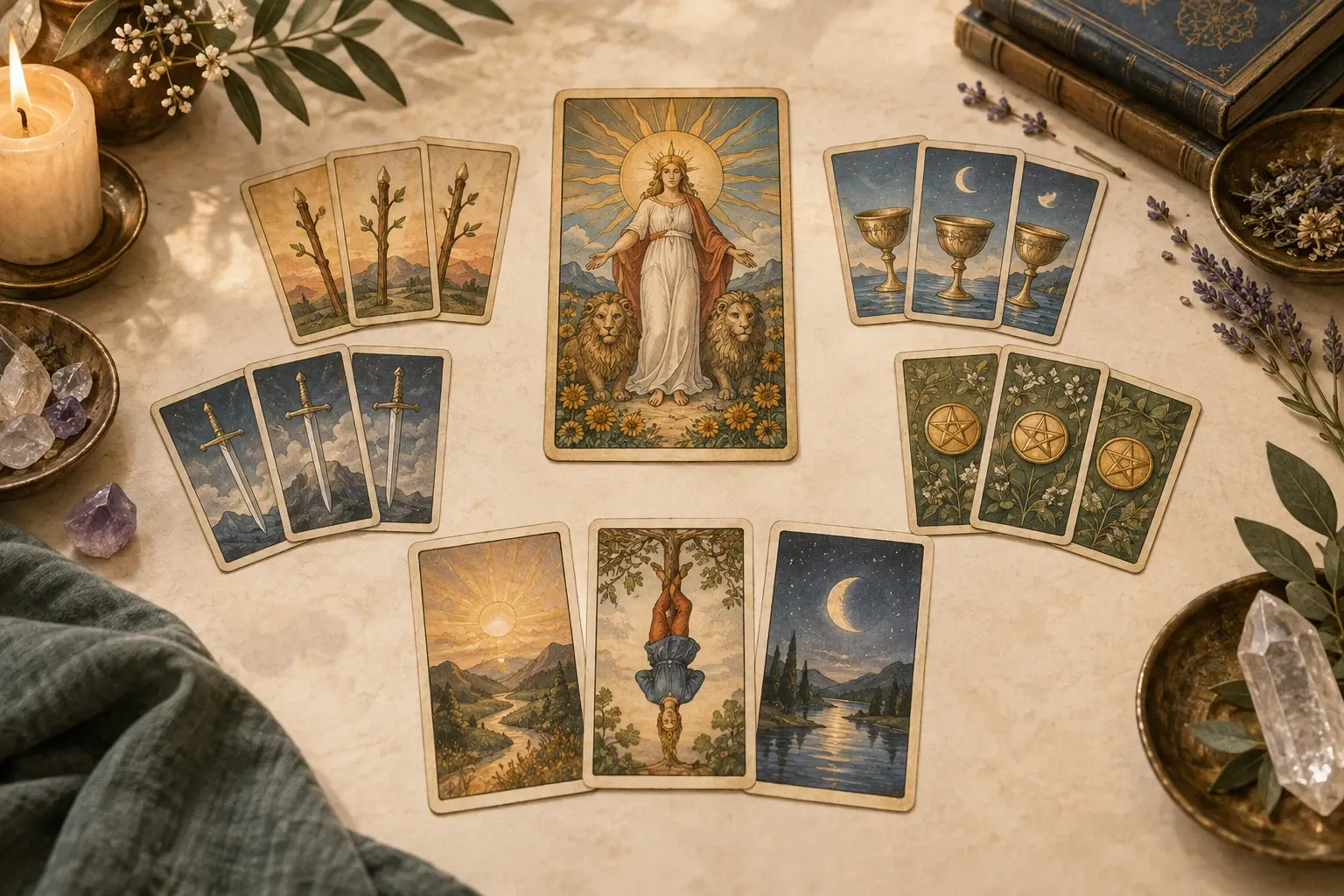
- Find the card. Major Arcana cards often point to broad themes. Minor Arcana cards add detail through their suit, number, or court role.
- Read its spread position. A card in the “challenge” position may invite a different interpretation from the same card in the “advice” position.
- Check its orientation. Start with the upright meaning. If the card is reversed, consider whether its theme feels delayed, internal, excessive, or ready to change. Reversed does not automatically mean bad.
- Return to your question. Ask what the card helps you notice or consider, rather than treating its keywords as a certain outcome.
- Look at neighboring cards. They may reinforce, narrow, or complicate your first interpretation.
For example, imagine a “situation, challenge, advice” spread about a new project: The Magician upright, Two of Pentacles reversed, and Temperance upright. The Magician can suggest skills or resources you already have. Two of Pentacles reversed may raise a question about competing priorities. Temperance can suggest a measured pace. One practical response would be to identify an available resource, reduce one commitment, and choose a manageable first step. The spread does not tell you whether the project will succeed.
Major Arcana Meanings
The 22 Major Arcana cards are commonly used to explore broad themes such as change, choice, responsibility, and growth.
| Card | Upright meaning | Reversed meaning |
|---|---|---|
| The Fool | New beginning, trust, freedom | Recklessness, hesitation |
| The Magician | Skill, action, manifestation | Manipulation, blocked potential |
| The High Priestess | Intuition, mystery, inner knowing | Secrets, confusion |
| The Empress | Creativity, nurture, abundance | Dependence, neglect |
| The Emperor | Structure, authority, stability | Control, rigidity |
| The Hierophant | Tradition, guidance, learning | Restriction, rebellion |
| The Lovers | Choice, alignment, relationship | Misalignment, imbalance |
| The Chariot | Willpower, movement, victory | Scattered energy |
| Strength | Courage, patience, compassion | Self-doubt, force |
| The Hermit | Reflection, solitude, wisdom | Isolation, avoidance |
| Wheel of Fortune | Change, cycle, turning point | Resistance, delay |
| Justice | Truth, fairness, accountability | Bias, dishonesty |
| The Hanged Man | Pause, surrender, new view | Stalling, resistance |
| Death | Ending, release, transformation | Fear of change |
| Temperance | Balance, healing, moderation | Excess, impatience |
| The Devil | Attachment, temptation, shadow | Freedom, awareness |
| The Tower | Disruption, truth, collapse | Avoided change |
| The Star | Hope, renewal, inspiration | Doubt, discouragement |
| The Moon | Uncertainty, dreams, illusion | Clarity, fear released |
| The Sun | Joy, success, vitality | Temporary doubt |
| Judgement | Awakening, review, calling | Avoidance, self-judgment |
| The World | Completion, integration | Unfinished business |
Minor Arcana: The Four Suits
The 56 Minor Arcana cards are divided into four suits of 14 cards each. A suit gives you a useful first clue, but the card’s position and your question still matter.
| Suit | Common themes |
|---|---|
| Wands | Energy, creativity, ambition, action |
| Cups | Emotions, relationships, connection, intuition |
| Swords | Thoughts, communication, conflict, decisions |
| Pentacles | Work, resources, home, material concerns |
Wands Meanings
| Card | Upright meaning | Reversed meaning |
|---|---|---|
| Ace of Wands | Spark, inspiration | Delay, low motivation |
| Two of Wands | Planning, vision | Fear, limited view |
| Three of Wands | Expansion, progress | Delays, frustration |
| Four of Wands | Celebration, milestone | Instability |
| Five of Wands | Competition, challenge | Avoidance |
| Six of Wands | Victory, recognition | Ego, doubt |
| Seven of Wands | Boundaries, courage | Exhaustion |
| Eight of Wands | Speed, movement | Delay, scattered action |
| Nine of Wands | Resilience, persistence | Burnout |
| Ten of Wands | Burden, responsibility | Release, overload |
| Page of Wands | Curiosity, spark | Distraction |
| Knight of Wands | Bold action | Impulsiveness |
| Queen of Wands | Confidence, warmth | Insecurity |
| King of Wands | Leadership, vision | Control |
Cups Meanings
| Card | Upright meaning | Reversed meaning |
|---|---|---|
| Ace of Cups | Love, openness | Emotional block |
| Two of Cups | Connection, harmony | Imbalance |
| Three of Cups | Friendship, joy | Gossip, excess |
| Four of Cups | Reflection, reevaluation | Acceptance |
| Five of Cups | Loss, regret | Healing |
| Six of Cups | Memory, kindness | Stuck in the past |
| Seven of Cups | Choices, fantasy | Clarity |
| Eight of Cups | Leaving, growth | Fear of moving on |
| Nine of Cups | Satisfaction, wish | Dissatisfaction |
| Ten of Cups | Harmony, fulfillment | Disconnection |
| Page of Cups | Sensitive message | Immaturity |
| Knight of Cups | Romance, invitation | Moodiness |
| Queen of Cups | Compassion, intuition | Overwhelm |
| King of Cups | Emotional maturity | Repression |
Swords Meanings
| Card | Upright meaning | Reversed meaning |
|---|---|---|
| Ace of Swords | Truth, clarity | Confusion |
| Two of Swords | Stalemate, choice | Decision pressure |
| Three of Swords | Heartbreak, grief | Healing |
| Four of Swords | Rest, recovery | Burnout |
| Five of Swords | Conflict, defeat | Regret |
| Six of Swords | Transition | Resistance |
| Seven of Swords | Strategy, secrecy | Exposure |
| Eight of Swords | Restriction, fear | New perspective |
| Nine of Swords | Anxiety, worry | Hope, support |
| Ten of Swords | Ending, collapse | Recovery |
| Page of Swords | Curiosity, message | Gossip |
| Knight of Swords | Direct action | Rashness |
| Queen of Swords | Boundaries, truth | Coldness |
| King of Swords | Logic, authority | Cruelty |
Pentacles Meanings
| Card | Upright meaning | Reversed meaning |
|---|---|---|
| Ace of Pentacles | Opportunity, money | Missed chance |
| Two of Pentacles | Balance, priorities | Overwhelm |
| Three of Pentacles | Teamwork, skill | Poor collaboration |
| Four of Pentacles | Security, saving | Greed, fear |
| Five of Pentacles | Hardship, lack | Recovery |
| Six of Pentacles | Generosity, help | Imbalance |
| Seven of Pentacles | Patience, investment | Impatience |
| Eight of Pentacles | Practice, craft | Perfectionism |
| Nine of Pentacles | Independence, reward | Dependence |
| Ten of Pentacles | Legacy, stability | Short-term thinking |
| Page of Pentacles | Study, planning | Procrastination |
| Knight of Pentacles | Consistency | Stagnation |
| Queen of Pentacles | Practical care | Overgiving |
| King of Pentacles | Success, leadership | Materialism |
What Does a Reversed Tarot Card Mean?
A reversed card appears upside down in a spread. Readers may interpret it as a blocked, delayed, internal, excessive, or releasing form of the upright theme.
For example, the Four of Swords upright can suggest rest. Reversed, it may prompt you to ask whether you are resisting needed rest or beginning to recover. The Devil reversed may suggest noticing or loosening an attachment. The question and surrounding cards help you decide which interpretation fits. Some readers choose not to use reversals at all.
Use AI to Explore a Reading
An AI interpretation can help you compare possible meanings when you provide the card names, orientations, spread positions, and a focused question. You could ask:
Interpret The Magician upright in the situation position, Two of Pentacles reversed as the challenge, and Temperance upright as advice for a new project. Explain each card in context, offer two plausible readings where the meaning is ambiguous, and suggest three practical reflection questions. Avoid certain predictions.
You can explore iWeaver’s AI Tarot Reading after using this reference. Check any generated interpretation against the cards and your own circumstances. If you are choosing between tools, see this guide to AI tarot reading tools.
How many tarot cards are in a standard deck?
A standard deck has 78 cards: 22 Major Arcana and 56 Minor Arcana. Each of the four Minor Arcana suits contains 14 cards.
What is the difference between Major and Minor Arcana?
Major Arcana cards often frame broad themes. Minor Arcana cards add more specific themes through their suit, number, or court role. Both need the question and spread position to become useful in a reading.
Are reversed tarot cards always negative?
No. A reversed card can suggest delay, inward attention, excess, or release. Consider the full spread before selecting a meaning.
Do I need to memorize all 78 card meanings?
No. Start with the Major Arcana and four suits. Use these tables as a reference while practicing simple one-card or three-card readings.