A company profile should quickly tell readers who you are, what your company does, who you serve, and why they should trust or work with you.
It may appear on your website, in a sales proposal, investor deck, media kit, business directory, or partnership document. The format can change, but the essential information stays largely the same.
If you're wondering what to include in a company profile, these nine sections are a practical starting point.
What Should a Company Profile Include?
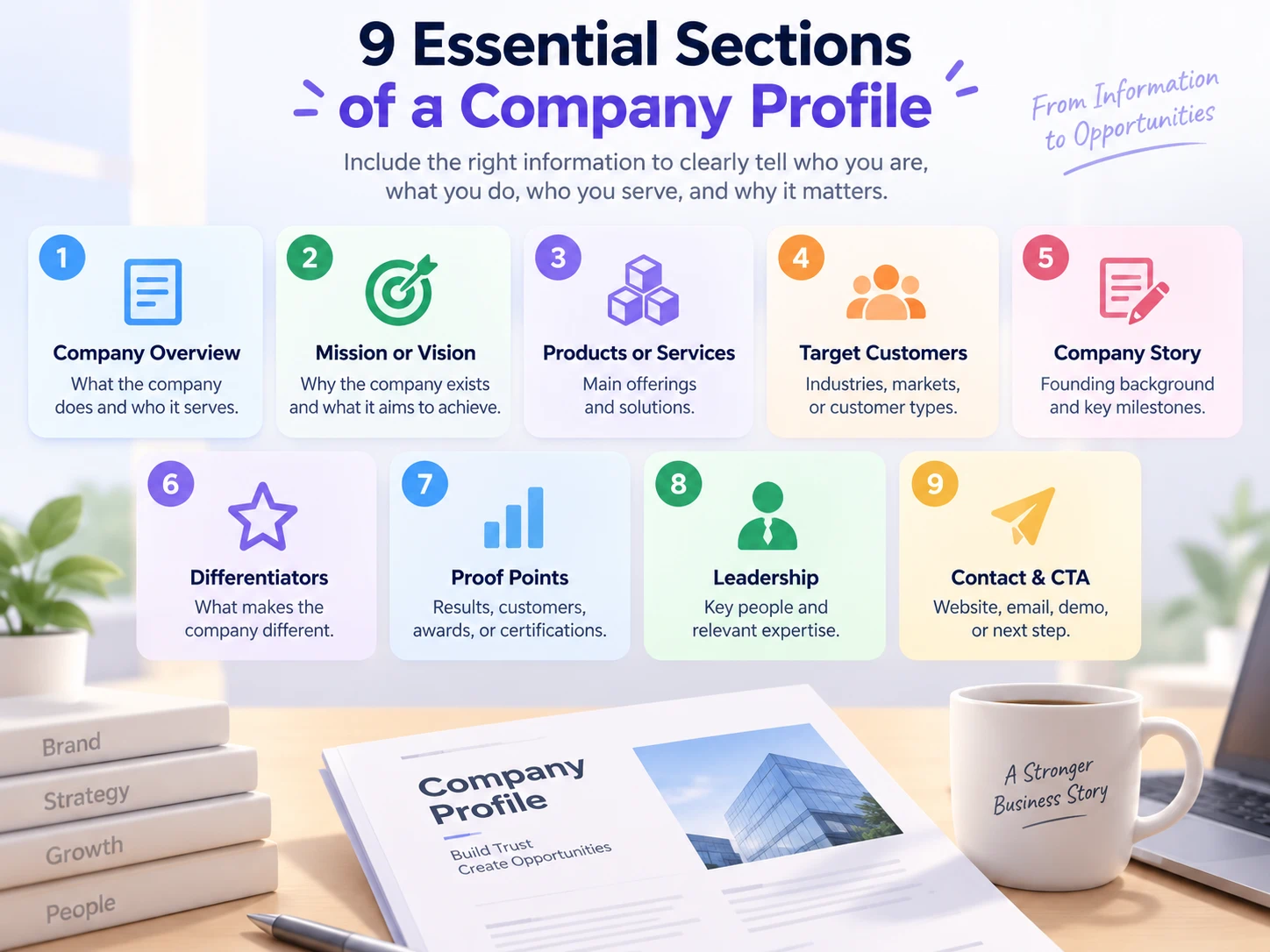
You don't need every section in every profile. A 150-word business introduction will naturally contain less information than a full corporate profile.
1. Start With a Clear Company Overview
The opening should explain your business in one or two sentences.
Answer three basic questions:
- What does your company do?
- Who does it serve?
- What problem does it solve?
Avoid generic openings such as “We are an innovative industry leader committed to excellence.”
Be specific instead:
BrightPath is a project management platform that helps small and mid-sized marketing teams plan campaigns, manage approvals, and track deadlines in one workspace.
Readers immediately know what the company offers and who it is for.
2. Add Your Mission or Vision
Your mission explains why the company exists, while your vision describes what you want to achieve over time.
You don't always need both.
For a short profile, one meaningful sentence is usually enough:
Our mission is to help independent retailers manage inventory without relying on complicated enterprise software.
Keep it connected to what your company actually does rather than using broad statements that could describe almost any business.
3. Explain Your Products or Services
Next, tell readers what you sell or provide.
For companies with several offerings, group them into simple categories rather than listing every feature.
For example:
- Consulting: Business strategy and operational planning
- Software: Tools for managing everyday workflows
- Implementation: Setup, migration, and integrations
- Training: Employee onboarding and workshops
- Support: Ongoing customer and technical assistance
Someone unfamiliar with your brand should be able to understand each offering without knowing your internal product names.
4. Identify Your Target Customers
Explain who your products or services are designed for.
Depending on your business, you might mention:
- Industries
- Company sizes
- Job roles
- Geographic markets
- Consumer groups
- Common use cases
For example:
We primarily work with e-commerce brands, online retailers, and marketplace sellers in North America and Europe.
This helps potential customers quickly decide whether your company is relevant to them.
5. Tell the Relevant Part of Your Company Story
You don't need to include your entire history.
Focus on details that explain how the business became what it is today, such as:
- Founding year
- Why the company was created
- Important milestones
- Product launches
- Market expansion
Keep this section short unless your company history itself is important to the brand.
6. Show What Makes Your Company Different
A strong company profile explains why someone might choose your business over alternatives.
Useful differentiators can include:
- Specialized expertise
- Proprietary technology
- Unique workflows
- Faster implementation
- Industry certifications
- Global coverage
- Integrations
- Customer support
Avoid unsupported phrases such as “best-in-class” or “world-leading.”
Specific details are stronger:
Every enterprise customer receives a dedicated onboarding specialist during implementation.
7. Support Your Claims With Proof
Proof points make a company profile more credible.
Consider including:
- Number of customers
- Customer results
- Case studies
- Testimonials
- Certifications
- Awards
- Partnerships
- Years of experience
- Major milestones
Only use information that is accurate and approved for public use.
If you don't have impressive statistics yet, don't invent them. A clear explanation of your business is more valuable than unsupported claims.
8. Introduce Key Leadership
A leadership section is particularly useful for consulting firms, agencies, startups, professional services companies, and investor-facing profiles.
Keep each introduction relevant and concise:
Sarah Chen, Co-Founder & CEO — Former retail operations leader with 12 years of experience in inventory management and supply-chain technology.
You usually don't need to include everyone's full résumé.
9. End With Contact Information and a Next Step
Don't leave interested readers wondering what to do next.
Your company profile can end with:
- Website
- Phone number
- Office location
- Request a demo
- Book a consultation
- Sales or media contact
Choose a CTA that matches the purpose of the profile.
Company Profile Example
Here is a simple example:
BrightPath is a cloud-based project management platform for small and mid-sized marketing teams.
Founded in 2022, BrightPath was created to simplify campaign management for teams working across spreadsheets, email, and disconnected tools.
The platform combines campaign planning, task management, content approvals, document sharing, and reporting in one workspace. It serves marketing agencies, e-commerce brands, and in-house marketing departments.
Unlike general-purpose project management software, BrightPath focuses on marketing workflows with built-in campaign templates and content approval tools.
Today, more than 1,500 teams use BrightPath to manage their marketing projects.
The example is short, but it covers the company, product, audience, background, differentiator, and proof point.
How to Create a Company Profile With iWeaver
Company information is often scattered across websites, presentations, PDFs, product documents, reports, and internal notes. Before writing, you first need to identify which details actually belong in the profile.
With iWeaver, you can upload existing company materials and use the Company Profile Generator to organize them into a structured profile.
For example, ask iWeaver to extract:
- Company overview
- Products and services
- Mission
- Target customers
- Business milestones
- Differentiators
- Proof points
- Leadership information
You can also use an AI Document Summarizer to review longer business documents before creating your final profile.
A useful instruction is:
Create a professional company profile using only the information provided. Include an overview, products or services, target customers, differentiators, proof points, and relevant company background. Flag missing information instead of inventing facts.
Afterward, adapt the master profile for your website, proposals, presentations, directories, or partner introductions.
Simple Company Profile Template
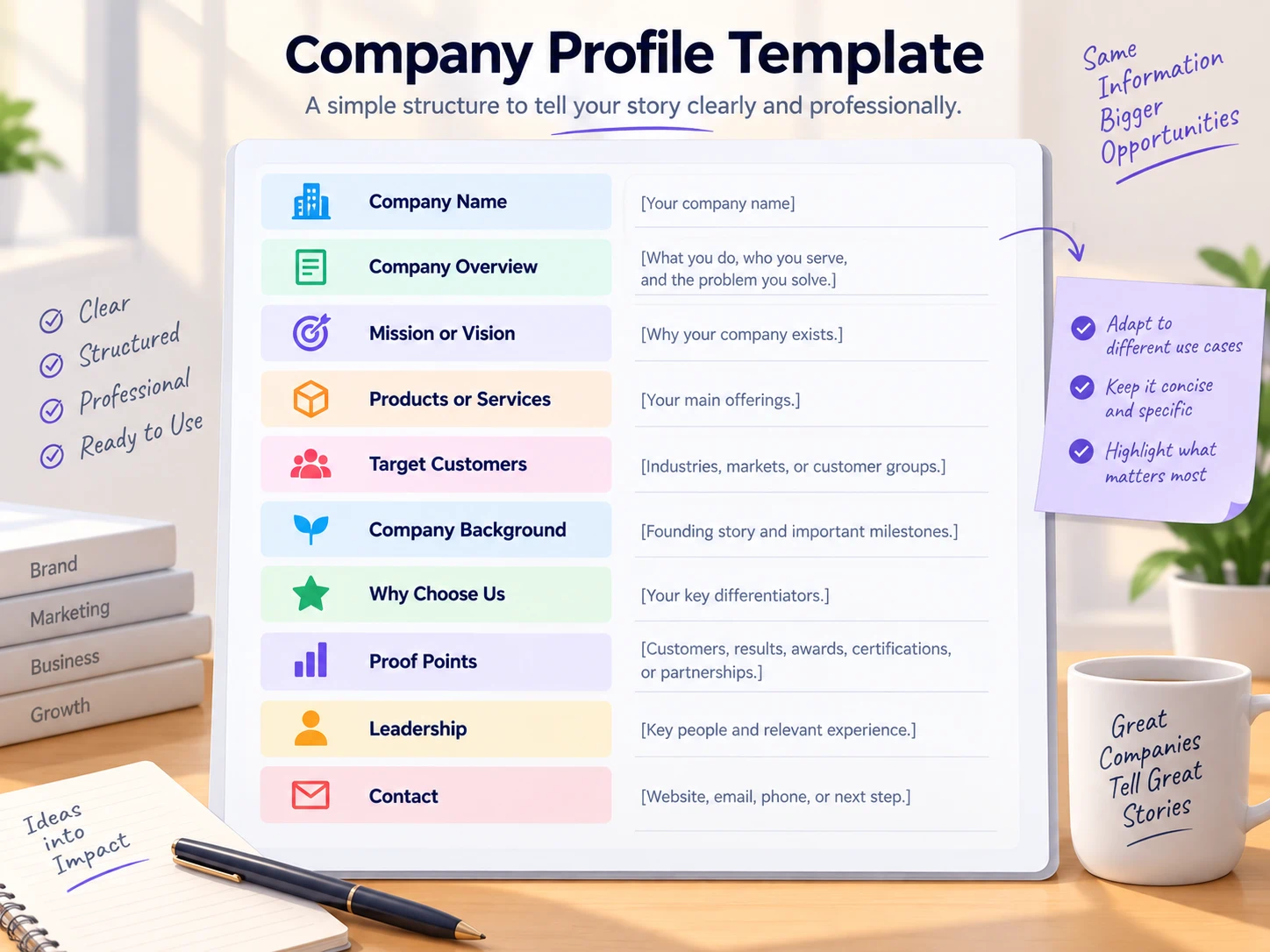
Company Name:
[Company name]
Company Overview:
[What you do, who you serve, and the problem you solve.]
Mission:
[Why your company exists.]
Products or Services:
[Your main offerings.]
Target Customers:
[Industries, markets, or customer groups.]
Company Background:
[Founding story and important milestones.]
Why Choose Us:
[Your key differentiators.]
Proof Points:
[Customers, results, awards, certifications, or partnerships.]
Leadership:
[Key people and relevant experience.]
Contact:
[Website, email, phone, or CTA.]
How long should a company profile be?
It depends on the use case. A short business introduction may be 100–250 words, while an About page or detailed corporate profile can be 500–1,000 words or longer.
What is the most important part of a company profile?
The company overview. Readers should quickly understand what your company does, who it serves, and what makes it relevant.
Should a company profile include mission and vision?
Include them when they provide useful context. For shorter profiles, a concise mission statement is often enough.
Can I use the same company profile everywhere?
It's better to maintain one master profile and adapt it for different channels. A sales proposal, About page, media kit, and business directory usually require different lengths and emphasis.
Can AI create a company profile from existing documents?
Yes. You can provide company presentations, PDFs, website copy, product information, and reports, then use AI to extract and organize the relevant facts. Always review names, statistics, dates, and claims before publishing.