What Is a Responsible AI Study Guide?
A responsible AI study guide helps students use AI in ways that support learning, protect privacy, and respect academic expectations. It gives students a practical process for deciding when to use AI, how to check outputs, and how to keep ownership of their work.
Responsible AI is not only about avoiding cheating. It is also about building better judgment. Students need to know when an output may be wrong, when a source needs checking, when a prompt gives away too much private information, and when support has become substitution.
Why Responsible AI Study Habits Matter
AI can help students understand difficult material faster. It can generate practice questions, explain confusing steps, summarize notes, organize research, and plan study time.
But speed can be misleading. A fast answer is not always a correct answer. A fluent explanation is not always complete. A helpful outline is not the same as original work. Responsible study habits help students keep the benefits while reducing the risks.
For U.S. students, responsible AI habits also help navigate different classroom policies. Some teachers welcome AI for practice. Some allow it only with disclosure. Some prohibit it for certain assignments. A responsible workflow makes students more prepared for all three situations.
The Responsible AI Study Workflow
Before: Set the Purpose
Students should decide what kind of support they need before using AI. Good purposes include:
- Explain a concept
- Create practice questions
- Summarize notes
- Organize research
- Give feedback
- Plan study time
- Compare ideas
Weak purposes include:
- Write my essay
- Do my homework
- Give me the answer
- Make this sound like I did more work
The purpose shapes the prompt. A clear purpose keeps the session focused on learning.
During: Verify and Question
Students should read AI output actively. That means asking:
- Does this match my class notes?
- What source supports this claim?
- Is anything missing?
- Is the answer too confident?
- Could there be another viewpoint?
- Do I understand this well enough to explain it?
iWeaver can help students work from uploaded notes, PDFs, and readings, which gives them a stronger base for checking explanations and summaries.
After: Reflect and Own the Work
After using AI, students should name what changed in their understanding. This can be short:
“Used iWeaver to explain the difference between meiosis and mitosis, then checked the explanation against biology notes and answered practice questions.”
Reflection helps students show that AI supported learning instead of replacing it.
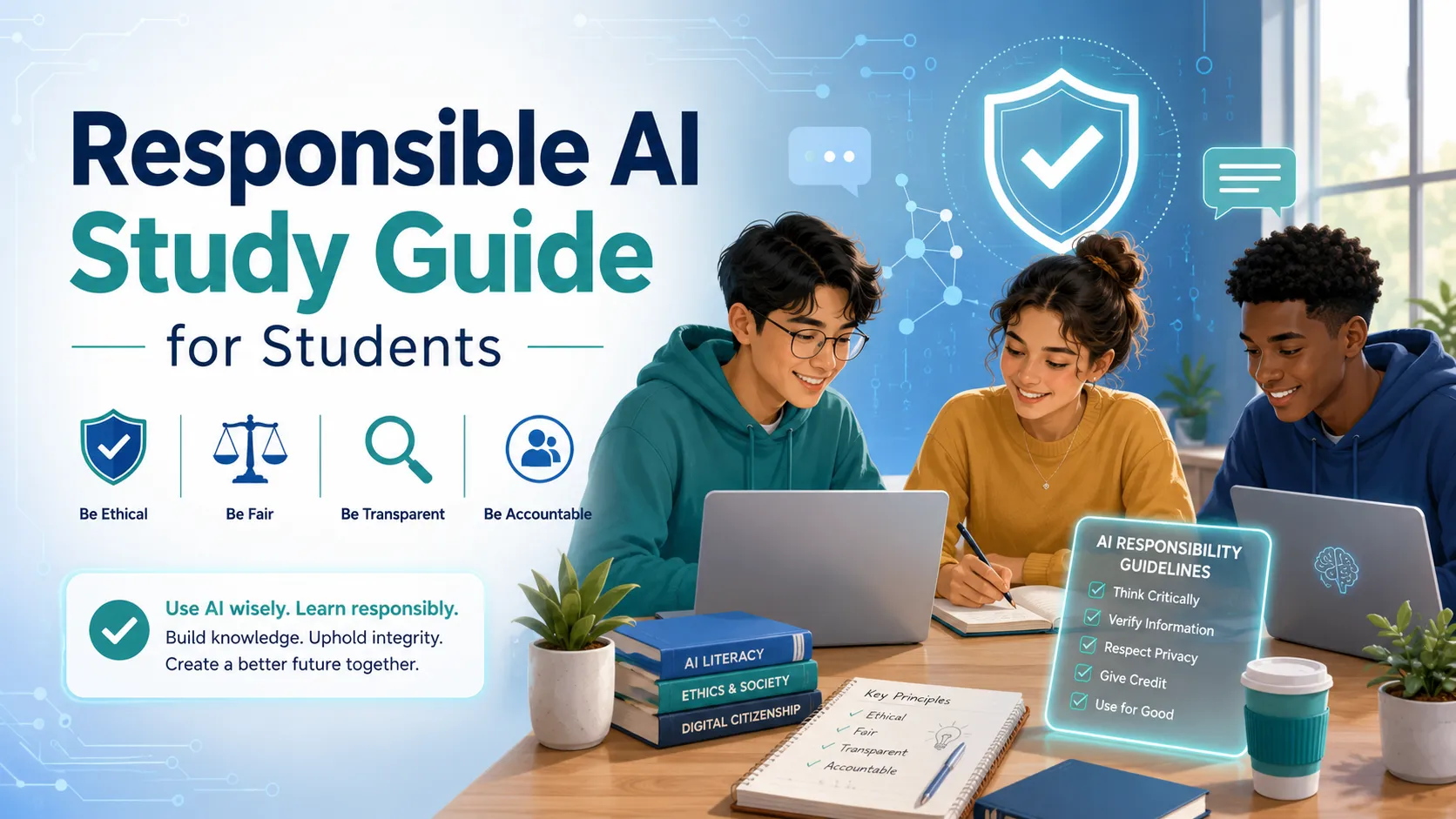
Responsible AI Principles for Students
Keep Learning Central
The goal is not to finish faster at any cost. The goal is to understand more clearly and practice more effectively.
Check Important Information
Students should verify dates, definitions, formulas, citations, statistics, and claims used in graded work.
Protect Personal Data
Students should avoid entering private information, student records, passwords, addresses, or sensitive family details.
Respect Assignment Rules
Teacher instructions matter. Students should check whether AI is allowed, whether disclosure is required, and what kind of support is acceptable.
Watch for Bias
Students should ask whether an answer leaves out perspectives, simplifies unfairly, or treats a contested issue as settled.
Keep Final Ownership
The final submitted work should reflect the student’s thinking, voice, and understanding.
Practical Examples by Study Task
Reading a Difficult Chapter
Responsible use: Ask iWeaver to summarize major ideas after reading, define key terms, and create questions for review.
Risky use: Skip the reading and rely only on a generated summary.
Writing an Essay
Responsible use: Ask for possible angles, counterarguments, outline questions, or feedback on clarity.
Risky use: Submit generated paragraphs as the final essay.
Studying for a Test
Responsible use: Generate flashcards, mock questions, and weak-topic drills from class notes.
Risky use: Use AI during a closed-book exam or quiz.
Doing Research
Responsible use: Organize source notes, identify research gaps, and generate questions to investigate.
Risky use: Cite sources that were not personally checked.
Responsible AI Study Checklist
- I know why I am using AI.
- I checked the assignment rules.
- I did not share private information.
- I verified important claims.
- I checked sources myself.
- I looked for missing perspectives.
- I used my own words and judgment.
- I can explain the final work.
- I disclosed AI use if required.
How iWeaver Supports Responsible Study
iWeaver can support responsible learning because students can connect AI assistance to real study materials. Instead of asking vague questions in isolation, students can upload notes, PDFs, articles, study guides, and lecture materials.
From there, iWeaver can help create summaries, explanations, flashcards, question banks, study plans, and review prompts. Students still need to verify, reflect, and follow classroom rules, but the workflow gives them more structure.
FAQs About Responsible AI Study
What is responsible AI study?
Responsible AI study means using AI to support understanding, practice, and organization while verifying information and keeping ownership of final work.
Can students use AI responsibly for homework?
Yes, when AI is allowed and used for explanation, feedback, planning, or practice rather than answer copying.
Why does source checking matter?
AI can make mistakes or invent details. Students need trusted sources for claims used in graded work.
What should students avoid sharing with AI?
Students should avoid private personal information, passwords, student records, sensitive family details, and confidential school materials.
How can teachers support responsible AI use?
Teachers can give clear rules, model acceptable examples, require reflection, and explain when disclosure is needed.