에이

AI 타로 읽기 온라인 사용법: 초보자 가이드

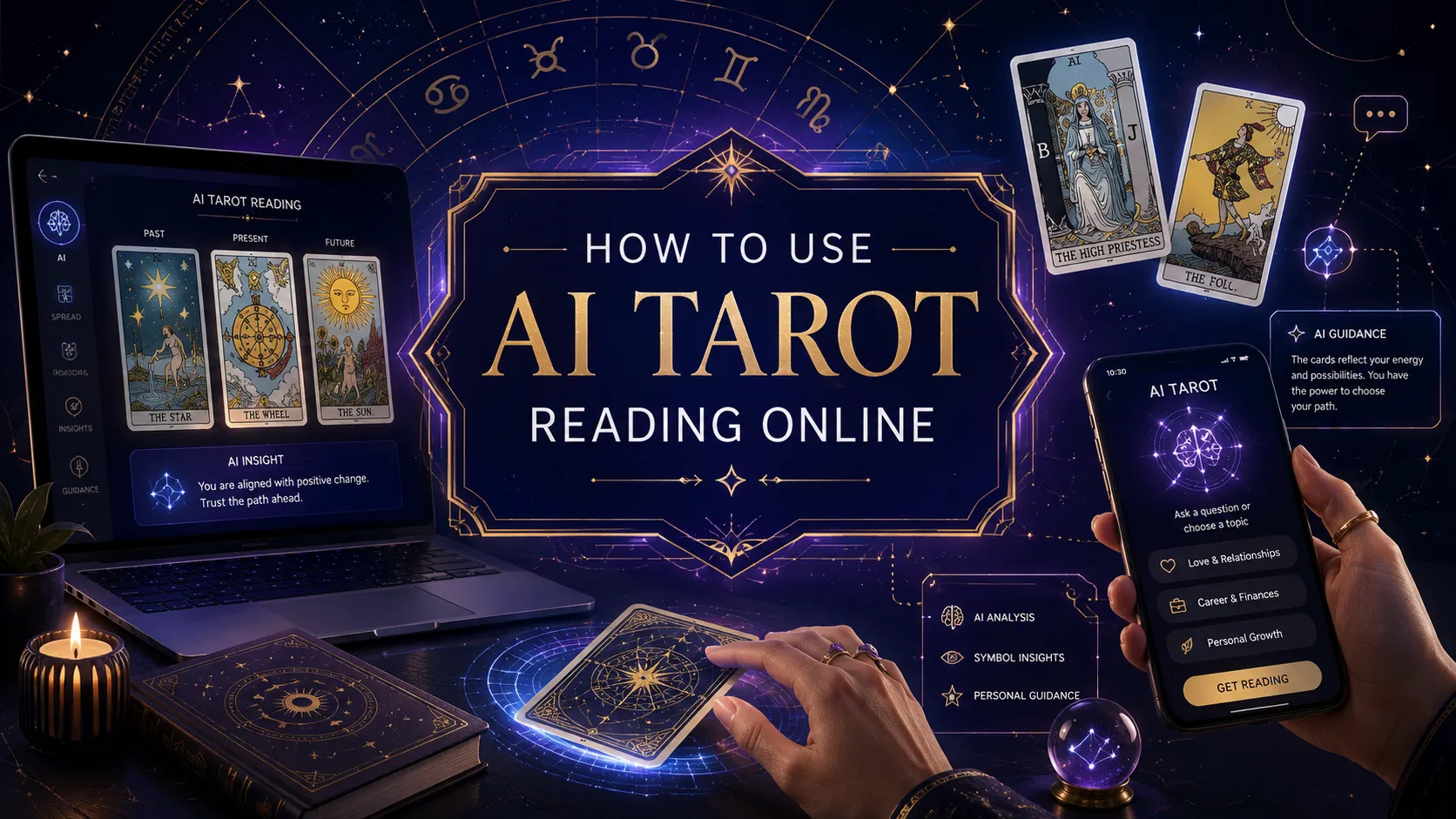
AI 타로 점 온라인 사용법

Learning how to use AI tarot reading online is mostly about three skills: asking a clear question, choosing the right tarot spread, and reading the result as guidance rather than a fixed prediction. AI tarot tools can draw digital cards, interpret card meanings, and connect the reading to your situation in seconds. But the quality of the answer depends heavily on how you use the tool.

This guide explains the process step by step for beginners. You will learn how to prepare your question, select a spread, interpret the result, ask follow-up questions, and use the reading responsibly.

What Is an AI Tarot Reading?

An AI tarot reading is an online tarot experience where artificial intelligence helps generate the interpretation. The tool may let you draw cards from a digital deck, choose a spread, enter a personal question, or upload a photo of your own physical tarot spread.

Most AI tarot readers combine three elements:

  • Traditional tarot card meanings
  • Spread positions, such as “past, present, future”
  • Your specific question or situation

The AI then writes a personalized explanation. Some tools offer simple one-card guidance. Others include decision spreads, relationship spreads, Celtic Cross readings, career readings, daily draws, and follow-up chat.

Current AI tarot platforms often emphasize focused questions, spread selection, and contextual interpretation. This matches how many human tarot readers work too: the cards matter, but the question and layout shape the meaning.

How to Use AI Tarot Reading Online Step by Step

Step 1: Choose a Reliable AI Tarot Tool

Start with a tool that clearly shows how the reading works. A good AI tarot platform should let you:

  • Ask a custom question
  • Choose a spread
  • See which cards were drawn
  • Read each card in context
  • Understand whether the reading is for reflection or entertainment
  • Avoid unnecessary personal data collection

Some online tools offer free one-card readings. Others provide deeper spreads after sign-up or payment. For a beginner, start free and simple. You do not need a complex reading for your first session.

Before entering sensitive personal details, check whether the site has a privacy policy. If a platform asks for your full name, exact birth information, relationship details, or payment information too early, pause and review what you are sharing.

Step 2: Set a Clear Intention

AI tarot works better when you bring a focused intention. You do not need a ritual, but it helps to slow down for a moment.

자신에게 물어보세요:

  • What am I actually trying to understand?
  • Is this about love, career, timing, confidence, or a decision?
  • Do I want reflection, advice, or emotional clarity?
  • Am I looking for permission, or am I looking for insight?

A clear intention gives the AI more useful context. It also helps you avoid treating the reading like a magic answer machine.

Weak intention:
“Tell me everything about my life.”

Better intention:
“I want to understand what I should consider before accepting a new job offer.”

Step 3: Ask a Better Tarot Question

The question is the most important part of an AI tarot reading. A vague question often creates a vague answer. A focused question gives the AI something specific to interpret.

Good tarot questions are usually open-ended, reflective, and action-oriented.

Instead of asking:
“Will my ex come back?”

Try:
“What should I understand about my attachment to this relationship?”

Instead of asking:
“Will I get rich?”

Try:
“What habit or decision may influence my financial stability this year?”

Instead of asking:
“Should I quit my job?”

Try:
“What should I consider before deciding whether to leave my current job?”

Best Ways to Ask AI Tarot Questions

Use “What,” “How,” and “Where” Questions

These question types invite deeper interpretation.

예시:

  • “What energy surrounds this situation?”
  • “How can I approach this decision with more clarity?”
  • “Where am I avoiding the truth?”
  • “What should I focus on this week?”
  • “How can I communicate better in this relationship?”

Avoid Questions That Remove Your Agency

AI tarot is more useful when it helps you think, not when it tells you what to do.

Less useful:

  • “Will I definitely marry this person?”
  • “Is my coworker secretly against me?”
  • “Should I invest all my savings?”
  • “When exactly will I become successful?”

More useful:

  • “What pattern should I notice in this connection?”
  • “How can I protect my energy at work?”
  • “What should I research before making this financial decision?”
  • “What strength can I build during this stage of my career?”

Give Enough Context, But Not Too Much

AI tarot tools can personalize readings when you provide context. But you do not need to overshare.

Good context:
“I am deciding between staying in a stable role or applying for a more creative job. I feel excited but nervous.”

Too much context:
Full names, private messages, addresses, workplace details, financial account information, or deeply sensitive personal history.

A helpful prompt usually includes:

  • The situation
  • The emotional tension
  • The kind of guidance you want

예:
“I am unsure whether to reconnect with an old friend after a conflict. Give me a three-card tarot reading focused on what I should understand, what I should avoid, and what action would be healthiest.”

How to Choose the Right AI Tarot Spread

A tarot spread is the layout of cards. Each card position has a role. The spread you choose should match the size and complexity of your question.

One-Card Spread: Best for Quick Guidance

Use a one-card spread when you want a simple message.

가장 적합한 용도:

  • Daily guidance
  • Emotional check-ins
  • Quick reflection
  • A single focus point
  • 초보자

Example questions:

  • “What should I focus on today?”
  • “What energy should I bring into this meeting?”
  • “What do I need to remember this week?”

A one-card reading is not ideal for complicated relationship or career decisions. It gives a signal, not a full map.

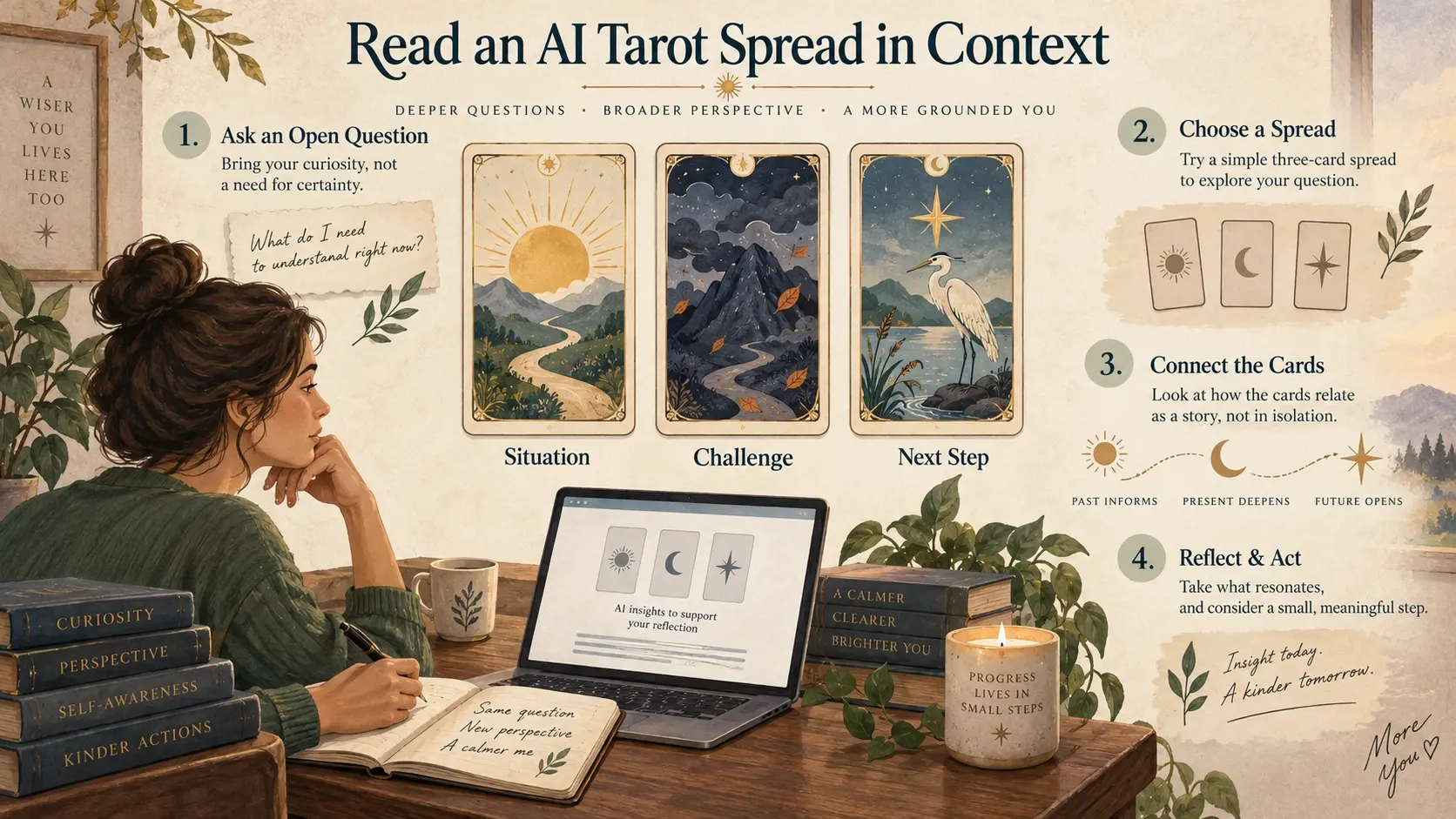
Three-Card Spread: Best for Beginners

The three-card spread is one of the most useful AI tarot spreads because it is simple but flexible.

Common versions include:

  • Past / Present / Future
  • Situation / Challenge / Advice
  • Mind / Body / Spirit
  • Option A / Option B / Guidance
  • What I know / What I do not know / Next step

가장 적합한 용도:

  • Relationship reflection
  • Career uncertainty
  • Personal growth
  • Understanding patterns
  • Small decisions

예시 프롬프트:
“Use a three-card spread: situation, challenge, and advice. My question is: How should I approach my next career move?”

Yes-or-No Spread: Best for a Fast Signal

Many AI tarot tools offer yes-or-no readings. They can be fun, but they are easy to misuse.

가장 적합한 용도:

  • Low-stakes decisions
  • Quick reflection
  • A first impression before deeper analysis

Not ideal for:

  • Medical, legal, or financial decisions
  • Relationship ultimatums
  • Major life choices
  • Questions involving another person’s private thoughts

Better yes-or-no framing:
“Give me a yes-or-no tarot reading, but explain the conditions, risks, and what I should consider before acting.”

Love Tarot Spread: Best for Relationship Reflection

Love spreads are popular because people often seek tarot when emotions feel unclear.

Use them for:

  • Communication patterns
  • Emotional needs
  • Compatibility themes
  • Relationship blocks
  • Healing after conflict

Avoid using AI tarot to spy on someone else’s feelings. A healthier love question focuses on your role, your boundaries, and your choices.

예:
“What should I understand about my role in this relationship dynamic, and what would support healthier communication?”

Career Tarot Spread: Best for Work Decisions

Career spreads can help you reflect on workplace stress, ambition, skill growth, or timing.

Good career questions include:

  • “What should I focus on professionally this month?”
  • “What is blocking my confidence at work?”
  • “What should I consider before changing jobs?”
  • “How can I prepare for a leadership opportunity?”

Use the result as a thinking tool. Do not let a tarot reading replace job research, financial planning, or professional advice.

Celtic Cross: Best for Complex Situations

The Celtic Cross is a larger spread often used for deeper readings. It can include positions for the present situation, challenge, past influence, future direction, conscious focus, hidden influence, advice, external factors, hopes and fears, and possible outcome.

가장 적합한 용도:

  • Complex life transitions
  • Long-running patterns
  • Deep self-reflection
  • Questions with several moving parts

Not best for:

  • First-time users
  • Quick daily readings
  • Simple yes-or-no questions

If you are new to AI tarot, try a one-card or three-card spread first. Move to Celtic Cross when you are ready to sit with a longer interpretation.

How to Interpret AI Tarot Results

Once the AI gives you a reading, do not rush to accept every sentence as truth. Read it actively.

1. Start With the Card Positions

A card means different things depending on where it appears. The same card in a “challenge” position may feel different from that card in an “advice” position.

Ask:

  • What role does this card play in the spread?
  • Is it describing the situation, the obstacle, or the next step?
  • How does this position answer my original question?

2. Look for Patterns Across Cards

Do not interpret each card in isolation. Read the spread as a whole.

Notice:

  • Repeated themes
  • Emotional tone
  • Action words
  • Tension between cards
  • Whether the reading points toward patience, change, honesty, or boundaries

For example, if several cards suggest reflection and pause, the message may be less about immediate action and more about timing.

3. Separate Symbolism From Decision-Making

AI tarot often uses symbolic language. That can be useful, but symbolism should not override common sense.

If the reading says “a new opportunity is opening,” ask yourself:

  • What real opportunities exist right now?
  • What action can I take?
  • What information do I still need?
  • What would a practical next step look like?

4. Notice What Resonates and What Does Not

A reading does not need to be accepted completely. Some parts may feel accurate. Others may feel generic or wrong.

Use a simple three-column reflection:

  • What feels true?
  • What feels uncertain?
  • What action, if any, is worth considering?

This is where iWeaver can support the workflow. You can save AI tarot readings, tag them by theme, and compare them with journal notes, decisions, dreams, or personal reflections. Over time, iWeaver can help summarize recurring patterns instead of letting each reading disappear after the session.

5. Ask One Follow-Up Question

Many AI tarot tools allow follow-up questions. Use this carefully.

Good follow-ups:

  • “Can you clarify the advice card?”
  • “What practical action does this reading suggest?”
  • “What should I avoid misunderstanding?”
  • “Summarize this reading in three grounded takeaways.”

Avoid repeatedly asking the same question until you get the answer you want. That usually creates confusion, not clarity.

Example AI Tarot Reading Prompt

Here is a strong beginner prompt you can use:

“Give me an AI tarot reading using a three-card spread: situation, challenge, and advice. My question is: I am deciding whether to stay in my current job or look for a new role. I want grounded reflection, not a prediction. Please explain each card in context and end with three practical takeaways.”

Why this works:

  • It gives the spread
  • It explains the situation
  • It sets a boundary around prediction
  • It asks for practical takeaways
  • It invites interpretation, not fear

피해야 할 일반적인 실수

Asking the Same Question Too Many Times

Repeating the same reading can make you more anxious. If the first reading is unclear, ask for clarification instead of starting over.

Treating AI Tarot as Certainty

AI tarot can help you think. It cannot guarantee what will happen.

Asking About Other People’s Private Thoughts

Questions like “Does this person secretly love me?” often lead to speculation. Focus on what you can observe and choose.

Making Major Decisions From One Reading

Do not make medical, legal, financial, or safety decisions based on tarot. Use qualified professionals when the stakes are high.

Ignoring Your Own Judgment

If a reading feels wrong, manipulative, or fear-based, step away. Your judgment matters.

A Responsible Way to Use AI Tarot Online

The best AI tarot practice is reflective, private, and grounded.

Try this workflow:

  1. Write your question.
  2. Choose the smallest spread that fits the question.
  3. Read the cards by position.
  4. Save the result.
  5. Write what resonates.
  6. Choose one practical next step.
  7. Revisit the reading later.

This turns AI tarot from a quick novelty into a useful reflection practice. If you already use digital notes, iWeaver can help collect readings, summarize themes, and connect them with related notes or decisions.

마지막 생각

AI tarot reading online is easy to try, but using it well takes intention. Ask better questions. Choose a spread that matches the situation. Read the result as symbolic guidance, not fixed destiny.

For beginners, start with a one-card daily reading or a three-card situation/challenge/advice spread. Keep your prompts specific. Look for patterns across the cards. Save useful readings and reflect on them over time.

Used responsibly, AI tarot can be a practical tool for self-reflection, journaling, creative thinking, and emotional clarity. The goal is not to hand your choices to an algorithm. The goal is to create a clearer conversation with yourself.

Part 4: Curated FAQ Module

Q1: How do I use AI tarot reading online?
Choose an AI tarot tool, enter a focused question, select a spread, draw cards, and read the AI interpretation. Start with a one-card or three-card spread if you are new.

Q2: What is the best AI tarot spread for beginners?
The three-card spread is usually best. Try situation/challenge/advice or past/present/future. It gives more context than one card without becoming overwhelming.

Q3: How should I ask AI tarot questions?
Ask open-ended questions starting with “what” or “how.” For example, ask “What should I consider before changing jobs?” instead of “Will I get a new job?”

Q4: Can AI tarot predict the future?
AI tarot should not be treated as a guaranteed prediction. It can generate symbolic guidance and reflective insights, but it cannot verify future events.

Q5: How do I interpret AI tarot results?
Read each card by its spread position, then look for patterns across the full reading. Focus on practical takeaways, not dramatic predictions.