에이

AI 점술이란 무엇인가요? 호기심 많은 초심자를 위한 실용 가이드

AI 운세

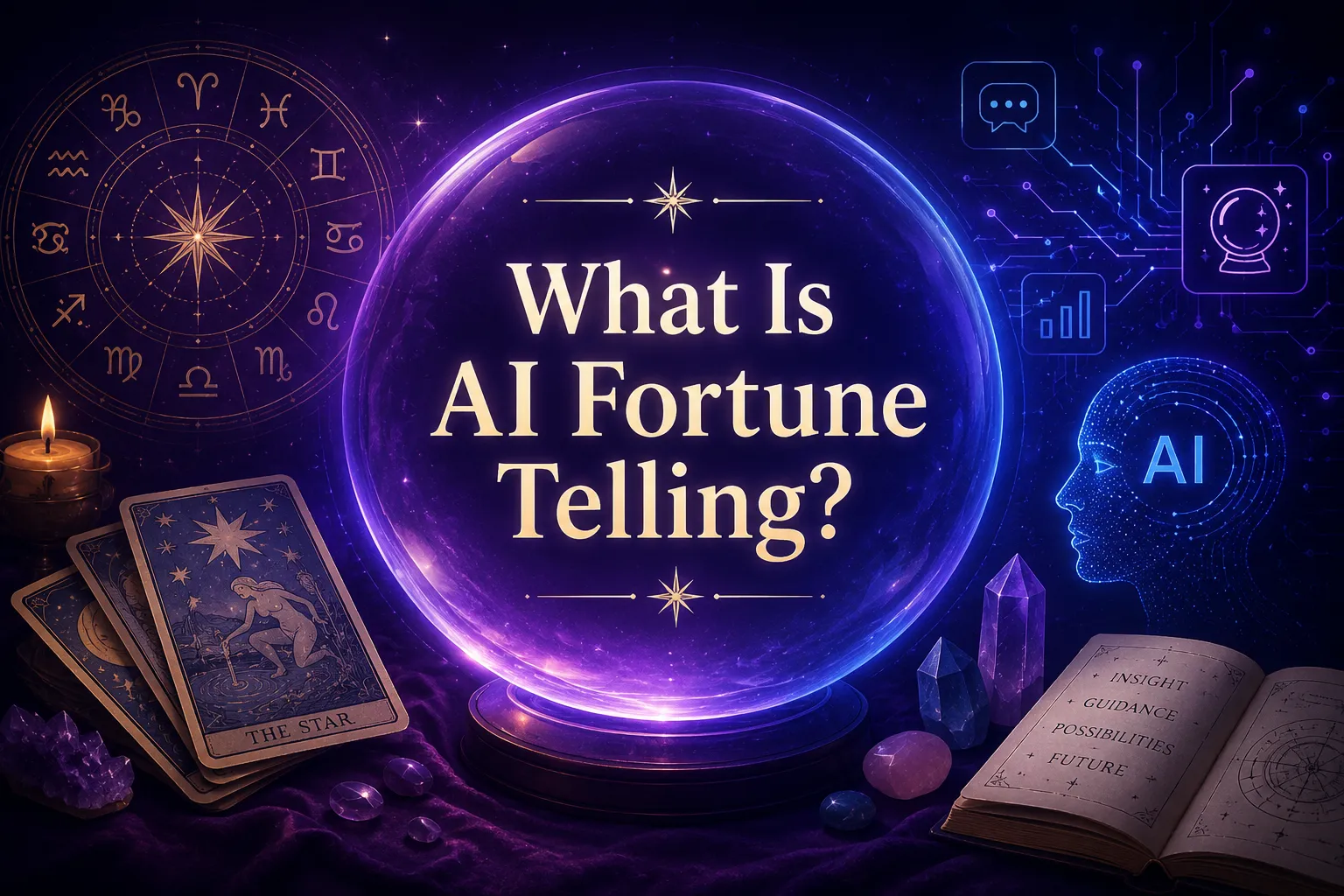
AI fortune telling is the use of artificial intelligence to generate tarot readings, horoscopes, palm readings, dream interpretations, numerology insights, compatibility readings, or other divination-style responses. Instead of visiting a human fortune teller, users ask a question, upload an image, enter birth details, or choose a reading format. The AI then produces a personalized answer in seconds.

For many people, the appeal is not that AI can literally predict the future. It is that AI can turn uncertainty into language. A reading gives users a frame for thinking about love, career, timing, emotions, identity, or personal decisions.

That makes AI fortune telling part entertainment, part self-reflection tool, and part cultural remix. It blends older divination traditions with modern language models, image recognition, chat interfaces, and mobile app design.

What Is AI Fortune Telling?

AI fortune telling refers to digital tools that use AI to imitate or reinterpret traditional fortune-telling methods. These may include:

  • 타로 카드 점
  • Astrology and horoscope readings
  • Palm reading from hand photos
  • Face reading or physiognomy-style interpretations
  • Dream interpretation
  • Numerology
  • Zodiac compatibility
  • Coffee cup reading
  • “Ask the oracle” chat experiences

Traditional fortune telling has long included methods such as palmistry, astrology, dream interpretation, and character analysis. Britannica describes fortune-telling practices as including forms like palmistry and physiognomy, which focus on interpreting physical or symbolic signs. AI tools borrow these formats and turn them into interactive digital experiences.

The “AI” part usually means the system can generate natural-language explanations, adapt the tone to a user’s question, summarize symbolic meanings, or analyze an uploaded image. For example, several current AI fortune-telling apps market themselves around tarot, horoscope, dream, palm, coffee, and compatibility readings.

How Does AI Fortune Telling Work?

Most AI fortune telling tools follow a simple pattern: input, interpretation, and response.

1. The User Provides a Prompt or Personal Detail

The input may be a question such as:

  • “Will I change jobs this year?”
  • “What does this dream mean?”
  • “What should I know about my relationship?”
  • “What does my palm say about my personality?”

Some tools ask for a zodiac sign, birth date, photo of a palm, face image, or card spread selection. Others work like chatbots and let the user type freely.

2. The System Applies a Reading Format

The AI then places the input inside a divination framework. For tarot, it may interpret card positions. For astrology, it may use zodiac traits or birth-chart style language. For palm reading, it may claim to examine lines such as the heart line, head line, life line, or fate line.

In many cases, the tool is not “seeing the future.” It is generating a structured interpretation based on symbols, user input, and patterns in its training or prompt design.

3. The AI Generates a Personalized Reading

The final output is usually written in a warm, reflective style. A good AI fortune telling response often feels specific because it mirrors the user’s question and uses emotionally resonant language.

That is part of the experience. The reading may help someone name a fear, reframe a decision, or notice a pattern. But it should not be treated as medical, legal, financial, or psychological advice.

The safest way to use AI fortune telling is as a mirror for reflection, not as a source of guaranteed prediction.

Popular Ways to Try AI Fortune Telling

AI fortune telling is not one single product category. It appears in several formats across websites, apps, and chat tools.

AI 타로 리딩

AI tarot tools let users choose a spread, draw virtual cards, and receive an interpretation. Some offer one-card pulls for quick reflection. Others provide three-card spreads, Celtic Cross layouts, or themed readings for love, career, and timing.

Common use cases include:

  • Relationship uncertainty
  • Career choices
  • Emotional clarity
  • Daily reflection
  • Yes-or-no questions

AI tarot is popular because the card structure gives the reading a clear beginning, middle, and end.

AI Horoscope and Astrology

AI astrology tools generate daily, weekly, or monthly horoscopes. Some use only a sun sign. More advanced tools may request birth time, birth date, and location to create a birth-chart style reading.

Typical topics include:

  • Love
  • Career
  • Money
  • Health and energy
  • Personal growth
  • 호환성

Users should be aware that astrology-based AI readings vary widely in depth. A short daily horoscope is usually broad and entertainment-focused. A birth-chart style interpretation may feel more detailed, but it still depends on the system’s method and data quality.

AI 손금 읽기

AI palm reading tools often ask users to upload a hand photo. The tool may identify palm lines and generate a personality or life-path interpretation.

This format raises extra privacy questions because it involves biometric-style images. Before uploading a palm or face photo, users should check whether the tool explains how images are stored, processed, deleted, or used.

AI Dream Interpretation

Dream interpretation tools ask users to describe a dream. The AI then identifies symbols, emotions, conflicts, and possible themes.

This can be useful for journaling because dreams are often fragmented. AI can organize the dream into patterns such as fear, transition, unresolved conflict, desire, or memory.

Still, dream interpretation should remain exploratory. A dream is not a diagnosis.

AI Compatibility Reading

Compatibility tools compare zodiac signs, birth details, personality inputs, or relationship questions. They often provide communication tips, emotional themes, and potential friction points.

This can be fun for couples or friends, but it should not replace honest conversation. The healthiest use is to treat it as a conversation starter.

Why Are People Interested in AI Fortune Telling?

The rise of AI fortune telling is not only about technology. It reflects a human need for meaning during uncertainty.

People often look for fortune-telling experiences when they are facing:

  • A relationship decision
  • Career stress
  • A move, breakup, or life transition
  • Anxiety about timing
  • Desire for reassurance
  • Curiosity about identity or personality

The AI format adds convenience. A person can get a reading privately, instantly, and often for free or at low cost. Some apps also make readings visually shareable, which fits social media behavior.

For U.S. users, the category sits at the intersection of wellness, entertainment, spirituality, and AI companionship. Many people do not need the reading to be “scientifically proven” to enjoy it. They want a reflective ritual.

Is AI Fortune Telling Accurate?

This is the most important question, and the honest answer is: AI fortune telling is not reliably accurate as a prediction system.

AI can generate plausible, emotionally intelligent, and highly personalized text. It can identify themes from your prompt. It can organize symbolic meanings. It can imitate the style of a tarot reader, astrologer, or dream interpreter.

But it does not have verified access to your future.

Accuracy in AI fortune telling often means one of three things:

  • The reading feels emotionally relevant
  • The advice is broadly useful
  • The interpretation matches what the user already senses

That is different from objective prediction.

A responsible AI fortune telling tool should make clear that readings are for entertainment, reflection, or personal insight. It should not claim guaranteed outcomes.

Best Use Cases for AI Fortune Telling

AI fortune telling works best when the stakes are low and the goal is reflection.

Self-Reflection

A reading can help users explore questions they have not fully articulated. For example, “What am I avoiding?” may produce more useful insight than “Will I be rich?”

Journaling Prompts

AI readings can become journaling starters. Users can save the reading, highlight themes, and write what feels true or false.

This is where iWeaver can fit naturally. If someone is using AI fortune telling for reflection, they can save readings, dream notes, horoscope patterns, or tarot interpretations into iWeaver as a personal knowledge base. Over time, iWeaver can help summarize recurring themes, compare past reflections, and turn scattered notes into structured insight.

창작 글쓰기

Writers can use AI tarot or astrology prompts to develop characters, conflicts, settings, or plot twists. The symbolic language is useful for brainstorming.

오락

Many users simply enjoy the ritual. A daily card or horoscope can feel like a small reflective pause.

Conversation Starters

Compatibility readings, dream interpretations, or “oracle” prompts can spark discussion among friends, partners, or online communities.

When You Should Not Rely on AI Fortune Telling

AI fortune telling becomes risky when users treat it as authority.

Avoid using it to make major decisions about:

  • Medical treatment
  • Legal disputes
  • Investments
  • Debt or financial planning
  • Immigration
  • 안전
  • Mental health crises
  • Whether to stay in an abusive relationship

If a reading creates fear, dependency, urgency, or pressure to pay for more answers, step back. The tool may be exploiting emotional vulnerability.

Privacy and Safety Tips Before You Try It

Before using an AI fortune telling tool, especially one that asks for photos or sensitive personal details, check the basics.

Read the Privacy Policy

Look for clear answers about:

  • What data is collected
  • Whether prompts are stored
  • Whether images are retained
  • Whether data is sold or shared
  • How to delete your data

Avoid Oversharing

You do not need to provide your full name, address, workplace, financial details, or private relationship information to get a reflective reading.

Be Careful With Photos

Palm, face, and aura-style tools may request images. If the platform does not explain image handling clearly, do not upload sensitive photos.

Watch for Fear-Based Upsells

Be skeptical of messages like:

  • “A curse is blocking your future”
  • “Pay now to prevent disaster”
  • “Only this reading can save your relationship”
  • “You must act today”

These are red flags.

Keep the Reading in Perspective

자신에게 물어보세요:

  • Does this help me think more clearly?
  • Is it making me anxious?
  • Am I using it to avoid a real conversation?
  • Would I make this decision without the reading?

How to Get a Better AI Fortune Telling Reading

The quality of the answer depends heavily on the question.

Weak prompt:
“Tell me my future.”

Better prompt:
“I’m deciding whether to stay in my current job or start looking for a new role. Give me a tarot-style reflection focused on what I may be overlooking.”

Better questions create better reflections because they give the AI context.

Try prompts like:

  • “What pattern should I notice in this situation?”
  • “What should I reflect on before making a decision?”
  • “Give me a symbolic reading for my career uncertainty.”
  • “Interpret this dream as a journaling exercise.”
  • “What question should I ask myself next?”

For serious reflection, save the output and revisit it later. Tools like iWeaver can help organize these readings alongside journal entries, articles, screenshots, or notes. Instead of treating each reading as isolated, you can build a personal archive of recurring themes and decisions.

AI Fortune Telling vs. Human Fortune Telling

AI fortune telling is fast, private, and scalable. Human readers may offer intuition, conversation, cultural context, and emotional nuance.

AI is useful when you want:

  • Instant access
  • Low-cost exploration
  • A private first step
  • Multiple reading styles
  • Structured written output

A human reader may be better when you want:

  • Live dialogue
  • Cultural or spiritual tradition
  • Emotional support
  • A nuanced conversation
  • Accountability around interpretation

Neither should replace professional advice when the stakes are high.

The Bottom Line

AI fortune telling is a modern, AI-powered version of tarot, astrology, palm reading, dream interpretation, and other divination-style experiences. It can be fun, reflective, and surprisingly useful for journaling or creative thinking.

But it should be used with clear boundaries.

Treat AI fortune telling as a symbolic mirror, not a guaranteed forecast. Ask thoughtful questions. Protect your privacy. Avoid fear-based tools. And when the reading touches real-life decisions, use it as one input among many, not the final authority.

For people who enjoy reflection, iWeaver can help turn scattered readings, journal notes, dreams, and personal insights into an organized knowledge base. That is where AI becomes most useful: not in predicting your future, but in helping you understand the patterns you are already living through.

Part 4: Curated FAQ Module

Q1: What is AI fortune telling?
AI fortune telling is the use of artificial intelligence to generate tarot, horoscope, palm reading, dream interpretation, numerology, or compatibility-style readings. It is usually designed for entertainment, reflection, or personal insight rather than verified future prediction.

Q2: Can AI really predict my future?
No AI tool can reliably prove it can predict your future. AI fortune telling generates interpretations based on your input, symbolic systems, and language patterns. Use it as a reflective tool, not as a guaranteed forecast.

Q3: Is AI tarot reading the same as traditional tarot?
AI tarot uses tarot card meanings and spread structures, but the interpretation is generated by software. Traditional tarot readings involve a human reader who may bring intuition, dialogue, and spiritual practice into the session.

Q4: Is AI fortune telling safe to use?
It can be safe if you avoid sharing sensitive information, check the privacy policy, and treat readings as entertainment or reflection. Be careful with tools that request face or palm photos without clear data policies.

Q5: What is the best way to use AI fortune telling?
Use it for journaling, creative thinking, self-reflection, or low-stakes curiosity. Ask specific questions, save useful insights, and compare patterns over time. iWeaver can help organize readings and notes into a structured personal knowledge base.