
Claude Opus 5.5 and OpenAI’s GPT-6 family are now competing for many of the same demanding AI workloads—but they take different approaches.
Anthropic positions Claude Opus 5.5 around long-running agentic coding and professional knowledge work. OpenAI splits GPT-6 across three models: Astra for the hardest end-to-end tasks, Sol for complex coding and agents, and Luna for focused, high-volume workloads.
So the useful comparison is no longer simply Claude vs GPT.
It is:
Claude Opus 5.5 vs GPT-6 Astra, Sol, and Luna—which model fits your actual workload?
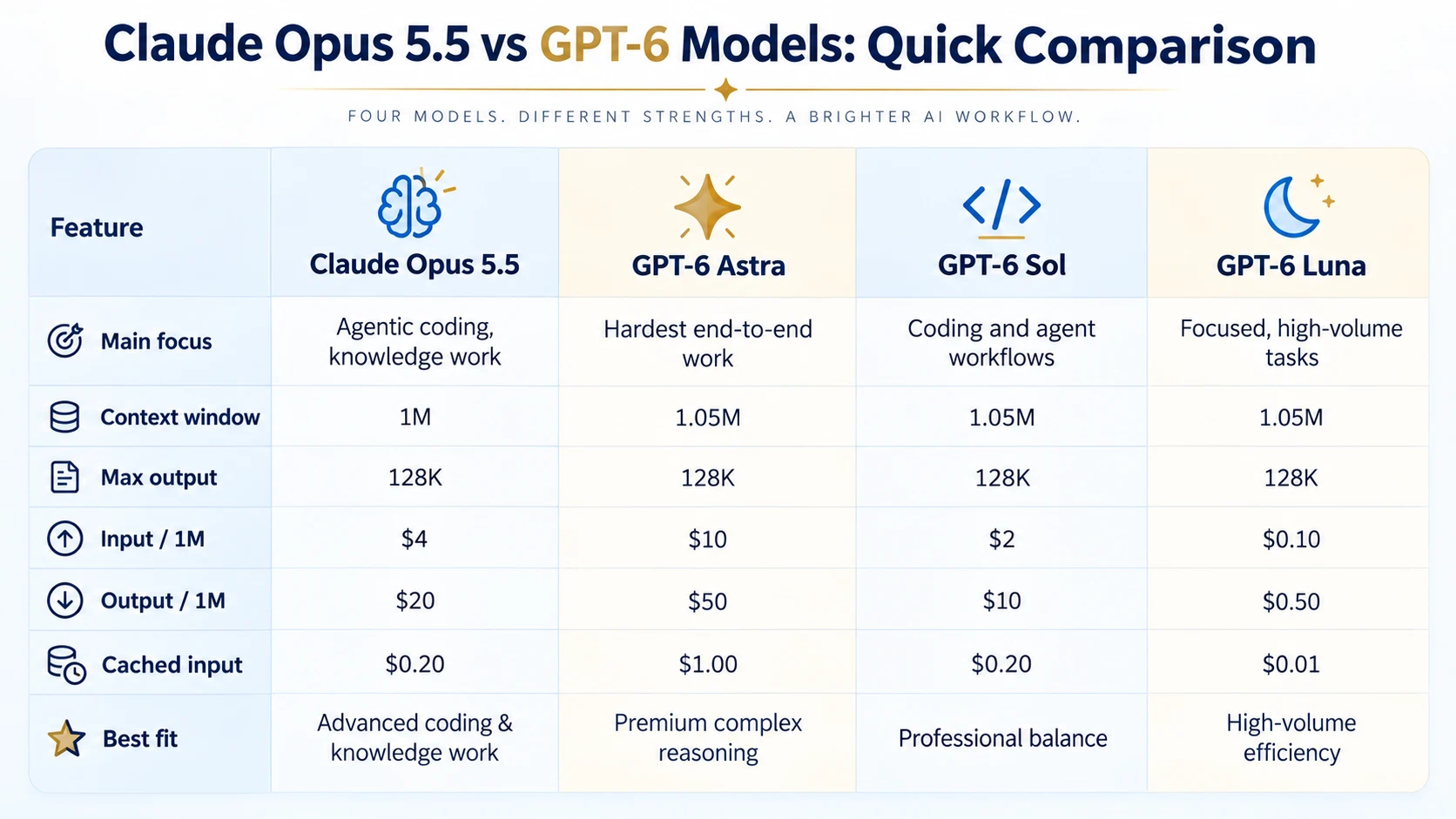
Claude Opus 5.5 vs GPT-6 at a Glance
| Feature | Claude Opus 5.5 | GPT-6 Astra | GPT-6 Sol | GPT-6 Luna |
|---|---|---|---|---|
| Main focus | Agentic coding, knowledge work | Hardest end-to-end work | Coding and agent workflows | Focused, high-volume tasks |
| Context window | 1M | 1.05M | 1.05M | 1.05M |
| Max output | 128K | 128K | 128K | 128K |
| Input / 1M | $4 | $10 | $2 | $0.10 |
| Output / 1M | $20 | $50 | $10 | $0.50 |
| Cached input | $0.20 | $1.00 | $0.20 | $0.01 |
| Knowledge cutoff | June 2026 | Apr. 30, 2026 | Apr. 20, 2026 | May 18, 2026 |
Claude Opus 5.5 supports a 1M-token context window and 128K standard output, while all three GPT-6 models offer a slightly larger 1.05M context window with the same 128K maximum output.
Claude Opus 5.5 vs GPT-6 Astra
GPT-6 Astra is the closest direct comparison to Claude Opus 5.5 when the task involves difficult reasoning, coding, research, or long-running agents.
OpenAI describes Astra as its most capable model for the hardest end-to-end work, including complex reasoning, coding, computer use, research, and document creation. Anthropic describes Opus 5.5 as a model for long-running agentic coding and knowledge work.
The biggest practical difference is price.
Claude Opus 5.5 costs:
- $4 / 1M input tokens
- $20 / 1M output tokens
GPT-6 Astra costs:
- $10 / 1M input tokens
- $50 / 1M output tokens
At standard listed rates, Opus 5.5 therefore costs 60% less per input and output token than Astra.
Astra does offer a slightly larger context window—1.05M versus 1M—but that difference is relatively small compared with the pricing gap.
What Do the Benchmarks Show?
Anthropic’s published Opus 5.5 results include direct comparisons with GPT-6 Astra.
In Anthropic’s testing, Opus 5.5 scored higher on benchmarks including Terminal-Bench 4.0 and FrontierCode v1.1, while GPT-6 Astra scored higher on tests such as AutomationBench and Terminal-Bench-Science 0.1. Anthropic also notes that benchmark differences should be interpreted carefully because testing conditions and statistical uncertainty vary.
That makes it difficult to reduce the comparison to a single overall score.
For real workflows, the better test is often whether the model can finish your coding, research, or agent task reliably—and how much that complete task costs.
Claude Opus 5.5 vs GPT-6 Sol
GPT-6 Sol may actually be the more interesting alternative to Opus 5.5 for many professional users.
Both models are explicitly positioned around coding and agentic workflows.
But their prices differ:
| Model | Input / 1M | Output / 1M |
|---|---|---|
| Claude Opus 5.5 | $4 | $20 |
| GPT-6 Sol | $2 | $10 |
GPT-6 Sol costs half as much per standard input and output token.
It also offers a 1.05M context window compared with Opus 5.5’s 1M. Both support up to 128K output tokens.
This makes Sol worth considering for frequent workloads such as:
- Daily coding
- Code review
- AI agents
- Tool-based workflows
- Research
- Document analysis
- Business automation
Opus 5.5 becomes more interesting when you want Anthropic’s Opus-class reasoning and its focus on long-running agentic tasks, while Sol is positioned as a more cost-conscious option for recurring coding and agent workloads.
Claude Opus 5.5 vs GPT-6 Luna
Claude Opus 5.5 and GPT-6 Luna target very different workloads.
Luna is OpenAI’s most efficient GPT-6 model for focused, high-volume tasks. Its API pricing is only:
- $0.10 / 1M input tokens
- $0.50 / 1M output tokens
That is far below Opus 5.5’s $4 / $20 pricing.
Luna makes more sense for tasks such as:
- Classification
- Information extraction
- Formatting
- Short summaries
- Content processing
- Repetitive automation
Opus 5.5 is aimed at the opposite end of the workload spectrum: complex coding, deeper knowledge work, and tasks that may require sustained reasoning over many steps.
So this is less of a direct model-versus-model contest and more about deciding whether a task needs an advanced reasoning model at all.
Pricing: Where Each Model Fits
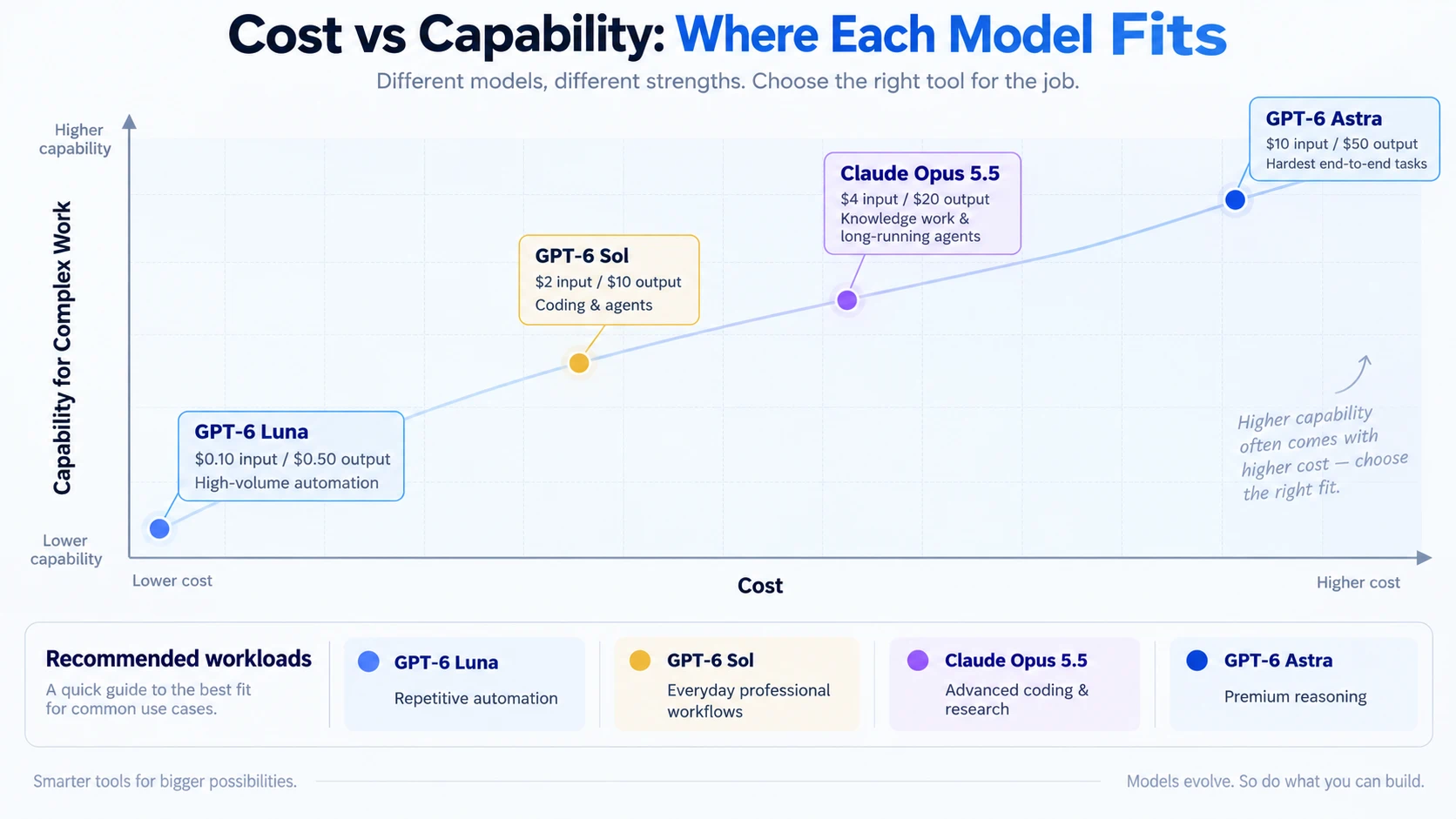
The price ladder makes the positioning especially clear.
| Model | Input | Output | Relative Position |
|---|---|---|---|
| GPT-6 Luna | $0.10 | $0.50 | High-volume efficiency |
| GPT-6 Sol | $2 | $10 | Professional balance |
| Claude Opus 5.5 | $4 | $20 | Advanced coding & knowledge work |
| GPT-6 Astra | $10 | $50 | Premium end-to-end reasoning |
These are standard listed token prices. OpenAI applies higher pricing to GPT-6 requests with more than 272K input tokens, so very long-context workloads can change the cost calculation.
Anthropic also supports prompt caching on Opus 5.5 at $0.20 per million cache-read tokens, which can matter for agents that repeatedly reuse large contexts.
Which Model Fits Which Task?
A practical way to compare the four models is by workload rather than brand.
| Task | Models worth testing |
|---|---|
| Difficult end-to-end reasoning | Claude Opus 5.5 / GPT-6 Astra |
| Large coding projects | Claude Opus 5.5 / GPT-6 Astra / Sol |
| Long-running agents | Claude Opus 5.5 / GPT-6 Sol / Astra |
| Everyday professional coding | GPT-6 Sol / Claude Opus 5.5 |
| Research and knowledge work | Claude Opus 5.5 / GPT-6 Astra / Sol |
| High-volume extraction | GPT-6 Luna |
| Classification and formatting | GPT-6 Luna |
| Repetitive automation | GPT-6 Luna / Sol |
There is no reason every step in a workflow has to use the same model.
A production agent could use Luna for lightweight extraction, Sol for regular reasoning steps, and route particularly difficult tasks to Astra or Opus 5.5.
That can matter more for cost than choosing one model for everything.
Try Claude Opus 5.5 and the GPT-6 Series on iWeaver
Specifications and benchmarks are useful, but they do not always predict which model will work better with your own documents, prompts, or workflow.
iWeaver lets you try Claude Opus 5.5 alongside the GPT-6 series, including GPT-6 Astra, Sol, and Luna, without building separate API integrations.
iWeaver also provides free daily credits, so you can test the same real task across different models—for example:
- Summarizing PDFs
- Comparing multiple documents
- Research and analysis
- Writing
- Knowledge extraction
- Coding questions
Running the same task through several models makes it much easier to compare response depth, speed, and usefulness than relying on benchmark numbers alone.
If you specifically want to start with OpenAI’s flagship model, see our guide on how to use GPT-6 Astra for free.
Claude Opus 5.5 sits in an interesting position inside the current frontier-model market.
It costs substantially less than GPT-6 Astra while targeting similarly demanding coding, agent, and knowledge-work use cases. GPT-6 Sol undercuts Opus 5.5 on price and focuses strongly on coding and agents, while GPT-6 Luna serves a different need entirely: inexpensive processing at scale.
The useful question is therefore not simply “Claude Opus 5.5 or GPT-6?”
It is whether your task needs flagship reasoning, balanced professional performance, or high-volume efficiency.
For that reason, testing the same workflow across Opus 5.5, Astra, Sol, and Luna is often more informative than choosing from benchmark tables alone.