
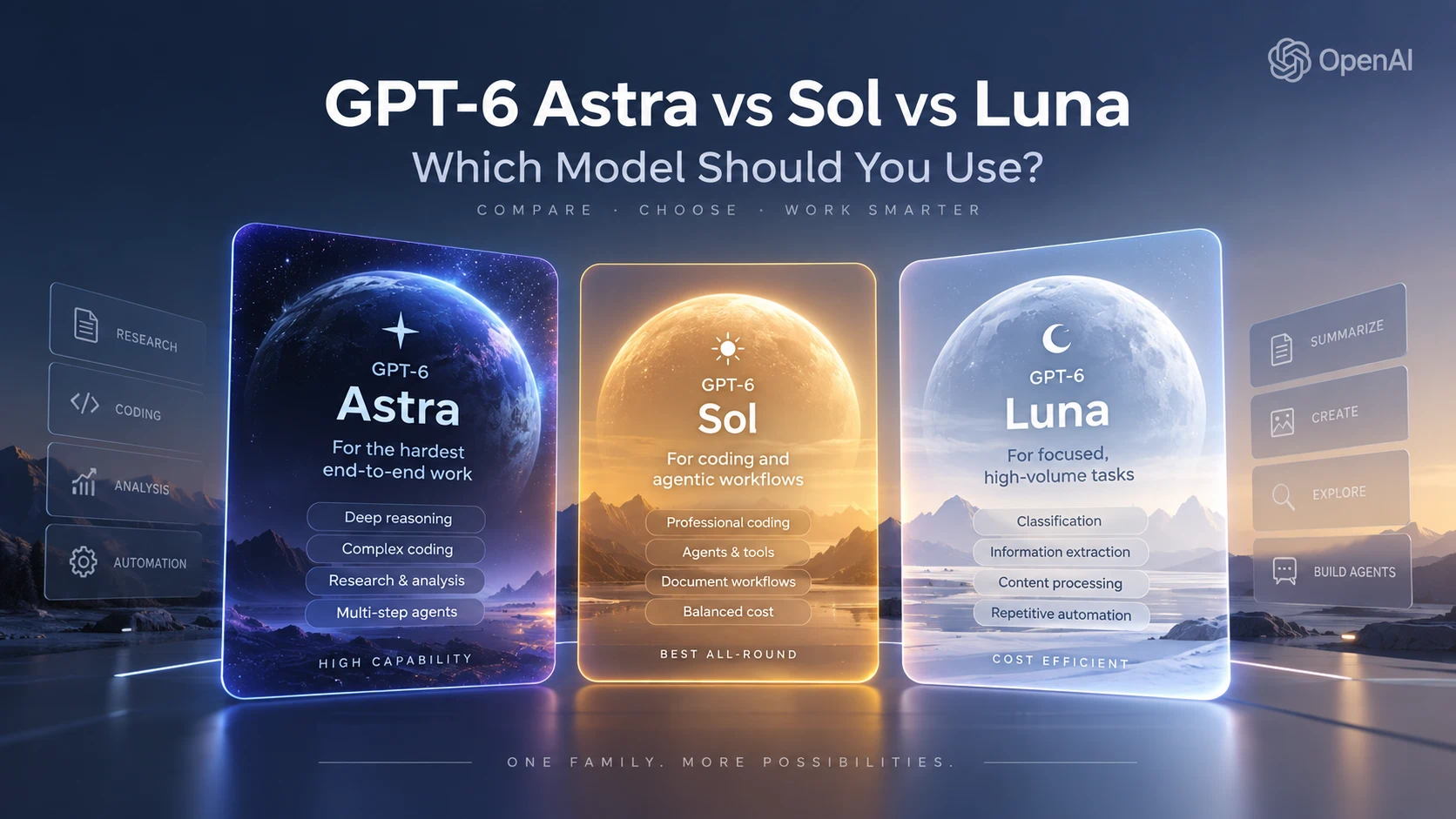
OpenAI’s GPT-6 lineup now includes three models with very different jobs: GPT-6 Astra, GPT-6 Sol, and GPT-6 Luna.
Astra remains the flagship for the hardest end-to-end work. Sol is built around complex coding and agentic workflows while balancing capability and cost. Luna is the most efficient option for focused, high-volume tasks.
That makes the choice less about finding one “best” GPT-6 model and more about matching the model to the workload.
If you want a deeper introduction to the flagship model first, see our GPT-6 Astra overview.
GPT-6 Astra vs Sol vs Luna at a Glance
| Feature | GPT-6 Astra | GPT-6 Sol | GPT-6 Luna |
|---|---|---|---|
| Positioning | Flagship for hardest end-to-end work | Coding and agentic workflows | Focused, high-volume tasks |
| Model ID | gpt-6-astra |
gpt-6-sol |
gpt-6-luna |
| Context window | 1.05M tokens | 1.05M tokens | 1.05M tokens |
| Max output | 128K tokens | 128K tokens | 128K tokens |
| Input price | $10 / 1M tokens | $2 / 1M tokens | $0.10 / 1M tokens |
| Output price | $50 / 1M tokens | $10 / 1M tokens | $0.50 / 1M tokens |
| Best suited to | Complex reasoning, research, coding | Coding, agents, professional workflows | Extraction, classification, repetitive tasks |
All three support text and image input, text output, reasoning, function calling, web search, file search, and computer use. The biggest differences are capability, speed, and cost.
What Is GPT-6 Astra?
GPT-6 Astra is OpenAI’s flagship GPT-6 model. It is designed for complex work that may require several capabilities at once, including reasoning, coding, computer use, research, and document creation.
Astra is the model to consider when the task is difficult, expensive to get wrong, or requires deeper judgment across many steps.
Typical use cases include:
- Advanced software engineering
- Complex research projects
- Multi-step computer workflows
- Difficult technical analysis
- Long-running agents
- High-value document and data work
Its standard model pricing is $10 per million input tokens and $50 per million output tokens.
That makes Astra the most expensive of the three, so it makes the most sense when the extra capability can justify the higher cost.
What Is GPT-6 Sol?
GPT-6 Sol is built for complex coding and agentic workflows.
It keeps the same 1.05M-token context window and 128K maximum output as Astra, but costs far less: $2 per million input tokens and $10 per million output tokens.
That makes Sol a strong fit for recurring professional work such as:
- Everyday software development
- Code review and debugging
- AI agents that call tools
- Research and analysis
- Document workflows
- Business automation
- Knowledge work
For many teams, Sol may be the model worth testing first when Astra feels unnecessarily expensive but the task still requires substantial reasoning.
What Is GPT-6 Luna?
GPT-6 Luna is designed for efficiency.
OpenAI positions it for focused, high-volume work, with pricing of $0.10 per million input tokens and $0.50 per million output tokens.
Good Luna workloads include:
- Classification
- Information extraction
- Text formatting
- Short summaries
- Large-scale content processing
- Repetitive support tasks
- Lightweight agent steps
- Background automation
One important detail is that Luna still has a 1.05M-token context window and 128K maximum output. Choosing the cheaper model does not mean giving up long context.
What changes is how much reasoning capability you want to spend on each request.
GPT-6 Pricing Comparison
| Model | Input / 1M | Cached Input / 1M | Output / 1M |
|---|---|---|---|
| GPT-6 Astra | $10.00 | $1.00 | $50.00 |
| GPT-6 Sol | $2.00 | $0.20 | $10.00 |
| GPT-6 Luna | $0.10 | $0.01 | $0.50 |
Sol costs one-fifth of Astra at the listed standard token rates, while Luna is dramatically cheaper again.
But token price alone should not decide the model.
If a harder task takes several retries with a cheaper model, requires more human correction, or fails to complete reliably, a stronger model can still be more economical in practice. For repetitive and predictable workflows, however, Luna’s lower cost becomes much more important.
All Three Models Have a 1.05M Context Window
A notable feature of the GPT-6 family is that Astra, Sol, and Luna all support a 1,050,000-token context window and up to 128,000 output tokens.
This gives all three models room to work with long documents, large collections of source material, extensive conversation history, or codebases.
Still, context size should not be confused with reasoning quality. A model can accept a large amount of information without necessarily handling every complex relationship inside that context equally well.
For a difficult research project or interconnected codebase, Astra or Sol may still be a better fit. For large-scale extraction or structured processing, Luna may be enough.
GPT-6 Astra vs Sol: Which One Fits Professional Work?
The practical difference between Astra and Sol is usually how much capability you need versus how often you plan to run the task.
Astra is better suited to unusually difficult end-to-end work where deeper reasoning and reliability matter more than token cost.
Sol is designed for work that is still complex but happens more regularly: coding, agents, research, analysis, and business workflows.
A team might use Astra for a difficult architecture decision or a complex research problem, while Sol handles daily coding, document analysis, tool-based agents, and repeated professional tasks.
GPT-6 Sol vs Luna: When Is Luna Enough?
Sol and Luna serve a different split: judgment versus volume.
Use Sol when the workflow involves interpretation, multiple steps, tool use, or deeper reasoning.
Use Luna when the task is predictable and repeated at scale.
For example, a company could use Luna for tagging, extraction, formatting, short summaries, and classification, then route harder cases to Sol.
This kind of model routing can reduce cost without forcing every request through the most capable model.
Which GPT-6 Model Should You Test First?
| Your task | Model to test |
|---|---|
| Difficult multi-step research | GPT-6 Astra |
| Advanced coding or engineering | GPT-6 Astra or Sol |
| Everyday coding | GPT-6 Sol |
| Agent workflows | GPT-6 Sol |
| Document and knowledge work | GPT-6 Sol |
| High-volume extraction | GPT-6 Luna |
| Classification and formatting | GPT-6 Luna |
| Repetitive automation | GPT-6 Luna |
The table is a starting point, not a fixed rule. The best choice depends on prompt quality, reasoning settings, tools, latency, and the cost of errors.
Where Can You Try GPT-6 Astra, Sol, and Luna?
GPT-6 Sol and GPT-6 Luna were released on September 22, 2026 and are available through the OpenAI API. OpenAI also rolled them out to supported ChatGPT Work and Codex plans, while GPT-6 Luna is available to Free and Go users in the desktop app.
If you want to compare the models without setting up separate API workflows, you can also try the full GPT-6 series on iWeaver.
Try the Full GPT-6 Series on iWeaver
iWeaver supports GPT-6 Astra, GPT-6 Sol, and GPT-6 Luna, so you can switch between the new GPT-6 models in one place and test them on real tasks.
iWeaver also provides free daily credits, making it easier to compare the three models before deciding which one fits your workflow.
You can use them for tasks such as:
- PDF and document summarization
- Multi-document research
- Writing and content workflows
- Knowledge extraction
- Coding and technical questions
- Everyday productivity
This is especially useful when model specifications alone do not tell you enough. Running the same prompt or document through Astra, Sol, and Luna can reveal meaningful differences in response quality, reasoning depth, speed, and overall usefulness.
If you want a step-by-step starting point, see our guide on how to use GPT-6 Astra for free.
GPT-6 is now a model family built around different levels of capability and cost.
GPT-6 Astra is designed for the hardest end-to-end work.
GPT-6 Sol targets complex coding, agents, and professional workflows while reducing cost substantially.
GPT-6 Luna is designed for focused, high-volume tasks where efficiency matters most.
Instead of choosing from specifications alone, test the models against the same real workload. With iWeaver supporting the full GPT-6 series and offering free daily credits, you can compare Astra, Sol, and Luna directly and see which one works best for the tasks you actually do.