
Claude Sonnet 5.5 and GPT-6.1 Sol have the same standard API token prices, but they are designed around different strengths. Sonnet 5.5 is positioned for fast, well-scoped coding and professional tasks. GPT-6.1 Sol targets complex coding, computer use, tool-driven work, and professional workflows while offering near-Astra performance at a lower cost.
The practical choice depends on the task. Sonnet 5.5 deserves a trial for bounded coding, polished documents, slides, and spreadsheets. GPT-6.1 Sol is a strong candidate when you need a very large context window, OpenAI’s Responses API tools, or a multi-step workflow. iWeaver offers a free trial of GPT-6.1 Sol, making it possible to test the model on your own documents and research tasks before choosing.
Claude Sonnet 5.5 vs GPT-6.1 Sol at a Glance
| Detail | Claude Sonnet 5.5 | GPT-6.1 Sol |
|---|---|---|
| Standard input price | $2 per 1M tokens | $2 per 1M tokens |
| Standard output price | $10 per 1M tokens | $10 per 1M tokens |
| Cache read price | $0.20 per 1M tokens | $0.10 per 1M tokens |
| Context window | Check the selected Claude platform | 1,050,000 tokens |
| Maximum output | Check the selected Claude platform | 128,000 tokens |
| Stated focus | Well-scoped coding and professional tasks | Complex coding, computer use, and professional work |
| Reasoning control | Adjustable effort | Low, medium, high, xhigh, and max |
| API model name | claude-sonnet-5-5 |
gpt-6.1-sol |
The GPT-6.1 Sol figures come from OpenAI’s model documentation. Sonnet 5.5 pricing and positioning come from Anthropic’s release announcement. Long-context pricing, batch processing, fast modes, cache writes, tool calls, and cloud-provider terms can change the final cost.
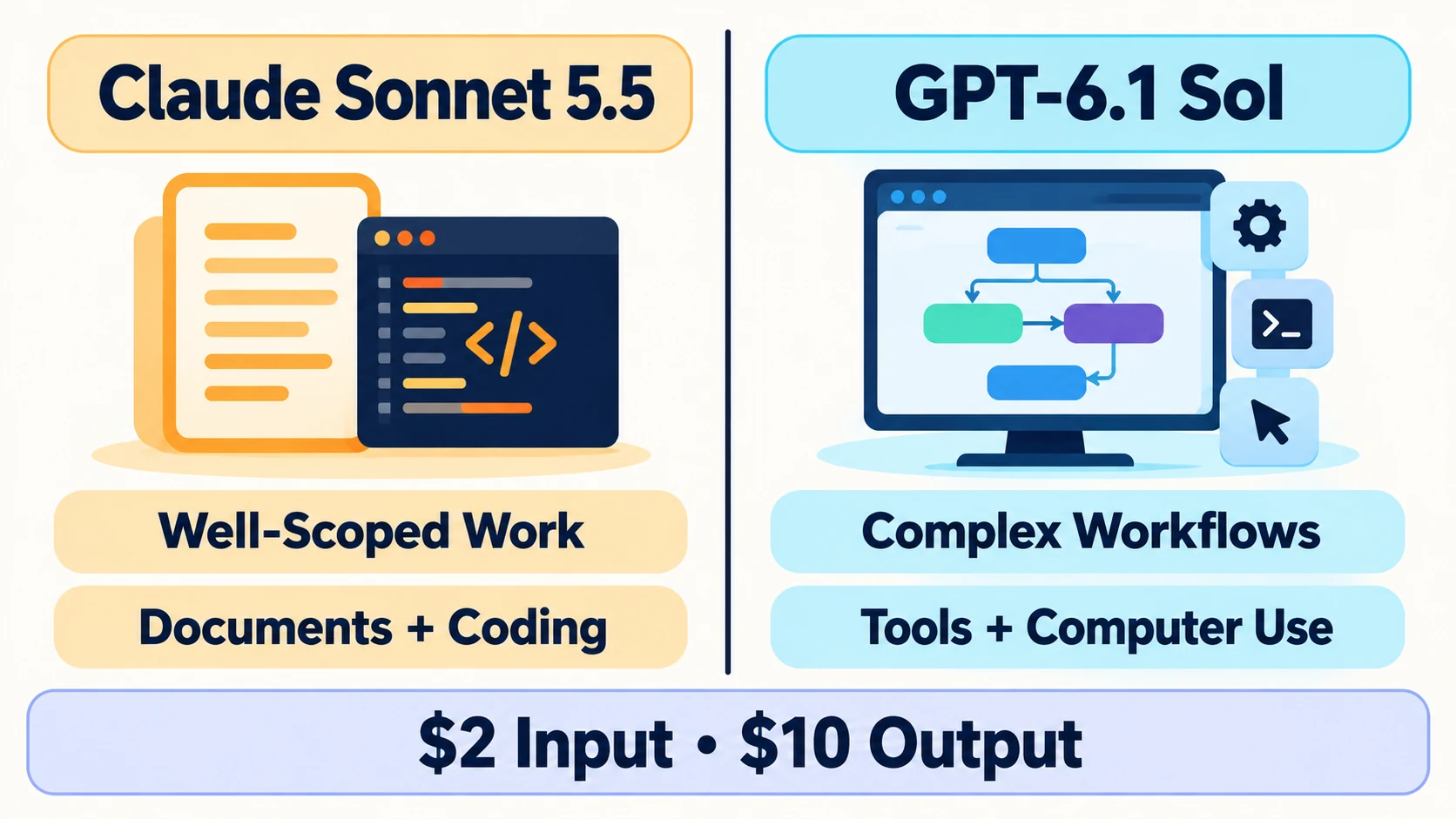
Coding: Scope Control Matters as Much as Raw Capability
Anthropic positions Sonnet 5.5 as a fast model for everyday professional work, bug fixes, and clearly scoped tasks. Its release materials report strong coding results, including 70.6% on Terminal-Bench 4.0 and 46.2% at Max effort on FrontierCode 1.1 Main.
GPT-6.1 Sol is positioned for complex coding and agentic work. OpenAI also gives it access to code execution, hosted shell, apply patch, computer use, and other tools through the Responses API.
Those facts do not establish a universal winner. A coding evaluation should use the same repository issue, instructions, environment, and time budget. Review whether the model found the right cause, changed only necessary files, ran appropriate checks, and stopped when the task was complete.
Choose Sonnet 5.5 for a trial when the task is bounded and fast iteration matters. Choose GPT-6.1 Sol for a trial when the job requires broader repository context, tool coordination, or several stages of implementation and verification.
Documents and Knowledge Work
Sonnet 5.5 is explicitly positioned for creating polished documents, slides, and spreadsheets. Anthropic’s release evidence also emphasizes professional knowledge work and improved efficiency compared with Sonnet 5.
GPT-6.1 Sol offers a documented 1,050,000-token context window and up to 128,000 output tokens. That makes it an interesting option for large document sets, research synthesis, policy review, and detailed structured deliverables.
Context capacity alone does not prove document quality. Test both models with the same source packet and ask them to extract figures, reconcile conflicting passages, distinguish evidence from inference, and show where each conclusion came from. The model that produces a more auditable result may be more valuable than the one that writes the smoother first draft.
Tools and Workflow Fit
GPT-6.1 Sol’s clearest advantage is its documented tool surface through the Responses API. It supports web search, file search, image generation, code execution, hosted shell, computer use, MCP, and tool search. That can reduce integration friction for teams already building on OpenAI’s agent stack.
Sonnet 5.5 is available through Claude products, the Claude Platform, AWS, Google Cloud, and Microsoft Azure. It may fit more naturally when an organization already uses those environments or has prompts and evaluations tuned for Claude.
The platform around the model matters. Logging, permissions, source management, review steps, data requirements, and team workflow can outweigh a small difference in a benchmark.
Readers who want the earlier baseline can review iWeaver’s published Claude Sonnet 5.5 vs GPT-6 comparison before evaluating what the 6.1 update changes.
Cost: Same Token Price, Different Task Cost
Both models list standard prices of $2 per million input tokens and $10 per million output tokens. That does not mean they cost the same to complete a task.
Total task cost includes prompt size, cache behavior, reasoning effort, tool calls, retries, output length, and human review. Anthropic says Sonnet 5.5 can use fewer tokens and run faster than Sonnet 5, but that is a comparison with its predecessor—not proof that it is cheaper than GPT-6.1 Sol.
Measure the total cost of reaching an acceptable result. A model that needs fewer corrections can be cheaper even if one individual response is longer.
Which Model Should You Choose?
Try Claude Sonnet 5.5 when your priority is well-scoped coding, rapid iteration, or polished documents and office-style outputs. Its strongest public evidence and product positioning align with those tasks.
Try GPT-6.1 Sol when you need a large context window, OpenAI’s tool ecosystem, complex multi-step work, or a lower-cost alternative to Astra. It is also the more natural option when your application already depends on the Responses API.
For a fair decision, run three representative tasks rather than one generic prompt: a routine task, a difficult task, and a source-heavy task. Score correctness, completeness, latency, total tokens, unnecessary changes, and review time.
You can start a free trial of GPT-6.1 Sol in iWeaver and evaluate it with your own documents or research workflow. The best model is the one that meets your quality standard with the least total effort—not the one with the loudest headline.