
Claude Sonnet 5.5 and GPT-6 Sol occupy a similar price tier, but they are not interchangeable products. Both cost $2 per million standard input tokens and $10 per million standard output tokens, and both target demanding professional work. Sonnet 5.5 is framed around fast, well-scoped coding and knowledge tasks; OpenAI describes GPT-6 Sol as a reasoning model built for complex coding and agentic workflows, with a broad set of tools through the Responses API.
The useful question is not which model is universally better, but which fits your workload and review process. Published benchmarks offer evidence, but the cleanest decision comes from running the same tasks with the same acceptance criteria.
Claude Sonnet 5.5 vs GPT-6 Sol at a Glance
| Detail | Claude Sonnet 5.5 | GPT-6 Sol |
|---|---|---|
| Standard input price | $2 per 1M tokens | $2 per 1M tokens |
| Standard output price | $10 per 1M tokens | $10 per 1M tokens |
| Cached input/read price | $0.20 per 1M tokens | $0.20 per 1M tokens |
| Context window | Check the selected Claude platform | 1,050,000 tokens |
| Maximum output | Check the selected Claude platform | 128,000 tokens |
| Stated focus | Well-scoped coding and professional work | Complex coding and agentic workflows |
| Reasoning controls | Adjustable effort | None, low, medium, high, xhigh, and max |
| API model name | claude-sonnet-5-5 |
gpt-6-sol |
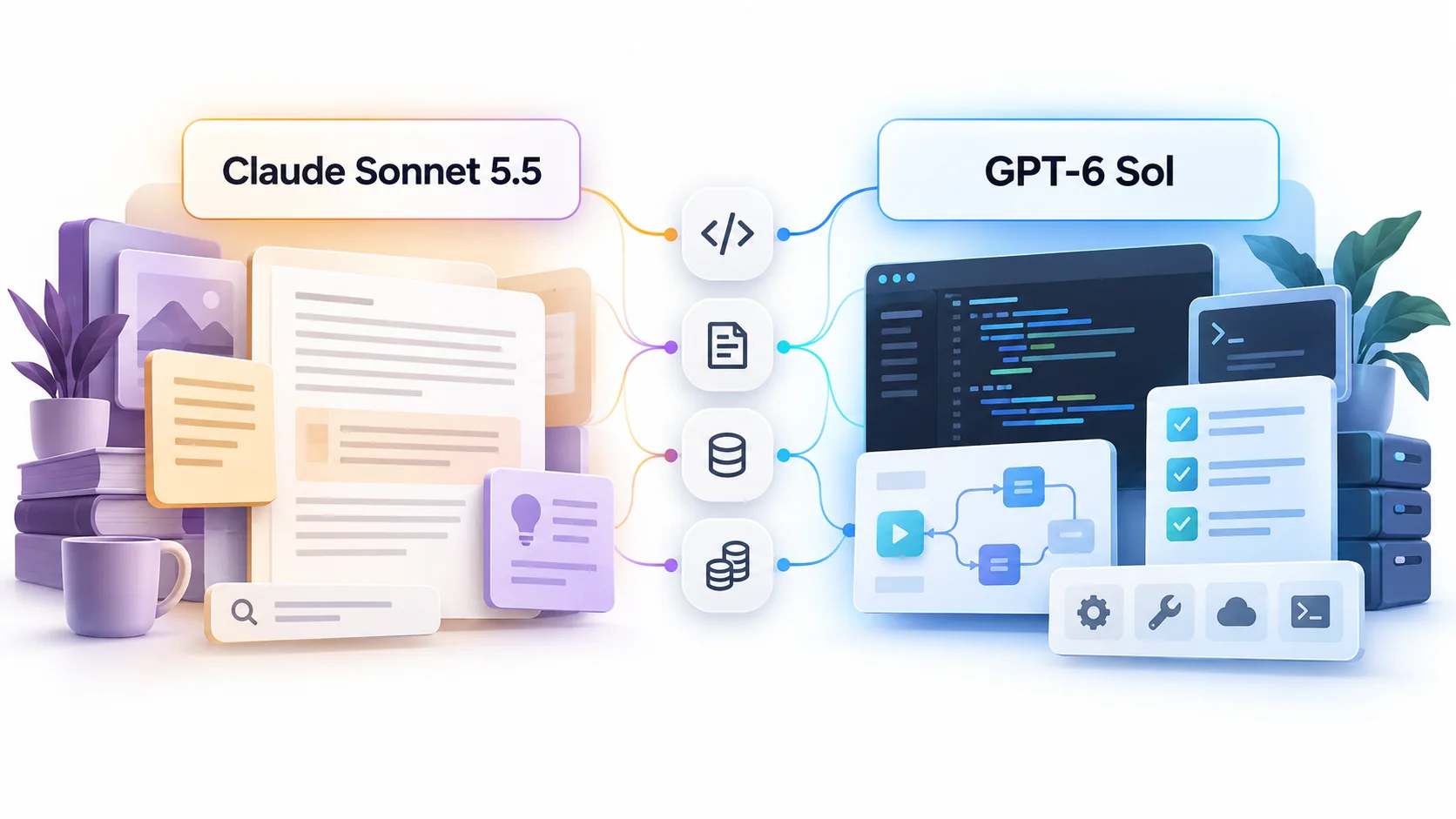
The GPT-6 Sol specifications and tool list are documented on the official OpenAI model page. Sonnet pricing, positioning, and benchmark results come from Anthropic’s release page. Published prices can vary with long-context, batch, fast, regional, or cloud-provider processing, so treat this table as the standard-rate starting point rather than a complete invoice forecast.
Coding: A Close Comparison With Different Evidence
Anthropic’s FrontierCode 1.1 Main table is one of the few official comparisons containing both models. It reports Sonnet 5.5 at 46.2% with Max effort, GPT-6 Sol at 49.3%, and GPT-6 Sol at 52.1% with Xhigh effort. Anthropic also cautions that its own Sonnet result at Max was lower than at some smaller effort settings because the agent sometimes made unnecessary out-of-scope changes.
That caveat is more useful than a simplistic winner label. Repository work is judged not only by whether tests pass, but by whether the patch is understandable, appropriately scoped, and maintainable. When evaluating either model, give it a real issue with a fixed time budget, then review the number of files changed, correctness, tests, tool calls, token use, and how much cleanup a developer must perform.
Sonnet 5.5 also posts strong Anthropic-reported scores on Terminal-Bench 4.0 and CursorBench 4.0, but GPT-6 Sol is not included in those rows. A blank cell is not a loss; until comparable results exist under the same harness, those benchmarks describe Sonnet rather than establish a head-to-head result.
Knowledge Work and Documents
Anthropic reports higher Sonnet 5.5 scores on GDPval-AA v2.1 and AA-Briefcase v1.1: 1844 versus 1487, and 1811 versus 1483, respectively. These results make Sonnet an appealing candidate for document-heavy professional work, but they remain vendor-published snapshots. They do not tell you how either model will handle your terminology, file quality, source hierarchy, or formatting requirements.
For research, policy review, market analysis, or executive reporting, build a small evaluation packet from material your team already understands. Ask both models to extract the same figures, reconcile conflicting passages, distinguish evidence from inference, and produce an output with traceable references. A polished answer that cannot be audited should score lower than a plainer answer that remains grounded in the source.
iWeaver fits naturally before and after that model comparison when the input is scattered across formats. Its AI Summarizer can organize PDFs, documents, webpages, audio, images, and videos into summaries, key points, or structured notes. That is a source-management workflow, not evidence that iWeaver exposes either specific model; model availability should be checked in the product interface at the time of use.
Context, Tools, and Ecosystem
GPT-6 Sol’s official documentation lists a 1,050,000-token context window, up to 128,000 output tokens, image input, structured outputs, and a broad tool set through the Responses API. Those capabilities can make Sol attractive when an application already depends on OpenAI’s agent stack or must coordinate many tools.
Sonnet 5.5 is available in Claude products and the Claude Platform as well as AWS, Google Cloud, and Microsoft Azure. Anthropic emphasizes coding, documents, slides, spreadsheets, design, image understanding, and long-horizon work. The better ecosystem choice may come down to deployment constraints, existing contracts, observability, regional requirements, and the tools your application already uses rather than raw model quality.
Speed and Cost per Completed Task
The two models share the same standard input and output list prices, so neither has an automatic cost advantage on that basis. Anthropic says Sonnet 5.5 produces output more than 30% faster than Sonnet 5 and can cost up to 30% less per task than its predecessor, but that comparison is with Sonnet 5—not GPT-6 Sol. It should not be repurposed as a cross-provider speed or cost claim.
Measure cost at the workflow level. Include cache behavior, long-context rates, tool fees, reasoning settings, retries, and human review. A concise model that needs one pass can be cheaper than a verbose model at the same token rate, while a large context window may reduce retrieval engineering for some applications but encourage expensive prompts if used without discipline.
Which Model Should You Choose?
Choose Sonnet 5.5 for a trial when your work centers on bounded coding, polished documents, spreadsheets, presentations, or source-grounded professional analysis. Anthropic’s evidence is particularly strong for those areas, and its effort control lets teams trade depth for latency on a task-by-task basis.
Choose GPT-6 Sol for a trial when you are building around the Responses API, need its documented tool suite or large context window, or want a model explicitly designed for complex coding and agentic workflows. Existing OpenAI integrations may make Sol easier to deploy even when raw benchmark differences are small.
Explore the Rest of the GPT-6 Family
GPT-6 Sol is the balanced reasoning option in a broader family rather than OpenAI’s only GPT-6 model. Astra targets the hardest end-to-end work, while Luna prioritizes speed and economical repeatable tasks. See GPT-6 Astra vs Sol vs Luna for a model-by-model comparison before deciding whether Sol is the right match.
If you want to move from comparison to hands-on use, How to Use GPT-6 Astra Free explains the practical access and trial workflow. Although the guide focuses on Astra rather than Sol, it is a useful next step for readers evaluating the GPT-6 ecosystem through iWeaver.
For important work, build a representative task set and compare quality, scope control, latency, cost, and reviewer effort. The winner may differ across coding, research, and automation, which supports routing tasks instead of forcing one model to handle everything.