
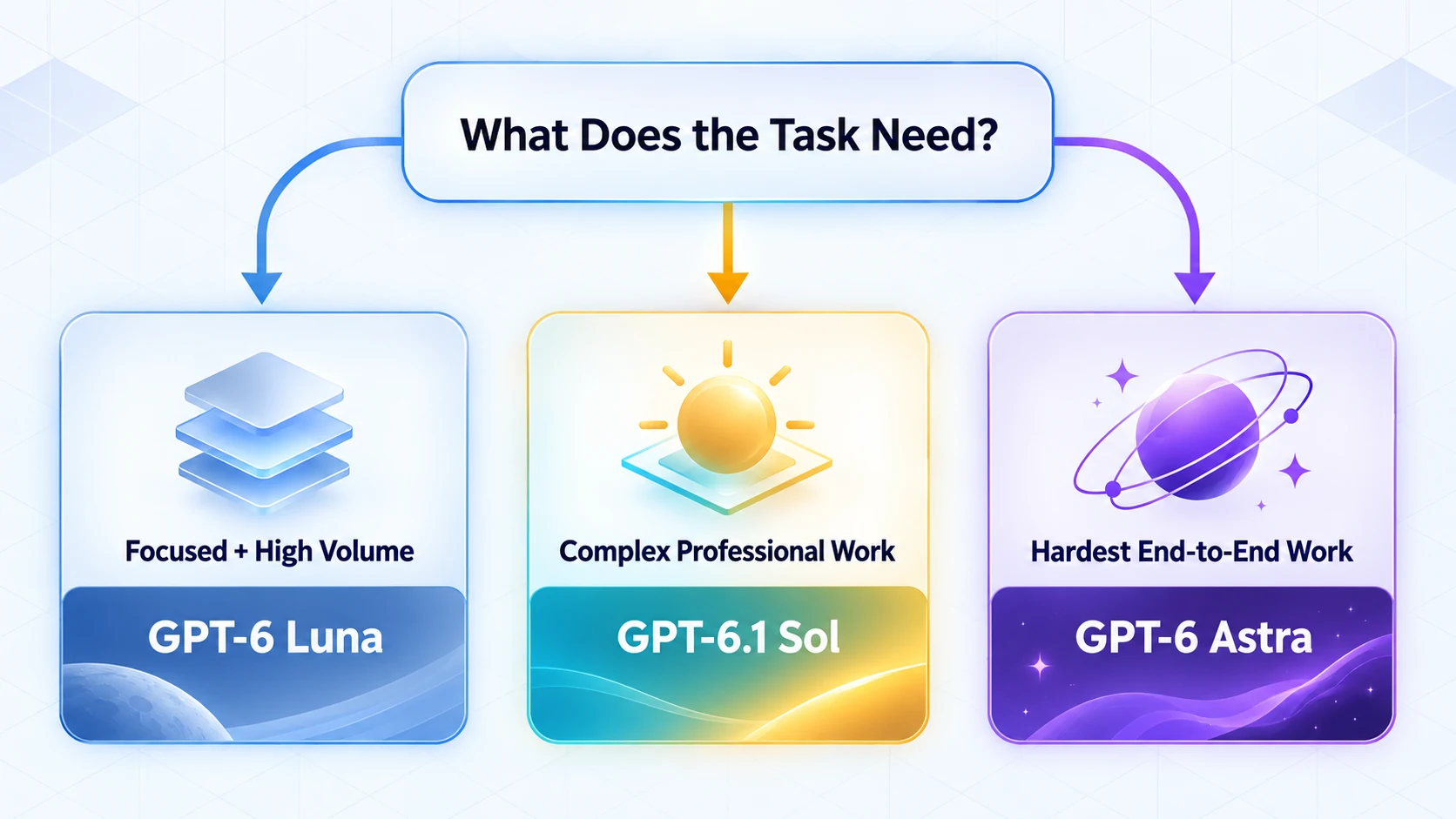
GPT-6 Astra, GPT-6.1 Sol, and GPT-6 Luna are designed for different levels of work. Astra is the highest-capability option for the hardest end-to-end tasks. GPT-6.1 Sol balances complex-work performance with a much lower price. Luna is the economical choice for focused, high-volume work.
For many professional workflows, GPT-6.1 Sol is the sensible starting point. It costs one-fifth of Astra’s standard input and output token rates while OpenAI positions it as providing near-Astra performance. iWeaver offers a free trial of GPT-6.1 Sol, so you can test that balance on a real task before deciding whether to move up to Astra or down to Luna.
GPT-6 Model Comparison
| Detail | GPT-6 Astra | GPT-6.1 Sol | GPT-6 Luna |
|---|---|---|---|
| Primary role | Hardest end-to-end work | Complex work at lower cost | Focused, high-volume work |
| Standard input price | $10 / 1M tokens | $2 / 1M tokens | $0.10 / 1M tokens |
| Standard output price | $50 / 1M tokens | $10 / 1M tokens | $0.50 / 1M tokens |
| Context window | 1,050,000 | 1,050,000 | 1,050,000 |
| Maximum output | 128,000 | 128,000 | 128,000 |
| Reasoning effort | Low to max | Low to max | None to max |
| Image input | Supported | Supported | Supported |
| Best starting point | Highest-stakes difficult work | Most complex professional workflows | Repetitive and cost-sensitive tasks |
The specifications and positioning are based on OpenAI’s model catalog, the GPT-6 Astra model page, and the GPT-6.1 Sol model page. Standard token rates do not include every long-context, cache, processing-mode, regional, or tool charge.
Choose GPT-6 Astra for the Hardest Work
OpenAI describes Astra as its most capable model for demanding end-to-end work. It is intended for difficult reasoning, software engineering, research, computer use, and document creation where quality matters more than the lowest token price.
Astra makes sense when a task is ambiguous, spans many stages, requires sustained judgment, or carries a high cost of failure. Examples include a complex system migration, an open-ended research investigation, or a workflow that must coordinate several tools while adapting to new information.
Its standard token price is five times GPT-6.1 Sol’s, so routing every routine request to Astra can be wasteful. The right question is whether Astra’s added capability reduces errors, retries, or human review enough to justify the difference.
iWeaver’s previous GPT-6 Astra vs Sol vs Luna guide provides the original family comparison and a useful baseline for the 6.1 update.
Choose GPT-6.1 Sol for Balanced Professional Work
GPT-6.1 Sol is designed for complex coding, computer use, and professional tasks. It retains the same documented context and maximum output sizes as Astra while charging substantially less per token.
That makes Sol a strong default candidate for research synthesis, document-heavy analysis, multi-step coding, structured report creation, and agent workflows. It is especially relevant when Luna is too lightweight for the job but Astra is difficult to justify for every run.
GPT-6.1 Sol supports low, medium, high, xhigh, and max reasoning effort. Medium is the documented default. Start there, then increase effort only when a representative evaluation shows that the harder task benefits from it.
Choose GPT-6 Luna for Volume and Efficiency
Luna is OpenAI’s cost-sensitive model for focused, high-volume workloads. Its standard API token prices are far below both Sol and Astra.
It is a reasonable candidate for classification, extraction, transformation, short summaries, routine customer operations, and other repeatable tasks with clear instructions. Because Luna supports none reasoning effort as well as higher settings, developers have more room to optimize simple workloads for speed and cost.
Low price does not automatically make Luna the cheapest operational choice. If a task repeatedly fails or needs heavy review, routing it to Sol may reduce total cost.
A Practical Model-Routing Rule
Use the smallest model that reliably meets the acceptance criteria:
- Start with Luna for narrow, repetitive tasks.
- Move to GPT-6.1 Sol when the work requires deeper reasoning, long context, or several coordinated steps.
- Reserve Astra for the hardest tasks where Sol does not meet the required quality or reliability.
This routing approach is more useful than declaring one model the winner. It connects model choice to task difficulty, risk, and review cost.
How to Test the Difference
Create a small evaluation set from your actual work. Include one simple task, one typical task, and one difficult task. Use the same sources, output requirements, and scoring criteria for each model.
Measure:
- Correctness and completeness.
- Compliance with instructions.
- Unsupported claims or unnecessary changes.
- Time and total token use.
- Human review and correction effort.
Start with the GPT-6.1 Sol free trial in iWeaver and use the result as your balanced baseline. If the task is easily completed, Luna may be enough. If the output still falls short after a well-designed prompt and appropriate reasoning effort, Astra deserves a controlled test.