
GPT-6.1 Sol is the updated balanced model in OpenAI’s GPT-6 family. It keeps the large context window, maximum output size, and standard $2/$10 input-output price point associated with GPT-6 Sol, but OpenAI now positions 6.1 as offering near-Astra performance for complex work at a lower cost.
The update also changes an important configuration detail: GPT-6.1 Sol supports reasoning effort from low through max, but it no longer supports none or minimal. Developers and power users should evaluate the model as an upgrade rather than assuming every previous setting can be copied unchanged.
iWeaver offers a free trial of GPT-6.1 Sol, providing a simple way to compare the updated model with the results and workflows you already know.
GPT-6.1 Sol vs GPT-6 Sol at a Glance
| Detail | GPT-6 Sol | GPT-6.1 Sol |
|---|---|---|
| Positioning | Complex coding and agentic workflows | Near-Astra performance for complex work at lower cost |
| Standard input price | $2 per 1M tokens | $2 per 1M tokens |
| Standard output price | $10 per 1M tokens | $10 per 1M tokens |
| Context window | 1,050,000 tokens | 1,050,000 tokens |
| Maximum output | 128,000 tokens | 128,000 tokens |
| Reasoning effort | None, low, medium, high, xhigh, max | Low, medium, high, xhigh, max |
| Tool calling | Responses API recommended | Responses API required for tool calling |
| API model ID | gpt-6-sol |
gpt-6.1-sol |
The comparison uses OpenAI’s GPT-6.1 Sol documentation, current model catalog, and GPT-6 guidance. Pricing can vary with long context, caching, service tier, regional processing, and tool use.
The Main Change Is Capability Positioning
GPT-6 Sol launched as the balanced member of the GPT-6 family, aimed at complex coding and agentic workflows. GPT-6.1 Sol receives a more ambitious description: near-Astra performance for complex coding, computer use, and professional work at a lower cost.
For the original family positioning, see iWeaver’s GPT-6 Astra vs Sol vs Luna comparison. It provides the baseline for understanding where the updated Sol model now sits.
That does not mean every 6.1 response will match Astra or improve every GPT-6 Sol task. It means Sol is being positioned closer to OpenAI’s top tier on the quality-cost curve. Teams should verify that claim on their own evaluation set, particularly for tasks involving judgment, long source material, tools, and several dependent steps.
Context and Output Limits Stay Large
Both models list a 1,050,000-token context window and a maximum output of 128,000 tokens. Applications that already depend on large inputs therefore do not need to redesign around a smaller context capacity.
The limit is not a recommendation to fill every request. Inputs above 272,000 tokens receive higher long-context pricing under the documented GPT-6.1 Sol rates. Large prompts can also make it harder to identify which material is relevant. Retrieval, source labeling, and staged analysis remain useful even when the entire collection fits.
Reasoning Settings Require Attention
GPT-6 Sol supports none, while GPT-6.1 Sol does not. The updated model supports low, medium, high, xhigh, and max, with medium as the documented default.
If an existing workflow uses none or minimal, OpenAI recommends starting with low when moving to 6.1, then comparing the output on representative tasks. Higher effort can improve difficult reasoning but may increase latency and token use. Do not raise the setting by default without measuring the effect.
Tool Use Belongs in the Responses API
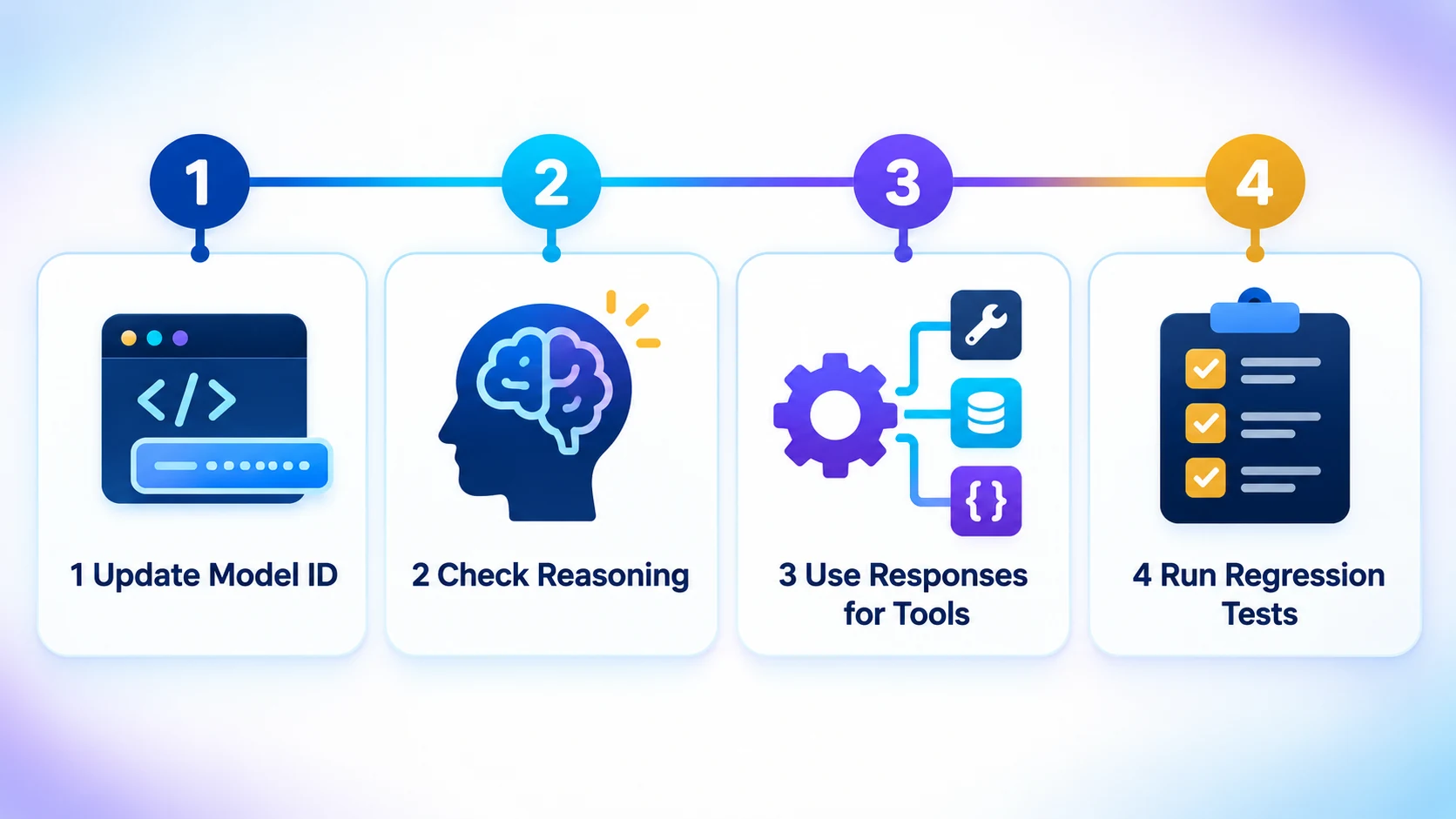
GPT-6.1 Sol supports Chat Completions for requests without tools. For tool calling, use the Responses API. The supported tool set includes web search, file search, image generation, code execution, hosted shell, apply patch, computer use, MCP, and tool search.
This matters for agent applications. A model upgrade is not only a model-ID change; it can require checking endpoints, unsupported parameters, reasoning settings, caching behavior, tool definitions, and evaluation results.
Should You Upgrade?
GPT-6.1 Sol is worth evaluating when you use GPT-6 Sol for coding, computer use, research, document creation, or other complex professional work. The strongest reason to upgrade is the possibility of better completion quality at the same standard input and output token prices.
Keep GPT-6 Sol temporarily when a production workflow depends on none reasoning, has not completed regression testing, or requires stable behavior that has already been validated. Upgrade after comparing both models on the same inputs and acceptance criteria.
A Simple Migration Test
Select 10–20 tasks that represent the work your application actually performs. Include common cases, difficult cases, long-context cases, and known failure cases. Run both models with equivalent instructions and record:
- Correctness and task completion.
- Instruction following and scope control.
- Tool-call success.
- Latency and total token use.
- Human review and correction time.
Update the model ID only after checking any use of none, minimal, sampling parameters, tool calling, and prompt caching. OpenAI’s migration guidance notes that some parameters are unsupported when reasoning is active.
For a quick hands-on evaluation, start the GPT-6.1 Sol free trial in iWeaver and rerun a familiar research, document, or writing task. Compare the result with your previous Sol output using the same quality checklist. That makes the upgrade decision concrete instead of relying on a release label alone.