

GPT-6.1 Sol is OpenAI’s balanced model for complex coding, computer use, and professional work. OpenAI positions it as delivering near-Astra performance at a lower price, making it the practical middle choice for people who need more than a lightweight model but do not want Astra’s cost for every task.
iWeaver now offers a free trial of GPT-6.1 Sol, giving users a direct way to test the model on research, documents, writing, analysis, and other knowledge-work tasks before deciding how it fits their workflow.
GPT-6.1 Sol at a Glance
| Detail | GPT-6.1 Sol |
|---|---|
| Best suited to | Complex coding, computer use, research, and professional work |
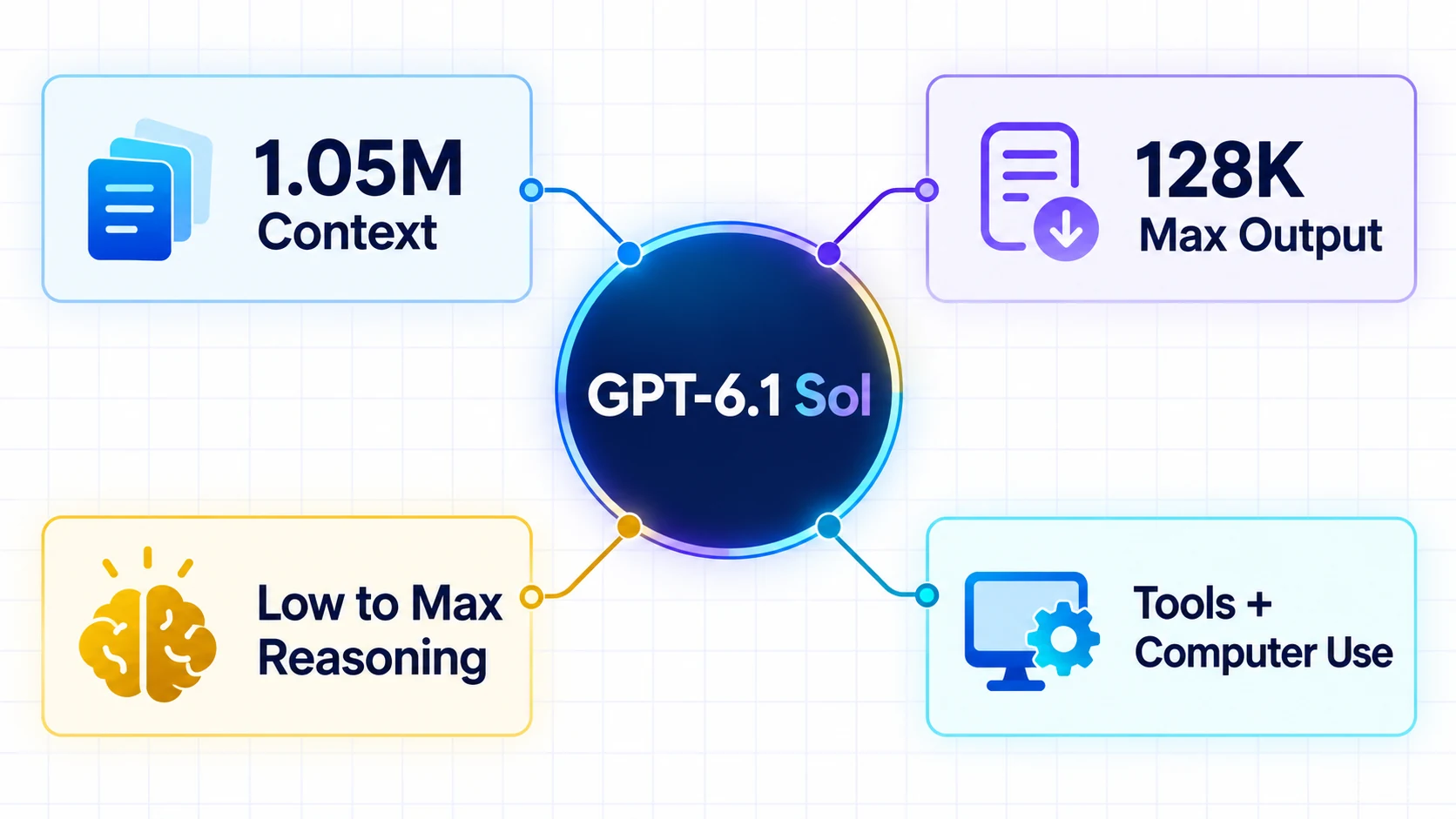
| Context window | 1,050,000 tokens |
| Maximum output | 128,000 tokens |
| Knowledge cutoff | April 30, 2026 |
| Image input | Supported |
| Audio and video input | Not supported |
| Reasoning effort | Low, medium, high, xhigh, and max |
| Standard API input price | $2 per 1M tokens |
| Standard API output price | $10 per 1M tokens |
| Fine-tuning | Not supported |
These specifications come from the official GPT-6.1 Sol model page. API prices can change with long-context prompts, processing mode, caching, regional processing, and tool calls, so the standard token rates are only a starting point for cost estimates.
What Is New About GPT-6.1 Sol?
GPT-6.1 Sol occupies the space between GPT-6 Astra and GPT-6 Luna. Astra is designed for the hardest end-to-end work, while Luna prioritizes efficient, high-volume tasks. Sol aims to retain much of Astra’s capability at a substantially lower token price.
For more context on the top tier, read iWeaver’s earlier GPT-6 Astra overview, which explains the role Astra plays in demanding end-to-end work.
The model is built for work that involves several connected steps rather than a single short answer. Examples include reviewing a large set of documents, investigating a technical problem, coordinating tools, producing a structured report, or carrying a coding task from diagnosis through verification.
“Near-Astra performance” is OpenAI’s product positioning, not a guarantee that Sol will match Astra on every prompt. The useful question is whether Sol meets the acceptance criteria for your own task at a lower total cost.
A 1.05M-Token Context Window
GPT-6.1 Sol supports a 1,050,000-token context window. This creates room for large codebases, long reports, multiple papers, transcripts, policy documents, or extended project history.
A large context window does not mean every uploaded detail will automatically receive equal attention. Better results still depend on clear source organization and a precise request. For a large document task, tell the model:
- Which files are authoritative.
- What questions it must answer.
- What evidence it should quote or reference.
- How the output should be structured.
- Which uncertainties it should flag instead of guessing.
iWeaver adds a practical workflow around this process. You can bring source material into one workspace, define the required output, and continue refining the result instead of treating the model as a one-shot chat box.
Reasoning Effort: From Low to Max
GPT-6.1 Sol supports five reasoning-effort levels: low, medium, high, xhigh, and max. Medium is the documented default.
Lower effort can suit routine extraction, rewriting, classification, and clearly scoped questions. Higher effort is more appropriate when a task requires planning, reconciliation of conflicting evidence, complex debugging, or careful multi-step analysis. More reasoning is not automatically better: it can add latency and cost without improving a straightforward answer.
The model does not support none or minimal reasoning effort. Developers migrating an application should also note that tool calling belongs in the Responses API. Chat Completions is supported only for requests without tools.
What Can GPT-6.1 Sol Do?
Analyze Documents and Research
The model can work across long source collections, extract claims, compare sections, identify contradictions, and produce structured outputs. The result still needs source checking when accuracy matters.
Handle Complex Coding Tasks
GPT-6.1 Sol is designed for software work that requires repository context, tool use, multiple edits, and verification. A good evaluation should measure correctness, unnecessary changes, test results, elapsed time, and reviewer effort—not just whether the model produced code.
Coordinate Tools
Through the Responses API, GPT-6.1 Sol supports tools including web search, file search, code execution, computer use, image generation, MCP, and tool search. Availability and charges can vary by tool and environment.
Create Professional Outputs
The model can help turn source material into reports, briefs, plans, tables, and structured drafts. Its large maximum output supports substantial deliverables, although concise prompts and staged review are usually more reliable than requesting an enormous final answer in one pass.
GPT-6.1 Sol Limitations
GPT-6.1 Sol can still misread a source, overlook an exception, produce incorrect code, or state an inference too confidently. Its knowledge cutoff also means current information may require browsing or up-to-date supplied sources.
For consequential work, verify quotations, calculations, citations, code execution, and business conclusions. Treat the model as a capable worker inside a reviewable process, not as the final authority.
How to Try GPT-6.1 Sol
The fastest way to evaluate the model is to use a task whose correct result you already understand. Choose a real report, research question, document set, or coding problem and define what a successful answer must contain.
You can try GPT-6.1 Sol with a free trial in iWeaver. Add your source material, describe the required result, and compare the output with your normal workflow. Judge it by accuracy, completeness, time saved, and how much review the result needs.
That kind of task-level evaluation tells you more than a benchmark score alone—and helps you decide when Sol is sufficient and when a different model tier is worth using.