
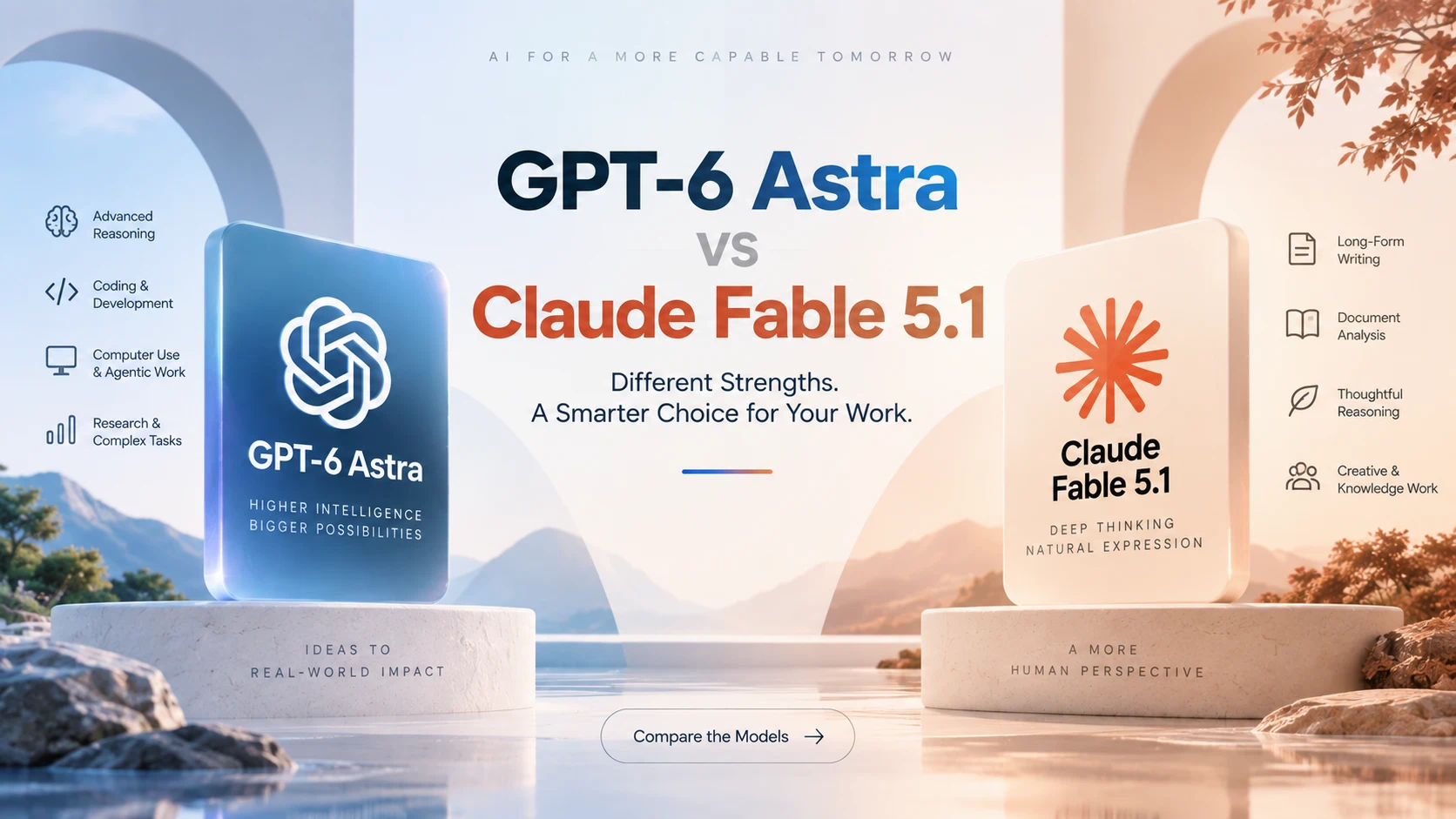
GPT-6 Astra and Claude Fable 5.1 represent two increasingly important directions for advanced AI: models that do more than answer questions and can instead help complete substantial pieces of work.
But choosing between them is not simply a matter of asking which model is "smarter."
The better question is:
Which model fits the work you actually do?
Some users need coding and agentic execution. Others spend their day reading documents, writing, researching, or synthesizing complex information.
Those differences matter.
Quick answer: GPT-6 Astra is especially compelling for advanced reasoning, tool-driven workflows, coding, and agentic tasks. Claude Fable 5.1 can be attractive for document-heavy work, writing, analysis, and sustained interaction with complex material. The better choice depends heavily on your workflow.
For the latest Astra release information, start with our GPT-6 Astra guide.
GPT-6 Astra vs Claude Fable 5.1 at a Glance
| Area | GPT-6 Astra | Claude Fable 5.1 |
|---|---|---|
| Complex reasoning | Excellent | Excellent |
| Coding | Strong focus | Strong |
| Agentic workflows | Major strength | Strong |
| Tool-driven tasks | Strong focus | Strong |
| Research | Excellent | Excellent |
| Long documents | Excellent | Excellent |
| Writing | Strong | Particularly attractive for writing-heavy workflows |
| Multi-step work | Major strength | Strong |
| Everyday chat | Excellent | Excellent |
| Best choice | Complex execution | Reading, analysis, writing, sustained knowledge work |
This is not a winner-takes-all comparison.
The differences become clearer when we look at actual tasks.
1. Which Is Better for Research?
Suppose you have six reports about the same market.
You want the AI to:
- summarize each report;
- identify conflicting claims;
- compare the evidence;
- find common trends;
- create a table;
- recommend three conclusions.
Both models can be useful.
Astra becomes particularly interesting when the research task expands into a longer workflow involving tools, additional steps, or actions.
Claude can be particularly comfortable when the core task involves sustained reading, synthesis, and writing around large amounts of source material.
For pure knowledge work, therefore, the source material and desired output often matter more than benchmark rankings.
2. GPT-6 Astra vs Claude Fable 5.1 for Coding
Coding is one of the areas where model differences become easier to notice.
A simple request such as:
Write a Python script that converts CSV files to JSON.
is not a particularly useful test.
Most frontier models can handle it.
A better test is:
Inspect this project, find the cause of the memory leak, identify the relevant dependencies, propose a minimal fix, update the affected code, and explain how we should test the change.
Now the model must behave more like an engineering assistant.
Astra's focus on complex and agentic work makes it particularly interesting for this category.
For developers, however, the best model can still vary by codebase, language, task, and tooling environment.
3. Which Is Better for Writing?
Writing is different from coding because "correct" is harder to define.
A strong writing model must understand:
- tone;
- audience;
- structure;
- context;
- nuance;
- style constraints;
- what should be omitted.
Claude models have historically attracted users who value natural long-form writing and document interaction.
Astra is also highly capable at writing, but upgrading purely for sentence-level rewriting may not reveal its biggest advantages.
Astra becomes more useful when writing is connected to research.
For example:
Read these five sources, identify the strongest evidence, create an argument, anticipate two counterarguments, and draft a 1,500-word report for executives.
Now reasoning and writing become part of the same workflow.
4. Which Is Better for Long Documents?
Both models are relevant for document-heavy users.
But context window size alone should not determine your choice.
A model can technically accept a large document without necessarily extracting the right information from it.
For practical document work, evaluate whether the model can:
- find specific details;
- connect information across sections;
- distinguish evidence from assumptions;
- preserve citations or source context;
- generate useful structured outputs.
This is also why the interface around the model matters.
Uploading a document to a generic chat window is useful.
Having dedicated workflows for PDF analysis, summarization, extraction, comparison, and knowledge organization can be much more productive.
5. Which Is Better for Agentic Work?
This is where Astra becomes particularly interesting.
AI is moving from:
"Tell me how to do this."
toward:
"Do as much of this as possible."
That change requires models to plan, use tools, maintain goals, recover from errors, and complete several dependent actions.
If this is your primary use case, Astra deserves serious consideration.
If most of your work remains reading, writing, brainstorming, and document analysis, the practical gap may be smaller.
6. Stop Choosing Models Like Sports Teams
There is an increasingly common problem in AI discussions.
Users pick one model and then try to use it for everything.
That is rarely necessary.
A researcher may prefer one model for reading papers and another for building a data-processing script.
A marketer may use one model for research and another for final copy.
A developer may use one model for architecture analysis and another for quick coding questions.
The better workflow is:
Choose the model based on the task, not the logo.
7. Use Multiple AI Models in iWeaver
This is one reason iWeaver focuses on the workflow around AI rather than forcing every task into a single generic chat experience.
You can work with advanced AI models while bringing your own source materials into the process.
For example, you can:
- upload research papers;
- analyze PDFs;
- summarize reports;
- extract structured information;
- generate mind maps;
- compare documents;
- organize findings;
- continue asking questions based on your materials.
Instead of deciding that one model must handle everything, you can choose the model and workflow that fit the job.
iWeaver also offers 3 free AI conversations every day, giving you room to test advanced models on real tasks rather than judging them only from benchmark charts.
GPT-6 Astra vs Claude Fable 5.1: Which Should You Choose?
Choose GPT-6 Astra if your priority is complex reasoning, coding, tool use, agentic workflows, and multi-step execution.
Consider Claude Fable 5.1 if your workflow centers heavily on reading, writing, document analysis, and sustained work with complex source material.
And if your work changes throughout the day, you may not need to choose only one.
The most productive AI setup may simply be the one that lets you use the right model for each task.
Is GPT-6 Astra better than Claude Fable 5.1?
There is no universal winner. Astra is particularly interesting for agentic and tool-driven workflows, while Claude can be attractive for writing, reading, and document-heavy knowledge work.
Which is better for coding?
Astra is a strong option for complex coding and longer engineering workflows. The best model can still depend on the programming language, repository, tools, and type of coding task.
Which is better for research?
Both can perform advanced research and synthesis. Consider not only model capability but also how easily you can provide source materials and turn results into structured outputs.
Can I test advanced AI models without committing to one?
Yes. iWeaver provides 3 free AI conversations per day, making it possible to test advanced AI workflows on your own documents and tasks.