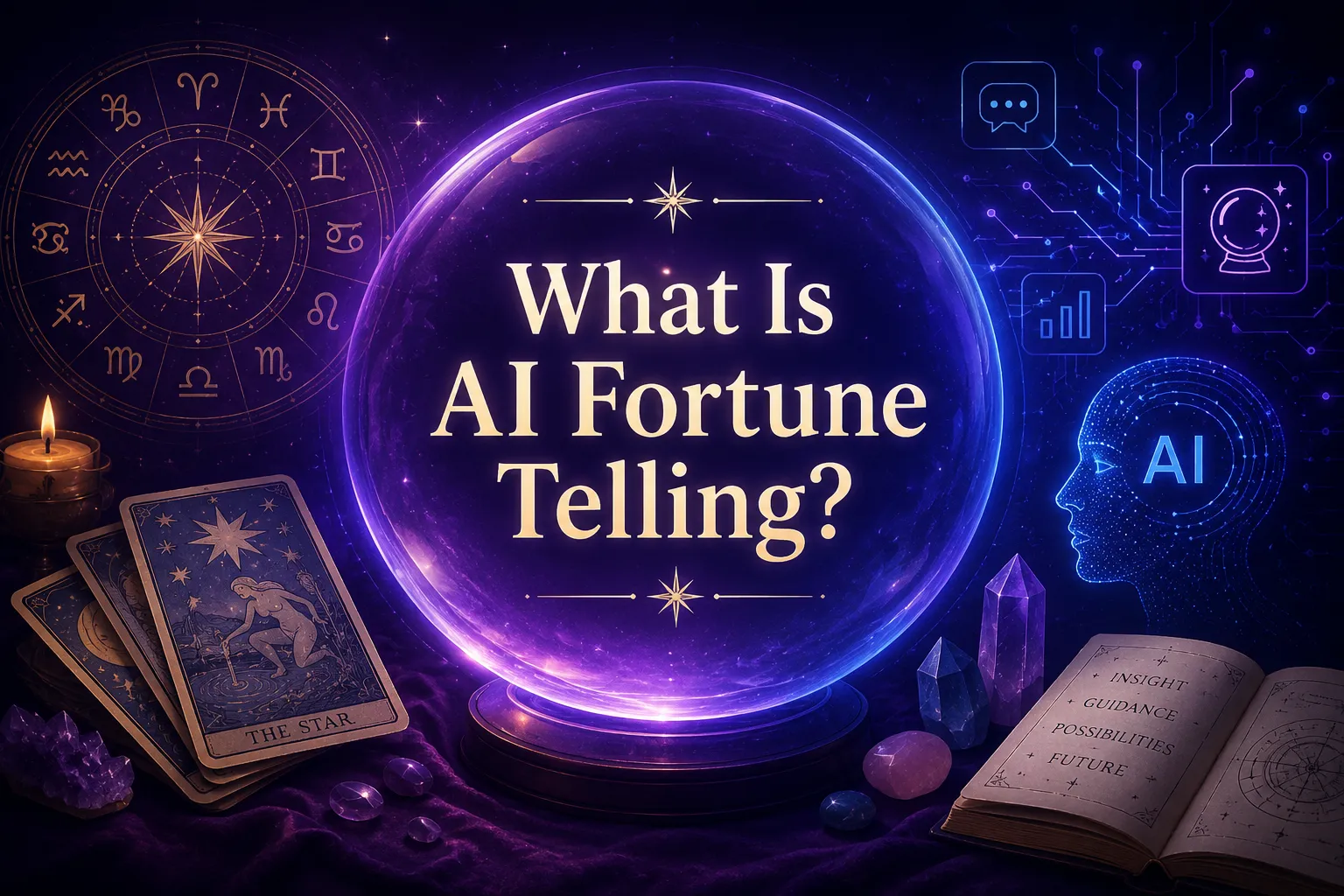
AI fortune telling uses artificial intelligence to generate interpretations based on tarot cards, astrology, numerology, palm images, dreams, or personal questions. Also called AI divination, it turns traditional symbolic practices into interactive digital experiences.
You might enter a question, provide birth details, select cards, or upload a photo. The tool then produces an explanation shaped by those inputs.
The important distinction is between a personalized interpretation and a verified prediction. A response can feel relevant without providing evidence that the system knows what will happen next.
How Does AI Fortune Telling Work?

1. You Supply the Input
The input depends on the reading format. Tarot may begin with a question and selected cards. Astrology may require birth details. Palm reading starts with a hand image.
Your wording also supplies context. “I am thinking about moving” gives a different starting point from “I feel uncertain about making friends after moving.”
Before submitting, check which details are necessary. More personal information does not automatically produce a more useful reading.
2. The Tool Establishes a Reading Structure
Some services calculate or select the underlying material separately from the AI explanation.
For example, FateMaster describes a system that calculates charts before generating an interpretation
Those are provider descriptions of their own systems, not a universal process. Other services may rely more heavily on prompts or predefined content. Look for an explanation of how the particular tool works.
3. AI Produces the Interpretation
The explanation connects the supplied material with your question. It may describe symbols, suggest themes, or offer follow-up prompts.
This is where you should examine the reasoning. Does the response explain which card, calculation, or visible feature supports its interpretation? Does it acknowledge missing information? A fluent answer alone cannot establish either point.
Common Types of AI Fortune Telling
Different formats answer different kinds of curiosity. Start with the input you are comfortable providing and the experience you want.
| Reading type | Typical input | What to examine in the result |
|---|---|---|
| Tarot | A question and card selection | Card names, positions, and explanations |
| Astrology | Birth details or a zodiac sign | Stated system and chart assumptions |
| Numerology | A birth date or name | Calculation steps and symbolic meanings |
| Palm reading | A clear hand photo | Visible features versus inferred traits |
| Dream interpretation | A description of a dream | Possible meanings rather than a single verdict |
| Compatibility | Information about two people | Assumptions, differences, and discussion prompts |
The format matters more than a dramatic label such as “AI psychic.” A tool that explains its inputs and method is easier to evaluate than one that simply promises answers.
For help comparing the available approaches, read our guide to the best AI fortune teller tools.
What Does “Accurate” Mean in an AI Reading?
Accuracy can refer to several different things, and they should not be confused.
Input accuracy concerns whether the tool used the details you supplied. Did it retain the correct birth date or identify the cards you selected?
Method accuracy concerns whether it followed the stated system. Can you check the arithmetic in a numerology calculation? Does the explanation match the displayed spread?
Personal relevance concerns whether an interpretation feels meaningful to you.
Predictive accuracy concerns whether a claim reliably anticipates events. A reading that passes the first three checks has not automatically demonstrated the fourth.
A useful follow-up question is:
Which parts of this answer come from my input, which come from the symbolic tradition, and which are your interpretation?
This encourages a clearer explanation without assuming the result is authoritative.
A Practical Example: From Prediction to Reflection
Imagine you are considering joining a local creative group.
A broad request might be:
Will this group change my life?
That invites a sweeping answer that would be difficult to evaluate. A more useful request is:
Give me a tarot-style reflection on joining a creative group. Explore my hopes about meeting people and my concern about committing time. End with three questions I can answer myself.
Suppose the response emphasizes openness and consistency. You can translate those themes into ordinary questions:
- What do I hope to gain from attending?
- How often could I realistically participate?
- Could I try one session before committing?
The reading has supplied a structure for reflection. Your schedule, preferences, and experience at the session provide the information needed for a decision.
How to Write a Better Prompt
A focused prompt usually needs four things: the situation, the reading format, the topic to explore, and the kind of response you want.
Try this reusable structure:
Use [reading format] to help me reflect on [situation]. Focus on [specific concern]. Explain the symbolism, acknowledge uncertainty, and finish with three questions rather than a fixed prediction.
If using iWeaver’s AI fortune teller, begin with a short, non-sensitive question. Ask for clarification when the response seems vague, and avoid treating confident wording as additional evidence.
You can also request alternative interpretations. That helps keep an initial explanation from becoming the only way you view a situation.
Keep a Record Without Chasing Reassurance
If you enjoy readings, save the original question alongside the answer and your own reaction. This makes it easier to distinguish what the tool actually said from what you later remembered.
A simple record can contain:
- The question and date
- The reading format
- One interpretation you found useful
- One part that did not fit
- Your own next step
An AI notes generator can help turn saved reading text into a structured note for review. Keep your observations separate from the generated interpretation.
Repeatedly asking the same question until a reassuring answer appears makes the record less useful. A better follow-up explores an unclear point or introduces genuinely new information.
What to Check Before Using a Tool
Check whether the service identifies its reading method, explains its charges, and provides accessible privacy information. For image uploads, look specifically for information about photo processing and retention.
Avoid including unrelated identity details or private information about other people. A short description is often enough for a reflective exercise.
Treat readings as entertainment or journaling material. Claims about unavoidable disasters, guaranteed outcomes, or payments needed to remove a threat are reasons to leave the experience.
Is AI Fortune Telling the Same as a Horoscope?
No. Horoscopes are one format within the broader category. AI fortune telling can also include tarot, palmistry, numerology, and other symbolic interpretations.
Does AI Fortune Telling Require a Palm Photo?
Only some formats use images. A text-based question or tarot-style reading may require no photo at all.
Why Can Two Readings Give Different Answers?
Tools may use different methods, selected cards, prompts, or generation settings. Compare the underlying inputs and assumptions before comparing the conclusions.
Can AI Fortune Telling Tell Me What Someone Else Thinks?
A generated reading cannot establish another person’s private thoughts. Use it to explore your own questions, then rely on conversation and observable behavior to understand the relationship.