
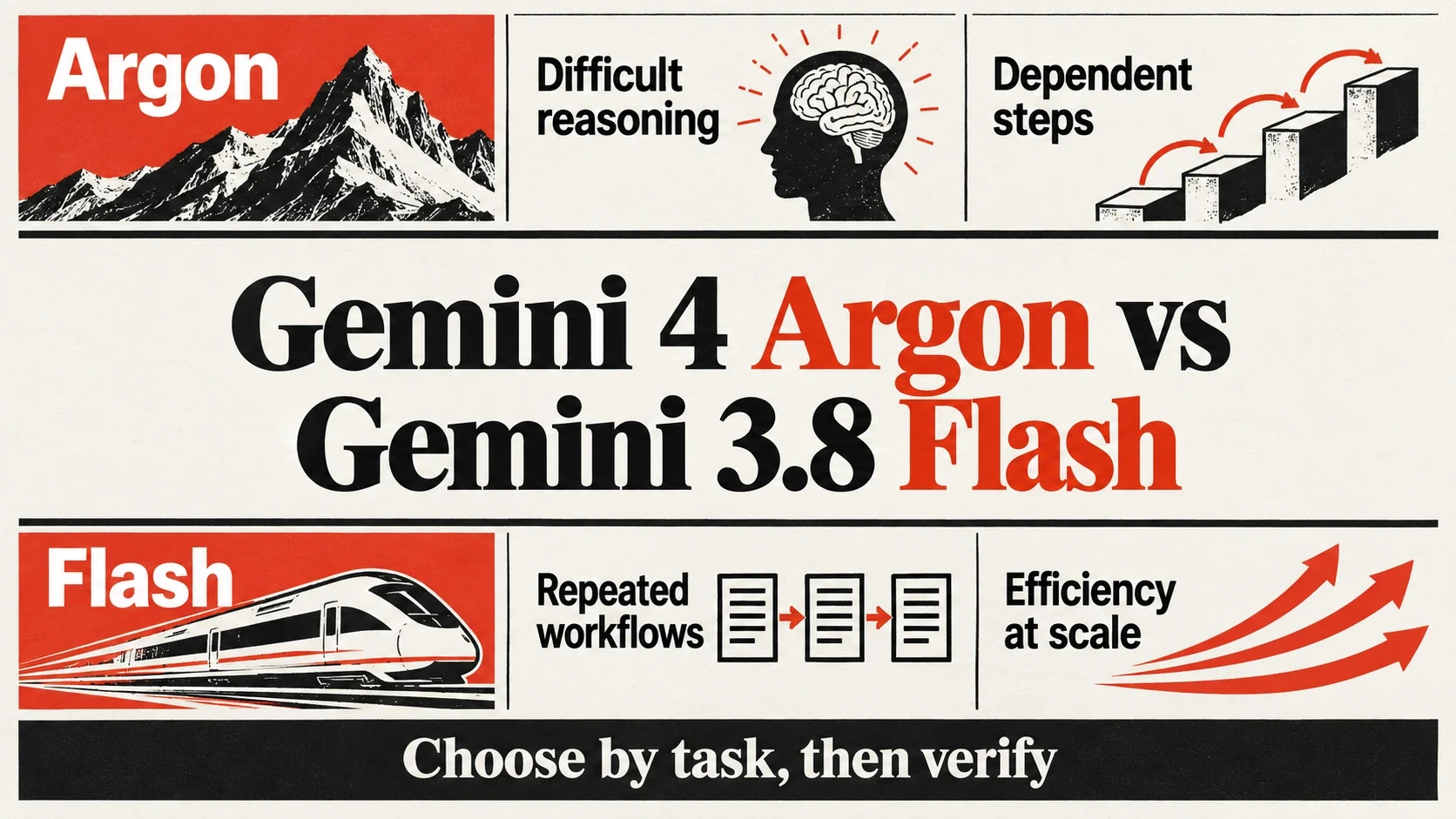
Gemini 4 Argon is the candidate to evaluate when a task requires difficult reasoning across many dependent steps. Gemini 3.8 Flash remains a candidate for repeated workflows where responsiveness and efficiency matter. Those are starting hypotheses based on Google's positioning; choosing between them requires checking how they handle your actual inputs.
Google describes Argon as its flagship reasoning model and Flash as a workhorse for coding and agents. Neither description provides an independent answer to which model will produce a better research brief, summary, or analysis for you. This comparison uses current documentation and a proposed evaluation method, not a claimed hands-on test.
The specifications that affect the choice
| Question | Gemini 4 Argon | Gemini 3.8 Flash |
|---|---|---|
| Published role | Flagship reasoning | Efficient workhorse for complex workflows |
| Context definition | 1,048,576 tokens, unified input and output | 1,048,576 input tokens |
| Standard output limit | 65,536 tokens | 65,536 tokens |
| Extended output | Long decode can extend output within the unified limit | No equivalent option listed on the model page |
| Inputs and output | Multimodal inputs; text output | Multimodal inputs; text output |
The two million-token figures are defined differently. For Argon, input and output share the published budget. For Flash, the table lists input and output limits separately. If you are planning a very large input followed by an unusually long output, account for that distinction rather than assuming identical capacity.
Most knowledge-work tasks will not need maximum-length output. A concise answer with correct evidence can be more useful than a document that consumes the full budget. Set your output length according to the reader's needs and evaluate whether either model follows it.
For a fuller explanation of the newer model’s scope and limitations, see our Gemini 4 Argon overview. It explains how to turn the published capabilities into tasks you can evaluate.
When to put Argon through a trial
Try Argon on a task where the hard part is resolving dependencies. A useful example is comparing research findings that use different definitions, then producing a recommendation that preserves those differences. Another is reviewing a technical proposal against several constraints that can conflict.
Look for improvements you can observe: fewer contradictions, fewer unsupported assumptions, and less need to repair the recommendation after correcting one fact. If the answer is simply longer, that is not evidence of a better result. The review should establish whether the added reasoning effort helps complete the task.
When Flash is a useful baseline
Google positions Gemini 3.8 Flash around latency, scale, and agentic work. That makes it a reasonable baseline for repeatable tasks with a clear format, such as turning a set of notes into a brief or classifying document passages by a supplied rubric. This is an editorial inference from its published role, not a measured speed or cost claim.
If Flash already meets your acceptance standard, identify the failure that would justify switching. Perhaps it merges conflicting evidence, misses an important constraint, or needs several rounds of repair. A concrete failure gives Argon something meaningful to improve on.
Compare both with the same source packet
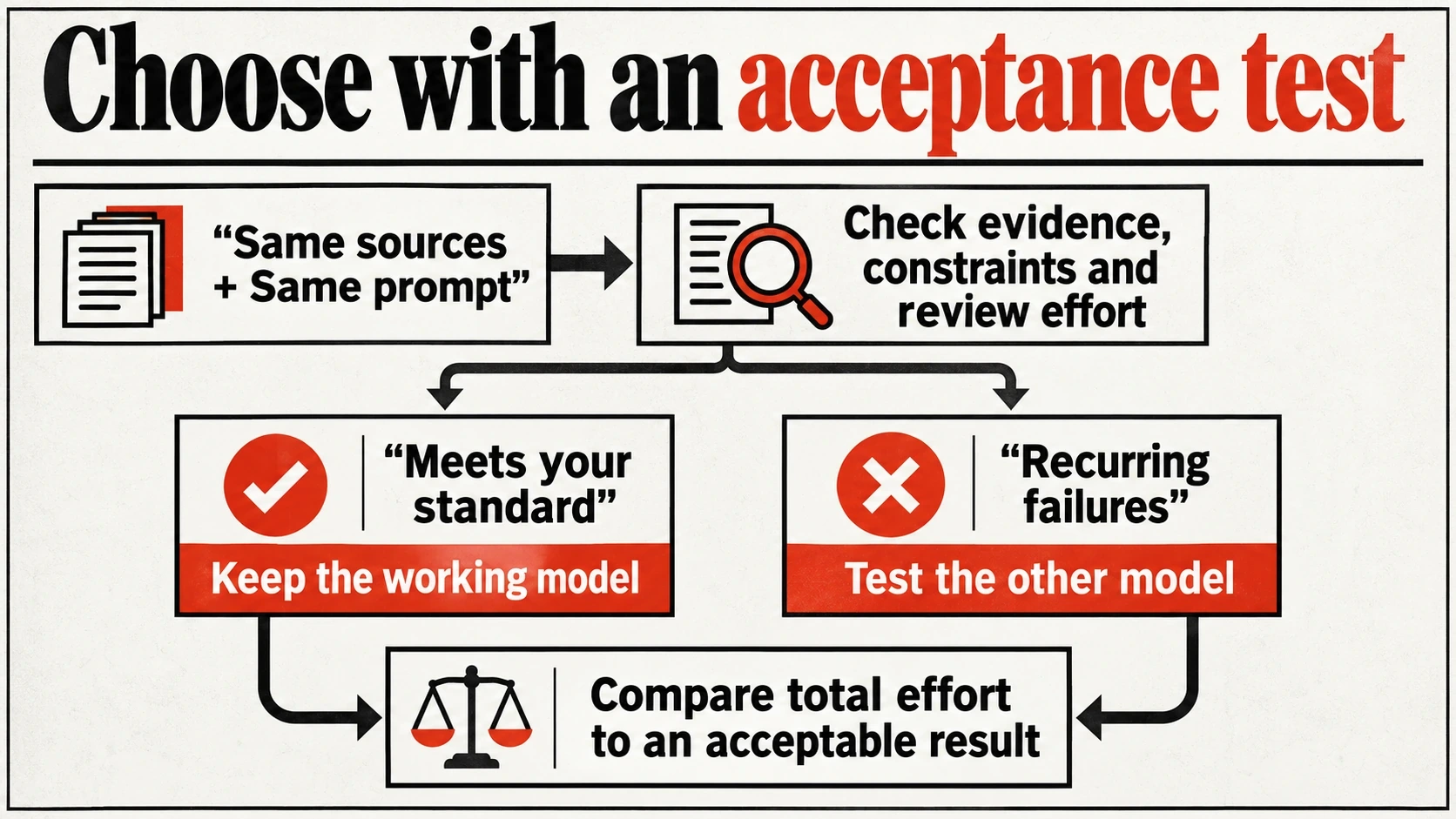
Use a small set of documents, the same prompt, and the same acceptance criteria. Keep tool access comparable, record relevant settings, and note when an interface prevents an equivalent setup. If tools differ, your result compares whole workflows as well as models.
Before reading either answer, define what counts as success. For a document comparison, you might require every central claim to be supported, all known contradictions to be surfaced, and the recommendation to respect your stated constraints. Judge those requirements before judging style.
Record total time to an acceptable result, including your review and corrections. If usage cost is visible, record it too. This is more informative than comparing response time alone because a quick answer that requires extensive repair may slow the whole task down.
Use a routing rule instead of a permanent winner
A practical starting rule is to use the model that already meets the task's standard, then test the other when the task becomes harder or recurring failures appear. For example, keep routine briefs on the model that produces dependable results and evaluate Argon for source conflicts or complex constraints. Adjust that rule using your own observations.
Gemini 4 Argon is now available in iWeaver, with a free trial so you can evaluate it on your own work. Select it in the workspace and use the same source packet and acceptance criteria for your comparison. Our Gemini 4 Argon usage tutorial walks through preparing sources, writing a focused prompt, and refining the result. The useful comparison is between the workflows you can run, with the review standards your work requires.