
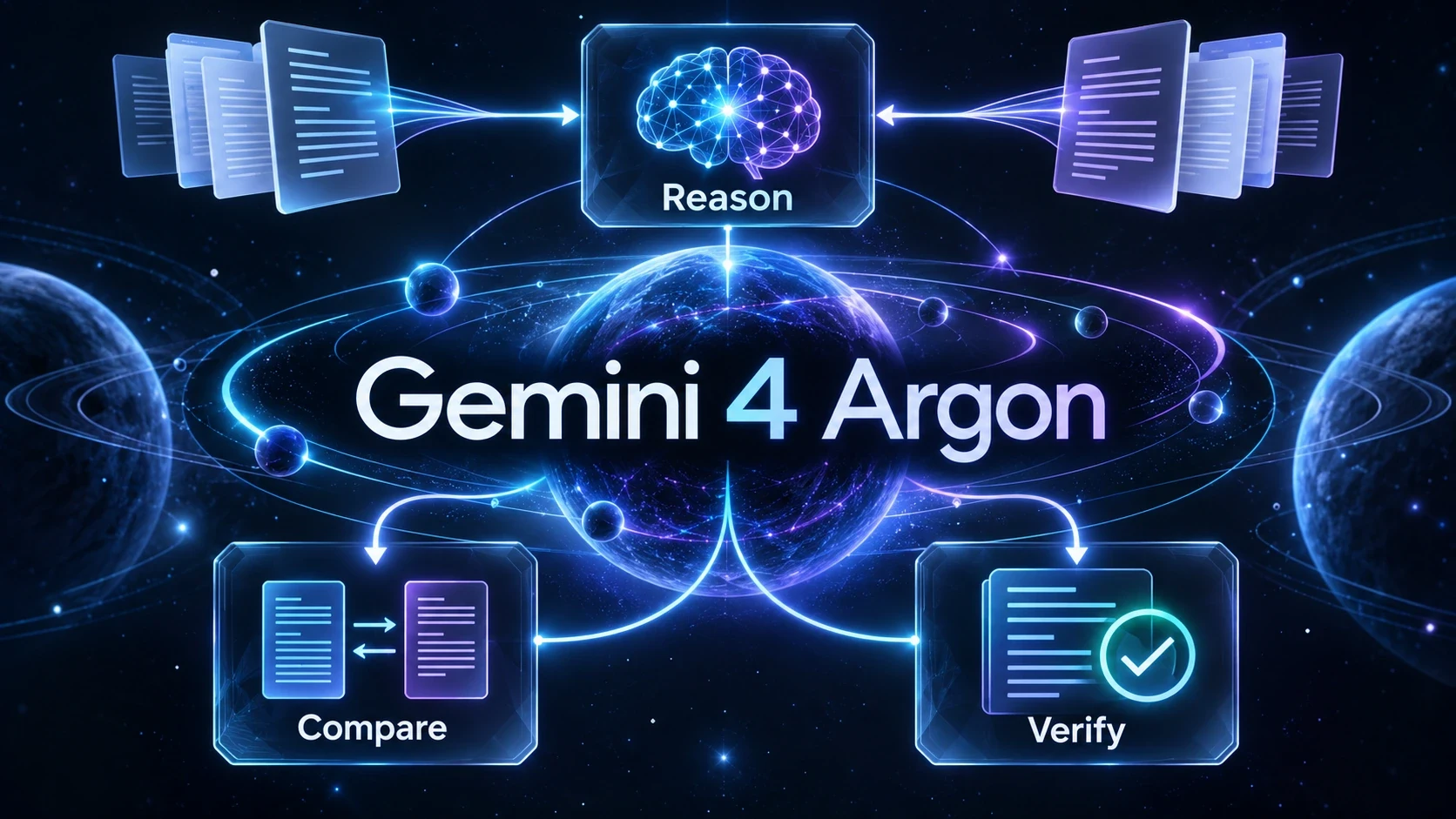
Gemini 4 Argon is Google's new flagship reasoning model, aimed at difficult problems that require sustained work across multiple steps. Its launch matters for people who need to reconcile conflicting documents, investigate a technical problem, or develop an argument from evidence. The useful question is whether it can complete those tasks with less correction from the person reviewing the answer.
Google initially introduced Argon through a restricted rollout to trusted cybersecurity partners. Google announced access in the Gemini app for Google AI Pro and Ultra subscribers. Articles describing the model as available only to early testers now need that qualification.
Why sustained reasoning matters
Google positions Argon for complex software engineering, scientific problem solving, and extended professional tasks. That positioning suggests a useful evaluation target: work where an early mistake can propagate through several later decisions. It does not establish that every summary or writing task will improve, or that the model can work without review.
Consider a research brief assembled from three reports. One report uses an older definition, another describes a different population, and the third summarizes both without explaining the difference. A useful answer should keep those boundaries visible before making a recommendation. A fluent paragraph that blends the findings would fail the task even if it sounds convincing.
This is the practical opportunity for reasoning models: preserving the structure of a problem while working toward an answer. To evaluate it, ask for the conflicts, supporting evidence, and missing information as separate outputs. That makes a failure easier to identify than a single polished synthesis.
What the published specifications actually mean
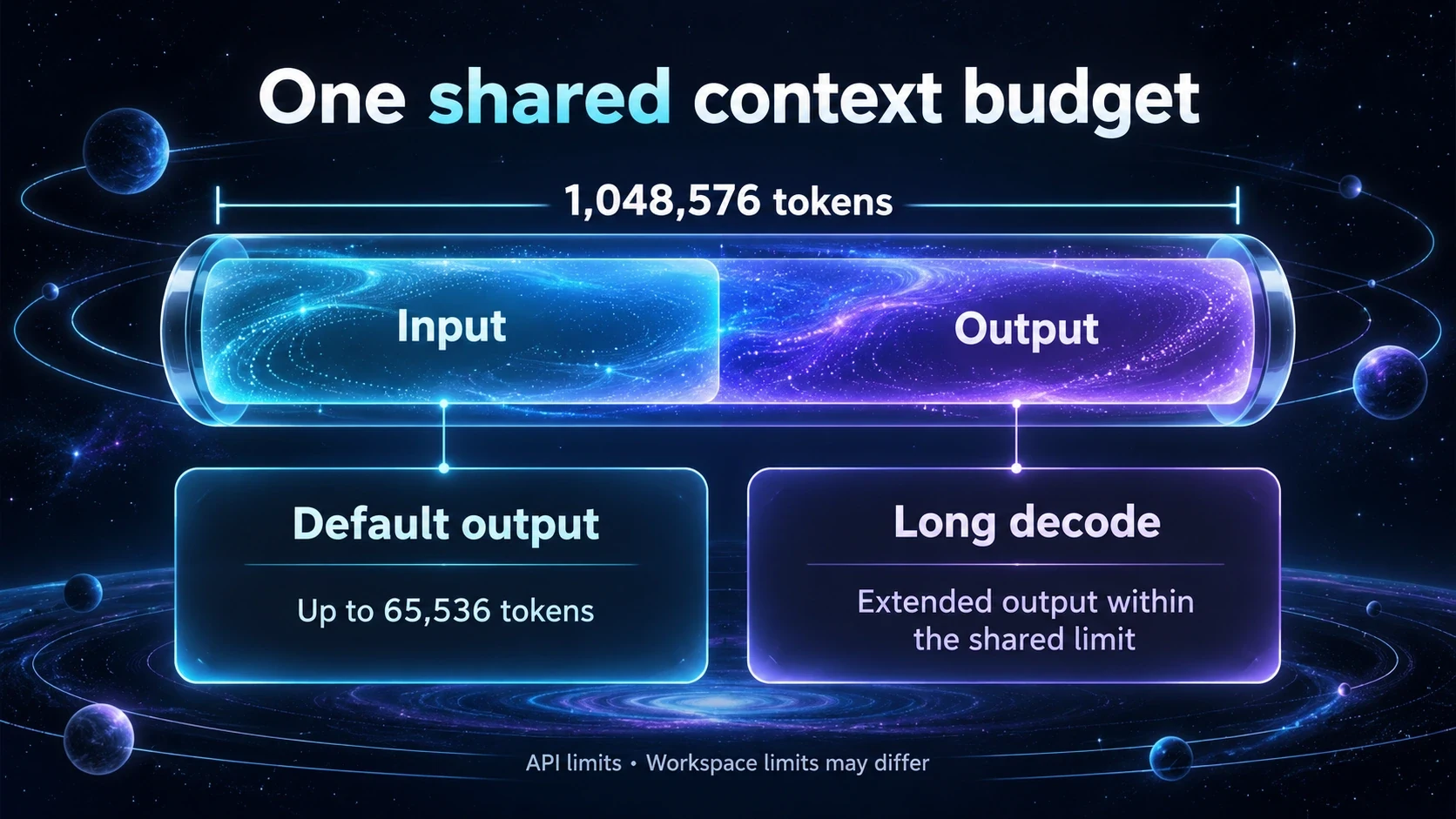
The Gemini API model documentation lists text, image, video, audio, and PDF inputs, with text output. It describes a unified input-and-output context window of 1,048,576 tokens. Default synchronous output is capped at 65,536 tokens; extended output up to the unified limit requires long decode.
Those are API specifications. An app or third-party interface can expose a different subset of capabilities, so the model's published maximum should not be treated as a promise about any particular workspace. Input support also does not imply image or audio generation: those output capabilities are not listed as supported for Argon.
For document work, the distinction between capacity and usefulness matters more than the headline number. A larger window gives you room to supply material, but it does not decide which version is authoritative. Label sources, identify dates, and explain how the answer should handle contradictions. A shorter, well-organized source packet can make the result easier to audit.
Three tasks worth using as a first test
Reconcile sources that disagree
Give the model a small set of reports with identifiable sections. Ask which claims agree, which conflict, and which cannot be compared because their definitions differ. Require a source reference for each finding and check a few references yourself. The test is whether the answer preserves distinctions you already know exist.
Explain a difficult argument
Choose a passage you understand well enough to judge. Ask for the argument's premises, conclusion, and unstated assumptions, then request an explanation for a less technical reader. For a focused document workflow, iWeaver's PDF Explainer is designed to help unpack difficult passages rather than merely shorten them.
Build a decision brief
Supply two options, explicit criteria, and evidence for each. Ask the model to recommend an option, state what evidence would change that recommendation, and flag unanswered questions. This tests whether it can reason within your constraints instead of inventing facts to complete an attractive table.
If you are deciding whether to switch from an existing Gemini workflow, our Gemini 4 Argon vs Gemini 3.8 Flash comparison explains how to compare task difficulty, output needs, and review effort.
How to read launch benchmarks
Google's announcement presents benchmark results as evidence of progress. They are useful signals, but the source is the model vendor, and evaluation conditions matter. This article does not report an independent hands-on benchmark or claim that Argon is the best model for every task.
Before translating a benchmark into a purchasing or workflow decision, identify the task, tool setup, and success criteria. Then compare them with your own work. A code benchmark cannot establish the accuracy of a literature review; a long answer cannot establish that its references are correct.
Bring the model into a repeatable workflow
Gemini 4 Argon is now available in iWeaver, and iWeaver provides a free trial of the model. Select it in the workspace and use one real task with a clear acceptance standard. Follow our guide to using Gemini 4 Argon for a source-based workflow and a prompt you can adapt.
The strongest first use is a source-based task you can verify. Prepare the evidence, define the desired output, inspect the result, and retain the corrections for the next run. Argon's launch gives you a new candidate for difficult work. The decision to keep using it should depend on what it gets right in that workflow.