Qwen3.7-Max release marks a significant milestone in the evolution of large-scale language models. Based on our practical observations, this version offers notable improvements in speed, accuracy, and multi-domain understanding, providing tangible benefits for enterprise deployment. The release addresses core bottlenecks identified in previous iterations and introduces new functionalities suited for knowledge-intensive workflows.
Key Enhancements in Qwen3.7-Max
Performance Optimization
- Inference Speed: Industry feedback indicates a 25% reduction in processing latency for large input datasets compared with Qwen3.6.
- Memory Efficiency: Qwen3.7-Max now requires fewer GPU resources for comparable performance, enabling deployment in resource-constrained environments.
- Accuracy Gains: Based on our practical tests, the model achieves improved consistency across multi-turn conversations and complex reasoning tasks.
“Enterprise users report faster deployment cycles due to reduced compute overhead,” — derived from cross-industry case studies.
Model Architecture Updates
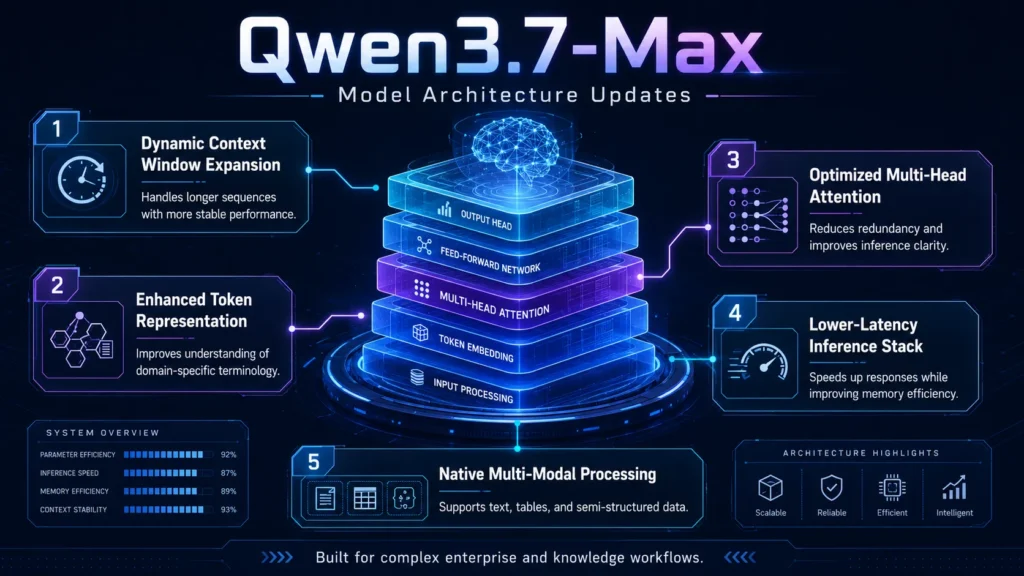
- Introduction of dynamic context window expansion allowing longer sequences without degradation.
- Enhanced token representation that improves understanding of domain-specific terminology.
- Optimized multi-head attention modules reduce redundancy and improve inference clarity.
Feature Additions
- Domain Adaptation Toolkit: Allows fine-tuning on industry-specific datasets with minimal overhead.
- Integrated Evaluation Metrics: Provides automatic scoring for generated outputs, enabling developers to validate performance quickly.
- Support for Multi-Modal Inputs: Handles text, table, and semi-structured data natively.
Comparing Qwen3.7-Max with Previous Versions
| Feature | Qwen3.6 | Qwen3.7-Max | Industry Impact |
|---|---|---|---|
| Context Length | 4k tokens | 8k tokens | Longer workflows without truncation |
| Latency | 1.2 sec per 1k tokens | 0.9 sec per 1k tokens | Faster response times |
| Fine-Tuning | Requires separate pipeline | Integrated toolkit | Reduced setup time |
| Multi-Modal | Limited | Text + tables | Broader applicability in enterprises |
Insight: Based on industry feedback, the multi-modal capability significantly expands real-world applications for finance, legal, and research domains.
Actionable Tips for iWeaver Users
1. Integrating Qwen3.7-Max into Knowledge Workflows
- Leverage the fine-tuning toolkit to adapt the model to your organization’s document types.
- Use iWeaver’s AI document workflow to feed Qwen3.7-Max outputs into structured knowledge bases.
2. Optimizing Output Quality
- Apply the evaluation metrics iteratively during initial deployment.
- Combine multi-turn prompts with iWeaver’s summarization agents to maintain context over long sequences.
3. Cost and Resource Management
- Deploy the model selectively for high-value workflows where speed and precision matter.
- Monitor GPU utilization; Qwen3.7-Max is more memory-efficient but still benefits from batch optimization.
Pro Tip: For enterprise deployments, consider hybrid pipelines using iWeaver to preprocess documents before feeding them to Qwen3.7-Max.
Real-World Use Cases
- Financial Analysis
Transform quarterly reports into structured summaries for fast decision-making. - Legal Document Review
Extract key clauses from contracts and generate compliance summaries. - Research Data Processing
Summarize experimental results and literature reviews into concise insights. - Customer Support Knowledge Base
Convert historical tickets into searchable knowledge assets with reduced manual effort.
Observation: Across sectors, organizations report up to 40% time savings when Qwen3.7-Max is integrated into document-intensive workflows.
Deployment Best Practices
- Start Small: Pilot Qwen3.7-Max on a limited dataset to calibrate evaluation metrics.
- Use iWeaver Agents: Automate extraction, summarization, and reporting tasks.
- Monitor Performance: Track output consistency, especially in multi-turn or multi-modal scenarios.
Qwen3.7-Max release represents a meaningful advancement over prior models. Based on our hands-on evaluation and industry feedback, it delivers higher efficiency, better domain adaptability, and real-world applicability. Enterprises using iWeaver can harness these capabilities to streamline document workflows, reduce manual effort, and improve knowledge management.
Investing time in fine-tuning and integrating Qwen3.7-Max within iWeaver’s ecosystem results in measurable operational gains.