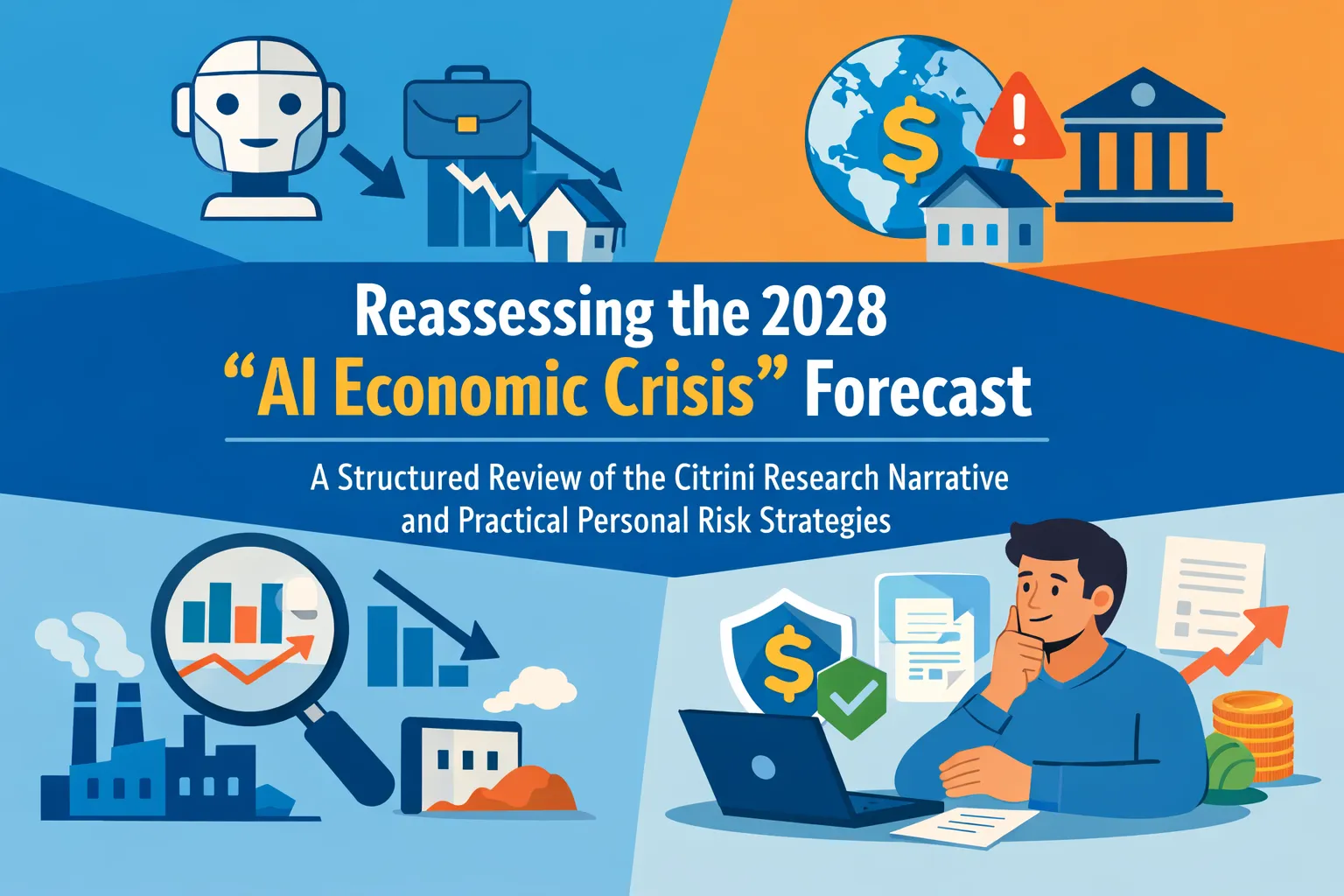
I recently read Citrini Research’s forward-looking macro memo, THE 2028 GLOBAL INTELLIGENCE CRISIS. The memo assumes that by 2028, rapid adoption of AI agents could drive large-scale displacement of white-collar roles, weaken consumer demand, and ultimately escalate into a systemic financial crisis.
The goal of this article is not to predict market direction. Instead, I break the narrative into testable cause-and-effect links and evaluate which parts could plausibly hold—and which are more likely to be constrained in practice—based on publicly available macroeconomic and labor-market signals around February 2026, along with information about AI investment and supply-side constraints. I then outline practical, individual-level risk management strategies.
How I Break Down Citrini Research’s “Systemic Collapse Chain”
In my view, Citrini’s thesis is not simply the widely accepted idea that “AI will automate some tasks.” It is a stronger feedback-loop argument:
Intelligence displacement → falling white-collar income
Assumption: AI agents become capable enough to replace a large share of “cognitive execution” work (for example, software development, financial analysis, consulting, and some layers of management), leading to rapid compression of labor income.
Income compression → weaker consumption and deteriorating credit (especially long-duration debt such as mortgages)
Assumption: income disruption among high-credit-quality white-collar workers triggers stress across housing mortgages, consumer credit, and corporate cash flows, creating conditions for systemic financial risk.
“Ghost GDP”
Claim: even if productivity and corporate profits rise, gains become concentrated among capital owners and compute infrastructure holders and do not recycle into broad-based consumption. Output may appear strong while demand weakens, pulling down overall growth.
Three Points Where the Narrative Is Most Likely to Be Weakened by Real-World Constraints
I do not treat this thesis as “necessarily wrong.” I treat it as a left-tail scenario that would require several strong conditions to hold. The key frictions, as I see them, are below.
AI diffusion is not instantaneous: supply-side hard constraints slow adoption
A counter-argument associated with Citadel Securities’ macro work emphasizes that AI adoption faces constraints in data-center buildout, energy supply, chip availability, construction lead times, and regulation. Under these conditions, diffusion tends to follow an S-curve rather than a sudden step change.
My view is that as long as deployment speed and unit replacement costs remain constrained, it becomes materially harder for the Citrini narrative to form a rapid macro-level negative feedback loop within a two- to three-year window.
Early-2026 labor-market signals do not show synchronized evidence of broad “collapse-style displacement”
At a minimum, cross-sectional signals around early 2026 include data points that do not align with “software and similar white-collar roles have already been rapidly displaced.” Citadel Securities, for example, highlights an increase in software engineer job postings year over year.
I interpret this kind of evidence as follows: it does not prove that displacement will not happen, but it suggests that the speed of substitution, breadth of industry diffusion, and strength of macro transmission may not meet the strong conditions required for a near-term collapse loop.
“Demand will collapse” is a strong claim: historically, productivity shocks more often shift demand structure
A critical leap in the Citrini thesis is the assumption that falling labor income outweighs price declines and new demand creation, resulting in persistent aggregate demand deficiency. I view this as a conclusion that requires more intermediate evidence.
Historically, major technology shifts often coincide with contraction in legacy roles and industries, alongside the creation of new roles, new products, new service formats, and changes in consumption patterns. That is not equivalent to aggregate demand being eliminated.
This point draws on broad economic history rather than a single source. In the current debate, the shared framing across Citadel and outlets such as Reuters and Barron’s is that Citrini is closer to a left-tail stress test than a baseline scenario.
My Practical Personal Risk Strategies: Converting the Approach Into an Executable Checklist
I do not build my plan on a binary view—“the economy will collapse” versus “it will not.” I assume that job structures and the distribution of returns between labor and capital are changing, and that individuals should improve resilience against volatility.
Do not resist AI
I start by identifying which parts of my workflow an AI office assistant such as iWeaver can simplify, including information organization, summarization, first-draft preparation, meeting notes, and knowledge retrieval. When these tasks are delegated to tools, I can spend more time on research, verification, hypothesis building, and decision-making.
If I can keep accumulating enough real-world information, validate it, and organize it into a structured knowledge base, my ability to read market changes becomes more stable. This also helps me identify role types that are less likely to be standardized and substituted.
Correct judgment is the scarce personal asset
A quote attributed to NVIDIA CEO Jensen Huang has been widely circulated online: “Smart is cheap. Taste is expensive.” I treat it as a signal about direction rather than a verified primary-source citation. The idea I take from it is that as models reduce the cost of standardized cognitive execution, personal value depends more on problem definition, constraint setting, delivery organization, and accountability.
In practice, I consider the following capabilities relatively scarce:
- identifying real market demand and translating ambiguous needs into measurable goals, constraints, and priorities
- decomposing delivery into executable tasks and organizing people, tools, and data to complete an end-to-end loop
- clarifying responsibility boundaries in cross-functional collaboration and ensuring outcomes are delivered
As information generation becomes cheaper, reference material increases, but the share of actionable information may not rise in parallel. I focus on filtering and verification, then pressure-test conclusions against real business constraints. Tools can generate candidate options, but humans still carry the primary responsibility for trade-offs, risk control, and delivery outcomes.
Control long-duration leverage
If my income depends heavily on areas that may be disrupted by automation, I reduce long-term fixed obligations—especially highly leveraged mortgages and long-duration consumer debt—so my balance sheet stays flexible. Examples include maintaining a lower debt-to-income ratio (DTI) and holding higher liquidity buffers. This is not a directional view on housing prices; it is a risk-budgeting decision under higher uncertainty.
Maintain a stable mindset and strong physical health
I treat mindset management and physical conditioning as part of a long-term strategy. Historical experience suggests that technology transitions can cause phase-based employment shocks, but they do not necessarily imply long-term stagnation in the overall economy. When uncertainty rises, emotional stability, sleep quality, exercise habits, and baseline health metrics directly affect learning efficiency and recovery speed. I rely on consistent routines, sustained exercise, and stress management to reduce the probability of decision errors during short-term volatility.
I view Citrini Research’s memo as a useful left-tail stress test because it highlights the potential impact of AI on income distribution, credit transmission, and capital concentration. However, based on early-2026 macro and hiring signals and the supply-side constraints that limit the speed of AI diffusion, I lean toward the view that a rapid systemic-collapse loop is not a baseline scenario and would require stronger intermediate conditions to materialize.
My personal focus is on resilience-building at the individual level: lowering leverage, improving physical and mental stability, strengthening capabilities that are difficult to standardize, and maintaining some exposure to sources of returns tied to productive assets rather than relying exclusively on wage income.