

Claude Fable 5.1 and GPT-5.6 Sol are both designed for work that goes far beyond simple chatbot questions.
Both can handle:
- large amounts of context
- complex reasoning
- coding
- research
- tool use
- long-running workflows
So asking “Which model is smarter?” is not especially useful.
A better question is:
Which model fits the work you actually need to do?
The answer depends on whether your priority is deep investigation, tool-heavy execution, cost, document production, or long-running agents.
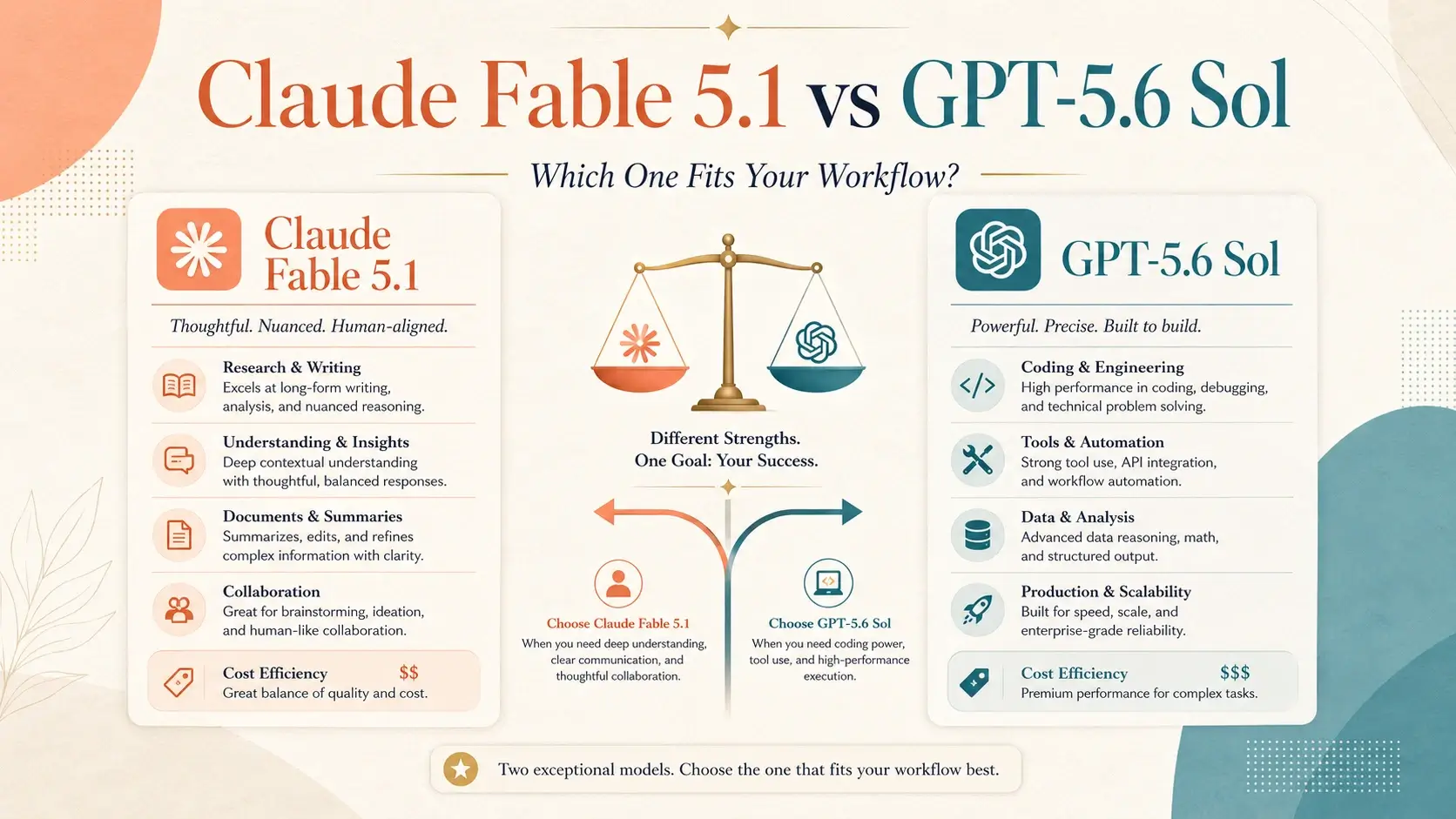
| Area | Claude Fable 5.1 | GPT-5.6 Sol |
|---|---|---|
| Deep research | Strong fit | Strong |
| Long-horizon reasoning | Strong fit | Strong |
| Coding | Excellent | Excellent |
| Tool-heavy workflows | Strong | Strong fit |
| End-to-end production | Strong | Strong fit |
| Context window | 1M | 1.05M |
| Max output | 128K | 128K |
| Standard input price | $10 / 1M | $4 / 1M |
| Standard output price | $50 / 1M | $20 / 1M |
| Cached input | $0.25 / 1M | $0.40 / 1M |
The table already shows the main difference.
Fable 5.1 leans toward difficult, sustained reasoning.
GPT-5.6 Sol makes a stronger case for broad production workflows and lower standard API cost.
Fable 5.1 makes the most sense when the path to the answer is unclear.
Think about a task like:
Investigate why this production system keeps failing, trace the issue across services, test possible causes, and keep going until you find the root problem.
That is not a normal Q&A task.
It requires the model to:
- understand the problem
- decide what to inspect
- use tools
- evaluate the result
- reject weak explanations
- try another direction
- verify the final conclusion
This is where Fable 5.1's focus on long-running reasoning becomes useful.
Good Fable 5.1 use cases
- deep technical investigations
- long research projects
- complex debugging
- multi-source analysis
- difficult scientific or analytical work
- agents that need to keep working through uncertainty
A useful shorthand is:
Fable 5.1 is a strong choice when the hard part is figuring out the answer.
Choose GPT-5.6 Sol for Broader End-to-End Work
GPT-5.6 Sol has a slightly different strength.
It is well suited to workflows where reasoning is only one part of the job.
For example:
Research → use tools → write code → inspect output → create a report → deliver the result
That makes it attractive for workflows involving:
- coding
- computer use
- document creation
- spreadsheets
- presentations
- research
- tool orchestration
- multi-step production
If Fable 5.1 feels like an investigator, GPT-5.6 Sol often feels more like a general production engine.
A useful shorthand is:
GPT-5.6 Sol is a strong choice when the hard part is completing the whole workflow.
Research: Fable 5.1 Has the Clearer Positioning
For pure research, Fable 5.1 has a strong case.
Its strengths become more visible when the job involves:
- comparing many sources
- following conflicting evidence
- revisiting earlier assumptions
- deciding what to investigate next
- checking whether a conclusion is actually supported
Consider these two prompts.
Basic research
Summarize these five reports.
Deeper research
Compare these five reports, identify where their assumptions conflict, trace the evidence for each position, and recommend which conclusion is best supported.
Many strong models can handle the first.
The second is where long-horizon reasoning matters more.
Edge: Claude Fable 5.1
Coding: It Depends on the Type of Coding
Saying one model simply “wins at coding” is too broad.
There are at least two different coding problems.
Problem 1: Investigate a difficult codebase
You need the model to:
- trace a bug
- inspect several services
- understand an unfamiliar codebase
- test hypotheses
- recover after failed attempts
Fable 5.1 is a strong fit.
Problem 2: Build and ship something
You need the model to:
- write code
- call tools
- generate supporting files
- inspect results
- connect several steps
- produce the finished output
GPT-5.6 Sol may be the more practical starting point.
So the coding decision is less:
Claude vs GPT
and more:
investigation vs production
Result: Tie, depending on the workflow
Tools and Automation: GPT-5.6 Sol Has an Edge
Tool use becomes increasingly important once AI moves beyond chat.
A useful AI system may need to:
- search
- run code
- read files
- browse
- work with applications
- check intermediate output
- call another tool based on the result
GPT-5.6 Sol is particularly attractive for these broader tool-driven workflows.
It also gives developers more flexibility around reasoning effort, making it easier to avoid using maximum reasoning on every request.
For large production systems, that control can matter as much as raw reasoning ability.
Edge: GPT-5.6 Sol
Context Window: Do Not Choose Based on 1M vs 1.05M
Claude Fable 5.1 supports around 1M tokens of context.
GPT-5.6 Sol supports around 1.05M tokens.
That sounds like a difference.
For most real-world workflows, it is not an important one.
Both are already huge.
The bigger problem is:
What are you putting into that context?
A million tokens of duplicated, outdated, and loosely related information is still bad context.
Twenty carefully selected sources may be far more useful.
That makes information preparation increasingly important as model context windows get larger.
Result: Tie
Pricing: GPT-5.6 Sol Is Much Cheaper for Standard Tokens
This is one of the clearest differences.
| Token Type | Fable 5.1 | GPT-5.6 Sol |
|---|---|---|
| Input | $10 / 1M | $4 / 1M |
| Output | $50 / 1M | $20 / 1M |
| Cached input | $0.25 / 1M | $0.40 / 1M |
For normal API workloads, GPT-5.6 Sol has a clear price advantage.
That matters when you are processing large volumes of:
- fresh user prompts
- new documents
- generated output
- high-frequency API calls
Fable 5.1 does have one interesting advantage:
cached context is cheaper.
So if an agent repeatedly reads the same large context, the total cost picture can change.
Practical rule
Lots of new input and output → GPT-5.6 Sol
Heavy reuse of the same large context → test both
Do not compare only price per token.
Compare:
cost per completed task
Where iWeaver Fits: Keep Your Knowledge Independent of the Model
There is another part of this comparison that has nothing to do with Anthropic or OpenAI.
Your information.
A real project may begin with:
- PDF reports
- research papers
- webpages
- YouTube videos
- images
- meeting notes
- internal documents
If all of that information lives inside one AI conversation, changing models becomes inconvenient.
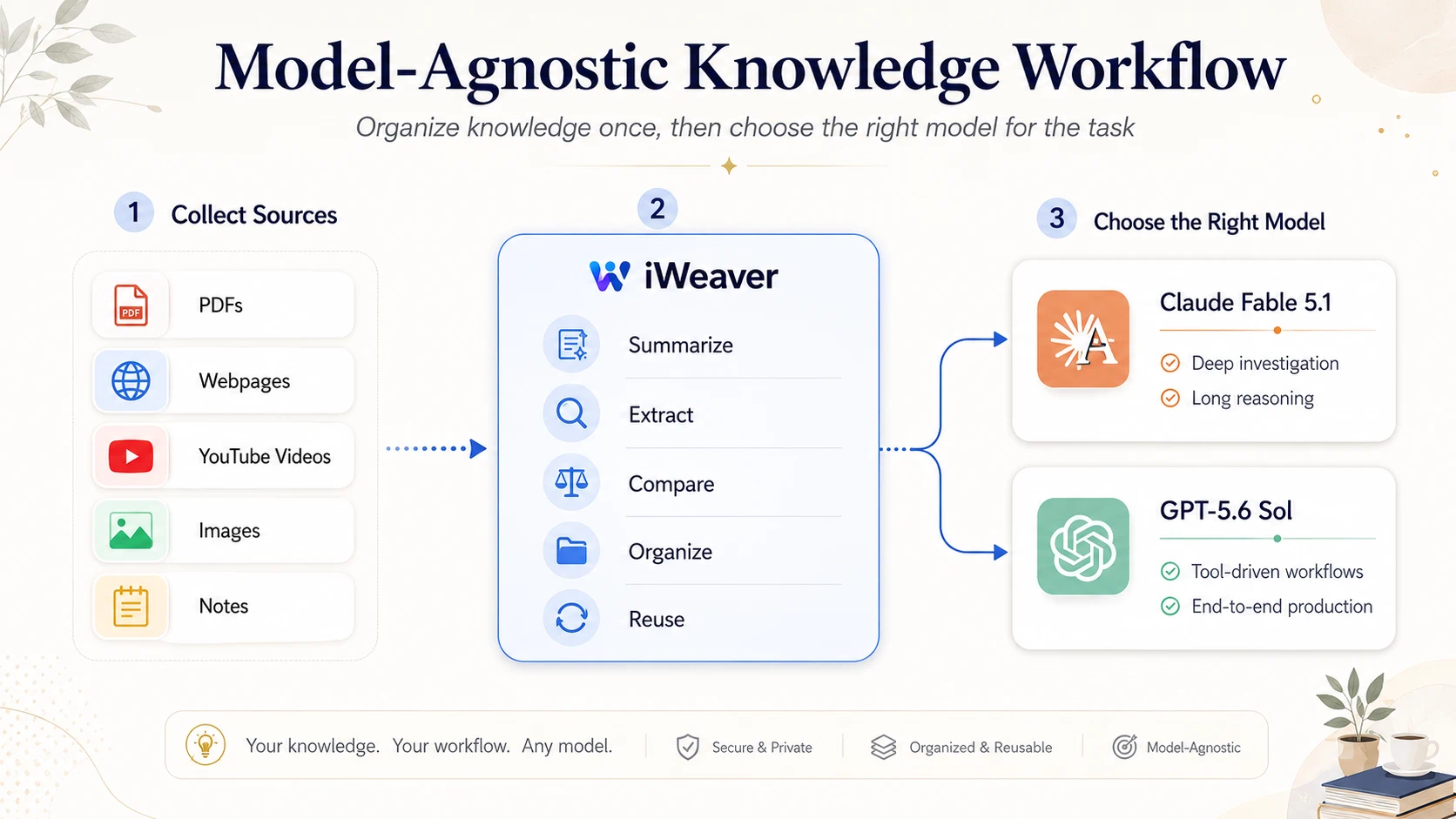
A more flexible approach is to keep the knowledge layer separate from the model layer.
With iWeaver, you can first turn scattered information into reusable knowledge:
Collect → Summarize → Extract → Compare → Organize → Reuse
For example:
Step 1: Build the source set in iWeaver
Bring together the PDFs, reports, webpages, videos, and notes you actually need.
Step 2: Reduce the noise
Use iWeaver to:
- summarize long sources
- extract key points
- compare documents
- ask questions across files
- create structured notes
- build mind maps
Step 3: Send the hard task to the right model
Use Fable 5.1 when the next step is:
Investigate this deeply and tell me what is really happening.
Use GPT-5.6 Sol when the next step is:
Use this information to complete a broader production workflow.
Your research stays reusable either way.
That makes iWeaver useful as a model-agnostic knowledge layer, rather than tying your whole workflow to one frontier model.
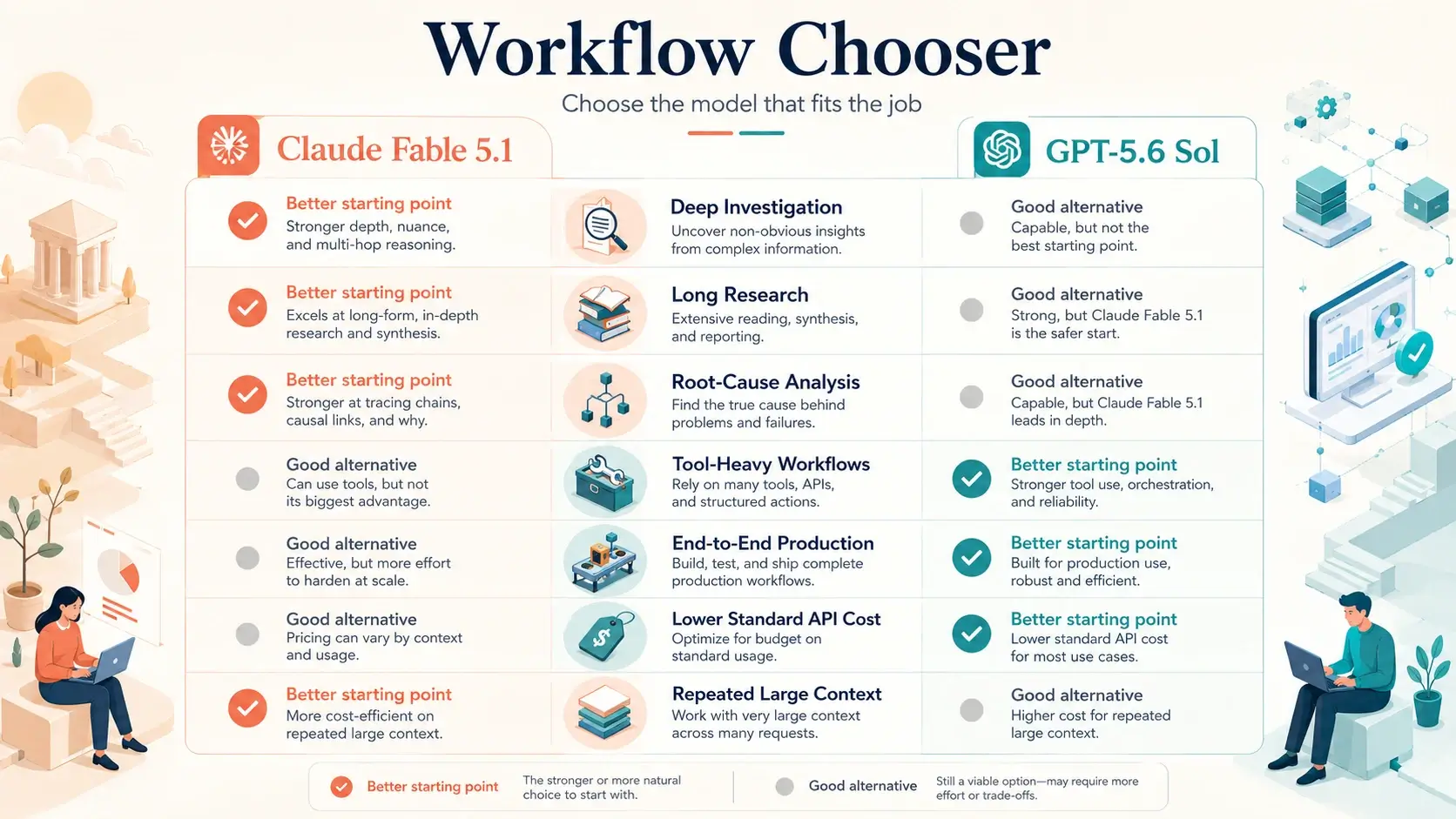
Here is the simpler version.
| Your Main Task | Better Starting Point |
|---|---|
| Deep technical investigation | Fable 5.1 |
| Long autonomous research | Fable 5.1 |
| Root-cause analysis | Fable 5.1 |
| Multi-source reasoning | Fable 5.1 |
| High-volume automation | GPT-5.6 Sol |
| Tool-heavy workflows | GPT-5.6 Sol |
| End-to-end production | GPT-5.6 Sol |
| Lower standard API cost | GPT-5.6 Sol |
| Repeated huge cached context | Test both |
| Simple everyday work | Use a cheaper model |
These are workflow recommendations, not claims that one model will win every individual prompt.
Do Not Let One Benchmark Make the Decision
Cross-model Benchmark charts look convenient.
They can also hide important details.
Different tests may use different:
- model settings
- reasoning budgets
- agent harnesses
- tool configurations
- safety settings
- benchmark versions
For a real production decision, build a small test set from your actual work.
For example:
- one deep research task
- one coding task
- one multi-document analysis
- one tool-heavy workflow
- one repeated-context task
Run both models.
Then measure:
| Metric | Why It Matters |
|---|---|
| Completion rate | Did the model finish? |
| Human correction | How much fixing was needed? |
| Latency | How long did it take? |
| Token use | How much did it consume? |
| Total cost | What did the finished task cost? |
| Reliability | Did it stay on track? |
That will tell you much more than a single leaderboard score.
Final Verdict
So, which is better: Claude Fable 5.1 or GPT-5.6 Sol?
There is no useful universal winner.
Choose Claude Fable 5.1 when the main challenge is:
understanding a difficult problem and reasoning through uncertainty.
Choose GPT-5.6 Sol when the main challenge is:
turning reasoning into a broader end-to-end workflow at a lower standard API cost.
And if your biggest problem happens before either model starts — because your research is scattered across dozens of files and formats — organize that layer first with iWeaver.
The more practical AI stack may look like this:
iWeaver → organize the knowledge
Fable 5.1 or GPT-5.6 Sol → handle the reasoning
That gives you something more flexible than choosing one model forever: the right model for the right task.
For more on Anthropic's new model, read Claude Fable 5.1: 5 Changes That Matter.
For a closer look at its strengths and weaknesses, see our Claude Fable 5.1 review.
Already using Fable 5? Read Claude Fable 5.1 vs Fable 5 before upgrading.