

Anthropic released Claude Fable 5.1 on September 1, 2026.
Despite the “5.1” name, this is more than a small tune-up.
The new model is aimed at work that takes hours rather than minutes: deep research, large coding projects, document-heavy analysis, and AI agents that need to keep working without constant supervision.
Quick take: Fable 5.1 keeps a 1M-token context window, improves long-running reasoning and agentic work, and cuts cache-read pricing by 75%.
1. It Is Built for Longer Tasks
Most modern AI models can handle a good prompt.
The harder part is what happens after the 10th, 20th, or 50th step.
Fable 5.1 is built for jobs where the model may need to:
- plan what to do
- use several tools
- check its own progress
- recover when a step fails
- keep working toward the original goal
Anthropic describes it as a model for demanding reasoning and long-horizon agentic work.
That is probably the most important change in this release.
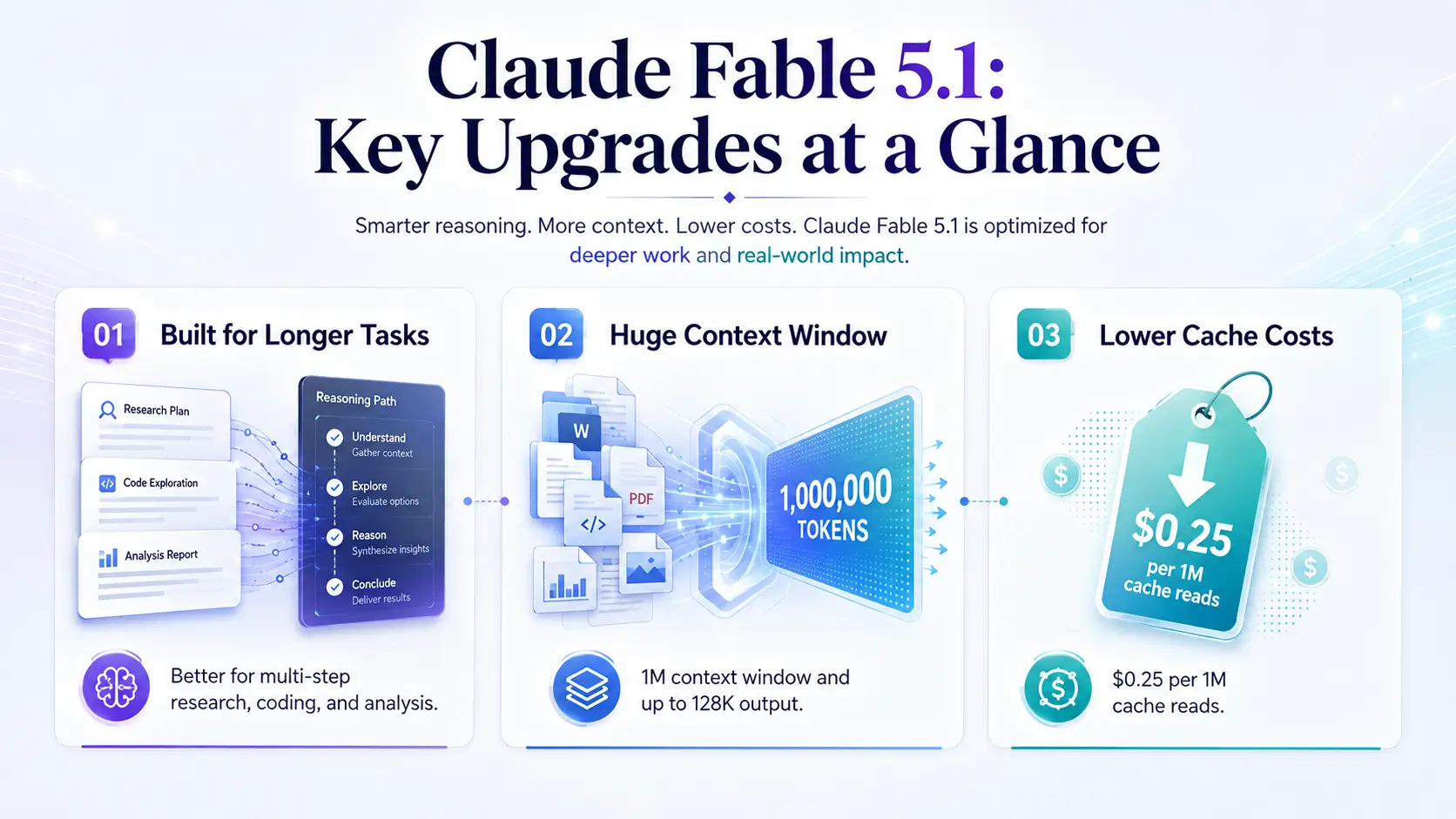
Fable 5.1 also puts more weight on multi-step research.
A simple summary usually has one obvious path:
Read → Condense → Answer
Real research is messier:
Find → Compare → Question → Verify → Revisit → Conclude
Fable 5.1 is designed to stay useful through more of that process rather than stopping after the first plausible answer.
That makes it more interesting for:
| Use Case | Why Fable 5.1 Matters |
|---|---|
| Market research | Compare evidence across sources |
| Literature reviews | Track ideas across many papers |
| Financial analysis | Work through complex documents |
| Technical research | Investigate instead of only summarizing |
| Business analysis | Move from information to recommendation |
3. PDFs Are More Than Text
Another useful upgrade is document understanding.
Fable 5.1 can work with diagrams, charts, and tables inside files and PDFs, which makes it more useful for finance, analytics, technical work, and other document-heavy tasks.
That matters because the useful part of a report is often not in a paragraph.
It may be:
- a chart on page 27
- a financial table
- an architecture diagram
- a slide
- a comparison matrix
For document-heavy work, this is often more useful than simply increasing context size.
4. The Context Window Is Still Huge
Fable 5.1 supports:
| Spec | Claude Fable 5.1 |
|---|---|
| Context window | 1M tokens |
| Max output | 128K tokens |
| Input | Text + images |
| Thinking | Adaptive |
| Default effort | High |
| Knowledge cutoff | June 2026 |
A 1M-token context window sounds impressive.
But it does not automatically solve information overload.
If you put hundreds of poorly organized documents into one conversation, the model still has to work out what matters.
That creates another problem before reasoning even begins:
How do you prepare the right context?
5. Cache Reads Are Much Cheaper
The standard API price remains:
Input: $10 / 1M tokens Output: $50 / 1M tokens
The bigger change is prompt caching.
Fable 5.1 cache reads cost $0.25 per million tokens, down from $1 for Fable 5.
That matters when an agent repeatedly needs access to the same:
- codebase
- research library
- company documentation
- project history
- knowledge base
The model is still expensive.
Reusing context is simply much cheaper.
Where iWeaver Fits
A stronger reasoning model works best when the information going into it is already useful.
Imagine your project starts with:
8 PDFs + 3 webpages + 2 YouTube videos + meeting notes + an old report
You could throw everything into one conversation.
Or you could organize the material first.
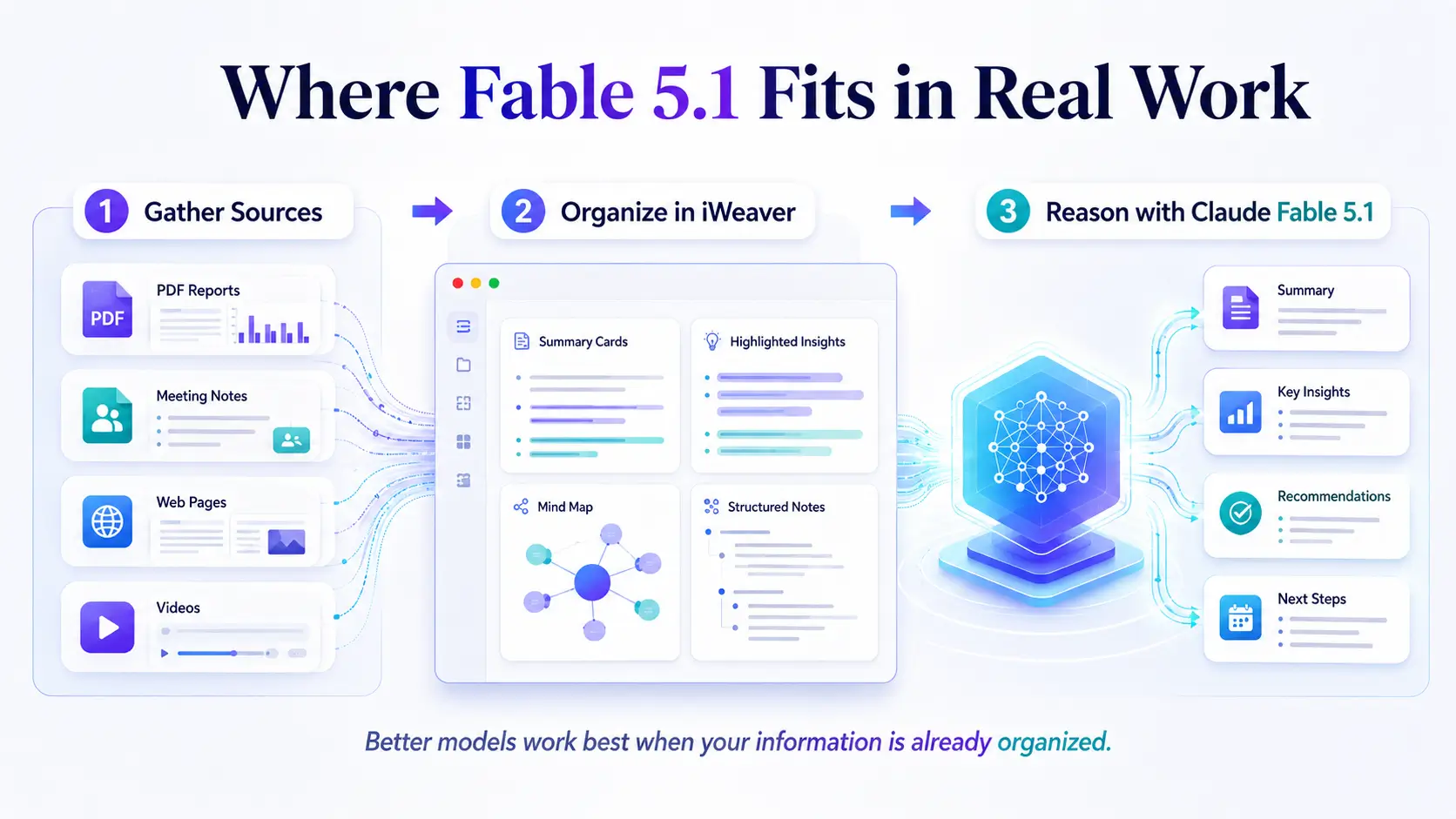
With iWeaver, you can bring different sources together, summarize long files, extract key points, compare information, ask questions across your materials, and turn useful findings into structured notes or mind maps.
A practical workflow looks like this:
1. Gather Sources
PDFs, documents, webpages, videos, images, and notes.
2. Understand Them in iWeaver
Summarize, extract, compare, and organize.
3. Use Deeper Reasoning When Needed
Take the important context into a frontier model such as Fable 5.1 when the problem requires deeper investigation or decision-making.
The point is not to use the most powerful model for every step.
It is to give the powerful model better material to reason about.
Probably yes, if your work involves:
- long research projects
- difficult coding problems
- large document collections
- multi-step AI agents
- tasks that need repeated verification
If you mainly use AI for quick summaries, short writing, or everyday questions, the difference may be much less noticeable.
Want a closer look at the tradeoffs? Read our Claude Fable 5.1 review.
Already using Fable 5? See Claude Fable 5.1 vs Fable 5 before switching your existing workflow.
Or, if you are choosing between frontier models, compare Claude Fable 5.1 vs GPT-5.6 Sol.
The Bigger Story
Claude Fable 5.1 is not really about making chat slightly better.
It reflects a broader shift from:
AI that answers to AI that works through a problem.
And as models get better at reasoning, the quality of the information you give them becomes even more important.
That may be where tools such as iWeaver and frontier reasoning models increasingly work together: one helps turn scattered information into usable knowledge, while the other tackles the hardest reasoning on top of it.