
A thesis demonstrates the breadth of your research. A journal article makes one clear contribution to a particular field. To turn a thesis into a research paper, choose a single research question and target journal, select the evidence needed to answer that question, and rewrite the manuscript for the journal’s readers. Cutting chapters down to a word limit is rarely enough.
This guide uses “research paper” to mean an original research article intended for a journal. Conference papers, review articles, and class assignments may follow different rules.
Thesis vs. journal article: what changes?
| Thesis or dissertation | Journal article |
|---|---|
| Shows the full scope of a degree project | Makes one specific contribution |
| Addresses supervisors and examiners | Addresses the journal’s readers and reviewers |
| May cover several research questions | Builds around one central question |
| Includes extensive background and appendices | Keeps the context needed to understand the study |
| Reports a broad set of analyses | Prioritizes findings relevant to the article’s claim |
| Follows university requirements | Follows the target journal’s author instructions |
Word counts, abstract formats, figure rules, and disclosure requirements vary by journal and discipline. Check the journal’s current author instructions before you begin rewriting.
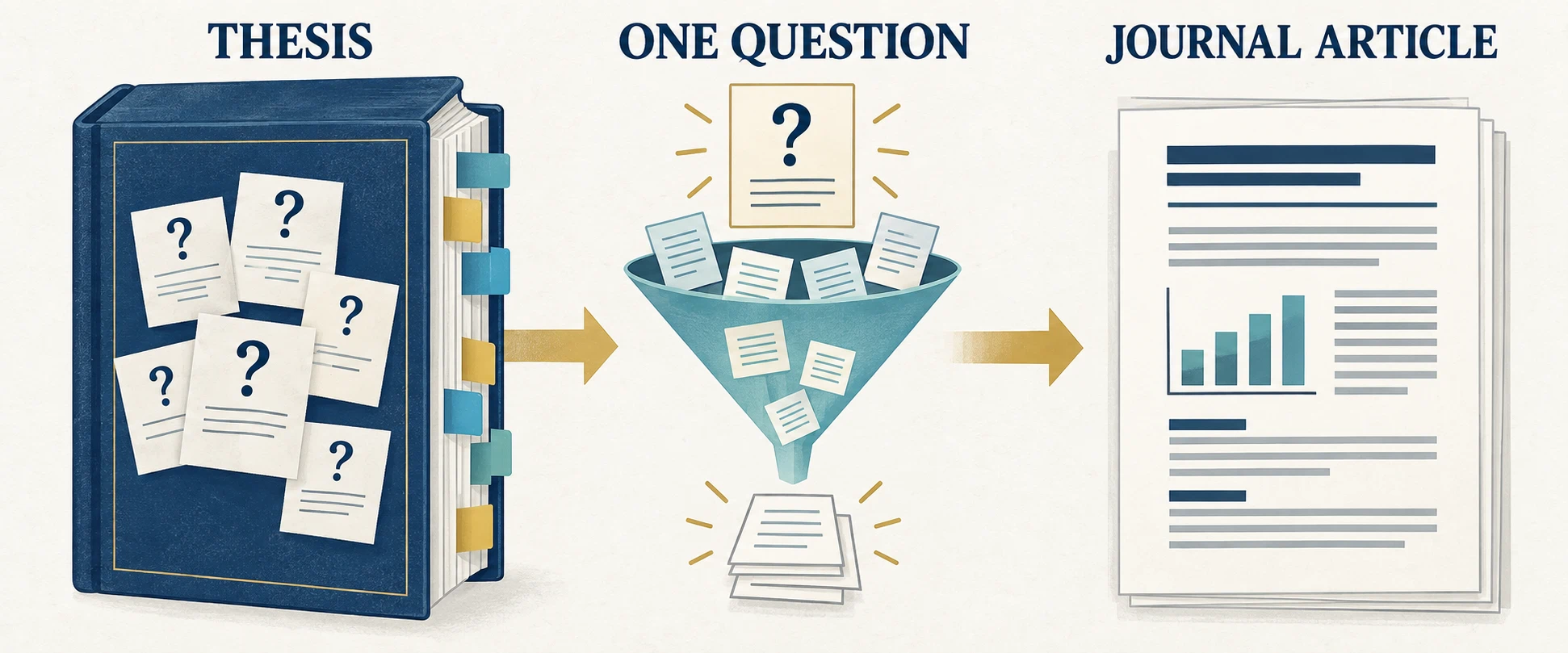
1. Find the paper inside the thesis
List your thesis’s research questions, datasets, methods, and major findings. For each possible article, write its contribution in one sentence:
Using [method or data], we found [specific result], which changes how readers understand [focused problem].
Choose a contribution that can stand on its own. A promising paper has a distinct question, sufficient evidence, a clear connection to existing literature, and an identifiable journal audience.
For example, a dissertation might examine a campus food program through student interviews, purchase records, and policy analysis. One article could focus on whether the program changed purchasing behavior. It would include the purchase data and methods needed to interpret that result. The interviews and policy analysis would appear only if they directly helped answer the article’s question.
A thesis containing several independent studies may support several articles. Each article should make a distinct contribution; splitting one finding into near-identical papers creates avoidable overlap.
2. Choose a journal before you rewrite
Shortlist journals that have published work with a similar question, method, and audience. Read their aims and scope, along with two or three relevant articles. Then record the requirements for your article type:
- Word, table, and figure limits
- Abstract structure and length
- Reporting guidelines
- Reference style
- Supplementary materials
- Policies on thesis repositories and AI use
Ask whether the journal’s readers would immediately understand why your finding matters. If the answer is unclear, reconsider the journal or the way you frame the article.
3. Build a new outline around one argument
Create an outline for the article instead of pasting thesis chapters into a journal template. For an empirical paper, the argument often follows this path:
- Introduction: What is unknown, why does it matter, and what question does this article answer?
- Methods: What did you do, and what information does a reader need to assess the work?
- Results: Which findings answer the article’s question?
- Discussion: What do those findings mean, and where are their limits?
- Conclusion: What can readers take from this specific study?
This is a common structure, not a universal template. Humanities, theoretical, and other disciplines may organize their arguments differently.
4. Rewrite each section for the journal reader
Title and abstract
Name the specific topic and contribution. Write the abstract once the article’s argument is stable. Follow the journal’s required format and state the question, approach, central result, and implication without claiming more than the evidence supports.
Introduction and literature
Replace the thesis’s broad literature survey with the studies needed to establish the article’s question and research gap. Add essential work published since the thesis was completed. Keep a citation because it helps frame or interpret this article, not simply because it appeared in the thesis.
Methods
Retain enough detail for readers to assess the design, sample or data, measures, analysis, and relevant approvals. Move lengthy instruments or procedural details to supplementary material if the journal permits it. Do not cut so much that readers can no longer evaluate the findings.
Results
Lead with findings that answer your chosen question. Keep relevant negative or unexpected results; removing them can distort the study. Rebuild tables and figures around the article’s argument, and check their labels, units, and formatting.
Discussion
Explain what the findings add, how they compare with previous research, and what the study cannot establish. Distinguish observed results from your interpretation. Avoid repeating every number from the Results section.
5. Check overlap, attribution, and permissions
A thesis deposited in a public university repository does not automatically prevent you from submitting a related journal article. The Committee on Publication Ethics discussion of thesis publication explains that otherwise unpublished work in a thesis generally need not count as prior publication. Individual journal policies may differ, particularly when a chapter has already been published elsewhere.
Disclose that the manuscript derives from a thesis when the journal asks about prior dissemination, and cite or acknowledge the thesis as required. Check permissions before reusing previously published figures, tables, or substantial text. Agree on authorship and contributions with collaborators before submission.
If you plan several papers from one thesis, give each a distinct question and contribution. Disclose related manuscripts when the journal requires it.
6. Use AI for support, then verify the manuscript
AI can help map a long thesis to a focused article. For example, you can ask it to identify chapters, tables, and citations relevant to one research question, then propose an outline for your review. iWeaver’s PDF to Article tool offers a way to turn a source PDF into an editable article draft. Treat generated outlines and prose as starting points.
A prompt you can adapt:
From this thesis, list the passages and tables relevant to the question “[question].” For each item, give its chapter or page location, the claim it supports, and any limitations stated in the thesis. Do not invent results or references. Then propose an article outline for [target journal] using only these items.
Check every proposed claim, quotation, citation, statistic, and method detail against the thesis and original sources. Follow the journal’s current AI disclosure policy. Before uploading confidential or unpublished research material, confirm that its use is permitted by your institution and collaborators.
7. Run a submission check
Before submitting, confirm that:
- The paper answers one clearly stated question and makes a distinct contribution.
- The journal publishes this article type, and the manuscript follows its current instructions.
- Each result is supported by the stated methods and original data.
- The abstract, tables, figures, citations, and supplementary files agree with the manuscript.
- Required limitations, ethics approvals, funding, conflicts of interest, data availability, and AI disclosures are included.
- Thesis reuse, earlier dissemination, related submissions, and figure permissions have been handled under journal policy.
- Every coauthor has reviewed and approved the submitted version.
Common thesis-to-article problems
| Problem | Better approach |
|---|---|
| Trying to compress the entire thesis | Select one question and the evidence needed to answer it. |
| Keeping a chapter-length literature review | Retain the work that establishes the article’s gap and helps interpret its findings. |
| Removing crucial methods details to meet a word limit | Cut repetition first; use permitted supplementary material for necessary detail. |
| Reusing thesis text without checking journal policy | Review disclosure, citation, licensing, and permissions requirements. |
| Treating an AI draft as a verified manuscript | Check every claim and reference against the source material. |
Turning a thesis into a journal article requires editorial judgment as well as shorter writing. The strongest manuscript is a focused, independently readable account of one contribution, written for a specific journal and checked against the underlying research.